Blog
Bed Frames Without Headboard: A Complete Buyer’s Guide


A homeowner in Dyer may be standing in a freshly painted bedroom, measuring around a low window and wondering whether a tall upholstered headboard would make the room feel crowded. In Crown Point, another family may be rearranging a guest room, trying to keep a doorway clear while still choosing a frame that feels finished. In both situations, a bed frame without a headboard can be an intentional design decision, not a missing piece.
The choice affects more than appearance. It changes where the bed can sit, how easily the room can be rearranged, how pillows behave against the wall, and whether the frame itself provides stable mattress support. Groen's Fine Furniture has served Northwest Indiana, including Dyer and Crown Point, since 1983, and the showroom conversation around a headboard-free bed should start with structure, not just style.
A frame without a headboard can open a small room, work beneath a window, and leave room for future changes. But the right model still needs sound slats, dependable joinery, and appropriate center support. This guide covers the practical trade-offs so shoppers from NWI, St. John, Schererville, and Munster can choose with confidence.
Why a Headboard-Free Bed Frame Might Be the Smartest Move for Your Bedroom
A Dyer ranch with a low bedroom window is a perfect example. A tall headboard might cover the window trim, compete with the natural light, and make the wall feel visually heavy. A simple wooden platform frame, placed neatly beneath the window, can keep the room open while allowing artwork, paint, or bedding to carry the design.
That's the first advantage: room-planning freedom. Without a fixed vertical panel behind the mattress, the bed can work under a window, beneath a sloped ceiling, or in a room where every inch of wall matters. The frame also becomes easier to move if the homeowner later changes the layout, converts a guest room into an office, or replaces a low window treatment.
A headboard-free frame isn't unfinished when the room has been planned around its openness.
The second advantage is a cleaner visual line. A low platform keeps the eye moving across the room instead of stopping at a large upholstered or wooden panel. That look pairs naturally with warm minimalism, natural materials, green accents, and layered bedding. Historical evidence also shows that headboards haven't always been purely decorative. Early examples appeared in ancient Egypt, while some of the earliest known bed frames came from Sumerian culture. In Europe, high-status beds by the 16th and early 17th centuries were defined by a headboard and tester, but improved insulation and central heating gradually made headboards optional rather than functional. Historical background on bed frames and headboards

A practical choice with an upgrade path
The third advantage is flexibility over time. A homeowner can begin with a low-profile platform, then add a wall-mounted headboard later if reading comfort or wall protection becomes more important. That makes the original purchase easier to live with, especially for families still settling into a new home.
The important distinction is between removing a decorative element and removing structural quality. A headboard doesn't replace a strong frame, and a frame without one shouldn't be judged as a lesser product automatically. Shoppers who want more guidance on coordinating bedroom pieces can also review this bedroom furniture selection guide. The next question is what type of frame will carry the mattress properly while preserving that open feel.
What a Bed Frame Without a Headboard Actually Is
A bed frame without a headboard is a complete support structure that holds the mattress and, depending on its design, may include a platform, slats, storage compartments, upholstery, or adjustable movement. It doesn't need a vertical panel at the head of the bed to perform its primary job.
A useful comparison is a picture frame without a mat. The frame still holds the picture securely, but the surrounding presentation looks lighter and more open. In the same way, a headboard-free bed supports the mattress while giving the wall and room layout more visual room.
Five common frame categories
Platform frames use a solid deck or closely spaced slats to support the mattress directly. They suit modern bedrooms, low-profile layouts, and shoppers who want a simple silhouette without relying on a box spring.
Metal frames generally emphasize practical strength and easy movement. They work well for renters, guest rooms, and spaces where a homeowner wants a straightforward structure that can be repositioned without a bulky headboard.
Storage frames build drawers or lift-up compartments into the base. They help small bedrooms hold extra bedding and clothing, but their enclosed construction requires closer attention to mattress ventilation and access.
Upholstered frames wrap the side rails or base in fabric while leaving the wall open. They bring softness and warmth to the room without committing to a large upholstered backrest. A durable upholstery program, such as options associated with Flexsteel, can be useful when the frame needs to coordinate with other upholstered pieces.
Adjustable frames raise or lower sections of the mattress for different sleep and relaxation positions. They can support sleep wellness goals, reading, and aging-in-place planning, but the mattress must be compatible with the movement of the base.
A wall-mounted headboard can pair with several of these categories later, especially a platform or upholstered base. For shoppers comparing a floor-level approach with a raised frame, this floor bed guide from Ocodile offers useful context about how headboard choices affect the overall sleep environment.
The showroom vocabulary that helps
A shopper should be able to ask whether the frame has a full platform, open slats, drawers, lift storage, adjustable movement, or upholstery around the base. Those terms make the conversation more precise. They also reveal that “no headboard” describes the frame's configuration, not its construction quality.
The Engineering Details That Matter Most Without a Headboard
A headboard can make a bed look substantial while drawing attention away from the frame's actual load-bearing work. Once that visual panel disappears, the shopper can inspect the parts that determine whether the bed feels quiet, stable, and properly supported.
Slat spacing comes first. Modern mattress-support guidance commonly caps gaps at roughly 2.5 to 3 inches, or 6.35 to 7.6 centimeters, with foam and latex mattresses generally needing the tighter end of that range. The reason is straightforward: a mattress can deflect between widely spaced slats, concentrating weight on fewer support points and increasing localized bending. Mattress slat-spacing guidance
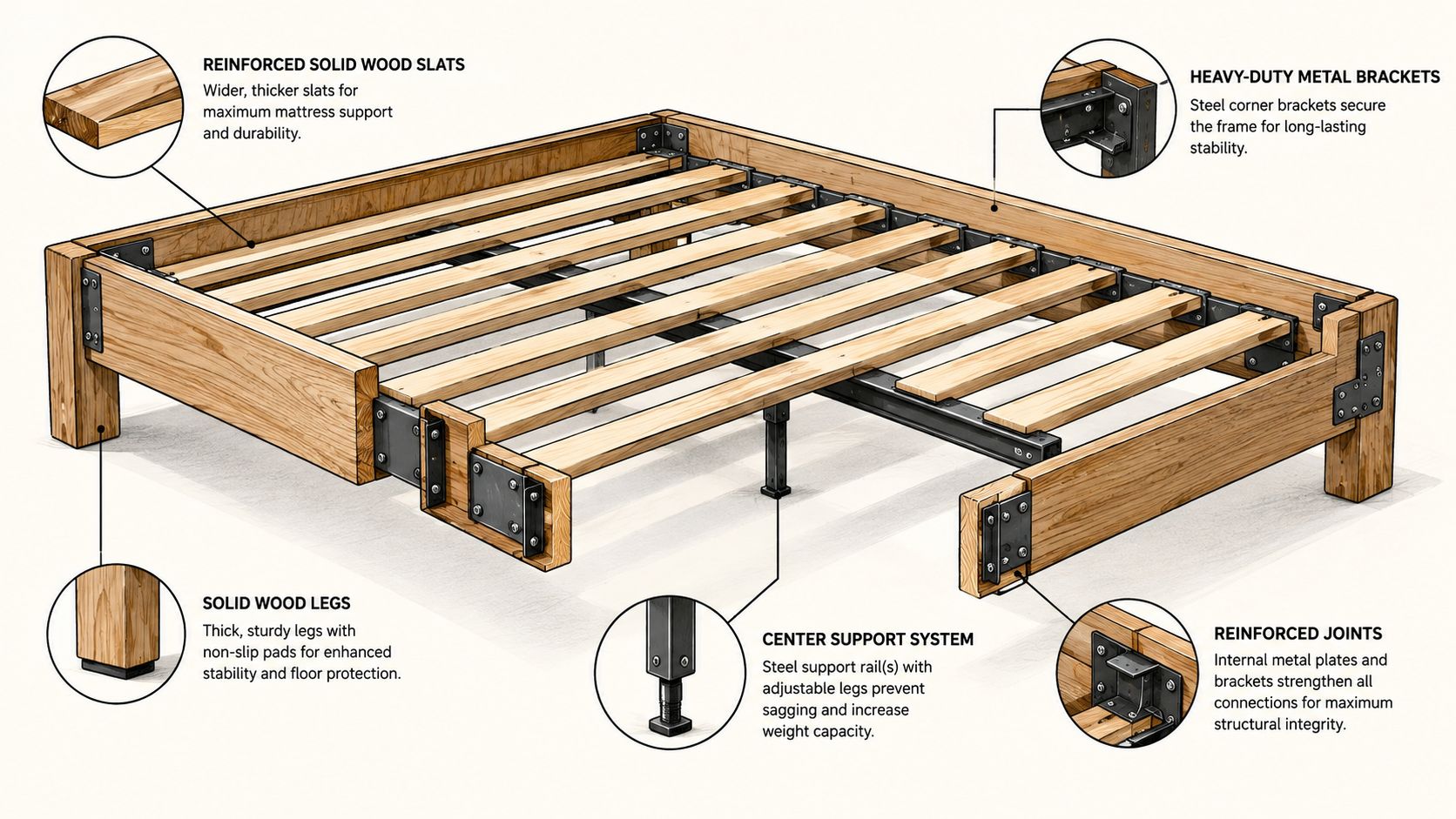
What to inspect under the mattress
For a queen-size or larger frame, a center support rail running from head to foot is a major requirement, not an optional extra. Multiple center support legs should transfer weight to the floor, while rigid slats and non-flexing construction help prevent downward movement. One technical benchmark recommends slats no more than 4 inches apart, ideally under 3 inches, combined with a center rail and evenly spaced support legs. Platform-bed foundation guidance
The frame should also resist racking, which is the sideways movement that makes a bed feel loose or crooked. Strong corner connections, properly seated rails, and joinery that doesn't shift under movement matter more than decorative detailing. A quick showroom check includes pressing gently on a corner, listening for movement, and asking how the center rail connects to the side rails.
If a larger frame lacks a true center rail and floor-supported center legs, the headboard won't rescue the design.
The two-minute comfort test
The engineering shows up at night. A stable frame doesn't wobble when someone turns over, doesn't squeak every time a sleeper sits down, and doesn't develop a noticeable dip through the middle. Poor slat spacing can also reduce edge support and may conflict with the mattress manufacturer's warranty requirements if the platform exceeds the stated gap limit.
Shoppers comparing a platform foundation with a traditional box spring can review Groen's explanation of alternatives to a box spring. The recommendation is simple: verify the mattress requirements, inspect the support system, and treat rigid construction as a comfort feature. A quiet, level bed feels better than a visually impressive frame that shifts under ordinary use.
Comparing the Main Frame Types Side by Side
The right frame depends on the room, mattress, and daily routine. This table gives a fast starting point before the details of materials, airflow, and comfort enter the conversation.
Bed Frames Without Headboard at a Glance
| Frame Type | Best For | Mattress Compatibility | Watch Out For |
|---|---|---|---|
| Platform | Low-profile modern rooms | Foam, latex, hybrid, and innerspring when the support surface meets mattress requirements | Slat spacing and mattress height |
| Metal | Renters, guest rooms, and frequent moves | Many mattresses, subject to the manufacturer's support requirements | Noise, movement, and limited visual warmth |
| Storage | Small bedrooms needing concealed space | Mattresses approved for the platform design | Reduced airflow and harder access beneath the bed |
| Upholstered | Softer, warmer bedrooms | Most mattresses when slats and spacing are appropriate | Fabric care and a heavier visual footprint around the base |
| Adjustable | Sleep wellness, reading, and aging-in-place needs | Adjustable-compatible foam, latex, or hybrid mattresses | Incompatible mattresses and clearance for movement |
A platform frame is usually the strongest fit for a homeowner who wants clean lines and straightforward support. Its lower profile can make a room feel more spacious, but the mattress may sit closer to the floor, so the finished sleeping height needs to suit the sleeper.
A metal frame earns its place through practicality. It can be easier to relocate, though shoppers should test for squeaks and ask about the quality of the connections. A storage frame solves a real problem when closets are limited, but enclosed compartments can restrict airflow and make cleaning beneath the mattress less convenient.
An upholstered base adds softness without requiring a full headboard. Flexsteel can be considered when durability is the priority, while Bassett may appeal to shoppers focused on style-forward silhouettes. For a more lasting, natural-material direction, Amish solid wood offers craftsmanship and the possibility of a custom build.
For an additional platform-bed perspective, Woodstock Furniture & Mattress Outlet explains platform-bed benefits. Local shoppers can also review Groen's wood bed frame collection before visiting the Dyer or Crown Point showroom. The practical advice remains consistent: choose the frame type based on the room's needs first, then select the finish and upholstery.
Sizing, Storage, and Mattress Compatibility That Actually Fit Your Room
A frame can be well built and still be wrong for the room. Twin, full, queen, king, and California king beds each require a layout that leaves room for opening drawers, walking around the mattress, and using the nightstands without squeezing past the footboard area.
Bedroom planning should begin with the room's actual measurements, including door swings, closet doors, windows, radiators, vents, and existing furniture. A buying guide recommends leaving at least 24 inches of clearance on both sides of the bed, with a 36-inch walkway on one side preferred. Bed-frame measurement and clearance guidance Those measurements protect circulation, but the correct layout still depends on the room's shape.
Storage earns its footprint in the right room
Storage is valuable when extra bedding, seasonal clothing, or children's items have nowhere else to go. A drawer frame makes sense when the drawers can open fully without striking a dresser or wall. Lift-up storage can work in tighter layouts, but access becomes less convenient if the bed is positioned under a low window or close to a ceiling fixture.
A simple platform is the smarter choice when the room already has adequate storage or when easy cleaning and airflow matter more than concealed capacity. Storage shouldn't be added just because it sounds useful. It should solve a problem the bedroom has today.
Match the support to the mattress
Foam and latex mattresses are especially sensitive to wide slat gaps because their materials can flex between support points. Hybrids and innerspring mattresses also need a stable foundation, although their internal construction can respond differently to the surface beneath them. The mattress warranty should always be checked before selecting a frame, since an unsupported platform can affect warranty eligibility.
Platform height affects more than appearance. A low base can create a modern, grounded look, while a taller frame can make it easier to sit down and stand up. Adjustable frames require compatible mattresses and enough room for the base to move without contacting a wall or nightstand.
Groen's approach to mattresses centers on health, rest, and long-term comfort, not just a firmness label. The Helpful Mattress Guide can support the measuring process before a shopper compares Serta or Beautyrest sleep options in person. Special Financing is also available, subject to credit approval, which can give families more buying power when the right mattress and frame need to fit a real household budget.
Styling a Headboard-Free Bed So It Looks Intentional
A headboard-free room doesn't need to look plain. It needs a strong visual element on the wall and enough texture around the mattress to make the bed feel anchored.
Oversized art can create the same sense of scale that a headboard provides, while a quilted wall hanging adds softness without adding furniture depth. A row of framed prints gives a homeowner more flexibility, and a textured paint accent can define the sleeping zone without committing to a permanent panel.
Solve the pillow and wall problem directly
Pillows can slide when they rest against painted drywall, especially on a low frame. A substantial euro-style arrangement, a firm bolster, or a folded quilt placed behind the sleeping pillows can create a stable transition from mattress to wall. Bedding with visible texture also carries more visual weight than thin, perfectly flat layers.
Wall protection matters most where pillows and the sleeper's shoulders contact the surface. Washable paint, a removable textile, or a properly mounted art piece can help prevent scuffs. A narrow upholstered wall panel may offer a middle ground, adding cushioning while preserving the frame's open construction.
Use current silhouettes without chasing a trend
Recent design coverage points toward low-profile platforms, warm minimalism, and softer upholstered silhouettes in 2026. Low-platform beds typically sit 6 to 11 inches off the floor, according to trend coverage, so shoppers should treat that range as a design reference rather than a universal standard. Coverage of low-profile bed-frame trends
A warm wood frame, linen bedding, natural greenery, and muted wall color can make the room feel calm rather than sparse. A soft upholstered base can add comfort while keeping the sightline open. If the homeowner later wants a backrest, a wall-mounted headboard can be added without replacing the entire frame, which is one of the strongest reasons to preserve the room's flexibility.
Assembly, Care, and Maintenance That Keep the Frame Quiet for Years
The first quiet night starts with careful assembly. Every rail should sit flush, every fastener should be tightened evenly, and every slat should rest in its intended position. A frame that begins slightly loose can develop movement and noise as the mattress and sleepers apply repeated pressure.
A simple maintenance routine
- Recheck hardware: Tighten accessible connections periodically, especially after the frame has been moved or the room has been rearranged.
- Inspect slats: Look for cracks, bowing, or slats that have shifted out of their supports.
- Protect the mattress: Rotate it according to the manufacturer's care instructions to help distribute wear.
- Control the environment: Avoid prolonged exposure to damp conditions and pay attention to humidity swings in basements or lake-effect Northwest Indiana homes.
- Keep the base clear: Remove dust and stored items that could interfere with drawers, vents, or adjustable movement.
A bed frame without a headboard depends on its own rails, slats, legs, and joints, so maintenance shouldn't focus only on visible surfaces. A small wobble deserves attention before it becomes a recurring squeak or a loosened connection.
Quiet construction is usually preserved by small corrections made early.
Assembly doesn't have to become a homeowner's weekend project. Groen's offers furniture delivery and assembly, including White-Glove Delivery options that can reduce the work involved in bringing a new frame into the bedroom. For those handling a move independently, this resource on hiring assembly after a move explains why professional setup can be useful for heavier furniture.
A well-selected, well-maintained headboard-free frame from a quality manufacturer can outlast a poorly built headboard-inclusive model. The difference isn't the presence of a decorative back panel. It's the quality of the structure and the care it receives.
Shop Bed Frames Without Headboard the Local Way at Groen's
A headboard-free frame should be judged in person whenever possible. The shopper needs to sit on the edge, test the sleeping height, press the corners, inspect the center support, and ask how the slats match the intended mattress. Those details are difficult to evaluate from a product photograph.
Groen's Fine Furniture is a family-owned Northwest Indiana retailer serving local households since 1983, with showrooms in Dyer and Crown Point. Its multigenerational ownership, five-star service, mattress guidance, Interior Design support, and White-Glove Delivery give shoppers a place to discuss the whole bedroom rather than purchase a frame in isolation.
Customization also matters. A homeowner doesn't have to settle for a floor-stock configuration if the room requires a particular finish, material, height, or support approach. Groen's custom programs include Canadel custom dining and Amish solid wood furniture, and the same design mindset can help shoppers explore a bedroom setup that feels made to order. Options from Flexsteel, Bassett, Serta, and Beautyrest add recognizable paths for upholstery, style, and sleep wellness.

Special Financing is available, subject to credit approval, so families can consider the frame and mattress that fit their needs while keeping buying power aligned with the household budget. The best recommendation is direct: choose a frame for its engineering, confirm its mattress compatibility, style the wall intentionally, and test the comfort before bringing it home.
Visit Groen's Fine Furniture in Dyer or Crown Point to test-drive bed frames without headboards, compare mattress support, and explore custom bedroom options from solid wood to upholstered designs. Our family-owned team serves Northwest Indiana with personal guidance, White-Glove Delivery, Interior Design help, and Special Financing subject to credit approval.