Blog
Custom Home Office Furniture: Transform Your Workspace 2026

A homeowner in Dyer may start the workday at a dining table, move a laptop to a spare bedroom for a video call, then clear paperwork away before dinner. In Crown Point, a narrow room may have to function as an office, guest room, and family command center. Standard furniture often makes those spaces feel temporary, crowded, or disconnected from the rest of the home.
Custom home office furniture gives Northwest Indiana families another option. A desk can fit the wall instead of forcing the wall to fit the desk. Storage can hide equipment, a work surface can match the user's body, and the finish can feel residential rather than corporate. The right choice isn't always custom, but it should always be intentional.
Why Your Home Office Deserves Better Than Stock Furniture
A typical work-from-home setup starts innocently. A homeowner brings in a stock desk, adds a chair, places a monitor on top, and expects the arrangement to settle into daily life. Then the problems appear. The desk blocks a doorway, the chair hits a cabinet, cords collect behind the monitor, and the surface leaves no room for paperwork or a second screen.
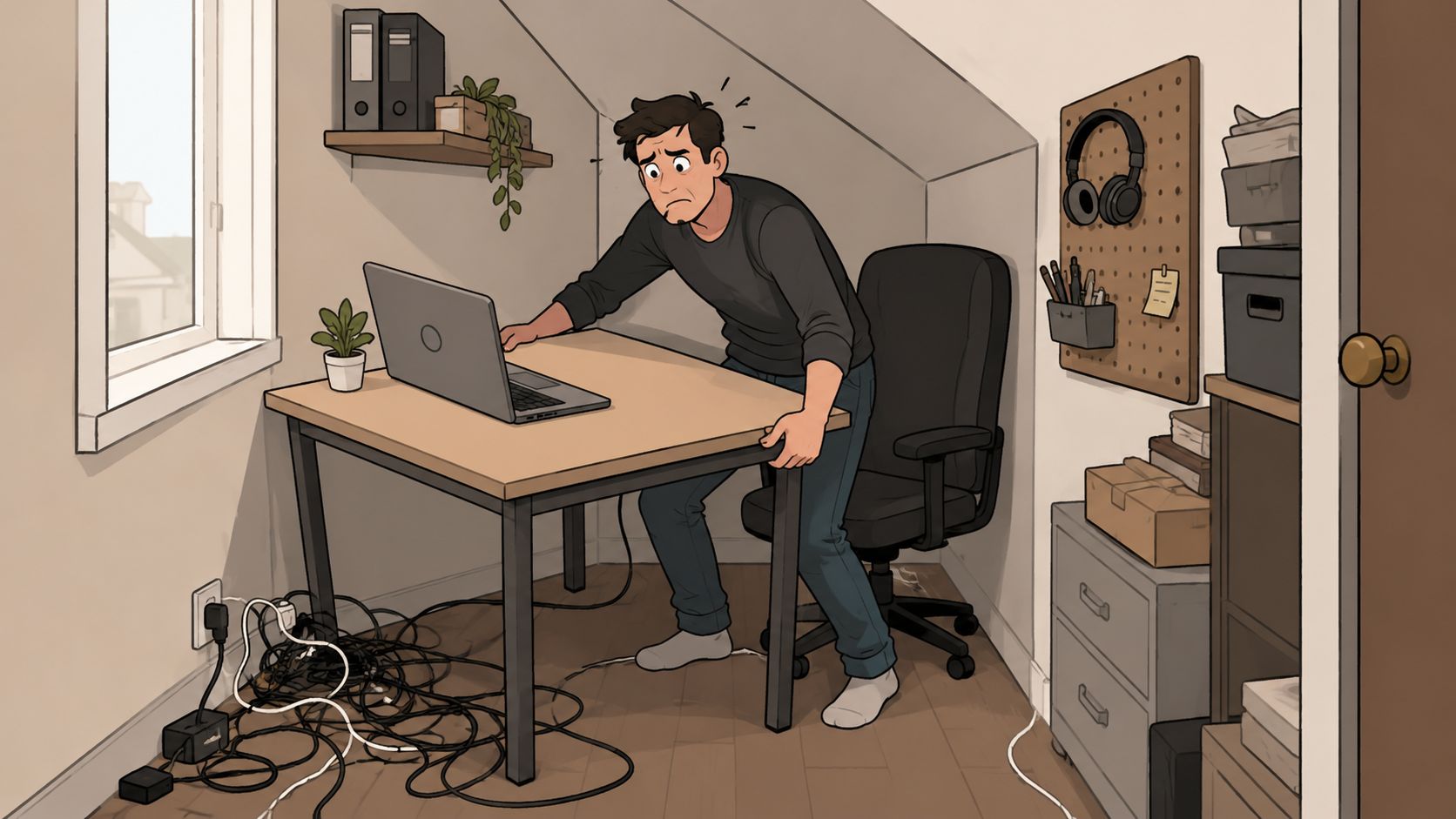
A standard piece can work when the room, user, and work routine all happen to match its dimensions. That alignment is less common in real NWI homes, where offices may occupy an awkward corner, a finished basement, a guest room, or part of an open living area. A fixed desk can look acceptable in a showroom and still fail once the household adds printers, files, lamps, chargers, and personal items.
The residential office problem
Hybrid work has changed the role of the home office. The room must support concentration, video calls, storage, and comfortable posture, but it also needs to look like part of the home. A corporate-looking workstation can dominate a family room, while a beautiful console may lack the depth and clearance needed for sustained computer work.
A custom design addresses the room's actual constraints. It can use vertical storage in a narrow space, preserve a walkway near a doorway, create two workstations for a household, or include closed compartments for technology. Built-in cable routes, carefully placed drawers, and a finish that relates to nearby furniture help the office feel settled instead of improvised.
Practical rule: If a stock desk forces the room, chair, monitor, or storage to compromise, the furniture is costing more than its purchase price in daily frustration.
Homeowners can also start with a focused solution rather than commission an entire room. A solid wood desk with the correct depth may solve the biggest problem, while additional storage or a matching return can come later. Groen's home office design ideas can help households think through the room's purpose before selecting individual pieces.
Custom makes the strongest case when the office must serve more than one role. A guest room can include a compact desk and concealed storage. A shared office can divide two work zones without making the room feel institutional. A living-area workstation can use furniture-like finishes and closed storage so work disappears when the day ends.
The Growing Demand for Custom Home Office Solutions
Home office furniture has moved well beyond the temporary desk category. A 2026 industry estimate valued the global home office furniture market at USD 37.07 billion in 2025 and projected it to reach USD 71.91 billion by 2034, representing a 7.64% CAGR. North America held 36.5% of the market in 2025, according to the global home office furniture market forecast.
That growth reflects a lasting change in how households use space. People want work areas that support posture, organize technology, and blend with residential interiors. They're also furnishing rooms that may need to shift from work to study, hobbies, entertaining, or overnight guests.
What the U.S. market reveals
The U.S. home office furniture market was estimated at USD 6.5 billion in 2025 and USD 6.94 billion in 2026, with a projection of USD 9.67 billion by 2031 at a 6.83% CAGR, as reported in U.S. home office furniture market statistics. The category's leading products also point toward practical concerns. Office chairs held a 28.55% revenue share in 2025, while height-adjustable desks were forecast to grow at a 7.78% CAGR.
Materials and shopping channels matter, too. Wood represented 41.35% of market size, and home centers accounted for 46.10% of distribution share in the same report. Those figures place custom desks, solid wood storage, and ergonomic seating inside an established market, not at its fringe.
The broader customized furniture market was forecast to grow from USD 54.16 billion in 2025 to USD 89.94 billion by 2030, supporting the view that made-to-order furniture has become a mainstream buying pattern. The customized furniture market overview provides that projection.
For a Northwest Indiana homeowner, the conclusion is straightforward. Customization isn't automatically an indulgence. It's a practical response to rooms that must work harder, bodies that need better support, and households that want furniture to reflect their homes.
A compact office may need a shallow visual profile but a usable work surface. A formal study may call for heirloom-quality wood and generous storage. A family office may need reconfiguration options more than decorative detail. The best design begins with the work routine, then selects the style.
Measuring Your Space and Body for Perfect Ergonomics
A beautiful desk with the wrong dimensions becomes uncomfortable furniture. Before ordering, the household should measure the room, the equipment, and the person using the desk. The goal is to align the work surface with the user's elbows while preserving enough depth for a monitor, keyboard, and forearm support.
Start with the room
Measure the full wall, nearby door swings, windows, outlets, baseboards, and walking paths. Mark the chair's movement area, not just the desktop footprint. A desk that technically fits may still fail if the user can't pull out the chair or open a cabinet.
Usable depth deserves special attention. UBC's ergonomics guideline recommends at least 30 inches of usable computer work-surface depth and says a 24-inch desk isn't ideal. The same guidance identifies a preferred adjustable height range of 22.6 to 48.7 inches, with minimum leg clearance of about 23.5 inches deep by 28 inches wide, as detailed in the office ergonomics design guidelines.
Measure the user while seated
The work surface should allow the elbows to remain near a 90-degree angle, with forearms parallel to the desk. General seated-work guidance places the surface around 27 to 29 inches high, while body-specific recommendations provide a more useful starting point.
| User Height Range | Recommended Desk Height | Notes |
|---|---|---|
| 5'0" to 5'3" | 25 to 26 inches | A lower surface can reduce shoulder elevation. |
| 5'4" to 5'6" | 26 to 27 inches | Confirm the fit with the chosen chair. |
| 5'7" to 6'0" | 27 to 30 inches | This range includes many standard desk users. |
| 6'1" to 6'5" | 30 to 32 inches | Extra height may help prevent a cramped posture. |
These height recommendations come from the University of Pennsylvania office furniture guidance. A fixed 29-inch or 30-inch desk won't suit every person, especially when two household members share the workstation. Adjustable surfaces are preferable for shared offices, while a custom fixed height can work well for a single primary user.
Place the monitor deliberately
The monitor should sit about arm's length away, with its top at eye level or just below. Positioning the desk perpendicular to windows can reduce glare, which is especially important when a built-in hutch or credenza limits later adjustments. The home office ergonomics tips offer the mechanical basis for these placement decisions.
A custom maker should also plan grommets, hidden channels, power access, and clearance after accessories are installed. The furniture measuring guide can help homeowners gather room dimensions before a showroom consultation.
Choosing Materials and Construction That Last
Material selection should follow use, not fashion. A home office used every weekday needs a surface that tolerates equipment, writing, cleaning, and repeated contact. An occasional workspace may allow more flexibility, particularly if the room must remain visually light.
Solid wood for lasting presence
Solid wood offers warmth, repairability, and a substantial feel. American-Made Amish Furniture is particularly well suited to buyers who want careful craftsmanship, solid construction, and a piece that can remain useful as the household changes. Wood species, finish, joinery, and hardware all affect the final result, so the material discussion should go beyond choosing a color.
A heavy-use executive office can justify a thicker solid wood top, sturdy drawers, and a finish selected for regular handling. In a multi-purpose room, the same material can be shaped into a smaller desk that resembles a console when the chair is moved away.
The wood furniture guide explains how hardwood selection influences longevity and style. Its practical value lies in helping buyers connect appearance with expected use.
Engineered wood, metal, and mixed construction
Engineered wood can provide consistent panels and stable surfaces, often making sense for cabinetry, shelving, or a budget-conscious office that won't receive demanding daily use. It can also create clean painted finishes in a built-in arrangement. Buyers should ask how edges, hardware attachment points, and high-contact surfaces are constructed, because those details affect ownership more than the label alone.
Metal brings visual crispness and can support an industrial or contemporary interior. It works well as a frame or base, but a completely metal workstation may feel less residential in a warm family room. Mixed materials often solve that concern. A wood top over a metal base can balance strength with warmth, while wood cabinetry with metal hardware can provide a polished look without visual heaviness.
A durable office isn't defined by one material. It's defined by construction that matches the workload, room, and owner's plans.
Finish and maintenance deserve equal attention. Open shelving requires more visual discipline than closed storage. Dark finishes may emphasize dust or fingerprints, while lighter finishes can make a compact office feel more open. Groen's Fine Furniture offers custom order services that can address desk dimensions, finishes, hardware, and cable-management details for solid wood Amish desks, giving buyers a made-to-order path without treating every office as the same project.
When Custom Furniture Makes Financial Sense
Custom furniture should earn its place in the budget. Stock furniture remains the better choice when the room has standard dimensions, ergonomic needs are straightforward, and the household may move or change the office soon.
The financial case strengthens when one piece solves several problems at once. A made-to-order desk can fit an unusual wall, suit a specific body height, conceal technology, and coordinate with an adjacent room. That combination may prevent a homeowner from replacing mismatched items as work habits and storage needs change.
The cost of bespoke work
Custom modifications can add about 20% to the price and may require roughly 22 to 24 weeks from order to arrival, according to this custom furniture planning FAQ. Build those figures into the decision at the start. A family facing an immediate move or urgent work requirement may need a stock solution. A homeowner planning to keep the office for years can treat the longer wait as part of the investment.
A custom order makes stronger financial sense when one or more of these conditions applies:
- Exact fit matters: The room has an angled wall, limited clearance, or an unusual footprint.
- The office serves multiple roles: Storage must stay concealed, or the room must shift between work, guests, and family use.
- The furniture will stay for years: Long-term ownership gives craftsmanship and adaptable design more time to justify the initial cost.
- Ergonomics require specificity: The primary user needs a height or depth that standard furniture cannot provide.
- The design must coordinate: A desk, return, storage unit, and nearby living furniture need a connected appearance.
When stock is the right answer
A stock desk can handle occasional computer use, a temporary rental, or a room with plenty of flexibility. It is also the practical choice when immediate availability matters more than a specific finish, size, or configuration.
The decision should account for more than the invoice. Measure the cost of compromises, including cramped movement, exposed cords, poor storage access, and a replacement purchase if the first desk cannot adapt. Custom work has value when it removes a daily problem that would otherwise persist.
Budget test: Custom furniture deserves serious consideration when it removes a recurring daily problem, not merely when it adds decorative detail.
Long-term value also includes comfort, room usability, and reduced clutter. Weigh those benefits against the lead time, delivery planning, and possibility of future relocation. Groen's Fine Furniture can help homeowners judge whether a made-to-order piece fits the room, workload, and length of ownership they expect.
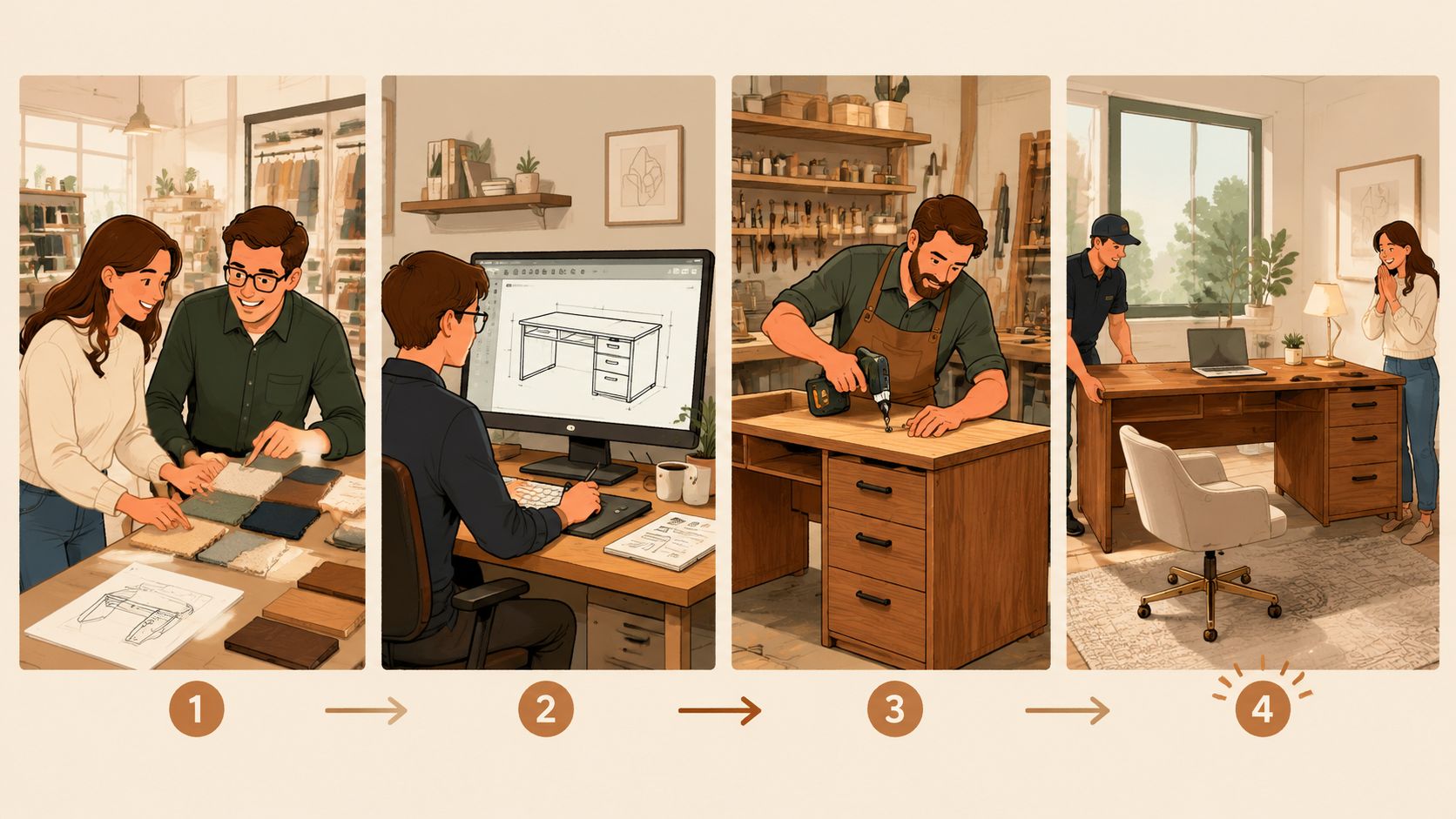
Groen's Custom Order Process from Start to Finish
A successful custom order starts with a conversation, not a catalog. The homeowner brings room measurements, photos, equipment dimensions, and a clear description of how the office functions. The design team can then separate essential requirements from attractive extras.
The consultation and design stage
The first step is identifying the room's job. A private executive office needs a different arrangement from a shared workstation in a guest room. The team should discuss desk height, work-surface depth, storage access, monitor position, cord paths, lighting, chair movement, and the relationship between the office and nearby living areas.
Finish and proportion come next. Solid wood Amish furniture may suit a homeowner seeking American-Made craftsmanship and heirloom character. A lighter mixed-material design may work better in an open room. The point is to select a construction approach that supports the household's routine rather than copying a showroom arrangement.
For buyers exploring made-to-order possibilities, the custom order starting guide provides a useful foundation. Canadel's custom dining program also demonstrates the breadth of made-to-order configuration, with thousands of combinations of sizes, shapes, and finishes described in this custom-made furniture overview. While dining furniture has its own requirements, the principle applies to office planning: buyers can choose a configuration instead of accepting a fixed stock format.
Ordering, delivery, and installation
Once dimensions, finish, hardware, and storage details are approved, the order moves into production. The household should keep the expected lead time in mind and avoid scheduling a move or major renovation too tightly around delivery.
White-Glove Delivery adds value at the point when a large desk or storage system arrives. Instead of leaving cartons for the homeowner to manage, the service is designed to bring furniture into the home, place it appropriately, and support installation according to the delivery arrangement. That matters in offices where heavy pieces must be positioned carefully around walls, flooring, and electronics.
Groen's multigenerational ownership and service history in Northwest Indiana, including Dyer and Crown Point, give local buyers a place to see finishes, feel construction quality, and discuss decisions face to face. The team serves surrounding communities including St. John, Schererville, and Munster, with a focus on personal guidance and 5-star service.
Making Quality Furniture Fit Your Budget
Affordable luxury starts with choosing quality where daily contact matters most. A household doesn't need to order every possible cabinet, accessory, or matching piece at once. It can begin with the desk, chair, and cable plan, then add storage when the room's workflow becomes clearer.
Special Financing, subject to credit approval, can provide additional buying power for households that want durable furniture without paying the full cost at once. Financing terms can change, so shoppers should discuss current plans directly with the showroom team rather than build a budget around an assumed rate or payment.
Build the office in sensible stages
A complete setup may include the work surface, ergonomic seating, storage, lighting support, and technology organization. The most important first purchase is usually the piece that solves the largest daily constraint. For one homeowner, that's a correctly sized desk. For another, it's a storage unit that clears the work surface and restores the room's residential feel.
Cost-per-use offers a more useful perspective than sticker shock alone. A well-built desk used throughout the workweek may provide value through comfort, organization, and longevity, while a lower-quality replacement cycle can create repeated expense and inconvenience. That doesn't make every custom order financially wise. It means the decision should account for the years of use, not just the day of purchase.
Groen's Fine Furniture combines Custom Furniture guidance, Special Financing options, design support, and White-Glove Delivery for Northwest Indiana homeowners furnishing a workspace. Visitors can compare Flexsteel durability, Bassett style, solid wood Amish craftsmanship, and the broader home furnishings available for connected living spaces.
Visit Groen's Fine Furniture in Dyer or Crown Point to review custom home office furniture, discuss dimensions and finishes, and ask about Special Financing plans subject to credit approval. The family-owned team can help homeowners from St. John, Schererville, Munster, and throughout NWI create a comfortable workspace, then test-drive the comfort in person before ordering.