Blog
How to Choose Bed Frame: A Durable Guide for 2026


A homeowner in Crown Point can spend days choosing the right mattress, then place it on a frame that shakes every time someone turns over. A hand-me-down metal base may look serviceable until the headboard starts wobbling, the mattress settles unevenly, and a child or pet turns ordinary bedtime movement into a stress test.
Learning how to choose a bed frame means treating the frame as part of the sleep system, not as decoration added after the mattress. The right choice must fit the mattress, clear the room, support the sleepers, survive delivery into the bedroom, and suit the way a Northwest Indiana household lives. The following guide gives homeowners a practical checklist before they commit.
Why the Right Bed Frame Matters for Northwest Indiana Homes
The right bed frame solves problems before they reach the bedroom. It positions the mattress correctly, distributes movement, and keeps the sleep surface supported night after night. A weak frame can let a mattress bow between slats, loosen at the joints, or develop noise that wakes a partner with every turn.
Northwest Indiana homes add practical complications. An older Schererville bungalow may have narrow doorways, tight stair turns, and little room to maneuver. A newer St. John home may offer a larger primary suite, yet a tall headboard can still fail at a hallway corner. A frame that fits the room can still be difficult to deliver and assemble.

The frame carries more than the mattress
Kids climb into bed, pets jump up, and couples shift weight independently. Those repeated forces test corner joints, slats, side rails, and center supports. Check how the pieces connect, whether the center support reaches the floor, and whether the frame stays quiet when you move on it.
The European standard EN 1725:2024 for domestic adult beds covers the assembled bed system, including the frame and mattress interface, with mechanical safety requirements and test methods. That supports a straightforward buying rule: construction and mattress compatibility matter as much as appearance.
Proper support also protects the mattress investment. Mattress manufacturers commonly require an appropriate foundation or base for warranty coverage, so check the mattress maker's support requirements before delivery. Foam, latex, hybrid, and innerspring mattresses can require different foundation arrangements.
Practical rule: Judge a frame by fit, support, and delivery access before finish or decorative detail.
The bed-frame market is broad, but a local homeowner does not need a forecast to choose well. Measure the route, verify the support system, and test the frame before committing. At Northwest Indiana furniture stores, a showroom test can reveal looseness, movement, or an uncomfortable height that photographs will not show.
For homeowners in Dyer, Crown Point, Munster, and nearby communities, choose a frame that suits the mattress, survives daily use, and can reach the bedroom. Confirm assembly requirements, door clearance, and the frame's long-term support before the delivery is scheduled.
Measure First and Match Mattress Size to Real Room Layout
Before choosing a frame, read the mattress label and measure the room around it. The label identifies the mattress footprint, while rails, legs, upholstery, and a headboard can make the finished frame noticeably larger. Use this furniture-measuring guide to record the room and furniture dimensions before visiting a showroom.
Build a measurement sheet
Write down these details before shopping:
- Mattress size: Confirm the labeled width and length, then measure the mattress yourself.
- Mattress depth: Record its finished height, especially with a tall foam or hybrid mattress.
- Frame footprint: Measure the frame's outer width and length, including the headboard and footboard.
- Room clearance: Keep at least 24 inches of walkway space along each open side and at the foot, following expert bed-frame clearance guidance.
- Furniture depth: Include nightstands, dressers, benches, and doors that open toward the bed.
The frame usually extends beyond the mattress on every side. Standard bed-frame sizing guidance places that added width and length at roughly 2 to 5 inches, depending on the design. A queen mattress at 60 x 80 inches may require a frame about 62 to 65 inches wide and 82 to 85 inches long. A king mattress at 76 x 80 inches may require about 78 to 81 inches wide and 82 to 85 inches long.
| Size | Mattress (W x L) | Frame Footprint | Min Room |
|---|---|---|---|
| Twin | 38 x 75 in | Mattress plus frame clearance | Confirm by measuring the selected frame |
| Full | 54 x 75 in | Mattress plus frame clearance | Confirm by measuring the selected frame |
| Queen | 60 x 80 in | Approximately 62–65 x 82–85 in | 10 x 10 ft |
| King | 76 x 80 in | Approximately 78–81 x 82–85 in | 12 x 12 ft |
| California king | 72 x 84 in | Measure the selected frame carefully | Confirm by measuring the selected frame |
Don't forget the delivery route
A frame can fit the bedroom and still fail at the front door. Measure the bedroom entrance, hallway, stairwell, landing, and every corner where the frame or headboard must turn. A king frame may not clear a standard 30-inch doorway, so confirm the delivery route before placing the order.
Frames shipped in pieces can make tight access easier, but ask who handles assembly and how long setup takes. Confirm whether the headboard, rails, slats, and hardware arrive together. Those details matter in older Northwest Indiana homes, where trim, stair rails, and narrow halls can reduce usable clearance.
Bring a photo of the room, a rough floor plan, and measurements of nearby furniture to a local showroom. At Groen's Fine Furniture, testing the frame in person can reveal movement, awkward height, or a bulky footprint that a product photo will hide. Choose the frame only after it fits the mattress, the room, and the route into the bedroom.
Platform Frames Versus Box Spring Foundations
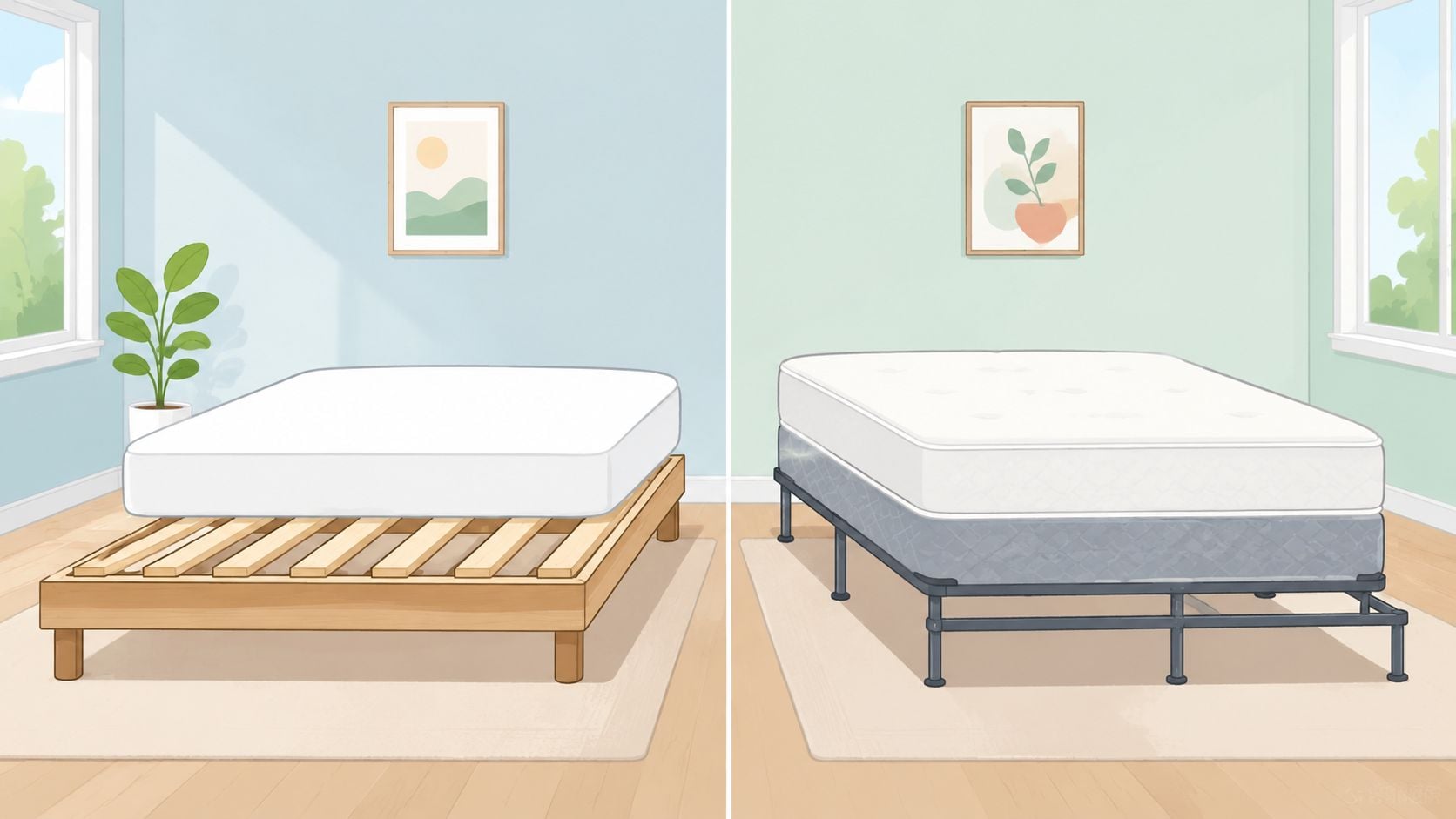
The right base depends on the mattress, the feel you want, and how much height the room can handle. A platform frame supports the mattress directly with closely spaced slats or a solid deck. It gives modern foam and hybrid mattresses an even surface, usually lowers the finished bed height, and removes the need for a separate foundation.
A traditional box spring foundation raises the mattress on a coil or wood box. That added height suits sleepers who prefer a taller bed and can work well with a compatible innerspring set. Do not assume every mattress fits every foundation. Check the mattress manufacturer's support and warranty requirements before buying.
Match the base to the mattress
- Memory foam: Choose a platform frame or flat foundation. Foam needs consistent support across its surface.
- Latex: Use a solid deck or closely spaced slats that limit flex between support points.
- Hybrid: A platform or box-style base can work if its support pattern meets the mattress requirements. Confirm the specifications instead of relying on a general rule.
- Traditional innerspring: A compatible box spring can provide the height and shock absorption associated with this mattress type.
Warranty language belongs in the decision. Some foam mattress warranties restrict coverage when the mattress sits on an incompatible box spring. Bring those requirements to a showroom and compare a platform frame, flat foundation, or adjustable base against the mattress specifications.
The practical answer is clear in this mattress foundation versus box spring comparison. A platform frame is the stronger default for modern foam and hybrid mattresses. Choose a box spring for a compatible innerspring set or when you specifically want more height.
Adjustable bases require their own check. They raise the head or foot of a compatible mattress, need outlet access and clearance, and must move without the frame restricting them. Before delivery, confirm the frame arrives in manageable pieces, ask who handles assembly, and verify that the headboard, rails, slats, and hardware are included. At a local showroom such as Groen's Fine Furniture, testing movement and finished height in person can expose problems that a product photo will hide.
Calculate the finished bed height as mattress height plus foundation height plus frame height. That measurement tells you more than the frame's appearance alone.
Support and Durability You Can Verify
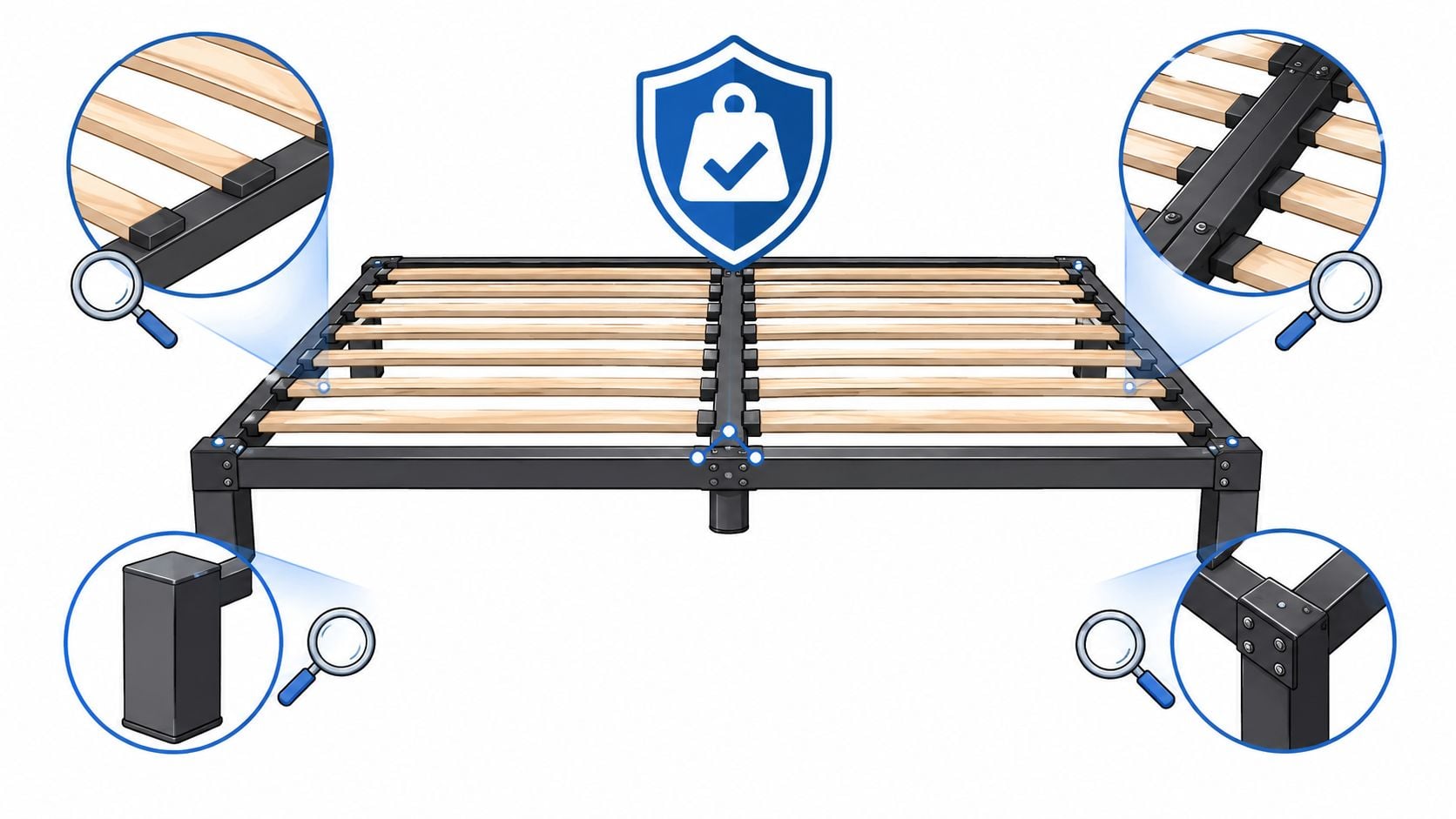
A sturdy label proves little. Check four construction points: slat spacing, center support, leg contact, and published weight capacity. Together, they show whether the frame will keep the mattress level or allow the center to sag over time.
Inspect the support surface
Slats need close spacing so the mattress does not flex excessively between them. Foam and hybrid mattresses generally perform better with tighter 2 to 3 inch spacing, based on these slat-support recommendations. Some support guidance allows wider gaps, but the mattress warranty sets the final requirement.
Wide openings can let foam dip between slats, adding stress and creating uneven comfort. They can also contribute to bowed slats or premature wear. Bring a tape measure to the showroom. A product description that says “sturdy” is not a substitute for checking the actual gap.
Look underneath larger frames
Queen, king, and California king frames need a center beam with legs that reach the floor. Broad spans put more force on the side rails and slats, so a center support that floats above the floor does not do enough work. Published capacity varies with the frame's materials and construction, and the rating for the specific model should include the mattress, sleepers, bedding, and ordinary movement.
A single center rail can still flex if its legs do not make firm floor contact. Check whether the feet sit flat, whether the beam stays aligned, and whether the rails remain rigid when weight shifts across the surface.
Run a fast showroom test
A minute of hands-on testing reveals problems that photographs hide:
- Press the slats from above. Excessive flex or movement is a warning.
- Push the headboard and side rails to check for wobble and squeaking.
- Inspect corner joints for solid blocks, bolts, or fitted joinery instead of staples alone.
- Lift one corner if the showroom permits it. Excessive twisting points to weak connections.
- Check the material. Oak, maple, and beech usually feel more substantial than pine or particleboard, although joint design still determines how well the frame holds together.
Joinery deserves close attention. This explanation of mortise-and-tenon joints shows how fitted wood connections differ from basic fasteners and why construction details matter for long-term use.
At a local showroom, test the frame before scheduling delivery. Sit on the edge, shift your weight, and listen for movement. Then ask how the pieces are packed and assembled. A durable frame still creates trouble if it arrives damaged or cannot be carried through the home.
Style, Materials, and Custom Options Worth the Investment
A frame can match the room and still fail after a few years. Choose the material for how the bedroom is used, how often the bed will be moved, and how much wear the household creates. Particleboard may chip at the edges, loosen around fasteners, or arrive damaged after delivery and assembly. Solid wood generally feels more substantial, while a well-built upholstered frame can soften the room without giving up internal support.
Choose material by the room's demands
Solid wood fits homeowners who want visible grain, steady construction, and furniture that can remain useful through several bedroom updates. Oak, maple, and beech are good materials to inspect, but the rails and joints still determine long-term performance. Amish Furniture offers solid wood pieces with made-to-order flexibility, allowing the finish and proportions to suit the room instead of forcing a stock design.
Metal suits a lighter visual profile and contemporary styling. Steel platforms can support a mattress well, provided the welds, rail thickness, slats, and center legs are properly built. Thin metal may look clean while passing movement or noise through the frame when connections are poorly designed.
Upholstered beds add comfort for reading and reduce hard edges around children and pets. The headboard should feel firm and evenly filled. Select a fabric that matches the household's cleaning routine, and check that the attachment points are broad and stable. A headboard that shifts when someone leans back will become irritating quickly.
Compare the structure beneath the finish. Flexsteel is associated with durability across home furnishings, Bassett offers a broad selection of bedroom styles, and established upholstered construction provides a warmer option than bare metal. The practical inspection remains the same: examine the rails, slats, hardware, and path carrying weight from the mattress to the floor.

Custom solves real fit problems
Standard sizing can fail in a room with an unusual ceiling height, a non-standard mattress, a farmhouse-style finish, or large dogs that climb onto the bed. Made-to-order construction can address those conditions through a custom width, hand-rubbed stain, taller or shorter headboard, or coordinated bedroom pieces.
Groen's Fine Furniture offers custom options, including Amish solid wood furniture, for homeowners who want to design it their way. That choice makes practical sense when an in-stock frame fails the room's access, scale, or durability requirements. Ordering the right proportions once can prevent another replacement and make delivery and placement easier to plan.
Customization also keeps the room coordinated. A matching nightstand, dresser, or chest can carry the same wood tone and hardware instead of combining several nearly compatible finishes. In a local showroom, ask to see samples, confirm what can be changed, and discuss how the finished pieces will be packed, carried inside, and assembled. Those details matter as much as the style.
Height, Storage, and Practical Daily Use
The right bed height becomes obvious at bedtime. A low-looking frame can become difficult to use after adding a thick mattress and foundation. Calculate the finished height by adding the mattress thickness, foundation or deck height, and frame height. Then test that complete combination, not an empty showroom frame.
For many adults, a sitting surface between 22 and 25 inches feels practical. Taller sleepers may prefer 25 to 27 inches, while joint stiffness or a low-profile foundation may call for a lower surface. Treat these ranges as showroom guidance. Sit on the actual mattress and base before choosing.
| Sleeper Profile | Total Height Range | Best Frame Type | Watch Out For |
|---|---|---|---|
| Lower-profile sleeper | Below 22 in | Low platform | Difficult bending if the surface feels too low |
| Most adults | 22–25 in | Platform or moderate-height upholstered frame | Mattress thickness can change the final height |
| Taller sleeper | 25–27 in | Higher frame with compatible foundation | Headboard and nightstand proportions |
| Joint-sensitive sleeper | Test below or near 22 in | Easy-entry frame and suitable mattress height | A tall box foundation may raise the surface too far |
A low platform keeps a compact Munster bedroom feeling open. Storage frames help only when the storage is easy to reach and large enough for daily use. A true 14-inch storage drawer frame holds meaningful bedding and clothing, while shallow plastic bins waste space and make retrieval frustrating.
Clearance under the frame also determines how easily you can clean. If it is less than 6 inches, a robot vacuum generally cannot use that space effectively. Check room for a standard vacuum, under-bed lighting, and outlet access before placing an adjustable base beneath the mattress.
Daily maintenance matters too. A tall or tightly fitted footboard can keep a mattress topper from sitting flush. Bulky rails can catch sheets and make bed changes awkward, especially in a narrow room. Measure the walkway around the finished bed, including space needed to open drawers and carry laundry.
Delivery and assembly should match the frame's design. Confirm that the assembled pieces fit through the doorway, hallway, stairwell, and bedroom entrance, then ask how the frame will be carried inside and set up. White-glove delivery and in-home assembly can reduce the work, but they cannot fix a frame that crowds the room or complicates everyday use.
Budget, Financing, and the Showroom Test Drive
A bed frame can look affordable until delivery, assembly, foundation, and removal of the old frame appear on the final invoice. Set the budget around construction first, then confirm what the quoted amount includes: frame, slats, center support, foundation, headboard, delivery, assembly, and haul-away.
Review essential household budget categories before visiting a showroom. That keeps the bedroom purchase in context and clarifies whether a custom solid-wood frame, upholstered frame, or simpler platform fits the household's priorities.
Bring the right information
Bring four things to the appointment:
- A tape measure: Record the mattress, room, doorway, hallway, and furniture dimensions.
- A mattress record: Note the size, thickness, type, and manufacturer support requirements.
- A room photo: Include wall placement, windows, outlets, nightstands, and the delivery path.
- A short priority list: Rank support, storage, height, upholstery, and custom finish.
A showroom test should reveal how the frame works in daily use. Sit on the mattress, shift your weight, press the slats, check corner movement, and inspect the center support. Compare finalists side by side for construction, warranty terms, slat spacing, delivery timing, and custom-order lead time. A frame that feels solid in the showroom is easier to judge than one selected from a photo alone.
Delivery details can change the value of the purchase. Ask whether the service includes White-Glove Delivery, in-home assembly, packaging removal, and haul-away of the old frame. Get the plan in writing, especially for a king frame, tall headboard, narrow stairway, or home with limited parking or access. Confirm how the pieces will enter the house and where assembly will occur.
Financing can help a household choose a frame built for longer use instead of settling for a cheaper construction. Review Groen's furniture financing options alongside the frame's support and material choices, subject to credit approval. The payment plan should serve the construction decision, not distract from it.
Make three checks before ordering: Does the frame fit the room and delivery route? Does it properly support the mattress? Can it handle the household's daily use? Style follows those answers.
Groen's Fine Furniture offers bed frames, mattresses, adjustable sleep solutions, custom furniture, Amish solid wood craftsmanship, and White-Glove Delivery through its Dyer and Crown Point showrooms. Visit Groen's Fine Furniture to test the frame, review custom options, and ask about Special Financing, subject to credit approval.