
How to Choose Cushions for Sofa: Foam, Fit and Fabric

For homeowners in Dyer and Crown Point, the hard part of sofa shopping usually starts after the first sit. One cushion feels wonderfully soft, another feels supportive, and a third family member immediately sinks too low to stand comfortably. Learning how to choose cushions for sofa seating means looking past that first impression at foam, fit, fill, and fabric.
A good choice balances daily use, body size, upkeep, and room style. The checks below give shoppers across Northwest Indiana a practical way to compare options before ordering, so comfort on delivery day still feels comfortable years later.
Match Cushion Foam to How Your Sofa Gets Used
For a family in Dyer or Crown Point, the direct answer is simple. Match the foam to how hard the sofa will work, not to how firm it feels during a quick showroom sit. A guest sofa and a primary family-room sofa need different specifications.
The lookup below sets practical starting points. Shoppers needing extra guidance for active households can also review kid-friendly and pet-friendly furniture choices before narrowing the options.
| Household Use | Seat Foam Density | Firmness (ILD at 25%) |
|---|---|---|
| Occasional guest seating | 1.8 lb/ft³ minimum | 25 lbf |
| Daily family seating | 2.0 lb/ft³ or higher, high-resiliency | 30 to 40 lbf |
| Kids, pets or heavy traffic | 2.0 lb/ft³ or higher, high-resiliency | 35 to 50 lbf |
| Primary seating for tall or heavy users | 2.0 lb/ft³ or higher | 35 to 50 lbf |
Density Predicts Durability
Density is measured in pounds per cubic foot and indicates how much foam material is packed into the cushion. More material generally helps the cushion keep its shape under repeated use. A technical upholstery guide reported in the Des Moines Register places typical seat foam at roughly 1.8 to 2.8 lb/ft³ and 25 to 50 lbf ILD at 25% deflection.
Shoppers should reject seat foam below approximately 1.8 lb/ft³ for heavily used household seating, based on that same guidance. Moderate residential use points to about 1.8 to 2.0 lb/ft³, while daily family-room use calls for at least 2.0 lb/ft³, preferably high-resiliency foam. Those thresholds give buyers a clear minimum instead of a vague promise of quality.
ILD Describes Perceived Firmness
Indentation load deflection, or ILD, describes how much force is needed to compress the foam and how firm it feels. Density and ILD are independent, so a high-density cushion can feel soft. A low-density cushion can also feel firm at first, then fatigue sooner as daily sitting breaks it down.
Practical rule: Never accept the word firm as proof of durability. Ask for density and ILD as two separate numbers.
ILD should be selected only after testing the complete cushion on its actual foundation. Springs, webbing, or a solid panel change how the cushion compresses, so a loose sample held in the hands can't predict the finished sit. Supplier certification and fatigue testing also matter more than showroom feel alone.
A Three Question Check Before Ordering
- Daily users: How many people sit on the sofa every day, and for how long?
- Weight range: What's the weight range of regular users, including the heaviest person?
- Written specification: Can the seller confirm both foam density and ILD in writing?
That sequence prevents a common mistake. A household chooses the firmest cushion, assumes firm means durable, and ends up with low-density foam that feels solid briefly but loses support. Starting with use intensity leads to a better match and a more honest comparison.
Compare Fill Types for Comfort and Upkeep
The softest cushion on the showroom floor often asks for the most work at home. Feather and loose fiber feels inviting, but it doesn't hold a neat shape without regular plumping. Foam cores ask for less attention, although they can feel less enveloping unless they're wrapped or layered well.
| Fill Type | Feel | Upkeep | Best Fit |
|---|---|---|---|
| High-resiliency foam core | Supportive, holds its shape | Low, rarely needs fluffing | Daily family seating |
| Foam core wrapped in fiber | Soft surface over firm support | Low to moderate | Mixed-use living rooms |
| Polyester fiber | Lofty and soft at first | Moderate, plump often | Occasional seating |
| Feather or down | Very soft, sinks deep | High, plump often | Formal or light-use seating |
Shape Retention Versus Sink In Comfort
A high-resiliency foam core springs back and keeps seat edges defined. It's the practical choice for primary seating, especially where children climb, adults nap, and the same corner gets claimed every evening. The trade-off is a more structured sit that some shoppers find less plush.
A foam core wrapped in fiber softens that structure. The surface feels welcoming, while the core prevents the deep sink that makes standing harder. Shoppers comparing constructions can use five things to look for in a new sofa or chair as a broader quality check alongside fill.
Polyester fiber and feather fills start lofty, then compress into the spots used most. Shopper discussions about buying a couch repeatedly raise frequent plumping, foam density, layered foam, and replacement inserts as ownership concerns. That pattern points to a useful question. Does the household enjoy reshaping cushions, or will flattened backs become a daily annoyance?
What to Ask the Retailer
- Core material: Is the center foam, fiber, feather, or a layered combination?
- Specification: What's the density or firmness rating, and how thick is the cushion?
- Ownership: What's covered by the warranty, and are replacement inserts available later?
- Cleaning: Are covers removable, and what cleaning instructions apply?
Thickness, cover design, and the ability to rotate or replace inserts affect durability too. Density alone doesn't tell the whole story. A replaceable insert can extend the life of a sound frame and good fabric.
A supportive layered cushion with a softer surface often gives busy households comfort with far less reshaping than an all feather seat.
For daily family seating, high-resiliency foam or wrapped foam usually wins on upkeep. Fiber suits occasional chairs, while feather suits light-use rooms where a relaxed look is welcome. Plump loose cushions after heavy sitting days, rotate seat cushions every few weeks, and confirm the cleaning code matches a cleaner already at home before the first spill.
Measure Seat Depth and Height for Your Household
A sofa can look perfectly proportioned on the showroom floor and still leave a shorter sitter's feet dangling. The depth printed on a spec sheet measures the whole frame, arms and back included, not the room a sitter gets. Usable seat depth, the distance from the front edge of the seat cushion to the back cushion, decides whether thighs get support without pressure behind the knees. Recline hardware and back thickness shrink the usable number further, so two sofas with the same listed depth can fit very differently.
The visual guide below shows where to place the tape before comparing models.
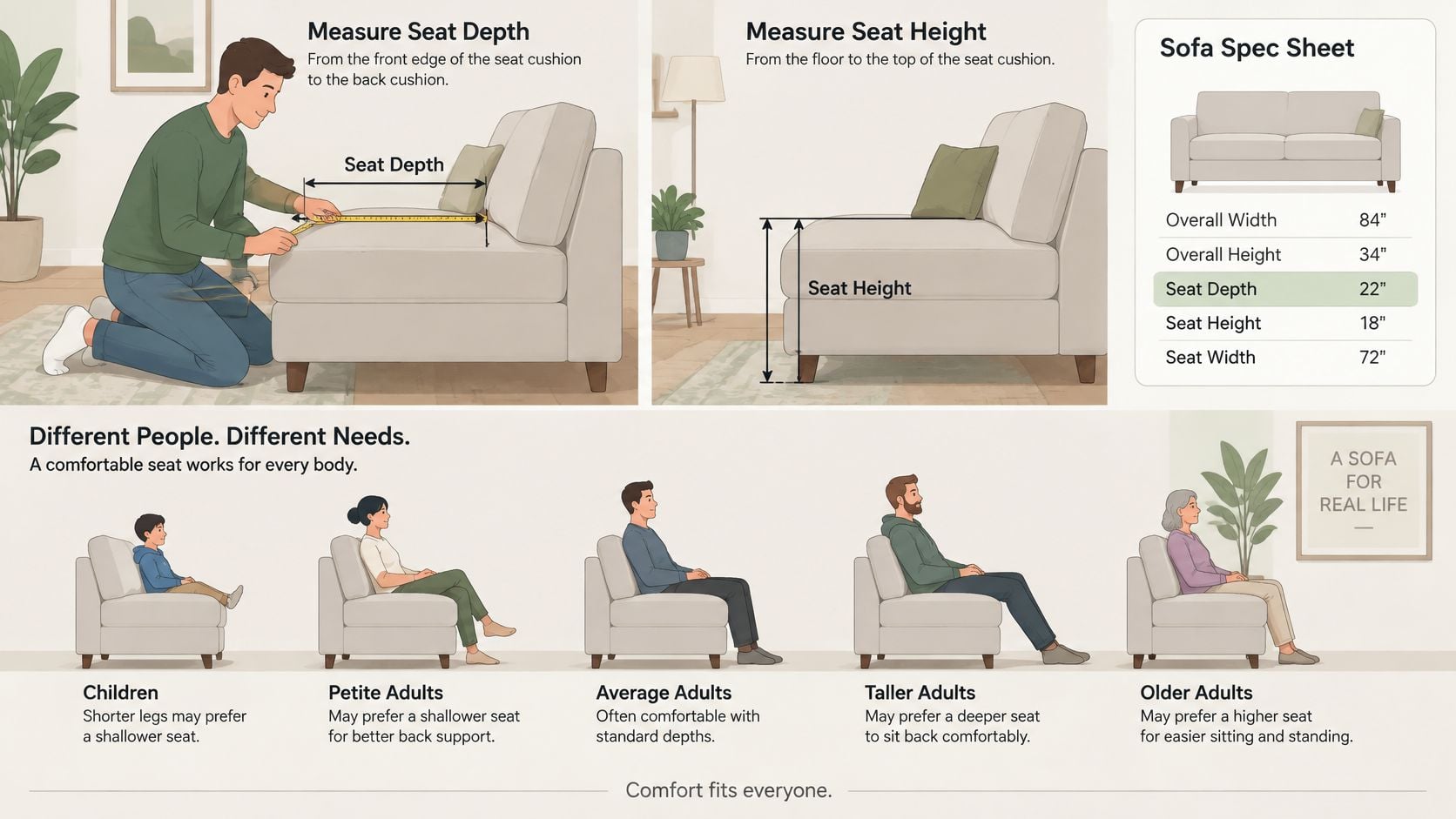
| User | Usable Seat Depth | What to Check |
|---|---|---|
| Shorter adults | 20 to 21 in | Back supported with feet flat on the floor |
| Standard fit | 21 to 22 in | Supportive for most adults |
| Taller adults | 23 to 25 in | Thighs supported with no pressure behind the knees |
Run the Fit Test in Order
- Measure hip breadth: Compare it with usable width per seat, aiming for personal room rather than total sofa width.
- Sit fully back: Keep both feet supported on the floor instead of perching near the edge.
- Check knee pressure: The cushion edge shouldn't press sharply behind the knees.
- Test the base: Try the cushion on its actual spring or panel foundation.
- Repeat for everyone: Include the tallest, shortest, and heaviest regular users.
Body size changes how a cushion loads its base. A controlled test pressed six indenter diameters from 20 to 58 cm into foam at densities of 30.8 and 33.3 kg/m³ over both spring and solid panel bases, and load and deformation shifted with body-contact size, foam specification, and foundation type. The BioResources seat-foundation study behind that work suggests about 42 cm as a suitable match when it comes closest to the user's hip breadth. That match explains why one cushion can feel supportive on a spring base yet bottom out on a solid panel. Close matching matters more than chasing the deepest lounge look, since excess depth encourages slouching when the back cushion stays out of reach while the feet stay planted.
Mistakes That Hide a Poor Fit
Judging a loose cushion while standing reveals almost nothing about posture. Sitting on the front edge hides it too, because pressure behind the knees only shows up at full depth. A seat that runs deep also weakens lower-back support over time, since the sitter gradually slides forward until the back cushion goes unused.
Households ordering custom sizes should record leg length, hip breadth, and preferred posture for each regular user. A guide to measuring furniture before it arrives connects those body measurements with doorways, hallways, and room layout. Re-measure before delivery or pickup as well, so the new piece is confirmed to fit the home before it leaves the store.
Fit check: Feet supported, back reached, thighs supported, and no sharp pressure behind the knees.
A seat that runs slightly deep can still work when back pillows or a lumbar cushion take up the slack. A seat that runs short offers no such fix, so the deeper option only makes sense when the shortest regular user still passes every step of the fit check.
Choose Fabrics and Covers That Survive Daily Life
A pretty weave doesn't prove durability, and fiber content alone doesn't either. Abrasion testing gives households a measurable way to compare fabrics before pets, denim, and daily sliding wear the surface. The swatches below show the range of textures shoppers may compare.
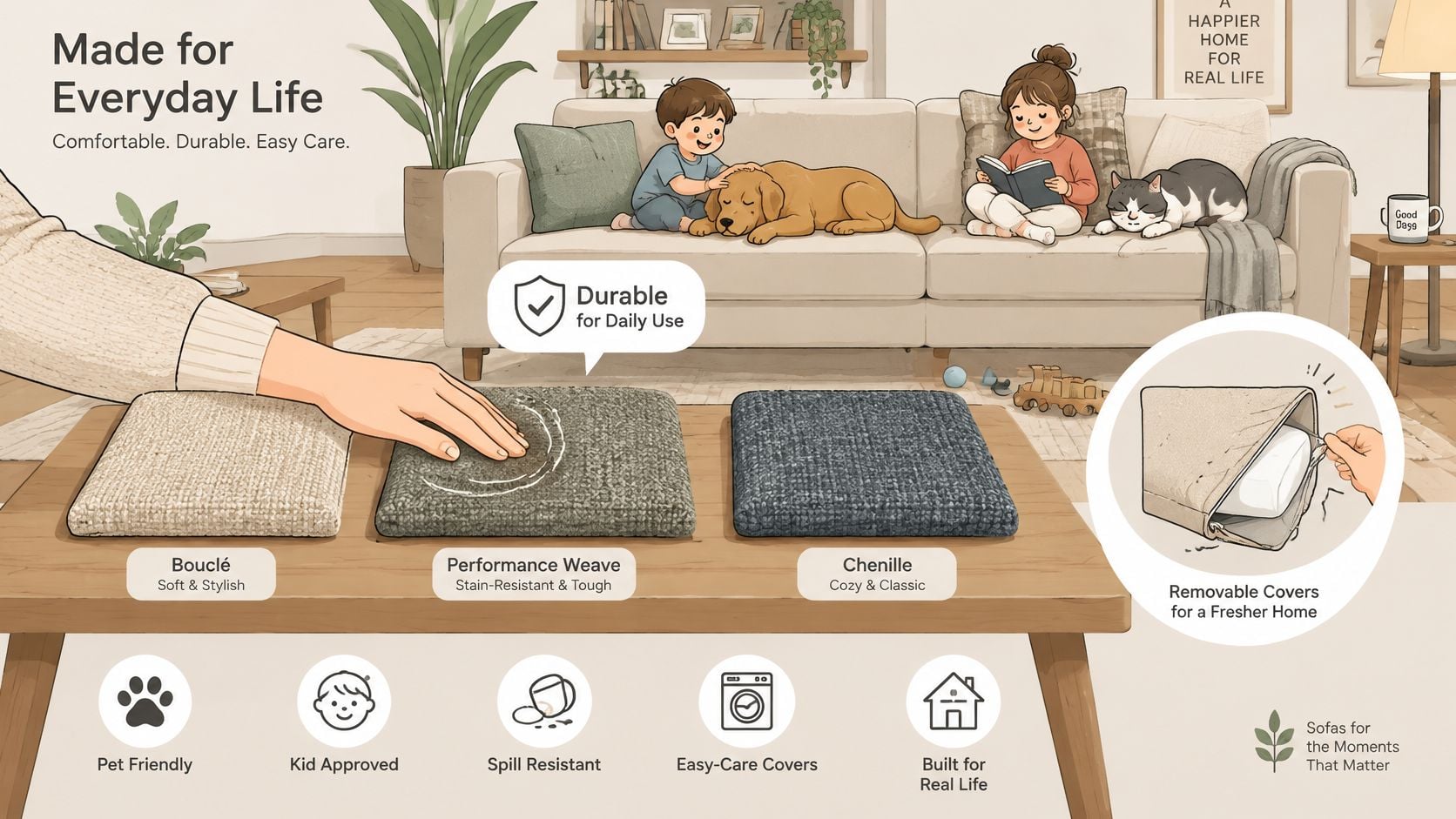
The American Leather guide to upholstery fabric rub tests explains that each back-and-forth Wyzenbeek cycle counts as one double rub. Residential fabrics commonly fall between 10,000 and 25,000 double rubs. Around 15,000 or more is commonly treated as a heavy-duty benchmark for busy homes, while ratings above 30,000 are associated with commercial or contract-grade use.
| Use Case | Double Rubs (Wyzenbeek) | What It Means |
|---|---|---|
| Occasional residential seating | 10,000 | Entry residential benchmark |
| Common residential range | 10,000 to 25,000 | Typical for home fabrics |
| Busy homes with children or pets | 15,000 or more | Heavy-duty benchmark |
| Commercial or contract grade | 30,000 or more | Above typical home need |
Wyzenbeek and Martindale results aren't directly interchangeable. Comparisons only work when ratings come from the same test method. Shoppers can review how to choose upholstery fabric for fiber, weave, and care considerations beyond abrasion.
Check the Cover Before the First Spill
- Removability: Confirm whether covers unzip and whether they're washable.
- Cleaning code: W means water-based cleaner, S means solvent, WS means either, and X means vacuum only.
- Performance finish: Ask whether the fabric is designed to resist spills and release stains.
Say a family has a golden retriever and two children. A fabric rated at the heavy-duty benchmark, paired with a removable cover and a WS code, gives that household options after muddy paws or spilled juice. A delicate velvet with dry-clean-only care may look richer, but it creates more risk and more work. The better fabric is the one the household can clean quickly without damaging the cushion.
Match Cushion Shape and Style to Your Room
Cushion construction changes both appearance and daily handling. Loose back cushions can be rotated, flipped, and replaced when one spot wears faster. Attached backs keep lines tidy and prevent cushions from sliding, but they can't be flipped to even out use.
Pillow-back designs feel relaxed and generous. Thick welted edges with a puckered stitch create a transitional look, while smooth contoured seats suit cleaner modern rooms. Welt cording also defines the cushion edge, although prominent piping shows misalignment sooner when loose cushions shift.
Count Cushions by Seating Habits
Three seat cushions suit family members who sit side by side and want defined places. Two wide cushions look calmer and more formal, but the center sitter may land on a seam. One long cushion invites stretching out, yet it's heavier to rotate and can show a single worn hollow.
Scale matters with accents too. Throw pillows should stay proportional to arm height and shouldn't consume the usable seat depth that shorter users need. A guide to throw pillow styles helps coordinate sizes, while shoppers can add warmth with cashmere blankets without adding bulky pillows.
One dominant sofa fabric with one or two accents usually looks settled. Three competing patterns can make even well-shaped cushions look restless. Replacement covers or new inserts can refresh that balance later, updating color and support without replacing the entire sofa.
Test Cushions in Person Before You Order
A showroom visit works best with a short list in hand. Bring hip breadth and leg length for regular users, the target double rub rating, and notes on who sits on the sofa most often. Those details turn a casual browse into a focused fit test.
Give each serious candidate at least five minutes. Sit fully back, place feet on the floor, change positions, and stand without assistance. The shortest and heaviest regular users should test the same seat, because a cushion that supports one body may feel deep or soft for another.
- Confirm specifications: Ask for foam density and ILD in writing.
- Check ownership: Ask about rotation, replacement inserts, covers, and warranty terms.
- Verify dimensions: Record usable seat depth, usable width per seat, and overall room fit.
That checklist travels well to Groen's Fine Furniture, a family-owned business serving Northwest Indiana since 1983 with showrooms in Dyer and Crown Point. Most of the furniture sold can be customized to the customer's personal style and comfort, so seat depth, cushion firmness, and fabric can be made to order when the floor model does not match the household. Shoppers can also call or text the furniture and mattress experts before visiting, which means the specification questions above can be answered in advance and the visit can focus on sitting.
Special financing is available, subject to credit approval, which helps when the sit test points to higher-density foam or a performance fabric as the right long-term choice. Honest pricing and personal guidance keep the decision grounded in daily life across Northwest Indiana.
Bring the measurements, fabric needs, and daily-use notes, then try the seats in Dyer or Crown Point. Compare the numbers side by side, weigh custom options against what is on the floor, and choose cushions built for the household that will use them.