Blog
Master Throw Pillow Styles for Designer Decor

A lot of living rooms reach the same point. The sofa is in place, the rug is down, the lamps are on, and the room still feels a little unfinished.
For homeowners in Dyer, Crown Point, and across Northwest Indiana, that missing layer is often simpler than expected. Throw pillows can change the mood of a room faster than almost any other accent. They add softness, color, structure, and comfort without asking a family to replace the pieces they already love.
Table of Contents
- The Finishing Touch for Your Northwest Indiana Home
- The Language of Pillows Shapes Textures and Edges
- The Art of the Mix Layering Patterns and Textures
- Pillow Proportions Sizing and Arrangement Rules
- Styling Your Sofa Tailored Tips for Common Layouts
- Design It Your Way Custom Pillows and Lasting Quality at Groens
- Create a Home You Love with Help from Our Family
The Finishing Touch for Your Northwest Indiana Home
A homeowner in St. John or Munster might bring home a handsome sofa, place it just right, and still feel like the room isn't settled. That happens all the time. A quality frame and good upholstery create the foundation, but pillows often provide the warmth that makes the room feel lived in rather than staged.
That's especially true with dependable seating pieces from lines many local families know well, such as Flexsteel or Bassett. The sofa may already fit the space, hold up to daily life, and match the room. What it may still need is a little contrast, a little softness, and a little personality.
Throw pillows do that work. They can pull in the color of a rug, echo the finish of a coffee table, soften a firm-lined sofa, or make a neutral room feel layered and welcoming. They're small, but they carry a lot of visual weight.
A room usually feels finished when the hard surfaces and soft surfaces start talking to each other.
Historically, pillows weren't everyday casual accents at all. A historical overview of decorative throw pillows notes that soft pillows were once considered status symbols in medieval Europe, and one account says King Henry VIII restricted them to pregnant women and others of high rank. The same guide also identifies the 18-inch square pillow as the most common and most popular shape today. That contrast helps explain why throw pillow styles feel so accessible now. What was once reserved and rare has become one of the easiest ways to refresh a room.
For local families who want a room to feel complete without starting over, pillows are often the final layer worth paying attention to. Helpful ideas for pulling that room together can also be found in Groen's home decor tips.
The Language of Pillows Shapes Textures and Edges
A lot of shoppers think pillow style means color or pattern. That's only part of the story. The pillow's shape, texture, and construction often change the look of the room even more than the print on the front.
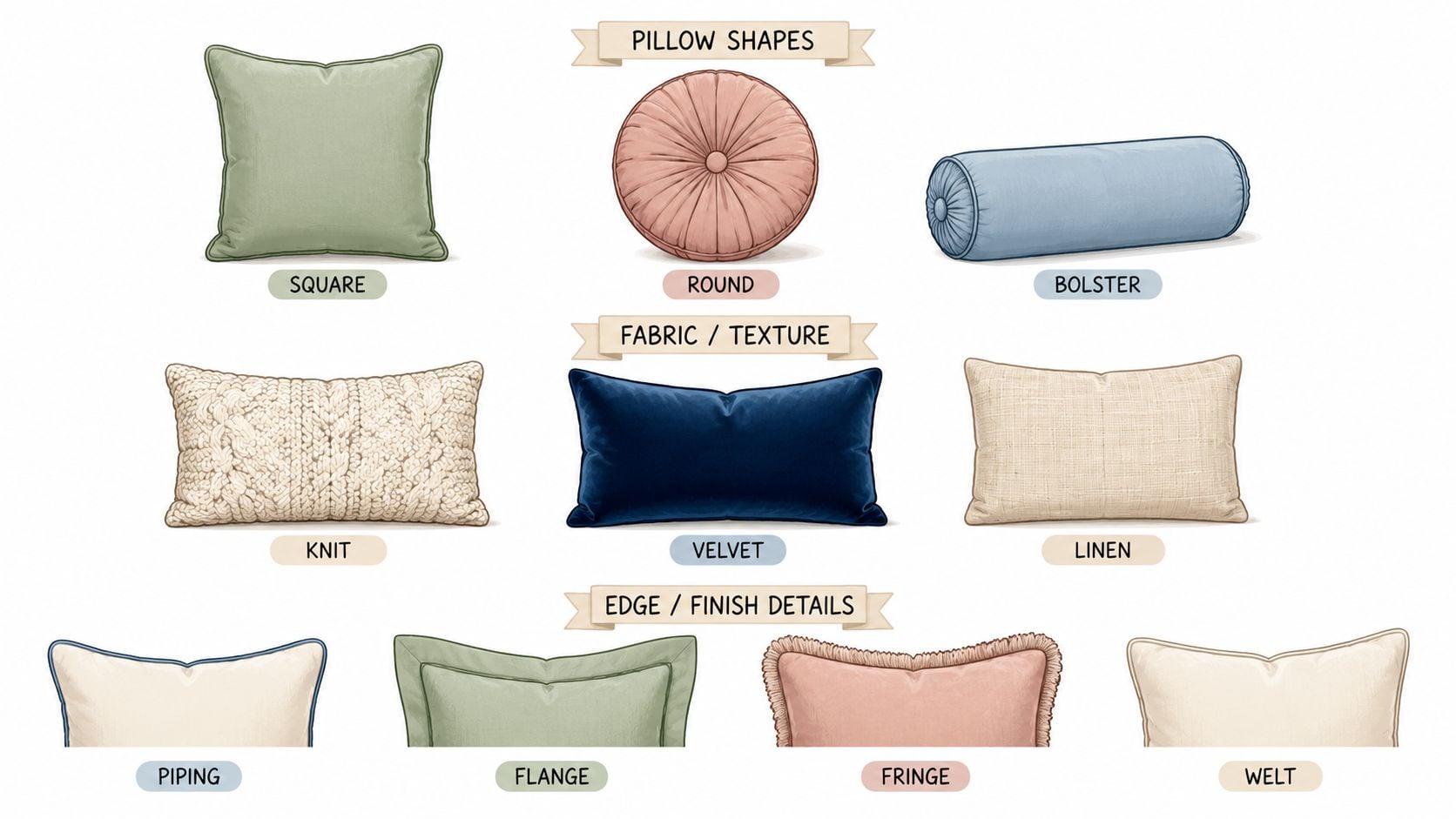
Shape sets the job
Square pillows are the everyday workhorses. They fit almost any sofa and layer easily. Lumbar pillows do something different. They sit lower, appear more refined, and often feel better behind the lower back on a chair or deep seat.
Round and bolster shapes are less common, but they can be useful when a room feels too boxy. If every piece has straight arms, square cushions, and hard corners, a curved pillow can break that up. It acts the way a rounded vase or oval mirror would. It softens the geometry.
A good way to think about shape is simple:
- Square pillows usually handle volume and layering.
- Lumbar pillows add support and a cleaner horizontal line.
- Round or bolster pillows bring a more decorative accent and soften strict furniture shapes.
Texture changes the mood
Texture is where many rooms come alive. A sofa upholstered in a smooth fabric can look flat if every pillow is smooth too. Add one nubby woven pillow, one velvety surface, or one softly structured linen-look cover, and the arrangement starts to feel richer.
That doesn't mean every pillow needs a different fabric. Usually, the better route is contrast with control. One chunky texture plus one smoother solid often works better than five competing tactile statements.
For homeowners trying to connect pillow choice with the rest of the room, fabric thinking matters. The same principles used in upholstery apply to accents too. A helpful starting point is Groen's upholstery fabric guide, especially when the goal is to match softness, durability, and everyday use.
Edge details define formality
Readers frequently find it surprising. The edge finish can completely change how a pillow reads.
A decorative pillow construction guide explains that the most important style signal of a pillow may be its construction, not its print. A knife-edge pillow looks cleaner and more modern, while welted or scalloped details feel more decorative, traditional, or custom.
Another useful distinction comes from a styling guide on pillow edges and layering. It notes that a knife-edge pillow has no decorative border, while a flange edge adds a fabric border, typically 1/2 inch to 3 inches beyond the sham dimensions, which makes the pillow feel softer and visually larger.
A quick comparison helps:
| Style detail | How it looks | Where it fits |
|---|---|---|
| Knife-edge | Clean, crisp, simple | Modern, transitional, casual spaces |
| Flange edge | Softer, broader, relaxed | Layered family rooms, airy looks |
| Welted edge | Tailored, framed, structured | Traditional, formal, custom-feeling rooms |
| Scalloped edge | Decorative, detailed | Accent pieces, more dressed-up spaces |
Practical rule: If the sofa already has strong lines and visible tailoring, a simpler pillow edge often keeps the room balanced.
The Art of the Mix Layering Patterns and Textures
Liking pillows isn't where the difficulty lies. The true challenge comes with combining them. A pillow can look great on its own and still feel wrong once it lands on the sofa.
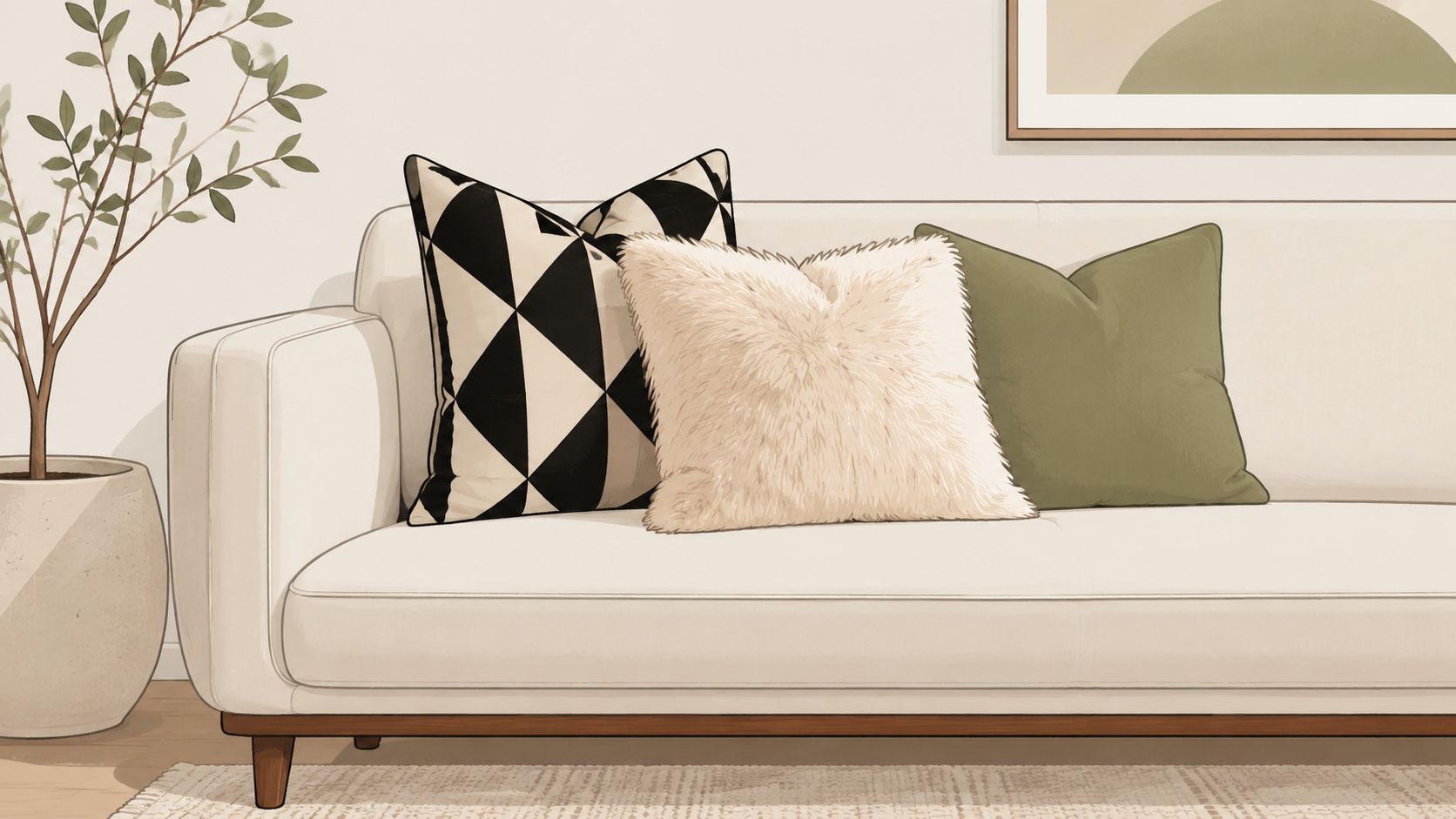
A simple formula that keeps the mix calm
An easy arrangement starts with three roles.
The anchor
This is usually the largest or most visually stable pillow. It's often a solid or near-solid color. Its job is to connect with the sofa or the room, not steal attention.The pattern
This pillow introduces movement. A stripe, subtle print, or geometric design can do the job. It should pick up at least one color already present in the anchor or the room.The accent
Texture or shape plays a key role. A smaller lumbar, a softly fringed cover, or a different surface can finish the grouping without making it too busy.
That mix works because it behaves like getting dressed. The anchor is the coat, the pattern is the shirt, and the accent is the scarf or jewelry. Every item has a purpose.
The range of available options is huge. A market report on throw pillows valued the category at $14.8 billion in 2025, with polyester pillows leading at 34.2% of sales. That helps explain why there are so many affordable options for seasonal changes, while higher-quality textured pillows can be reserved for the pieces that stay out all year.
How to keep mixed fabrics from feeling random
Fabric mixing gets easier when each pillow belongs to one of two groups. Either it adds contrast or it adds continuity. If every pillow tries to do both, the arrangement gets muddy.
A few practical ways to make that clearer:
- Repeat one color at least twice so the eye has a path through the arrangement.
- Change scale, not just pattern. If one print is bold, pair it with something quieter.
- Use texture as a pattern substitute when the sofa already has enough visual activity.
- Keep one calm piece in the group so everything else has room to breathe.
For readers who enjoy understanding how fabric character changes the final result, this Essential fabric guide for dressmakers offers a useful way to think about material behavior. Even though it isn't about interior design, the same plain-language fabric comparisons help explain why some pillow covers feel crisp, relaxed, smooth, or structured.
Homeowners who want more confidence mixing prints can also browse Groen's guide to mixing and matching patterns.
Pillow Proportions Sizing and Arrangement Rules
Color usually gets all the attention, but size does more to make pillows look intentional. A beautiful cover in the wrong proportion will still feel awkward. A simpler cover in the right size often looks polished right away.
Start with size before color
A throw pillow sizing guide notes that the 18-inch square pillow is the most common size. It also lists other common decorative sizes such as 16 x 16, 20 x 20, and standard lumbar options like 12 x 20. The same guide explains that designers often use an insert about 2 inches larger than the cover to create a fuller, more structured look.
That last point matters more than many shoppers realize. A pillow that matches its insert exactly can look underfilled and limp. A slightly larger insert gives the cover shape and helps it hold its corners.
Down-and-feather inserts also compress more easily, so they need regular fluffing to keep their loft. That makes them feel softer and more relaxed, but they do ask for a little maintenance.
Fullness is part of the style. A pillow that slumps too much can make even a nice sofa look tired.
For readers comparing fill options, sewing-style resources can be helpful too. This overview of Minky pillow forms and kits gives a practical look at how inserts and forms affect softness and shape.
Easy arrangement ideas by seat type
Exact formulas aren't required, but a few rules of thumb make styling easier.
| Seating piece | Arrangement idea | Why it works |
|---|---|---|
| Loveseat | One pair of matching or coordinated pillows | Keeps the scale clean |
| Standard sofa | Larger pillows near the ends, smaller or lumbar toward the center | Adds depth without crowding |
| Armchair | One lumbar or one medium square | Supports comfort and keeps the chair usable |
| Deep sofa | Slightly larger back pillows with one lower accent | Helps the seat feel grounded |
A common mistake is adding too many medium-size pillows. When every pillow is nearly the same size, the arrangement looks flat. Varying size creates depth in the same way a gallery wall needs frames of different proportions.
Shoppers unsure whether their sofa is scaled for larger pillows or a tighter arrangement can get more clarity from Groen's sofa size guide.
Styling Your Sofa Tailored Tips for Common Layouts
You get the sofa home, set down a few pillows, and suddenly the room feels harder than it should. The sofa looks good, but the seats feel crowded, the corner spot is blocked, or every pillow seems to fight the shape of the furniture. The fix usually is not buying more pillows. It is matching the arrangement to the way that sofa is used.
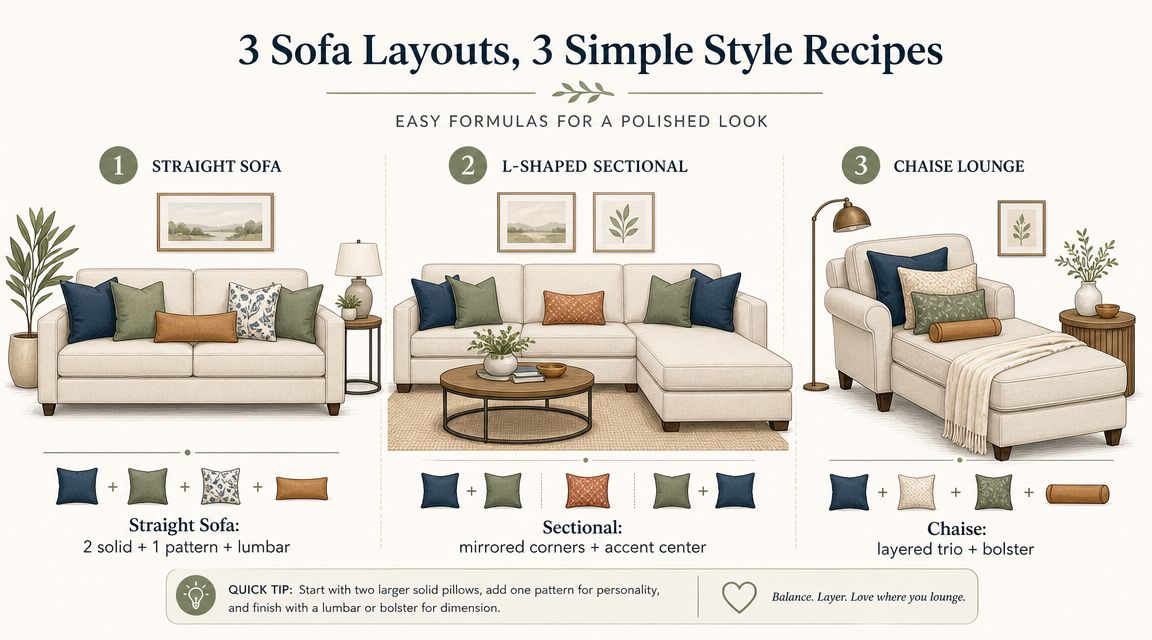
A classic sofa does well with balance
A traditional three-seat sofa usually looks strongest with a steady, even layout. Two larger pillows at the ends frame the sofa the way table lamps frame a buffet. Then one smaller accent pillow in the middle loosens the look so it does not feel stiff.
This approach works especially well on sofas with clear lines, shaped arms, or a defined back. Good pillows should support the design of the sofa, not hide it. If the frame has beautiful structure, let that structure stay visible.
For many Northwest Indiana living rooms, this is the easiest setup to live with too. You keep comfort at both ends, leave the middle seat more open, and still get enough pattern or color to make the room feel finished.
A sectional works better in zones
A sectional is really a few seating jobs combined into one piece. One area is for stretching out. One is for conversation. One often becomes the favorite movie-night corner.
That is why repeating the same pillow stack on every seat rarely feels right.
Start with the outer corners. Those spots can handle the largest pillows because they anchor the whole shape. Then reduce the amount of layering as you move toward the middle and the corner seat people use most. The goal is simple. Keep the sectional looking full without making everyone move pillows to sit down.
This matters a lot on family-friendly sectionals, especially the kind shoppers often try in a Groen's showroom. A roomy Flexsteel sectional usually benefits from durable, easygoing groupings with open seats and good back support. A more sculpted Bassett sectional often looks better with fewer pillows that call attention to the lines and fabric rather than covering them.
If you are choosing a made-to-order piece, the planning gets easier when you review the custom furniture ordering process at Groen's. It helps connect pillow choices to the sofa shape before the room starts filling up.
Chairs and chaises need a lighter hand
An accent chair usually needs one pillow, not a pile. A single lumbar pillow often gives better support and keeps the chair inviting.
The same rule helps on a chaise. Place one pillow where a person naturally wants support, then stop. Too many pillows on a chaise turn the best lounging seat in the room into a storage area for accessories.
Quick matches for common sofa types
A few simple pairings make shopping easier:
- For a Flexsteel-style family sofa, keep the arrangement calm and practical. Choose pillows that hold their shape but still leave plenty of room to sit.
- For a Bassett-style statement sofa, use fewer pillows with more intention so the silhouette stays visible.
- For a sectional corner or chaise, build one comfortable cluster where people lounge most.
- For a recliner or reading chair, put support first and decoration second.
The easiest test is this. If the pillows make the seat look better and feel easier to use, they are doing their job. If they only look pretty from across the room, the arrangement still needs work.
Design It Your Way Custom Pillows and Lasting Quality at Groens
Showroom styling often looks nice because no one is living on the furniture. Real homes in Northwest Indiana need pillows that can handle family routines, weekend lounging, and changing tastes.
When style guides stop short
A useful gap in many pillow articles is function. A video discussion about pillow styling and real-life use points out that most style guides focus on decorative layering but offer little help with choices tied to napping, kids, pets, and daily use. That's exactly where many families get stuck.
A beautiful scalloped pillow may suit a formal room. It may not be the right answer for the corner seat where everyone piles in for movie night. A crisp knife-edge pillow may look sharp on a sleek sofa. It may not be the shape a person wants behind the back during a long evening.
Why custom makes more sense for real homes
That's where custom order thinking becomes valuable. Families don't have to settle for a pillow that's only pretty or only practical. They can choose the shape that suits the seat, the fabric that matches the room, and the fill that fits the way the pillow will be used.
That approach pairs naturally with made-to-order furniture. A household that has already chosen a bespoke dining set, solid wood Amish furniture, or a custom-upholstered sofa usually wants the finishing accents to feel just as considered. It's the difference between decorating around a room and designing it your way.
One factual example from the store's assortment is the Kendall Pillow, listed as an accent pillow option within Groen's Fine Furniture's home decor offering. It's one example of how accent pillows fit into a broader furniture and decor selection rather than standing alone.
Several practical benefits make custom worth considering:
- Better fit for the seat so the pillow doesn't slide, slump, or crowd the arms
- Smarter fabric choices for homes with kids, pets, or heavy everyday use
- A more personal finish that feels tied to the room instead of borrowed from a display
- Buying power through special financing for shoppers furnishing a complete space, subject to credit approval
Homeowners interested in bespoke options can explore getting started with custom order furniture. White-glove delivery and a design-focused conversation can make the process feel much more manageable.
Create a Home You Love with Help from Our Family
Throw pillows may be small, but they do a big job. They soften lines, add texture, support comfort, and help a room reflect the people who live there. Once shoppers understand shape, texture, construction, and proportion, throw pillow styles stop feeling confusing and start feeling playful.
That's especially helpful for homes in Dyer, Crown Point, Schererville, St. John, and the rest of NWI, where family rooms need to be both attractive and usable. A well-styled sofa shouldn't look untouchable. It should look inviting.
Our family has served Northwest Indiana since 1983, and that multigenerational ownership shapes how these design decisions are handled. The focus stays on honest guidance, lasting quality, and 5-star service rather than pressure. Whether a customer is pairing pillows with a Flexsteel sectional, a Bassett sofa, or custom furniture built to fit a room, the goal is always the same. Help create a home that feels personal, comfortable, and complete.
Bring a few room photos, a fabric swatch, or even just a question. The right pillow arrangement often becomes much easier once someone can test the scale, texture, and comfort in person.
Visit Groen's Fine Furniture in Dyer or Crown Point today to explore custom options and ask about special financing plans. Let our family help create a home you love, and test drive the comfort of sofas, sectionals, and accent pieces in person.