Splat Back Dining Chairs: A Fit and Style Guide

In a Dyer or Crown Point dining room, guests often touch the chairs before they notice the table. Someone pulls a chair out for a parent, another settles in for a long family meal, and suddenly the pretty back design matters less than whether everyone can sit comfortably and get up easily.
Splat back dining chairs can bring a familiar, welcoming character to a Northwest Indiana home. But the decorative center panel isn't a guarantee of comfort or strength. At Groen's Fine Furniture, our approach is straightforward: understand the style, check the fit, and look closely at the construction before choosing a chair for everyday life.
What a Splat Back Dining Chair Is and How the Styles Differ
A splat is the usually central, flat panel within an open chair back. The crest rail forms the top, the side posts frame the back, and some designs add slender sticks around the center panel. A splat may be solid, pierced with decorative openings, or shaped into a recognizable pattern.
Think of the splat as the chair's backbone. It gives the eye a center and the sitter a place to lean, while the open sides keep a formal dining room from feeling heavy. That visual balance helps explain why this chair family works with both substantial dining tables and lighter-looking interiors.
Pierced splats became popular in eighteenth-century British furniture, and Thomas Chippendale's 1754 edition of The Gentleman and Cabinet-Maker's Director helped carry these patterns beyond individual workshops, as documented by the Victoria and Albert Museum's John Linnell design record. The Windsor tradition also incorporated central splats, but with legs and back supports doweled into a solid seat, a construction described in the Victoria and Albert Museum's Windsor chair collection.
Splat back styles and where they belong
The distinctions below are style cues, not proof that a chair is antique. A newly made chair can borrow a historical silhouette while using contemporary finishes and upholstery.
The Nationalmuseum's Swedish Rococo chair record illustrates the central panel and stabilizing H-stretcher associated with period examples. The Wycombe Museum's wheelback Windsor record identifies a High Wycombe example from the 1850s, with the wheel design forming the splat.
| Style | Era cue | Best dining mood | What to look for |
|---|---|---|---|
| Pierced formal splat | Pattern books from Chippendale's publication | Formal or traditional | Openwork center panel, curved crest, often a stretcher |
| Solid central splat | Rococo and later traditional dining | Formal with a lighter look | Flat vertical panel between open sides, H-stretcher on many period forms |
| Wheelback Windsor | Historical High Wycombe chairmaking | Casual traditional or farmhouse | Wheel shape is the splat, sticks doweled into a solid seat |
| Two-part Midlands splat | Mid-nineteenth-century regional Windsor tradition | Relaxed everyday dining | Two-part splat and tapered hoop rather than one pierced panel |
A pierced formal splat adds detail without filling the entire back with wood. It suits a room where a shaped table edge, traditional cabinet, or patterned rug already establishes a formal mood. Inspect the openings with a hand as well as an eye, because the edges nearest the sitter matter.
A solid central splat offers a quieter appearance. Its surface makes grain and stain more noticeable, so it can be a useful choice when the table itself has strong visual character.
Wheelbacks and regional Windsor forms feel more relaxed. Their surrounding sticks create a different rhythm from the broad rails of a formal chair, even when both use a central splat.
Style is a starting point: A beautiful outline earns a closer look, not an automatic place at the table.
For a broader comparison with ladder, spindle, and upholstered backs, Groen's guide to dining chair styles helps separate the back design from the rest of the chair.
Seat Height and Back Support That Actually Fit
An attractive splat isn't automatically ergonomic. Comfort depends on where the seat positions the body and where the back makes contact, not how supportive the chair looks in a photograph.
The general dimensions below come from Woodbin's chair-design guidance. The older-adult measurements and observations come from a study of seating and older adults, which discusses recommended seat heights around 430 mm, approximately 470 mm with a footrest, and surveyed private dining chairs commonly measuring 440–480 mm.
Dining chair measurements that change comfort
| Measure | Working range | Who it serves | Watch-out |
|---|---|---|---|
| Seat height | About 406–432 mm (16–17 in) | General adult dining-chair design | Upholstery compresses, so the sitter ends lower |
| Higher seat for rising | About 430 mm, or about 470 mm with a footrest; many surveyed private dining chairs 440–480 mm | Older adults and people who struggle to stand | Excess height can leave feet unsupported |
| Seat depth | About 406–419 mm (16–16.5 in) | Upright dining posture | Extra depth can make the sitter move forward off the back |
| Seat width | Rear about 380–395 mm (15–15.5 in); front about 457 mm (18 in) | Tapered dining-seat layouts | Wide fronts need more space beside neighboring chairs |
| Back height and angle | 305–405 mm (12–16 in) above the seat; formal recline about 5 degrees or less | Torso support without crowding the shoulder blades | A high, narrow, or sharp splat can press instead of support |
These are starting dimensions, not a prescription for every body. A shorter diner may need less depth, while another diner may prioritize a higher, firmer seat to make standing easier. The older-adult seating study identifies seat height, depth, back angle, under-seat clearance, and armrests as relevant to rising safely.
Turn discomfort into a useful test
A splat set too high can leave the lower back unsupported. A sharp edge may create a pressure point, and an overly deep seat can force someone to choose between reaching the backrest and keeping feet planted. Soft upholstery adds another variable because the occupied seat sits lower than the unloaded cushion.
Our family fit check focuses on practical movements:
- Compare knee-to-floor height: Consider the person who'll use the chair, including usual footwear.
- Check foot contact: Feet should rest securely rather than hover or hook around a stretcher.
- Find natural back contact: The splat should meet the back without requiring a rigid pose.
- Watch the stand-up: A diner shouldn't need to haul on the tabletop to rise.
Armrests can help some people push up, but they also need clearance and may restrict entry at a crowded table. For a multigenerational NWI household, made-to-order dining can be worth considering when standard proportions don't fit; available seat-height and depth changes must be confirmed for the selected model.
Test the chair, not the photograph.
The relationship between the chair and eating surface matters too. Groen's guide to dining table heights provides context for evaluating them together.
Pairing Splat Back Chairs with Tables and Rooms
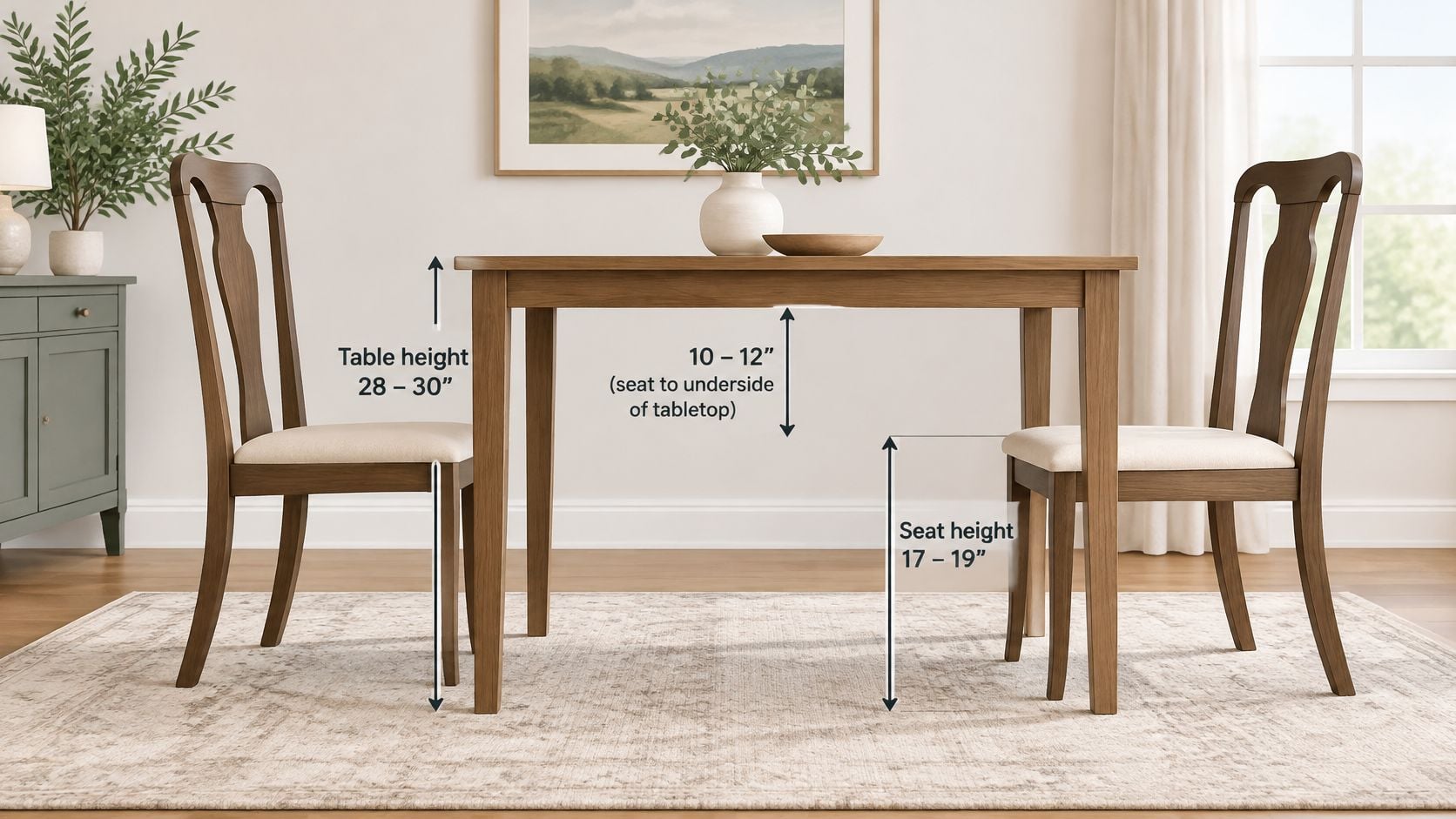
Start with clearance, then choose the look. Willis Furniture's dining-chair guidance describes typical seats around 17–19 inches high paired with tables around 28–30 inches, and recommends roughly 10–12 inches between the seat top and the underside of the tabletop.
Those ranges aren't a substitute for measuring the actual table. A low apron, decorative bracket, or thick upholstered seat can reduce usable space, so record the lowest obstruction rather than relying only on overall table height.
Three rooms, three sensible approaches
In a formal Crown Point dining room, pierced splats in a walnut-toned stain can complement a substantial table without creating an entirely solid wall of chair backs. Side chairs keep the long edges accessible, while armchairs at the heads work when their arms and overall width fit comfortably.
For a farmhouse kitchen in St. John or Schererville, consider wheelbacks or plain central splats around a solid-wood table. A natural finish emphasizes grain; a painted chair can create contrast with a wood tabletop. Repeating a finish elsewhere in the room makes the combination feel deliberate rather than assembled by accident.
In a transitional room, a restrained splat and an upholstered seat can soften the dining area without adding another heavily upholstered silhouette. Leather or performance fabric may work well near a Bassett upholstered piece, provided the colors and textures complement rather than compete. Take fabric and finish samples into the room's actual light.
Plan for people, not just place settings
Chair count should come from usable table length and the chairs' widest points. Include arms, flared front legs, and the space needed to enter the seat. A chair that tucks under neatly may still be awkward when someone tries to sit between neighboring diners.
- Check the pulled-out position: Allow a person to sit and another to pass without squeezing against a wall.
- Map the table base: Pedestal feet and corner legs can interfere with otherwise sensible chair spacing.
- Use benches selectively: A bench can suit flexible seating, but it isn't a substitute for a supportive back when a diner needs one.
Groen's guide to table shapes and seating arrangements can help turn those measurements into a workable layout. A coordinated table and chair combination should make gathering easier, not merely look complete when nobody's seated.
Joinery Finishes and Upholstered Seat Rules
Sunday dinners put a chair's connections to work. The important question isn't just whether the frame is wood, but how its parts stay connected when someone shifts, leans, or moves the chair.
A numerical study published in BioResources found that increasing tenon length or width improved joint strength and stiffness, with length contributing more to moment resistance and width contributing more to stiffness; rectangular-end joints were approximately 15% stronger than the other tested configurations. That finding concerns tested joint designs, not a blanket strength rating for any finished chair.
Check the connection, not just the label
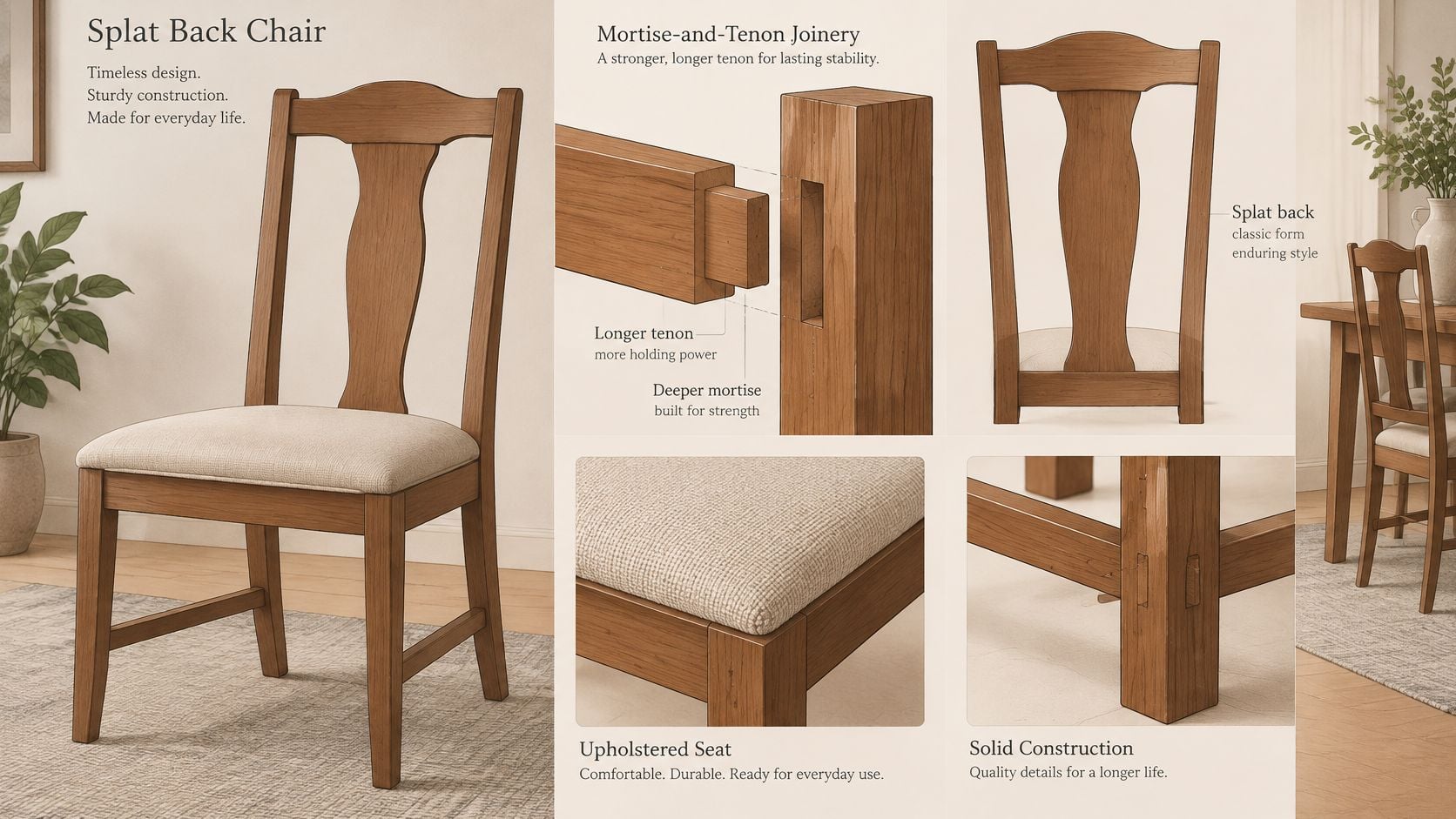
A mortise-and-tenon joint fits a projecting wooden tongue into a matching pocket. Groen's explanation of mortise-and-tenon construction makes that connection easier to recognize.
Inspect the leg-to-rail connections and where the splat meets the surrounding frame. Look for gaps, movement, mismatched repairs, and joints hidden beneath decorative additions. A glued-on ornament doesn't establish that the underlying frame is serviceable.
Solid hardwood offers repair and refinishing possibilities, but the finish, damage, and construction determine what's practical. Request information about touch-up products and replacement seat components before treating a chair as a long-term purchase.
For painted furniture, sheen affects the appearance of repairs and surface imperfections. Neasden Hardware's paint finish advice for UK home improvers offers useful background on satin and gloss, though furniture work still needs a coating compatible with the existing topcoat.
Verify upholstered-seat compliance and sourcing
Wood seats, removable wooden seat assemblies, leather, and performance fabric involve different care decisions. For upholstery, there's also a concrete compliance check.
The U.S. Consumer Product Safety Commission's upholstered-furniture guidance states that covered furniture manufactured, imported, or reupholstered in the United States on or after June 25, 2021, falls under 16 C.F.R. part 1640, incorporating California Technical Bulletin 117-2013, and must carry a permanent compliance label. The testing covers applicable fabric, filling, barrier, and decking components; an entirely wooden chair generally falls outside that upholstered-furniture definition.
For sustainability claims, request documented wood sourcing, such as applicable FSC or PEFC chain-of-custody information. A 2025 Boston Consulting Group survey of European consumers, cited by imm cologne, found 52% considered sustainability when purchasing furniture and 95.5% considered durability important or very important.
A useful buying question: What can be repaired, replaced, or touched up, and what documentation supports the material claims?
Pros and Cons of Splat Back Dining Chairs
The strongest reason to choose a splat back is the balance between a defined center and an open surrounding frame. The strongest reason to pass is a mismatch between that shape and the people who'll use it.
Weigh the everyday trade-offs
| Advantage | Trade-off |
|---|---|
| A recognizable traditional focal point | Ornate shaping can compete with a clean-lined modern room |
| Open areas around the center panel | Pierced details take more effort to dust |
| An exposed frame that can be inspected | Visible wood doesn't establish sound construction |
| A choice of wood or upholstered seats | Upholstery introduces additional care and compliance considerations |
| A composed, upright dining appearance | The chair may feel less suited to relaxed lounging |
A plain central panel generally presents fewer dust-catching corners than elaborate openwork. For a busy breakfast area, that difference may matter more than another layer of carving. A soft brush can reach pierced details, but the household has to be willing to give them that attention.
A tall crest also deserves a room-level check. It can interrupt sightlines across an open kitchen or look crowded beneath a visually low light fixture, even when the seat fits the table.
Choose according to the actual routine
- Favor a splat back when traditional character, an upright meal posture, and an inspectable frame suit the household.
- Consider a simpler back when easy cleaning and an uncluttered silhouette carry more weight.
- Compare a more enveloping chair when diners regularly stay at the table for extended conversation and prefer broader contact across the back.
For a household that hosts occasionally but eats daily in the kitchen, the practical chair may be a restrained splat rather than the most elaborate design. The right decision accounts for routine use, not only the holiday table.
How to Order and Care for Splat Back Dining Chairs
A sensible order starts with the room and ends with the details that make ownership easier. Photos, measurements, and a clear budget help keep attractive options from distracting from the household's needs.
A practical buying path
Measure the setting. Record table height, the lowest apron clearance, and walking space with a chair pulled out. Photograph any base or leg that could obstruct seating.
Set a budget before comparing finishes. In 2025, 1stDibs reported an average selling price of $3,867 for splat-back chairs, with listed prices from $403 to $12,640. That marketplace snapshot isn't a local retail quote, so compare the actual chair, condition, construction, and set quantity.
Arrange a seated trial. Include the family member whose fit or mobility needs are hardest to accommodate. Let that person settle into a normal eating position rather than posing briefly on the seat edge.
Inspect the frame. Look beneath the seat, examine stretchers, and listen for clicking during normal movement. Don't accept unexplained flex when the finish looks flawless.
Choose the material and seat together. Consider the wood species, finish maintenance, and whether the occupied seat remains suitably firm. Request a written specification rather than relying on a display photograph.
Verify upholstery documentation. For a covered upholstered model, confirm the permanent compliance label before completing the purchase.
Use custom ordering for a specific problem. A different stain, back shape, or dimension should solve a real mismatch. Confirm available modifications on the chosen model, because made-to-order doesn't mean every feature can change.
Review the full purchase arrangement. Discuss payment options, delivery access, assembly, and placement before ordering. Any financing decision should account for its approval requirements and full terms.
Keep care simple and consistent
- Dust gently: Use a soft cloth and a soft brush for openwork.
- Handle spills promptly: Wipe moisture away and dry the surface; don't leave wet cloths on the seat.
- Protect the topcoat: Keep hot dishes off chairs and use only compatible care products.
- Address movement early: Tighten serviceable fasteners appropriately, but have loose glued joints repaired rather than forcing screws into them.
- Separate cleaning products: Leather cleaner belongs on suitable leather, not wood polish.
- Reduce environmental stress: Avoid standing water and prolonged harsh sunlight.
Floor protection belongs on the care list too. Flacks Flooring explains practical ways to protect hardwood floors from chair scratches, including attention to the contact points beneath chair legs.
Groen's wood furniture care guide offers further guidance for maintaining finished wood without turning routine cleaning into unnecessary refinishing.
Test Drive a Chair in Dyer or Crown Point
A chair can look right beside the table and still be difficult for an older family member to get in and out of. At a showroom, sit down and stand up as you would at home. Notice whether the seat feels steady and whether the back supports you without pressing uncomfortably.
Groen's Fine Furniture has served Northwest Indiana since 1983, with showrooms in Dyer and Crown Point. Our family-owned team welcomes shoppers from Munster, St. John, Schererville, and surrounding communities.
Bring the information that makes a visit useful
You don't need a finished room plan. A few practical details can help you judge whether a chair will fit your table and suit the people who use it every day.
- Bring table measurements: Measure the underside and apron, as well as the table's overall height.
- Bring room photographs: Show the flooring, nearby upholstery, lighting, and paths people use to move around the table.
- Include the everyday diners: Ask each person to try sitting and standing, especially anyone with mobility concerns.
- Choose a priority: Easier standing, a lighter-looking profile, simpler care, or a closer finish match can help focus the decision.
At Groen's Fine Furniture, dining offerings include tables, chairs and benches, dining storage, and dining sets. Custom Order Services include Canadel dining, with thousands of combinations of sizes, shapes, and finishes, as well as locally crafted Amish solid wood pieces built to specification. Special financing is available, subject to credit approval, and our premium delivery service helps carry the plan from inspiration to installation.
Choose the chair that earns its place
Before choosing a splat back for its appearance, check how it fits the diners, clears the table, and feels to sit in. Ask about its construction and care, too. Those details matter more to daily use than a decorative shape alone.
Groen's Fine Furniture has five-star reviews and offers a premium delivery service. Visit our Dyer or Crown Point showroom to explore dining options and ask our team about custom ordering and special financing, subject to credit approval.