
How to Choose Dining Room Lighting That Works

A dining room can look finished and still feel wrong at the first family meal. The chandelier may be beautiful in a showroom, yet glare across the tabletop, leave the table ends dim, or make homework and cleanup harder than they should be. For homeowners in Dyer, Crown Point, and throughout Northwest Indiana, the answer usually isn't a more dramatic fixture. It's a lighting plan built around the table, the furniture, and the way the room changes from morning through evening.
The most reliable approach combines fixture scale, layered illumination, warm color, glare control, and dimming. That approach also makes furniture decisions easier. A solid wood Amish table, a custom Canadel dining set, or a styled Bassett arrangement deserves lighting that shows its finish without turning the room into a spotlight.
Start With How the Room Actually Gets Used
A fixture can look perfect online and disappoint the moment people sit beneath it. Exposed bulbs may shine into guests' eyes, a narrow shade may leave the table ends dark, and a fixed bright setting may feel excessive for a quiet Tuesday meal. Dining rooms in NWI often serve several roles, from family dinners and holiday gatherings to homework, crafts, board games, and cleanup.
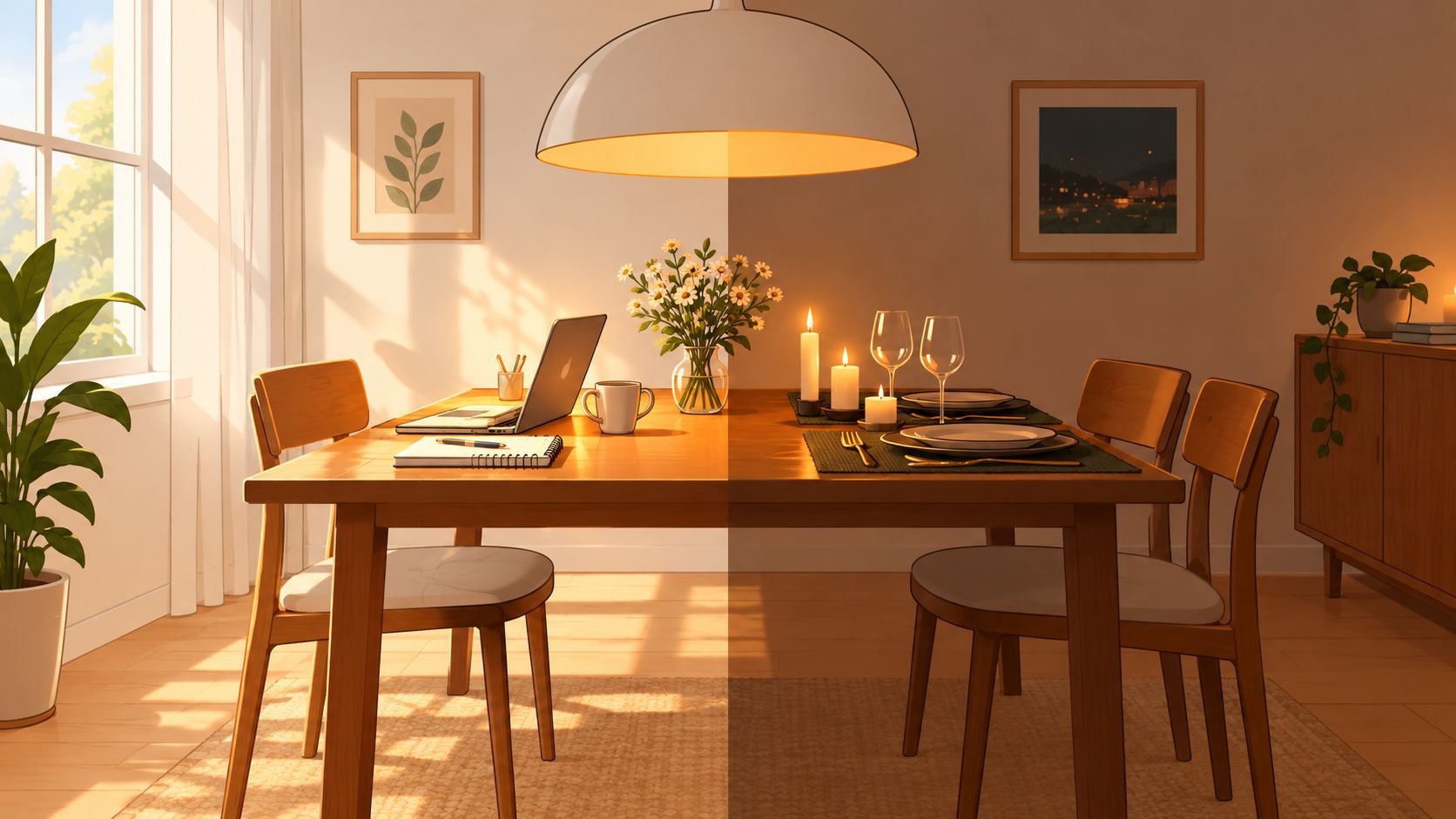
Start with the table's daily jobs
Formal dining and everyday dining need different light levels. Residential guidance cited by the Illuminating Engineering Society lists formal dining at approximately 5 footcandles for general illumination and 2 footcandles for supplemental lighting, while informal dining is listed at approximately 10 and 4 footcandles. Since one footcandle equals about 10.76 lux, those levels correspond roughly to 54 and 22 lux for formal dining, or 108 and 43 lux for informal dining.
That distinction matters in a Northwest Indiana home. A formal room used mainly for meals can feel comfortable at a lower setting, while an everyday table needs more visibility for reading, schoolwork, crafts, and serving food. A dimmer lets the same fixture support both situations instead of forcing one brightness level all day.
Build around comfort, not decoration
Direct light can produce considerable glare, even when it uses energy efficiently. A shade, diffuser, or shielded bulb usually works better than a clear high-output bulb aimed toward seated eye level. Glossy tabletops also reflect bright points, so the fixture needs even distribution rather than one concentrated beam.
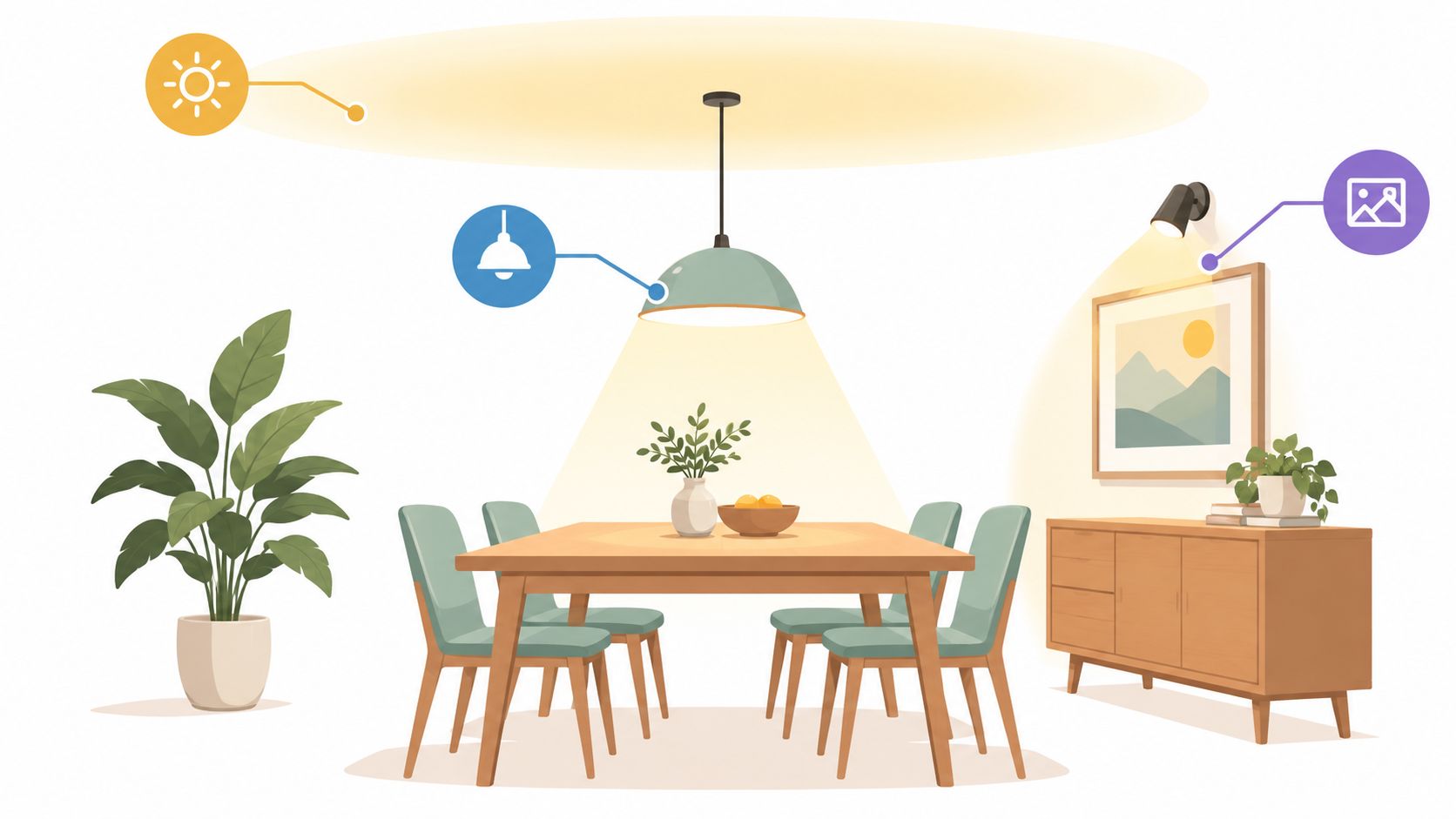
Three layers create the dependable solution:
- Ambient light fills the room.
- Table light supports meals and activities.
- Accent light gives depth to artwork, a buffet, or built-ins.
A room also benefits from small finishing details. Soft dinner candles from Shivora Candles can add warmth during entertaining without asking the ceiling fixture to provide every visual effect. Homeowners planning the whole room can also use this dining-room design guide to coordinate the table, chairs, storage, and lighting before ordering.
The Three Layers That Make a Dining Room Feel Right
A single ceiling fixture can illuminate a table, but it rarely makes the whole room feel finished. Ambient, task, and accent lighting each solve a different problem, and the best dining rooms let those layers work independently.
Ambient light sets the room's baseline
Ambient light provides general visibility beyond the tabletop. It may come from ceiling fixtures, wall lighting, or carefully controlled recessed sources. For a family dinner in a room connected to the kitchen, ambient light helps people move safely, see the sideboard, and clear plates without raising the dining fixture to an uncomfortable level.
A bare recessed layout often fails because it lights the floor and walls but gives the table no focal point. The main fixture should still earn its place visually, especially above a well-made dining set.
Task light serves the table
Task lighting focuses on what people do at the table. It should reveal food, faces, place settings, homework, and game pieces without creating a harsh pool of brightness. A pendant or chandelier with diffusion can provide this layer, particularly when paired with a dimmer and a fixture sized to spread light across the entire tabletop.
For example, a family may want stronger output while setting the table, a moderate setting for dinner, and a softer setting while talking after the meal. The fixture works better when those changes happen through control rather than bulb replacement.
Accent light adds depth
Accent lighting highlights the parts of the room that overhead light tends to flatten. A buffet lamp, a wall fixture, or a small light aimed toward artwork can make the dining area feel connected to the rest of the home. Homeowners displaying artwork should review practical gallery lighting advice before positioning accent sources, especially where reflections may affect framed surfaces.
Practical rule: The main fixture should light the table. It shouldn't be forced to light every wall, corner, and decorative object.
Keep accent controls separate where possible. That arrangement allows the table to remain softly lit during conversation while artwork or architectural details continue to give the room shape.
Get the Sizing and Hanging Height Right
Sizing should begin with the table, not the room alone. A room-based formula can provide a useful check, but dining furniture determines the visual scale and the clearances that matter most.
A practical three-stage method works well:
- Measure the tabletop.
- Leave at least 6 inches of clearance from each table edge, which means the fixture should be no more than about 12 inches narrower than the table width.
- Set the fixture bottom approximately 30 to 36 inches above the tabletop.
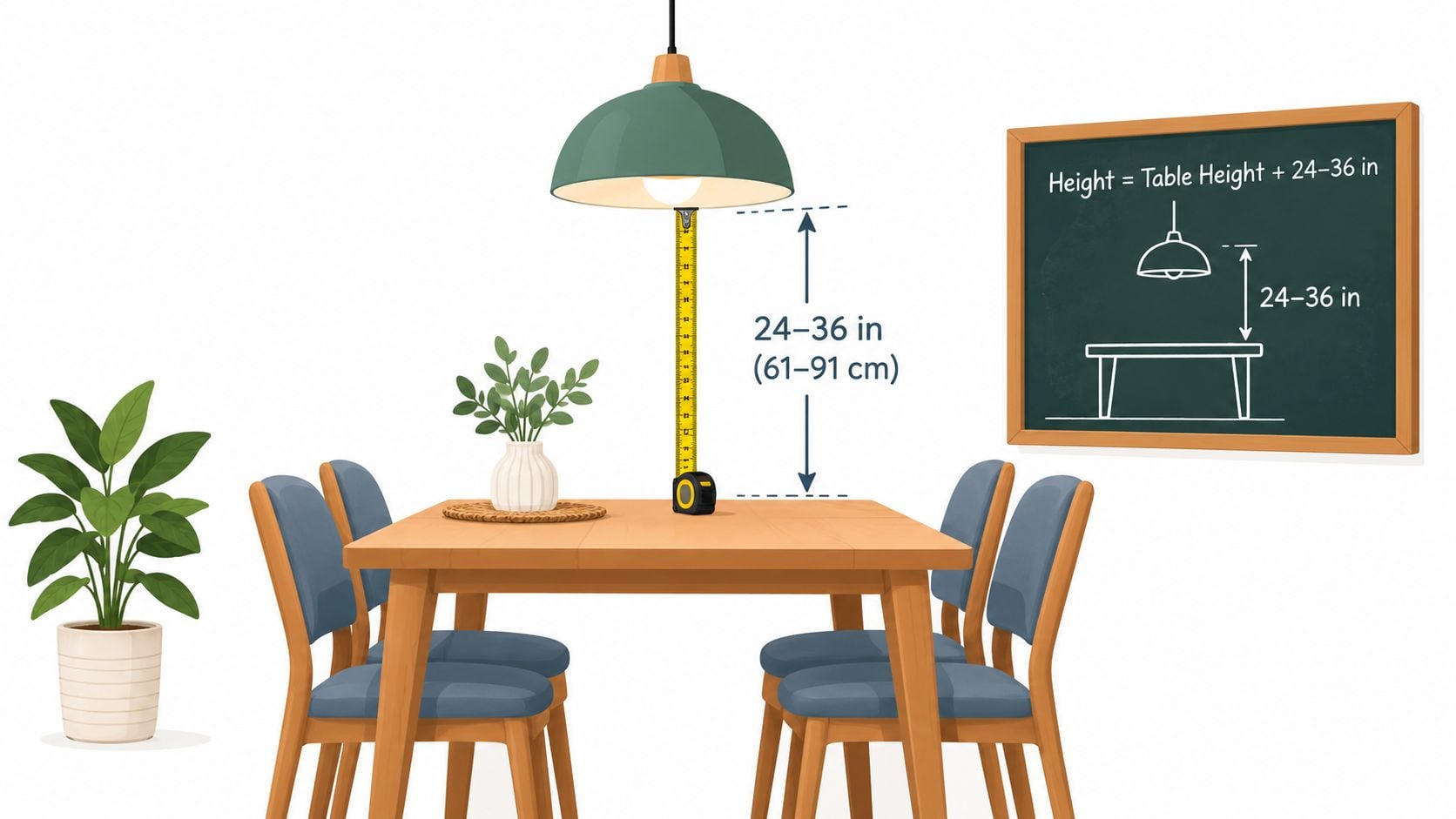
Use both sizing formulas
A second rule adds the room's length and width in feet, then uses that total as the approximate fixture diameter in inches. A 12-by-14-foot room, for example, points toward a chandelier about 26 inches wide. That formula is helpful when the table hasn't been selected, but the table-based measurement should take priority once furniture is known.
For a round or square table, a chandelier usually works well at approximately one-half to two-thirds of the table's width. A linear fixture should generally cover about one-third to two-thirds of the table length, while grouped pendants need enough separation to distribute light evenly.
Quick sizing reference for common tables
| Table Size | Max Fixture Diameter | Hang Height Above Table |
|---|---|---|
| 48-inch-wide table | About 36 inches | 30 to 36 inches |
| 60-inch rectangular table | 30 to 36 inches as a starting range | 30 to 36 inches |
A 48-inch table therefore allows a practical maximum fixture diameter of about 36 inches. A 60-inch rectangular table can support a 30-to-36-inch fixture, depending on the design and whether the fixture is round, linear, or grouped.
Multiple pendants should be spaced roughly 18 to 30 inches apart, depending on fixture size. Homeowners comparing ceiling height, table length, and sightlines can use this dining table size guide before visiting a showroom. For installation planning, practical lighting height advice from Golden Lighting offers another useful reference.
The final test is visual. Sit at the table and look toward the opposite chair. If the shade blocks conversation, the bulb is glaring, or the fixture dominates the tabletop, raise it, diffuse it, or choose a smaller design.
Choosing Between a Chandelier, Linear Pendant, or Grouped Pendants
Fixture type should follow the table's shape and the room's use. Trends matter less than even coverage, comfortable sightlines, and a silhouette that will still make sense when the dining set changes.
A chandelier suits centered, social arrangements
A chandelier is the strongest choice for a round or square table because it concentrates attention at the center. It also works well in a smaller breakfast nook, where one substantial fixture can create a clear dining zone without adding visual clutter.
Open-arm chandeliers can feel lighter above a substantial table, while shaded or glass designs provide more control over glare. A formal room with an Amish solid wood table may benefit from a fixture with enough presence to balance the table's craftsmanship. A delicate design can disappear above a thick trestle base.
A linear pendant follows a long table
A linear pendant makes sense above a long rectangular table because its shape follows the furniture. It can distribute light from end to end without requiring multiple ceiling junctions, which is useful when the table has an extension leaf.
This is often the cleanest choice for a formal dining room or open-concept space. The fixture helps define the dining area while keeping the floor plan visually organized.
Grouped pendants add flexibility
Two or three pendants provide a more modular appearance and can suit a table that changes length. They need careful spacing and consistent visual weight. If the pendants are too small, the arrangement looks scattered. If they're too close together, the light pools overlap and the composition feels crowded.
A Canadel dining set can support a flexible pendant arrangement because its dimensions and finishes are selected together. Homeowners comparing traditional, transitional, and contemporary approaches can also review dining-room style ideas before choosing a fixture.
The deciding question is simple: does the fixture distribute light evenly while leaving faces and conversation unobstructed? If not, the style isn't earning its place.
Dialing In Color Temperature, CRI, and Dimming
Bulb selection determines whether a dining room feels welcoming or clinical. The fixture may be perfectly scaled, but the wrong light source can make food look flat, skin tones appear tired, and wood finishes lose their warmth.
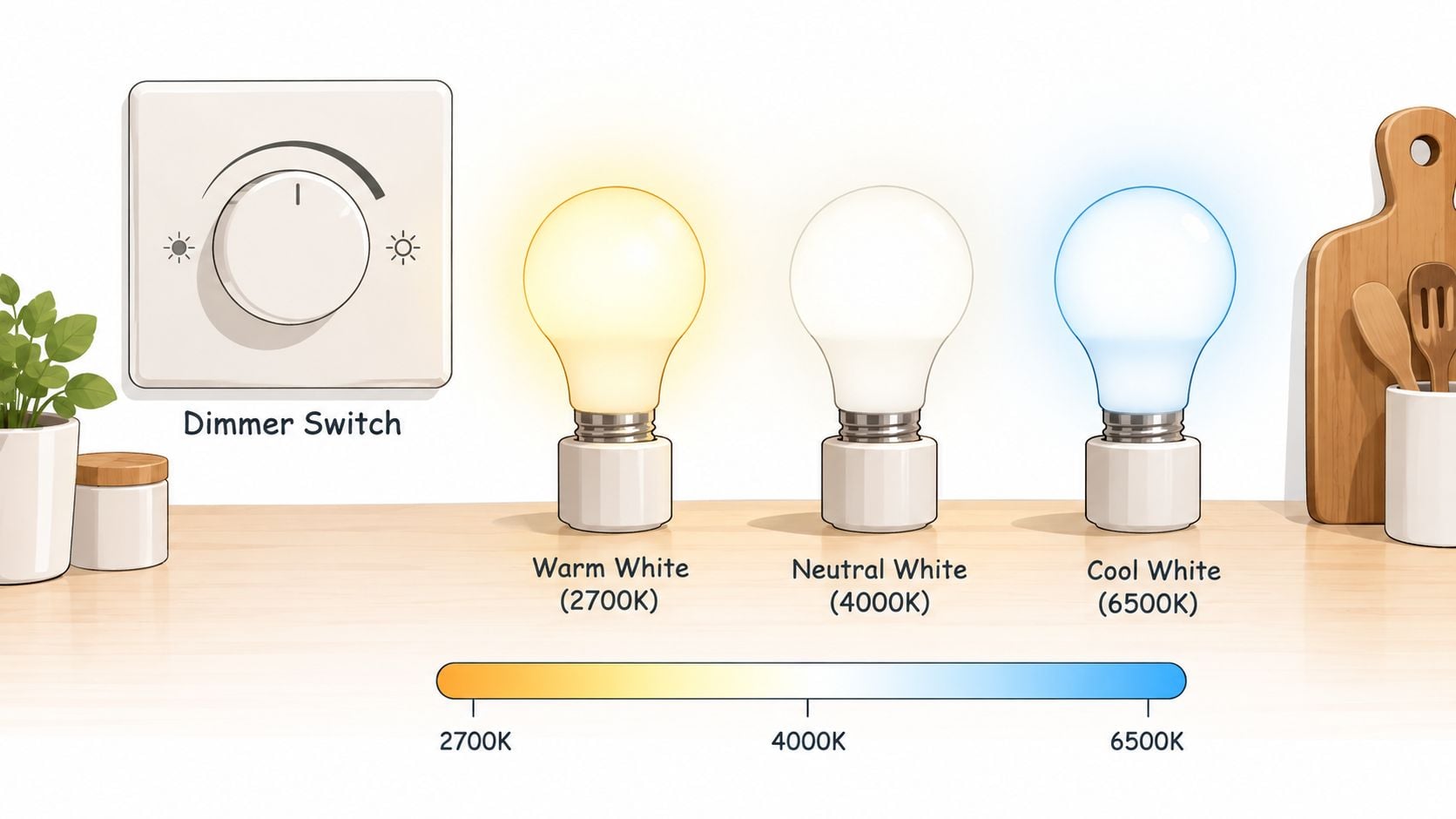
Start with Kelvin
Light temperature is measured in Kelvin. Lower values look warmer and more yellow, while higher values appear cooler, whiter, or bluer. ENERGY STAR's lighting guidance places warm incandescent-like light roughly between 2200K and 3000K, with whiter light around 3500K to 4100K and bluer white around 5000K to 6500K.
For most residential dining rooms, 2700K to 3000K is the comfortable starting range. Warmer, lower-intensity light suits evening meals, while brighter and bluer light can feel more functional during daytime activity. A single permanently bright daytime setting isn't the right answer for dinner.
Check color rendering
Color rendering matters around food, faces, artwork, and wood furniture. A warm bulb can still make a cherry, oak, or walnut table look dull if its color rendering is weak. Shoppers should ask for the fixture's color-rendering information and compare the actual table finish under the bulb rather than judging the sample in isolation.
This is especially important with solid wood furniture. The finish, grain, and surrounding wall color all influence the result.
Test the dimmer before installation
LED adoption is already widespread. The U.S. Energy Information Administration reports that 90% of households used LED bulbs indoors in the latest Residential Energy Consumption Survey, while 63% used mostly LED lighting by 2024. Those figures make compatibility more important than choosing an LED label alone.
A compatible dimmer helps prevent flicker, buzzing, limited dimming range, and premature failure. ENERGY STAR recommends checking dimmer compatibility, and a practical test should include:
- Full output: Check whether the table is bright enough for preparation and cleanup.
- Middle output: Seat people and inspect faces, food, and wood tones.
- Low output: Confirm that the fixture remains steady and comfortable during conversation.
Avoid clear, exposed high-output bulbs at seated eye level. Diffusers, shades, and shielded sources usually create a more forgiving dining environment.
Match the Fixture to the Table and the Room
Lighting and furniture should be selected as one composition. A chandelier that looks balanced above a light, open table may feel undersized over a thick solid wood top, while a large metal fixture can overwhelm a refined custom dining set.
Warm bulbs generally flatter cherry, oak, and walnut because they support the natural warmth of those finishes. The fixture should also respect the table's base. A heavy trestle table needs visual weight overhead, while a slender pedestal or glass-topped arrangement may call for a lighter silhouette.
Let the furniture guide the scale
An Amish solid wood table brings visible craftsmanship and substantial material to the room. Its lighting should reveal the grain and preserve clear sightlines across the tabletop. Canadel dining allows a more customised approach, with a made-to-order combination of sizes, shapes, finishes, and chairs that can be matched to the fixture from the beginning.
Bassett can suit homeowners who want a more styled look, while Flexsteel is associated with durability in other parts of the home. The same buying principle applies across the room: select pieces for how the household lives, not just for how a staged photo looks.
Homeowners comparing table proportions, chair scale, and finish can use this guide on how to pick the right dining-room table before finalizing the light.
Choose the table and lighting together
A showroom visit makes this decision more reliable because the fixture can be viewed beside real furniture rather than against a blank screen. The team at Groen's Fine Furniture can show dining furniture, decorative lighting, and custom-order possibilities in the same conversation. Customers don't have to settle for a mismatched set. They can design it their way through custom Canadel dining or specify solid wood Amish furniture made to order.
Protect the furniture with sensible placement and control. Keep the fixture centered over the table, reduce glare on glossy surfaces, and use daylight when available instead of leaving electric lighting at full output from morning through evening.
Shop, Install, and Live With Your New Lighting
A successful lighting purchase starts with useful information. Before visiting a showroom in Dyer or Crown Point, homeowners should bring room measurements, table dimensions, ceiling height, a photo of the dining area, and a short description of how the room changes from noon to dinner.
Bring the right questions
The fixture should be evaluated as a working part of the room. Ask whether it supports a compatible dimmer, whether bulbs are replaceable, and whether the package includes enough chain or downrod for the ceiling height. Integrated fixtures deserve extra scrutiny because replacing the light source may require replacing the entire fixture.
A simple showroom checklist keeps the decision practical:
- Confirm the scale: Compare the fixture with the actual table dimensions.
- Check the sightline: View it from seated eye level.
- Test the light quality: Compare food, faces, and wood finishes under the source.
- Verify controls: Ask about dimmer compatibility and smart-home operation.
- Plan installation: Confirm how the fixture will be delivered, assembled, and positioned.
- Set two scenes: Decide how the room should feel at midday and during dinner.
Homeowners should also ask about White-Glove Delivery, especially when the dining set includes solid wood pieces or a larger fixture. Groen's delivery and assembly information is available through its furniture delivery and assembly service.
Make the project fit the household
Lighting is easier to choose when the table, chairs, fixture, and room accessories are evaluated together. Custom Furniture services can support a bespoke result, while Special Financing, subject to credit approval, can provide buying power when the household wants to fit a complete dining project into its budget. The important question isn't only what looks good today. It is whether the room will remain comfortable for ordinary meals, celebrations, homework, and the gatherings that make a home feel lived in.
Groen's multigenerational ownership and 5-star service reflect a local legacy serving Northwest Indiana, including St. John, Schererville, and Munster. A visit gives families the chance to compare materials, test the visual scale, and make a decision with personal guidance instead of guessing from a screen.
Visit Groen's Fine Furniture in Dyer or Crown Point to compare dining tables, decorative lighting, Canadel custom options, and Amish solid wood furniture in person. Ask about Special Financing, subject to credit approval, and let the family team help create a comfortable dining room with lasting proportions, warm light, and honest guidance.