Home Office Furniture L Shaped: 2026 Buyer’s Guide

A home office can start as the spare bedroom in Dyer, a corner of a family room in Crown Point, or a quiet wall in a St. John townhouse. Then the laptop gains a monitor, paperwork begins to collect, and the chair starts blocking the door. Home office furniture with an L-shaped layout can solve that pressure, but only when the shape serves the room and the person using it.
For Northwest Indiana homeowners, the smartest purchase isn't automatically the largest corner desk. A fixed L can improve task separation and storage, yet it can also restrict chair movement, interfere with a guest bed, or leave the primary monitor stranded in the corner. A smaller rectangular desk with a movable return may work better in a multipurpose room. The right choice depends on workflow, clearances, craftsmanship, and the ability to adapt later.
Designing a Functional L-Shaped Workspace
In many NWI homes, the office has to do more than support remote work. It may also hold school supplies, household paperwork, a printer, or a visiting family member's luggage. An L-shaped workstation becomes useful when each run receives a clear job instead of becoming one oversized surface.
Consider a homeowner who works from a bedroom that doubles as a guest room. The long run can face the user and hold the primary monitor, keyboard, and mouse. The return can carry documents or a printer without forcing paperwork beneath the screen. If guests need the room later, however, a deep fixed return may make the bed difficult to access. That homeowner might need a reversible or movable return rather than a permanent corner installation.
Practical rule: The return should follow the work sequence, not simply the longest available wall.
Give each side a purpose
A sensible arrangement usually assigns the longer side to the activity requiring the most concentration. The shorter side can support secondary work, equipment, or occasional collaboration. That division keeps frequently used items in front of the user and limits repeated twisting.
The return's orientation also deserves attention. A right-handed user may prefer writing materials or a telephone on one side, while a left-handed user may prefer the opposite arrangement. Room conditions matter just as much. Windows, outlets, heating vents, door swings, and drawer access can outweigh personal preference when the desk occupies a tight room.
Before purchasing, painter's tape can mark the proposed footprint on the floor. The user should sit in the chair, approach the corner, open nearby drawers, and walk around the marked area. This simple test often reveals whether the desk supports movement or merely fits on paper.
Homeowners planning a detached or garden-based work area can also review this resource on planning a garden office to think through how the workspace relates to the wider property. For interior arrangements, Groen's home office desk setup ideas offer another way to connect desk placement with everyday use.
Measuring Your Space and Ergonomic Needs
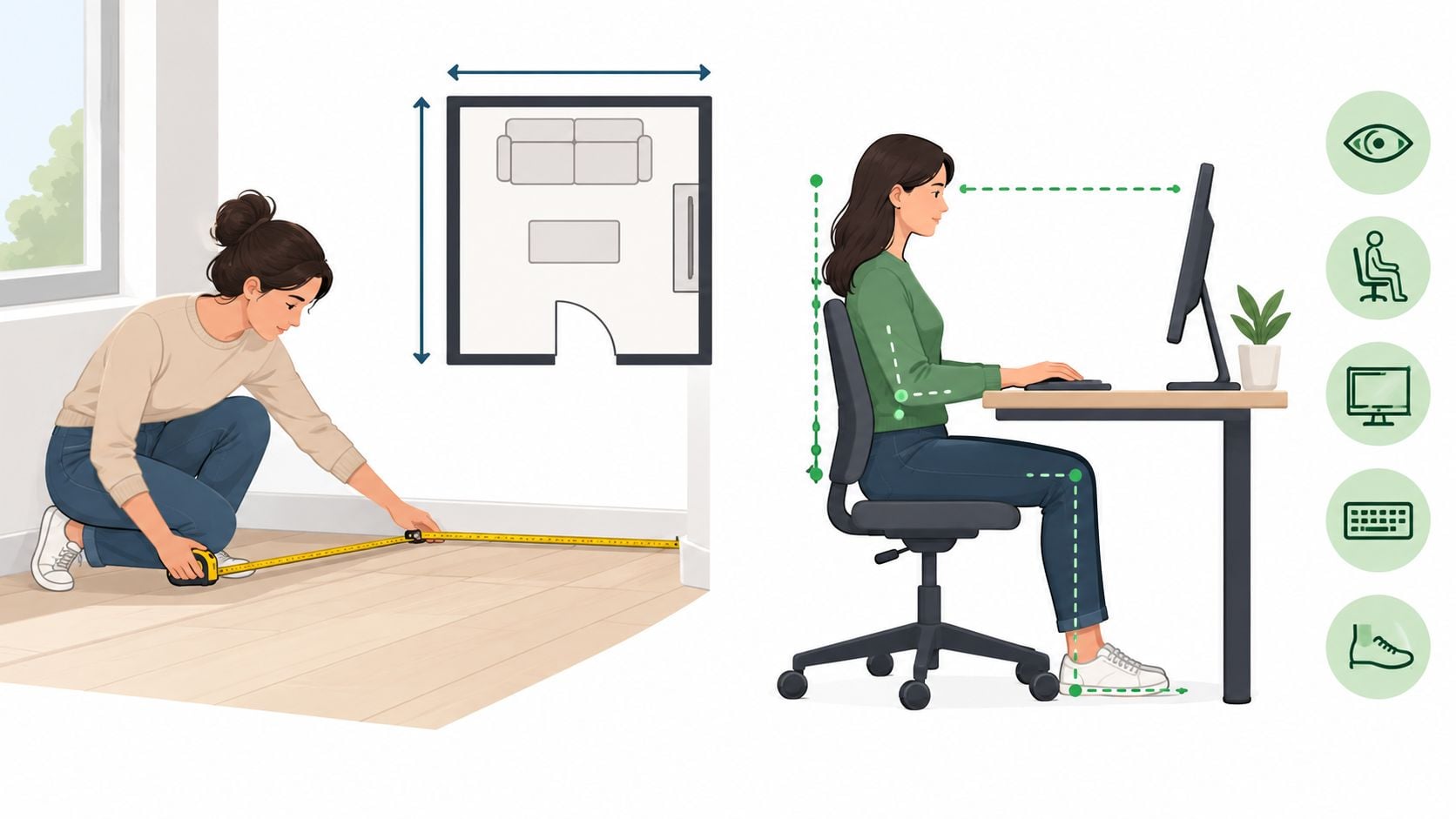
A large desktop doesn't guarantee a comfortable workstation. An L-shaped desk becomes ergonomic only when the surface height, monitor position, chair movement, and leg clearance work together. The National Institutes of Health recommends setting desk height approximately at elbow height for light-duty desk work, keeping the keyboard about 1 to 2 inches above the thighs, and positioning it close enough to prevent excessive reaching. It also recommends forearms approximately parallel to the floor, elbows near a 90-degree angle, a mouse adjacent to and level with the keyboard, and wrists in a neutral position. NIH ergonomic guidance
Measure the room before the furniture
Start with the room rather than the product page. Record wall lengths, door and closet swings, window locations, outlet positions, heating vents, and the clearance needed to pull out the chair. Include the return in the footprint. A desk can fit against two walls and still prevent a person from entering the chair comfortably.
The chair needs room to approach both work surfaces. Check whether a pedestal, center support, modesty panel, or cable tray blocks the knees. OSHA purchasing guidance lists 17.6 inches of minimum knee-depth clearance, 24 inches of foot-depth clearance, and approximately 20.8 inches of knee-width clearance beneath a workstation. OSHA purchasing guidance
Position the primary station first
The long run should generally hold the primary monitor and keyboard. Reserve at least 20 inches between the user and the monitor, place the display directly in front of the seated user, and keep its top at or slightly below eye level. OSHA desk guidance OSHA identifies a preferred viewing distance of approximately 20 to 40 inches, measured from the eyes to the front of the screen, and advises keeping monitors within 35 degrees to either side of the user. OSHA monitor guidance
That makes the inside corner a poor default location for the main screen. The corner may look space-efficient, but it can turn the torso and neck away from the keyboard. A monitor arm can help place the screen directly in front of the user while preserving surface area on the return.
Lighting belongs in the measuring process. A primary screen should sit approximately perpendicular to windows or strong light sources, rather than directly facing a window or sitting beneath a bright fixture. Oregon OSHA guidance gives roughly 20 to 50 lumens per square foot for screen viewing and 50 to 70 lumens per square foot for reading printed documents, with 40% to 60% relative humidity as a comfort benchmark. Oregon OSHA lighting guidance Readers concerned about prolonged screen use can also explore practical information about glasses for long screen time.
For room planning, Groen's guide to measuring furniture helps homeowners account for access paths, not just the final wall position. The actual chair and user should still be tested in the proposed corner before a made-to-order piece is approved.
Comparing Materials and Build Quality
The visible footprint gets most of the attention, but the construction determines how the desk feels after years of daily use. An L-shaped work surface carries monitors, lamps, paperwork, charging equipment, and sometimes a printer. A thin panel with weak joints may look acceptable at delivery and become less convincing as the workstation grows.
Compare construction, not just finish
Mass-produced panel furniture can offer predictable dimensions and quick availability. It may suit a temporary office or a light-duty setup, but buyers should inspect edge treatment, hardware, support points, and the way the corner joins. Particle board and thin laminates can be serviceable in the right application, yet they don't provide the same repair and refinishing possibilities as well-built solid wood.
Amish Furniture offers a different proposition. Solid wood construction, careful joinery, and made-to-order dimensions can create a desk intended to remain useful through several household changes. The trade-off is that custom work requires more planning, and natural wood includes variation in grain and color. That variation is part of the material rather than a manufacturing flaw.
Groen's Fine Furniture also carries office pieces such as an executive L-shaped desk made with mindi veneers and solids, wire management, and antique brass hardware. The important question isn't whether a desk has decorative details. It is whether the materials, support structure, finish, and storage match the way the desk will be used.
Match the material to the room
Finish should support the home's existing character. A warmer wood tone may suit a farmhouse-inspired room, while a restrained finish can work in a contemporary office. A desk should also relate to nearby furniture instead of creating a disconnected visual block.
For shoppers comparing brands, Flexsteel is associated with durability, while Bassett offers a broad style vocabulary for coordinated interiors. Those names don't replace an in-person inspection. The buyer still needs to check surface depth, edge comfort, drawer operation, cable routing, and the stability of the corner.
A useful material review should answer practical questions:
- Repairability: Can a damaged component be replaced or refinished?
- Hardware: Are hinges, drawer slides, and fasteners sturdy enough for repeated use?
- Adaptability: Can the return orientation or storage arrangement change?
- Finish: Will the surface tolerate the household's normal writing, equipment, and cleaning habits?
Groen's guide to choosing hardwood for longevity and style helps homeowners evaluate wood beyond color. A sustainable purchase isn't automatically one labeled modular. Components should be separable, replaceable, and serviceable rather than proprietary pieces that require complete replacement.
Optimizing Storage and Cable Management
An L-shaped desk creates more surface area, but unmanaged space quickly becomes visual clutter. The best arrangement treats storage and cabling as part of the ergonomic design. A printer that occupies the primary keyboard zone is still a problem, even if the desk has room for it somewhere else.
The long run should remain the main monitor-and-keyboard station. The return can hold documents, a printer, a second display, or a charging area. Frequently used items belong in front of the user or within easy reach. Repeated side-reaching turns the extra surface into a source of unnecessary movement rather than a workflow advantage.
Protect the leg zone
OSHA recommends approximately 20 to 28 inches of vertical clearance beneath a desk for the legs. It also advises keeping the keyboard and pointing device easy to reach and adjusting the chair so the feet and back remain supported. OSHA chair guidance
That clearance must continue beneath both runs. A drawer pedestal may provide convenient storage but can prevent the chair from moving between the main station and the return. A center support may strengthen the desk while blocking the user's knees. A cable tray may keep wires off the floor but still occupy valuable leg space if placed carelessly.
Route cables for today and later
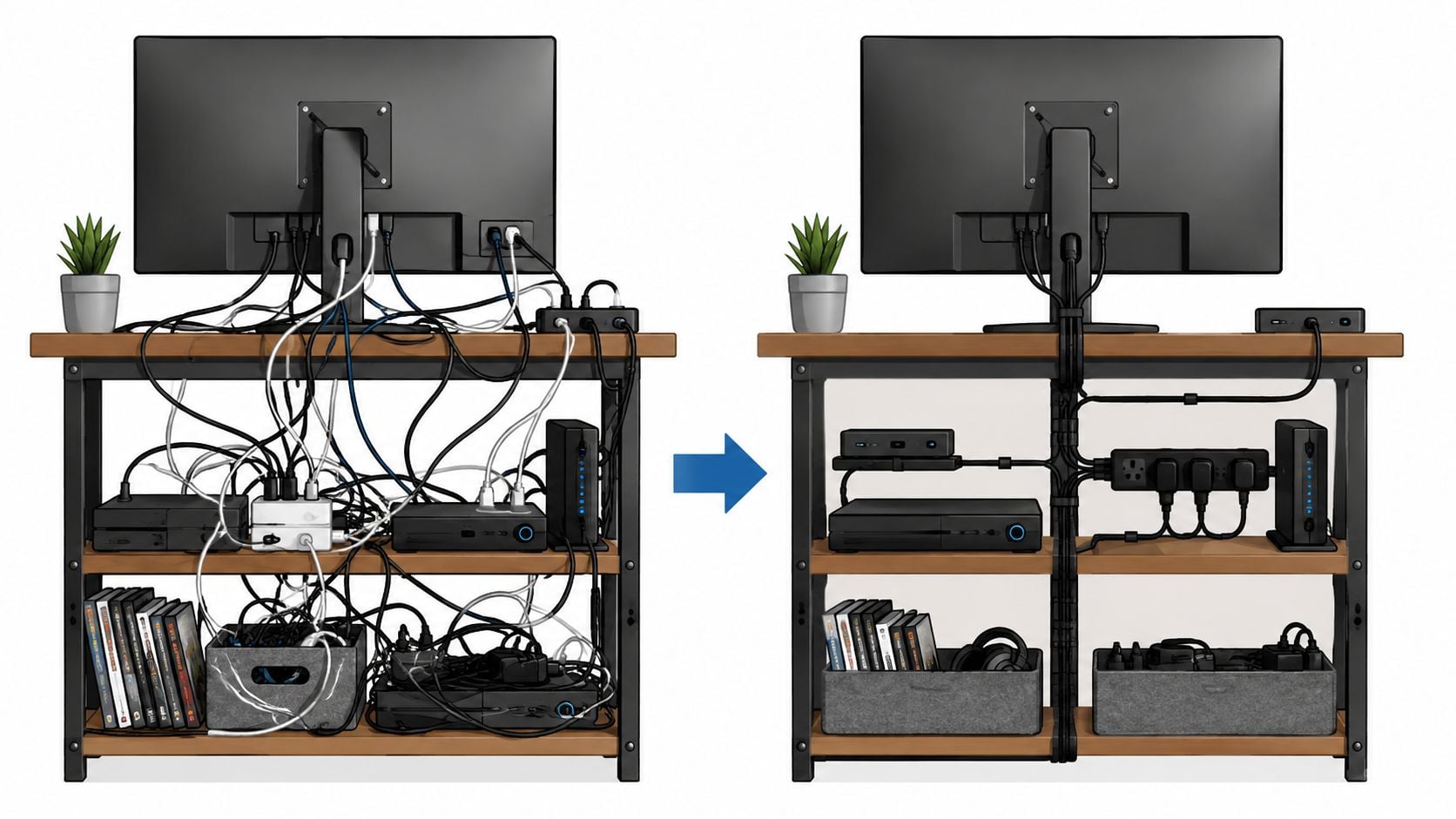
Cables should follow the desk's structure without crossing the user's legs or becoming tight when equipment moves. Separate power cords from peripheral cables where practical, bundle only what needs to travel together, and leave access to the outlet and power strip. A removable raceway or under-surface channel can make future equipment changes less frustrating than permanently fixed clips.
Hidden compartments can keep chargers, notebooks, and small accessories out of sight while preserving access. A desk with hidden compartments can be useful when the office shares space with family activities and the work surface needs to clear quickly.
Energy-conscious households may also appreciate PureHQ's efficiency guide when reviewing how office equipment, lighting, and standby power fit into broader home routines. The furniture decision remains physical, but the setup works better when the technology is organized and easy to switch off.
Customizing Your Office Solution
A fixed L-shaped desk makes sense when the room, workflow, and future use are stable. Many homes don't have that certainty. A homeowner may move from one monitor to several, convert an office into a nursery, add a homework station, or relocate the desk after a renovation. That uncertainty makes custom configuration more valuable than just choosing the largest available model.
Groen's Fine Furniture offers a route for homeowners who want to customize home office furniture around the room rather than forcing the room around a standard footprint. A made-to-order conversation can address desk depth, return orientation, wood finish, cable routing, storage, and the amount of open legroom beneath each surface.
Design it your way
Custom ordering works best when the household identifies its top priorities first:
- Primary work zone: Decide where the user will sit and which display must remain directly ahead.
- Secondary tasks: Assign the return to paperwork, printing, a second display, or occasional collaboration.
- Future change: Consider whether the return should be reversible, movable, or built as a separate component.
- Service details: Ask whether hardware, finish, or high-wear parts can be replaced or repaired later.
This approach supports bespoke furniture without confusing customization with unlimited complexity. A simpler desk with a movable return may provide more long-term value than a one-piece L that cannot leave the room when the household's needs change.
Make quality fit the budget
Furniture is a significant household purchase, so buying power matters. Groen's offers Special Financing, subject to credit approval, which can help a family fit a carefully chosen office solution into its budget while avoiding a rushed decision based only on the lowest initial price.
The same custom philosophy extends across the home. Canadel's made-to-order dining program supports personalized sizes, shapes, and finishes, while Amish solid wood furniture emphasizes craftsmanship and longevity. Those services reflect a broader principle: homeowners don't have to settle for furniture that almost fits when dimensions, materials, and finish can be discussed before the order is placed.
Visiting Our Showrooms in Dyer or Crown Point
Photos can't show how a chair approaches the corner, how a drawer feels in use, or whether the desk edge sits comfortably against the forearm. A showroom visit lets homeowners test the actual proportions before committing to a permanent arrangement.
Start with the room's measurements and a short list of tasks. Bring the monitor dimensions, preferred return side, outlet locations, and any concerns about a guest room or shared office. At a Dyer or Crown Point showroom, the team can help compare standard and custom configurations, discuss solid wood and finish options, and review wire management without treating the desk as an isolated purchase.
Groen's Fine Furniture has served Northwest Indiana since 1983 as a family-owned business with multigenerational ownership and a focus on 5-star service. Homeowners from Dyer, Crown Point, St. John, Schererville, and Munster can also ask about White-Glove Delivery, Interior Design support, American-Made options, and coordinated pieces for other rooms. The store's broader collection includes Flexsteel, Bassett, Amish Furniture, and sleep brands such as Serta and Beautyrest, with a Helpful Mattress Guide available for customers furnishing an entire home.
A test drive should include sitting at the primary station, reaching toward the return, checking leg movement, opening drawers, and imagining the desk after equipment is added. Customers should also ask how custom orders are documented, what delivery includes, and whether future service or refinishing is available.
Visit Groen's Fine Furniture in Dyer or Crown Point to explore custom L-shaped home office furniture, solid wood options, and practical cable-management solutions. Ask about Special Financing, subject to credit approval, and let the family-owned team help test the comfort, plan the configuration, and arrange White-Glove Delivery for a workspace that fits the way the household lives.