
Sofa Set Wood Guide: Frames, Materials and Durability


For homeowners in Dyer and Crown Point, the search often starts with a sofa that looks right, feels comfortable, and promises a wood frame. Then the questions begin: Are the legs the same material as the frame? What's beneath the cushions? Will the set stay sturdy through family movie nights and another Northwest Indiana winter?
A search for sofa set wood should lead to construction answers, not just finish samples. The best purchase isn't necessarily the heaviest sofa or the one with the most exposed timber. It's the set with appropriate materials in each part, well-fitted joints, and a practical path to future repairs.
What a Wood Sofa Set Frame Is Really Made Of
Wood frame doesn't mean solid wood throughout. A sofa can combine hardwood legs, plywood cross members, fiberboard panels, metal mechanisms, foam, and upholstery. Those materials serve different jobs, so the useful question is where each material sits.
The Food and Agriculture Organization's furniture-market report distinguishes primary forest products, processed wood, and finished wooden furniture. That distinction matters at the showroom level: a finished furniture label doesn't describe every component beneath the fabric.
Frame parts and their typical materials
| Frame part | Typical material | Why it is used | What to ask |
|---|---|---|---|
| Visible legs and front rails | Solid hardwood | Carries daily load and shows the finish | Which species and how the leg joins the rail |
| Seat deck and cross members | Plywood or kiln-dried hardwood | Holds its shape under weight | How many plies and what glue is used |
| Side and back panels | Plywood or MDF | Stable in concealed areas | Which panel type and its emission rating |
| Support boards under cushions | Particleboard | Low cost and concealed | Whether it meets composite-wood emission standards |
| Cushions, upholstery and foam | Foam, polyester fiber and performance fabric | Comfort and easy cleaning | Foam density and fabric rating |
These are common material assignments, not a universal recipe. A structural plywood component deserves a different assessment from a thin panel used only to close the back.
Documentation beats a broad label
Buyers should request a component description rather than accept hardwood construction as a complete answer. For anyone interested in how manufacturers document timber sourcing, the SIX ERP timber traceability guide provides useful context for asking about material records.
Judge the part, not the label. Attractive legs say little about the concealed seat frame, and comfortable cushions don't prove that the joints underneath are sound.
How Solid Wood Frames Are Joined and Built
A sofa frame works like a house skeleton: the members carry weight, and the connections transfer that weight safely. Strong timber can't compensate for a loose connection between the seat rail and the leg.
The construction sequence below helps identify the connections worth examining beneath the upholstery.
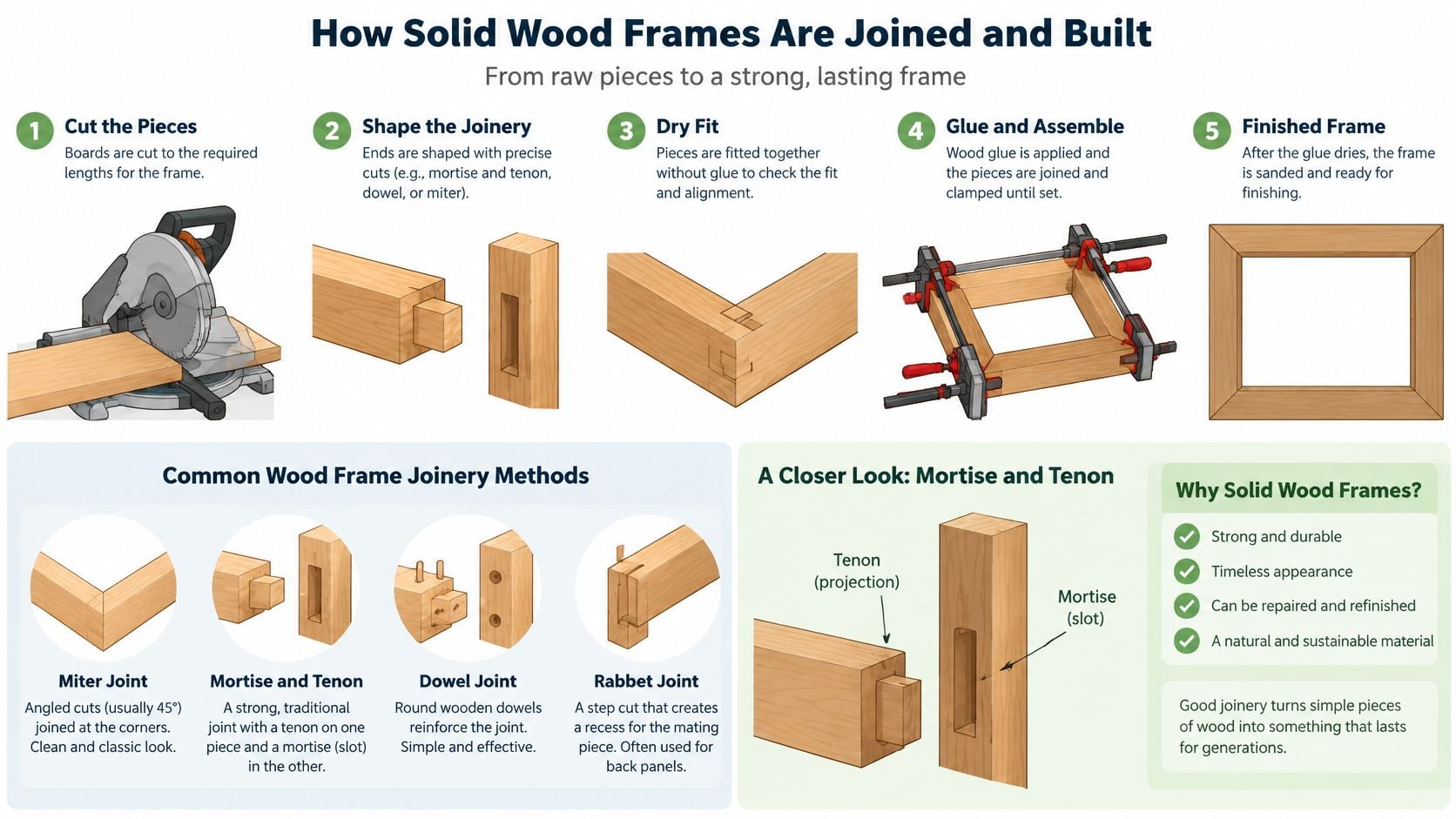
Follow the load through the frame
Weight begins at the cushions and support system, passes into the seat rails, and travels through the legs to the floor. Each connection needs enough bearing surface and restraint to resist both downward pressure and sideways movement.
A mortise-and-tenon joint places a shaped projection inside a matching pocket. Its fitted surfaces help connect rails and legs without relying solely on a fastener driven into end grain. Groen's explanation of mortise-and-tenon joinery gives buyers a closer look at that connection.
Dowels can also produce dependable joints when their holes align accurately and the surrounding wood provides adequate support. A poorly aligned dowel joint, however, doesn't become good construction because the manufacturer adds more adhesive.
At seat-platform corners, fitted blocks can brace adjoining rails. Glue and screws work together here, but the block should contact the members cleanly. Screws need suitable pilot holes, sound wood, and enough purchase to hold without splitting the component.
Construction check: A joint should fit before adhesive fills the connection. Thick glue deposits aren't a substitute for accurate machining.
Separate the frame from the seat support
A webbed or sprung seat support spans the frame and influences how the sofa feels. Solid cross members reinforce the assembly, while a layered plywood deck offers a different, generally firmer foundation. None of those descriptions alone establishes quality; attachment, span, and reinforcement matter.
Kiln-dried stock is a sensible starting point, but it isn't a finished construction specification. Buyers still need to know how the pieces connect and whether concentrated loads receive proper support.
A practical showroom inspection includes:
- Press each corner firmly. Unexplained rocking or racking deserves investigation, not dismissal as normal softness.
- Look for fitted joints. Accessible connections should meet cleanly rather than disappear beneath excess filler.
- Inspect beneath the platform. With staff assistance, examine reinforcing blocks, brackets, and fasteners without removing protective upholstery.
Wood Species and Frame Stiffness Compared
A wood sofa frame may use different species in different parts. Legs and rails benefit from stiffness and strength, while concealed components can have different requirements. Ask which wood is used for each component, not just which species appears in the product description.
Stiffness and strength of common sofa frame woods. Clear-wood values are from the USDA Forest Service's Wood Handbook.
| Species | Modulus of elasticity | Modulus of rupture | Best use in a sofa |
|---|---|---|---|
| Clear white oak | About 12.27 GPa | About 104.80 MPa | Front legs, rails and seat frame |
| Western white pine | About 10.07 GPa | About 66.88 MPa | Concealed or secondary parts |
| Hard maple | Not tabulated here; confirm the lumber grade with the supplier | Not tabulated here; confirm the lumber grade with the supplier | Legs and rails, subject to grade |
| Red oak | Not tabulated here; confirm the lumber grade with the supplier | Not tabulated here; confirm the lumber grade with the supplier | Frame components, subject to grade |
| Poplar | Not tabulated here; confirm the lumber grade with the supplier | Not tabulated here; confirm the lumber grade with the supplier | Concealed parts and panels |
Modulus of elasticity describes resistance to bending. Modulus of rupture describes bending strength at failure. Stiffness concerns how much a member flexes; strength concerns the load it can withstand before breaking.
What the numbers do and do not show
The listed clear white oak values are higher than those for western white pine. That comparison can help when considering materials for heavily loaded rails and legs, but it does not establish the capacity of a finished sofa. The figures describe clear wood, not every board sold under the same species name.
Knots, grain direction, member dimensions, and joint placement all affect performance. A defect near a connection can weaken a rail, even when the species is suitable.
Hard maple, red oak, and poplar can also serve in sofa frames. Their suitability depends on the actual lumber grade and how each component is designed, rather than a broad hardwood-versus-softwood ranking.
Specify the whole assembly
For a useful comparison, ask which species is used for the legs, rails, and seat frame, and ask for the lumber grade. A guide to choosing hardwood for longevity and style can help separate appearance preferences from material choices. The goal is a clear specification that matches each component to its job.
Moisture Movement and Joint Durability at Home

A sofa frame can loosen or split if its solid-wood parts are prevented from moving with seasonal humidity changes. Purdue Extension's furniture-moisture guidance explains that a 6-percentage-point moisture-content change can produce approximately 2.5% dimensional change, or roughly 25 mm across a 1,000 mm-wide component. It identifies a conservative 2% in-service movement allowance for furniture design.
That example concerns movement across the relevant grain direction. It does not predict that every long sofa rail will change length by the same amount.
| Movement issue | Meaning for a sofa frame |
|---|---|
| Humid indoor air | Solid components absorb moisture and swell |
| Dry heated air | Components release moisture and shrink |
| Restrained cross-grain movement | Connections can become stressed or parts can split |
| Movement-tolerant construction | Panels and connections accommodate expected dimensional change |
Wood exchanges moisture with surrounding air until it approaches equilibrium. In Northwest Indiana homes, heated winter air and humid summer conditions make indoor moisture management part of furniture care.
Construction that accommodates the seasons
Choose frames made with kiln-dried, interior-grade lumber conditioned for indoor use. Where broad solid panels meet a frame, floating details or movement-tolerant fasteners let the wood expand and contract without excessive restraint.
Load-bearing joints still need firm support. A panel that can move is no excuse for loose legs or a flexible seat-frame corner.
- Check conditioning. Ask whether the solid components are prepared for indoor service.
- Check panel attachment. Broad solid panels should not be rigidly trapped across the grain.
- Check concentrated loads. Rail intersections and leg connections need appropriate support.
A squeak may come from wood rubbing, loose hardware, suspension attachments, or a reclining mechanism. A newly opening joint gap is a stronger reason to request a structural inspection. Don't drive an extra screw through the upholstery.
Keep the set away from radiators and sustained direct sunlight. Use a humidifier or dehumidifier when needed to moderate indoor conditions, and inspect accessible joints as the seasons change.
Composite Panels and Indoor Air Quality
Solid wood alone doesn't guarantee low emissions. A sofa can have hardwood legs while concealed panels, adhesives, finishes, or upholstery introduce other indoor-air considerations.
The U.S. Environmental Protection Agency's formaldehyde guidance identifies pressed-wood products bonded with urea-formaldehyde adhesives, including particleboard, hardwood plywood, and MDF, as significant potential indoor formaldehyde sources; MDF generally has the highest resin-to-wood ratio among those products.
The EPA also explains that heat and moisture increase formaldehyde release. Indoor concentration reflects more than the product itself: ventilation, humidity, emission rate, and the amount of material in the room all matter.
Questions that deserve direct answers
A material disclosure should identify concealed components, not just the visible finish. Buyers should request:
- A component breakdown. Which parts are solid timber, plywood, particleboard, or MDF?
- Compliance documentation. Do applicable composite-wood emission standards cover the panels used?
- Panel locations. Are composites limited to back panels, or are they also beneath the seating?
- Adhesive and finish information. What documentation is available beyond the frame material?
Groen's explanation of engineered wood furniture helps clarify the categories buyers encounter. The distinction is useful because engineered wood isn't a single material with a single performance profile.
For homeowners also considering refinishing work elsewhere in the room, Painters North Shore's resource on spray painting MDF cabinet doors addresses a separate finishing application. A painted surface shouldn't be treated as proof of a furniture panel's emissions compliance.
A pleasant finish and an absence of obvious odor aren't substitutes for material documentation.
After delivery
Ventilate a closed home after introducing new furniture, using outdoor-air exchange when weather and outdoor conditions permit. Avoid leaving the set in a sealed, overheated room, and keep indoor humidity moderate.
There's no universal airing-out period that proves a sofa is ready for every household. Persistent irritation or strong odors warrant follow-up rather than an assumption that the problem will disappear on schedule.
Composites aren't automatically unsuitable. They deserve the same direct scrutiny as the rest of the construction, with documentation instead of reassurance based only on appearance.
Styles and Matching Choices for Your Room
A solid-leg loveseat can sit comfortably beside a sofa with the same leg finish, even if the arms and upholstery differ. That shared detail connects the pieces while leaving room for different frame designs. Check which parts of each frame remain visible: legs, rails, and arms shape the style, while concealed sections can use panels without changing the room's overall look.
Wooden sofa styles compared
| Style | Visible frame parts | Construction choice to consider | Best room |
|---|---|---|---|
| Transitional | Tapered legs, angled arms | Solid legs show the grain; concealed panels can keep the outline clean | Open-plan living rooms |
| Modern | Slim legs, narrow rails, minimal arms | Exposed solid wood puts finish consistency in view; hidden panels suit less visible areas | Compact or loft-style spaces |
| Traditional | Thicker rails, substantial arms | Solid rails make the wood prominent; inspect how rails meet the legs | Formal living rooms |
| Rustic or shabby chic | Legs, rails, contrasting wood finishes | Solid visible parts highlight varied grain and finish; concealed panels can keep the look from becoming busy | Cottage, family, or farmhouse rooms |
A coordinated sofa and loveseat can bring calm to a room with patterned rugs or busy architectural details. A mixed arrangement works when a visible feature, such as the leg finish or upholstery color, repeats across the pieces.
Wood undertone matters more than an exact stain match. Warm brown legs can work with a different warm-toned coffee table; an orange finish may look out of place beside cool gray-brown timber.
Room-planning rule: Repeat a wood undertone or upholstery color, then let the silhouettes differ.
In a compact room, exposed legs and restrained arms keep more of the floor visible. In a larger family room, deeper rails and fuller backs can feel proportionate. Either way, inspect exposed joints and the fabric-to-wood transition closely. Those details affect both the look and how accessible the frame may be for future repairs.
The illustration shows how sofa shapes and room styling can work together.

Make finish decisions in a useful order
Start with the visible wood finish, especially if the floor or tables will stay. View upholstery samples beside those fixed materials, not in isolation.
Then check leg taper, rail thickness, arm profile, and how neatly the fabric meets the wood. These visible details help you judge whether a set's construction and style suit the room. For active households, choose upholstery whose cleaning instructions fit your routine.
Custom Orders and Special Financing for Your Set
A sofa that nearly fits can still be the wrong choice when its dimensions, finish, or seating feel do not suit your room. Custom ordering can help resolve those specific mismatches, but the available options depend on the model. Ask which details can change before placing an order.
Define the choices before ordering
Groen's Fine Furniture says most of its furniture can be customized to suit personal style and comfort. The store carries Flexsteel and Bassett furniture, and offers special financing subject to credit approval.
The Canadel High Dining catalog shows how a custom program can offer choices in size, shape, color, and finish. It covers dining furniture, so do not assume sofa frames offer the same options.
Ask clear questions:
- Available changes: Which dimensions, woods, finishes, fabrics, and comfort options can be specified for this model?
- Construction: Can the maker identify the frame materials and explain how the parts are joined?
- Order terms: What lead time and warranty apply? Get important selections confirmed in writing.
Use the design-your-own-sofa guide to organize your preferences before discussing an order. Confirm financing terms and approval requirements directly, and compare the full cost rather than relying on a monthly payment alone.
Get the order details in writing
Groen's Fine Furniture has showrooms in Dyer and Crown Point and serves Northwest Indiana. Its reputation is supported by five-star reviews, not a promise that every order will follow the same process.
Before committing, make sure the written order records the chosen dimensions, materials, finish, upholstery, and comfort options. Clear specifications reduce the risk of receiving a sofa that differs from what you selected.
Repairability and Long-Term Ownership
Durability includes what can be serviced later. A sturdy frame loses practical value if a worn cushion can't be replaced or a loose connection can't be reached.
A wood-furniture consumer study reported average importance scores of 4.74 for durability and 4.57 for repairability within one consumer segment, while another segment rated those factors substantially lower. The useful lesson is that buyers value different things, so weight and appearance shouldn't stand in for a serviceability assessment.
Repairability scorecard for a wooden sofa set
| Part | Serviceable later? | What to look for |
|---|---|---|
| Legs and rails | Yes, if bolted or dowelled and accessible | Visible fasteners and replaceable leg plates |
| Joints and corner blocks | Yes, if tightenable | Accessible screws and corner blocks that can be reinforced |
| Cushions | Yes, if standard size and available | Known dimensions, fill type and reorder availability |
| Covers and upholstery | Yes, if removable or accessible to an upholsterer | Zip-off covers and matching fabric still in stock |
| Concealed panels | Limited | Confirm the panel type before buying |
Favor accessible components
Bolted legs are generally easier to replace than integrated frame members. Dowelled rails may require professional disassembly, so serviceable shouldn't be confused with an easy household repair.
A sofa containing engineered panels can still be a sensible purchase when cushions, covers, and hardware remain replaceable. Buyers should establish who handles repairs and whether parts can be ordered independently.
Routine maintenance also matters. Groen's guide to caring for wood furniture supports a sensible care routine without treating cleaning as a cure for structural damage.
The strongest ownership question is simple: What can be repaired, and who will perform the work?
Groen's Fine Furniture offers sofas, sectionals, loveseats, recliners, sleeper sofas, tables, and accents, alongside Bedroom, Dining Room, Home Office, Entertainment, Home Decor, and Mattresses. Visit Groen's Fine Furniture in Dyer or Crown Point to explore custom options, ask about special financing subject to credit approval, and test-drive the comfort with this scorecard in hand. Let the family help create a home with comfortable seating, understandable construction, and choices that feel personal.