Dining Room Furniture: Sizes, Styles and Custom Options

For homeowners in Dyer and Crown Point, the dining room is rarely only a dining room. Tuesday pasta lands on the same surface as homework, and the extra leaf comes out when family from St. John, Schererville, or Munster stays through the holiday. The frustration shows up fast. A table that looked right online leaves chairs bumping the wall, or a favorite finish only exists in a size the room cannot hold.
Dining room furniture works as a system. The table, the chairs, and the walkway around them have to agree. Miss one of those three, and the set feels wrong every day, no matter how good the photo was.
Why Your Dining Set Deserves a Careful Plan
Groen's Fine Furniture has served Northwest Indiana since 1983, when David, Evelyn, and the late Jay Groen opened a small storefront in Dyer. The business remains family-owned today, and the staff brings decades of combined sales experience to the showroom floor. That continuity matters when a dining purchase is meant to last through school years and holiday crowds.
A table seats six on an ordinary evening, then twelve when the grandkids arrive, and the path to the kitchen has to stay open either way. A useful plan comes down to three decisions.
Seat count and walkway clearance decide whether the table fits. Style and materials decide whether the set holds up through heated Midwest winters and humid summers. A stock size or a made-to-order piece decides whether an odd room, a large family, or a specific finish gets a real answer instead of a compromise.
The aim is practical. A household should finish knowing which size fits the room, which materials can be repaired over the years, and whether a custom piece solves a space that standard sizes cannot.
Those choices are easier to judge in person. The showrooms are at 208 Matteson Street in Dyer and 1510 North Main Street in Crown Point.
Dining Table Sizes, Shapes and Clearances
Start with the seat count, then check the room, not the other way around. The lookup below is a planning rule of thumb for common dining room furniture sizes. Round diameters and rectangular lengths assume a normal place setting, about two feet of width per person, plus elbow room.
| Seats | Round table diameter | Rectangular table length by width | Walkway clearance |
|---|---|---|---|
| 2 seats | 30 to 36 in | 36 to 48 in by 24 to 30 in | 36 in |
| 4 seats | 36 to 48 in | 48 to 54 in by 36 to 40 in | 36 in |
| 6 seats | 60 in | 60 to 72 in by 36 to 40 in | 36 to 42 in |
| 8 seats | 72 in | 84 to 96 in by 36 to 42 in | 42 in |
| 10 seats | 84 in | 108 to 120 in by 40 to 42 in | 42 to 48 in |
| 12 seats | 96 in | 132 to 144 in by 42 to 48 in | 48 in |
Walkway clearance is the open path from the table edge, or from a pulled-out chair, to the nearest wall, cabinet, or island. Plan about 36 inches on every side for a comfortable pass. Where a chair swings into a main route, such as the path from kitchen to hallway, use 42 to 48 inches. A standard dining height is 28 to 30 inches. Counter height runs 34 to 36 inches. A chair seat of 17 to 19 inches leaves roughly 10 to 12 inches between the seat and the underside of the top, which is what lets someone sit without hunching or knocking knees.
Measure in three steps
Say a family in Munster wants six seats in a room that is 12 feet by 14 feet, with a doorway on one long wall.
- Measure width and length. Include radiators, a sideboard, and any door that swings inward. Write the clear floor size, not the drywall-to-drywall size.
- Subtract clearance on both sides. At 36 inches per side, a 12-foot width loses 6 feet, which leaves about 6 feet for the tabletop. That points to a rectangular top near 36 to 40 inches wide, not a bulky 48-inch square.
- Match the leftover to the seat count. A 60- to 72-inch length fits six. If the leftover is shorter, the honest choice is four daily seats plus an extension, not a cramped six.
Check an extendable table at both sizes. Leaves add seats, and they also steal walkway. A table that is fine at 60 inches can block a doorway at 84.
Shape, base, and the chairs
Round tables suit tight rooms because there are no corners to steer around. Rectangular tables sit well against a wall and pair with a bench on one side. Pedestal bases give more knee room at the ends than four legs, which matters when someone sits at the head. Armless chairs tuck closer and open the path, often more than shrinking the top would.
A dining area that doubles as a homework station or a home office needs a surface that can be cleared in a minute and storage nearby for laptops and papers. Market research on living and dining furniture ties smaller urban footprints and rooms used for more than one purpose to demand for extendable tables, stackable seating, and convertible pieces. Those products only help if the opened size still leaves a path.
Practical rule: The smallest-looking table isn't always the best space saver. A slightly narrower extendable top can protect the walkway better than a compact but bulky fixed table.
Before buying, mark the top and the clearance lines on the floor with painter's tape, then pull a chair out as if someone were standing up. The dining table size guide walks through the same check for more room shapes.
Traditional, Modern and Farmhouse Styles Compared
Most searches land on three looks: traditional, modern, and farmhouse. Match them on the same traits, silhouette, finish, and daily feel, and the room usually picks for itself.
Traditional uses turned legs, a pedestal, or a trestle, with richer stains in cherry, mahogany tones, or deep oak. It feels formal and steady. A separate dining room with a rug, a chandelier, and chairs that stay put is its natural home. Solid oak or cherry fits this look because the grain and the stain are part of the design.
Modern favors clean lines, slim profiles, and matte or neutral finishes. Metal bases and engineered veneers are common, because the goal is a thin edge and a quiet surface, not a heavy carved apron. Open-plan rooms in newer Crown Point houses often suit this, since a slim set doesn't visually block the kitchen.
Farmhouse is the everyday option. Frames are sturdy, joinery is often visible, and finishes run painted or lightly distressed. Solid pine or another hardwood takes the bumps of family meals. Benches store under the top, and a worn edge looks intentional rather than damaged.
Bassett lines cover a wide range of these silhouettes, and Flexsteel is worth a look where frames and upholstery have to survive daily use. Canadel and Amish pieces can be built to the chosen style instead of forcing the room to accept a catalog finish.
Style also has to live with what is already there. A traditional table under modern lighting can work if the chairs share one of those languages. Keep one element from a second style, such as a simple metal pendant over a trestle table, so the room doesn't feel like a showroom set. For the wall above a sideboard, dining room wall art ideas from Striped Circle are a useful way to test scale and color before committing to a large frame. Chair backs change the look as much as the table, which is why it helps to compare dining chair styles against the finish already chosen.
Match the table to the chairs, the rug, and the lighting already in the room. If three of those four agree, the fourth can be the personality.
Choosing Materials That Hold Up for Decades
Material decides whether a dining set is still welcome in twenty years. Three choices cover almost every showroom floor: solid hardwood, veneer over a core, and engineered composite.
Solid wood isn't frozen once it leaves the kiln. It keeps shrinking and swelling as indoor humidity changes. The U.S. Forest Service reports that hardwood lumber used for furniture is typically dried to approximately 6–8% moisture content. Wood moves mostly across its grain, so a wide tabletop shows seasonal change more than a narrow apron or leg does.
In a Northwest Indiana house, that isn't abstract. Winter heating dries the air. Summer humidity pushes it back up. A top built too wet, or locked so it cannot move, can gap, cup, split, or stress the joints. A top that was dried correctly, then joined so the wood can move, usually just breathes. A loose table leaf stored in a damp basement can swell enough that it stops sliding smoothly into the top. The same rule applies to every wooden part of the set, not only the surface everyone sees.
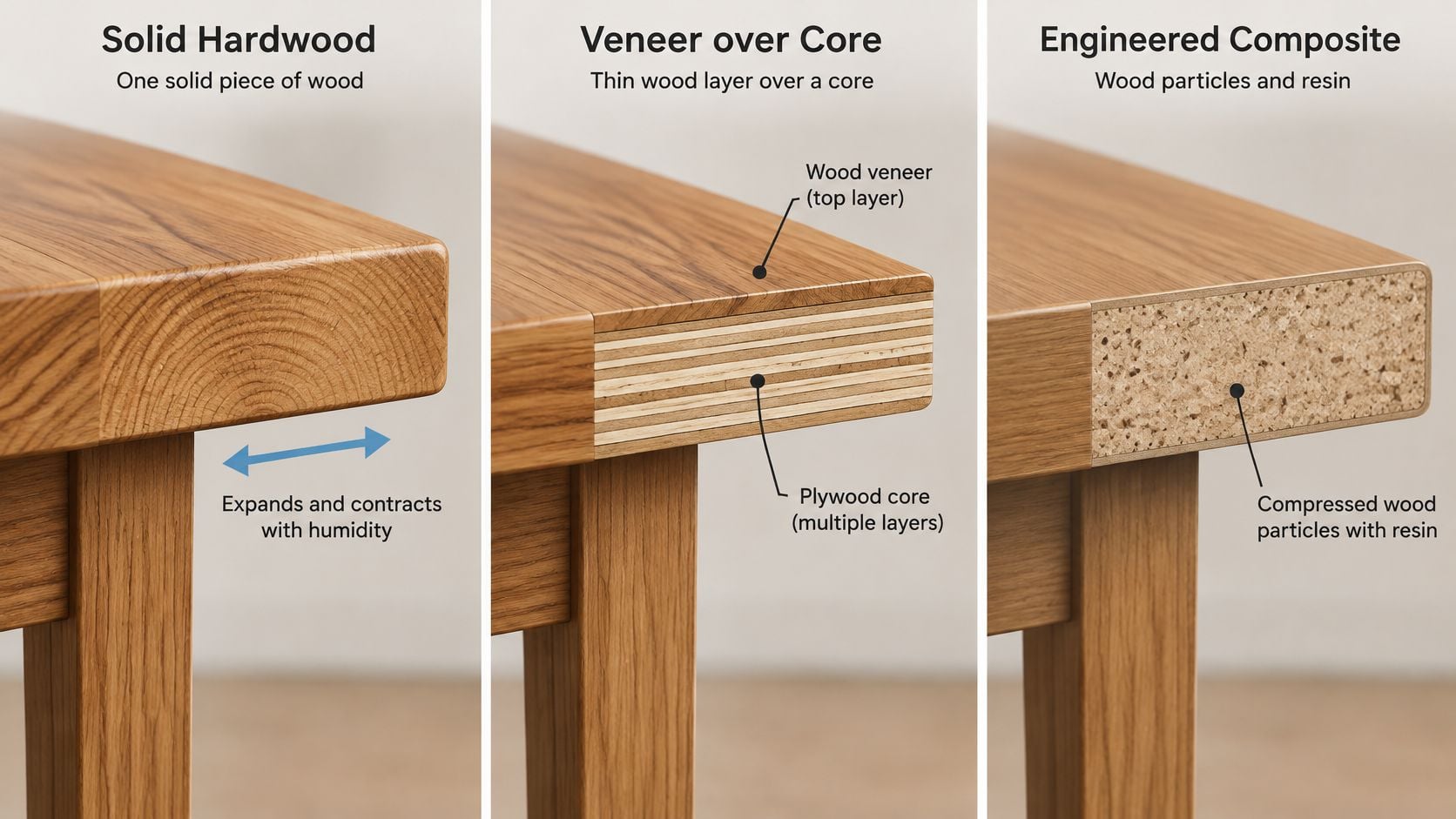
How the three materials compare
| Material | Movement and durability | Repair options | Best for |
|---|---|---|---|
| Solid hardwood | Kiln-dried to about 6 to 8 percent moisture; moves with humidity, so joints must allow movement | Surface wear can be renewed for decades | Heirloom tables and chairs |
| Veneer over core | Face layer and core respond differently to humidity; finish on all edges matters | Limited to the thin top layer | Stable looks at a moderate price point |
| Engineered composite | Fastener and glue joints; performance depends on the core | Limited; cores may not be repairable | Lighter daily use and pieces that move often |
Veneer earns its place when the core is sound and every edge is sealed. Over a good core, the surface stays flatter than a wide solid board, but the thin face cannot be sanded back to fresh wood. Composite pieces, often built with particleboard or MDF and held by screws, staples, or glue, stay lighter and suit rooms that get rearranged often. Their strength lives in the hardware and glue joints, so wobbling usually traces back to a loose fastener rather than the board itself.
What to ask before the piece comes home
- Kiln-dried stock: Was the wood conditioned for indoor use, near that 6 to 8 percent range?
- Movement-friendly joinery: Are panels floating, or is the top rigidly trapped?
- Finish on every face: Are the underside and the edges coated, not only the show surface?
- Chair frames: Are the frames solid wood, even if the seats are upholstered?
- Fabric: For kids and pets, performance fabric or a tight weave wipes clean. Leather does too, if it is conditioned instead of soaked.
White chairs in a bright NWI dining room show every scuff, so the cover matters as much as the wood. A practical look at styling white chairs in bright dining rooms is helpful when the question is how a pale seat holds up in real light, not just in a photo. For the table itself, the differences among solid wood dining tables are easier to see on an edge and a joint than on a finished top.
Custom Dining Furniture Designed Your Way
Standard sizes fail in predictable ways. The alcove is 7 inches too narrow. The family needs ten seats twice a year and four the rest of the time. The stain that matches the floor isn't offered on the only table that fits. Settling feels cheaper until the set is in the room and nobody wants to sit there.
A custom order is the way to design it your way. Canadel's UDesign program is a clear example of how made to order dining works. Shoppers choose color, shape, size, and finish for a table or a full set. Canadel's living catalog advertises 9 million options through that configurator, including color, shape, size, and finish, with a quoted delivery window of approximately 4–6 weeks.
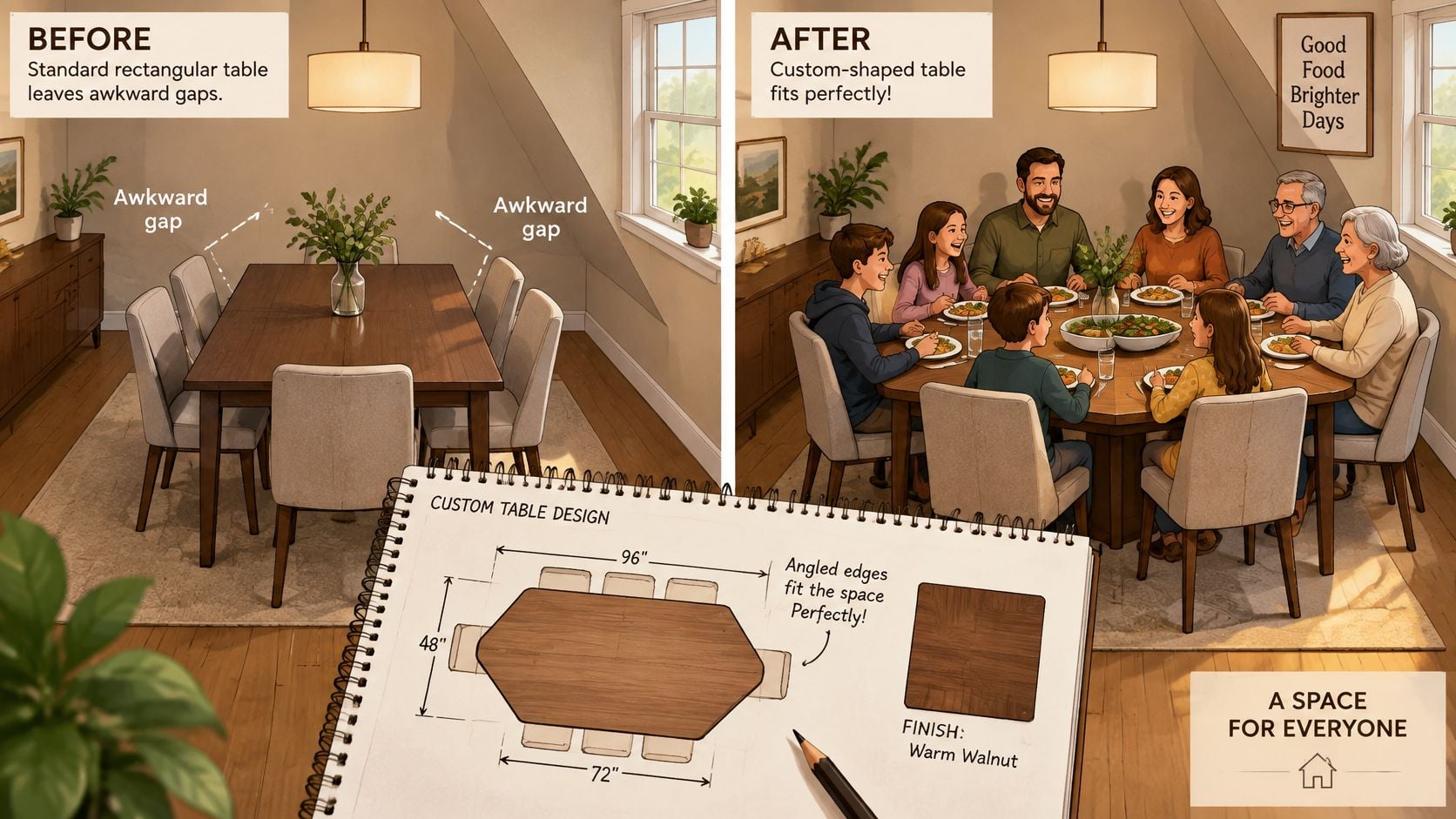
That photo is the whole argument. A rectangle that crowds the doorway gives way to a shape cut for the actual floor.
The order, in order
- Measure the room and lock the seat count. Use the clearance rules, including the opened size if leaves are part of the plan.
- Select shape, size, and finish. A bespoke top earns its place at this stage, whether that is a narrower oval or two finishes on one base.
- Confirm table and chair clearances. Arm height, apron depth, and the path to the kitchen all get checked before anyone builds.
- Place the order. The piece is specified first and produced after, which is the opposite of grabbing an in-stock set.
- Plan around the production window. About four to six weeks is the quoted range for that program, so a holiday meal needs the order placed well before the guests.
The trade is honest. Same-day pickup and a short list of finishes go away. A much wider design range comes back, and delivery follows the build instead of the other way around. The custom dining table and chairs path is built around that sequence.
When the goal is an heirloom
Amish solid-wood furniture is the other custom route, aimed at craftsmanship rather than a million finish combinations. A comparison written for Northwest Indiana shoppers points to solid hardwood components, dovetail joinery with solid-wood drawer boxes, and mortise-and-tenon joints at key stress points, set against particleboard, MDF, veneer, and screws or staples in many mass-produced connections, on the Amish furniture store page. Solid wood can often be repaired or refinished. A composite core often cannot.
Bring three things to that conversation: room measurements with the clearance lines, a seat count for daily use and for the biggest meal, and photos of finishes already in the house. American-made solid wood, cut to those numbers, is how an awkward NWI floor plan gets a table that standard sizes never offered.
Caring for Your Dining Set So It Lasts
Choose the set you can repair, then care for it as a working system: top, chairs, and the walkway around it. The finish takes plates, elbows, and hot serving dishes. The joints take leaning, pulling, and the scoot of chair legs across the floor. Even the traffic path matters, because a chair that barely clears the table will keep hitting the same edge. A made-to-order piece can solve a tight room, but the daily routine is what keeps the fit looking intentional.
Water and heat do the fastest damage. A wet glass rings the finish, a hot platter can cloud it, and a spill left at the edge reaches end grain first. Wipe once, wipe dry, then let the surface fully cool before putting decor back on top.
A simple weekly and seasonal routine
- Dust weekly: Use a soft cloth. Skip silicone sprays, which build a film that later finishes won't grip.
- Protect the top: Coasters, placemats, and a pad under hot dishes stop rings and heat marks.
- Wipe spills at once: Water left on an edge finds the end grain first.
- Hold the humidity: Keep the room near 35 to 55 percent relative humidity so seasonal movement stays modest.
- Rotate use: Swap chair positions and turn leaves so sun and traffic don't wear one spot.
- Check the hardware: Every six months, snug bolts and look at joints before a wobble becomes a split.
A hairline scratch in a solid finish often takes a matching touch-up pen. A top that has gone cloudy or worn needs a full refinish, which is realistic on solid wood and limited on veneer. For upholstery, vacuum the seams and rotate loose cushions so one seat doesn't pancake. Performance fabric and leather both wipe clean, and both need the cleaner the maker approves rather than whatever is under the sink.
Ask for the care sheet before the delivery truck leaves. Find out the finish type, which cleaner is approved, whether a touch-up kit matches the stain, and who to call for glides, leaves, hardware, or a loose joint. That ten-minute conversation turns care from guesswork into a routine, and a well-kept set stays quiet, level, and ready for the next holiday table.
What Shapes Price and How Special Financing Helps
Price follows construction before it follows a sale sign. Solid hardwood with mortise-and-tenon joints and dovetailed drawer boxes costs more than veneer over a composite core, and the gap is easy to read once you know what each figure buys. The higher figure pays for a frame that can be refinished and chairs that can be rebuilt. The lower figure buys a stable look for lighter use. A set earns its price when it fits the room and the daily traffic it was bought for.
A joinery list works like a recipe card. Two tables can look identical across a showroom and still cook differently over twenty years of meals, because the species, the joints, and the sealed surfaces are the ingredients you cannot see.
Special Financing is available, subject to credit approval. It is buying power for a quality set, a way to bring the furniture home now and pay for it over time on a schedule that fits a family budget. Rates and terms change, so the numbers worth planning around are the ones quoted in the showroom that week. The current details sit with the financing options for furniture purchases.
Three questions for any price tag
- What wood and joinery are included? Species, solid versus veneer, and how the joints are made.
- Can the finish be repaired? Touch-up versus a full refinish, and whether all surfaces were sealed.
- Will parts and new upholstery be available later? Glides, leaves, and seat covers are the pieces that wear first.
Honest pricing means comparing the answers to those three questions across the sets on your shortlist. A tag that holds up under all three usually outlasts the cheaper one that only looks good at checkout.
Test Drive Your Dining Set in Dyer or Crown Point
A tape diagram settles the floor plan. The showroom settles everything else. A table height and a chair seat either feel right under you or they do not, and no measurement answers that question.
Bring the room sketch with clearances marked, the daily seat count and the holiday count, and photos of finishes already in the house. Sit at the table height you plan to buy. Pull a chair back the distance your walkway allows and check whether it still clears. A set is a working system of table, chairs, and the space around them, and the floor is the only place all three can be tested at once.
Groen's Fine Furniture in Dyer and Crown Point has served Northwest Indiana since 1983 as a family-owned business, and the staff bring decades of combined sales experience to questions on joinery, lead time, and fit. In-stock pieces can be picked up at the local warehouse at no charge, and a premium delivery service carries a chosen set from the showroom floor to the spot the tape marked at home.
Groen's Fine Furniture builds dining room furniture around the room a Northwest Indiana family uses, from solid-wood and made-to-order tables to chairs that clear the walkway. Special financing, subject to credit approval, and premium delivery make a lasting set easier to bring home. Visit Groen's Fine Furniture in Dyer or Crown Point, sit in the chairs, and match a size and finish to the space.