
Blog
Sustainable Wood Furniture: A Buyer’s Guide

For homeowners in Dyer and Crown Point who are comparing two dining tables that look almost identical, the central question isn't which one looks nicer under showroom lights. It's which one will still belong in the house twenty years from now, after family dinners, moved chairs, and a few honest scratches. That's where sustainable wood furniture stops being a trend and starts being a buying decision with consequences.
A good piece begins with where the wood came from, then moves to what was put on it, and finishes with how it was built. Families in Northwest Indiana, including St. John, Schererville, and Munster, need that whole picture because a pretty finish can hide weak construction, and a strong frame can still be a poor choice if the sourcing is sloppy. For a practical care foundation, this guide from how to care for wood furniture is worth keeping close once the piece is in the house.
By the end, a buyer should know what to ask, what to inspect, and what to skip. That's the difference between a table that gets replaced and one that gets refinished.
Why Sustainable Wood Furniture Matters for Your Home
A Dyer homeowner standing in front of two nearly identical tables should ask one blunt question, what kind of ownership story does this piece have? One table may be built to age well, while the other is designed to survive a photo and not much else. The sustainability angle matters because a piece that lasts, repairs cleanly, and doesn't force early replacement is usually the better long-term choice for the home and the planet.
Wood has a real advantage here. A lifecycle review found that, across the examples studied, wood had the lowest environmental impact, while adding metal, plastic trim, glues, and varnishes could materially increase a furniture piece's burden FWPA furniture review. That's the first clue that a “wood” label alone doesn't solve the problem. Buyers need to look past the category name and examine the whole build.
What the buyer should keep in view
Sustainable wood furniture is not just a finish choice. It's a three-part decision, sourcing, finishing, and construction. If one of those three is weak, the sustainability story gets thinner fast.
Practical rule: a piece that can be repaired, refinished, or passed down is usually doing more for a home than a piece that only looks green at delivery.
For families in Crown Point, St. John, Schererville, and Munster, that matters because furniture has to handle real life, not just a showroom floor. If a table fits the room, suits the household, and can be maintained without drama, it's easier to keep it in service for years instead of sending it back into the cycle of replacement.
What Sustainable Wood Furniture Actually Means
A family walks into a showroom because the table looks right, then starts asking the harder questions. That is the right order. Sustainable wood furniture is furniture made from wood that is responsibly sourced, finished with lower-impact materials when possible, and built so repair makes sense before replacement does. A piece can still waste material if it is made from wood but falls apart early, or if heavy coatings and glue make future repair nearly impossible.
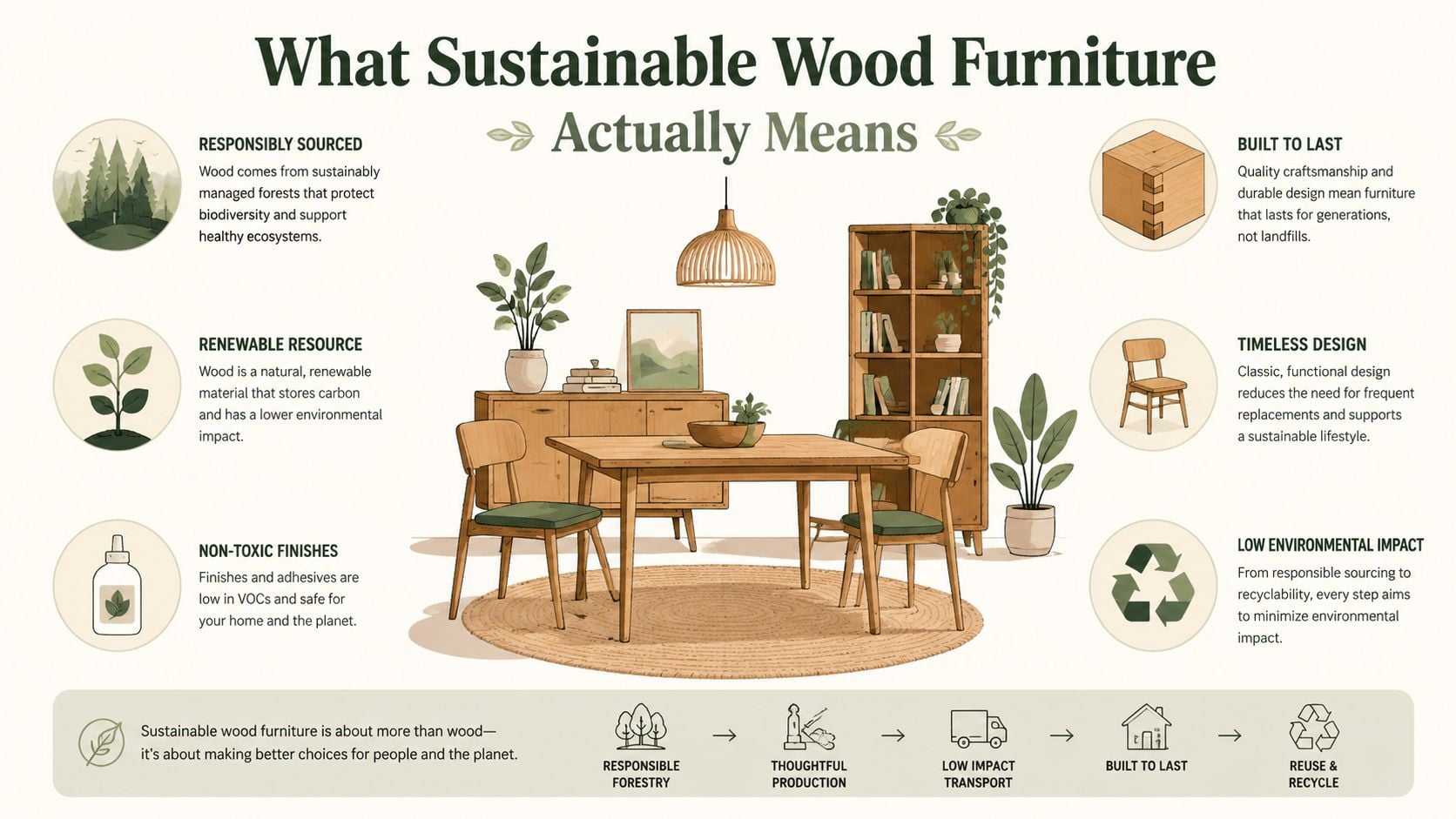
Wood gives you a better starting point than a lot of mixed-material furniture, but the build details still decide how green the piece really is. The peer-reviewed furniture lifecycle assessment points to pre-production as the heavy part of the impact picture, so where the wood comes from, how it is processed, and what gets added to it matter more than a polished showroom finish.
The four wood stories a buyer will hear
Shoppers usually hear four stories about wood. FSC-certified wood comes with documentation tied to responsible forest management. Reclaimed wood comes from previous use, often with visible marks and character. Plantation-grown wood comes from managed planted forests or faster-growing species, which can be a practical middle ground. Old-growth wood has a strong visual appeal, but the sourcing questions deserve more scrutiny than a sales tag usually gives.
That is only the start. A buyer still needs to ask whether the piece is mostly solid wood, or whether it relies on engineered layers that change both durability and repair options. If you want a plain-language breakdown of that difference, what is engineered wood furniture is a useful place to separate the structure from the marketing.
A wood label does not equal a sustainability claim.
Carry this forward: ask where the wood came from, what finish is on it, and whether the piece can be repaired without gutting the whole thing.
Construction matters just as much as sourcing. Tight joinery, replaceable parts, and panels that can be refinished later do more for long-term sustainability than a trendy label on a piece that is built to be discarded. Green finishes also deserve a hard look, especially when a seller uses vague words instead of clear material and coating information. If you want a simple reminder that even small details around home materials matter, the wood wick candle club is a good example of how buyers now expect cleaner materials and clearer sourcing across the home, not just in furniture.
FSC, Reclaimed, Plantation, and Old-Growth Compared
The right wood choice depends on what the household values most. Some buyers want documentation. Others want visible character. Some need a price point that fits the budget. There isn't one moral winner, only a better match for the job.
| Wood Sourcing at a Glance | What It Means | Strength | Trade-off |
|---|---|---|---|
| FSC-certified | Wood backed by chain-of-custody documentation from responsible forest management | Clear paperwork and strong sourcing signal | Can cost more, and the label still says little about build quality |
| Reclaimed | Wood recovered from prior use, such as old buildings or previous furniture | Distinct character and reduced demand for new timber | Can be heavy, inconsistent, and harder to refinish |
| Plantation-grown | Wood from managed planted forests or fast-growing species | Practical middle ground on renewability | Not every plantation system is equal, so documentation still matters |
| Old-growth | Wood from mature natural forests | Often prized for appearance and stability | Higher ethical and environmental concern, so buyers should ask hard questions |
For procurement standards, the buyer can also look for the kind of documentation that schools and public agencies use. Hong Kong's green procurement spec accepts furniture wood if at least 50% of the wood material is recycled or waste wood, or if the wood carries FSC, PEFC, or equivalent certification, and EU public-procurement criteria similarly require at least 50% of wood in the final product to come from sustainably managed sources Hong Kong green procurement specification. Some ecolabel frameworks go even higher. That's useful because it gives buyers a real filter instead of a vague “eco-friendly” claim.
How to use the comparison in real life
If the room needs durability and easy maintenance, FSC or plantation-grown wood with documentation is usually the cleanest path. If the buyer wants character and can live with a more rustic finish, reclaimed wood can be a smart choice. If a salesperson leans hard on old-growth as a premium story, the buyer should slow down and ask why that story matters more than the piece's actual life cycle.
For more on structure and material construction, mortise and tenon joint basics is a useful companion before any final decision. And if the buyer wants a different kind of sustainable habit at home, this wood wick candle club is a nice reminder that material choices can be thoughtful across the whole house, not just in furniture.
Finishes, Glues, and the VOC Question
A beautiful wood table can still be a poor choice if the finish keeps releasing fumes into the dining room long after delivery. VOCs, or volatile organic compounds, are chemicals that can evaporate into indoor air, and off-gassing matters most in homes with kids, pets, or anyone sensitive to smells and irritation. The buyer should care because the finish is part of the furniture, not an afterthought.
Finish families and what they usually mean
Oil-based polyurethane tends to be durable, but it often carries a heavier emissions profile and can be less forgiving in a closed home. Water-based polyurethane usually dries cleaner and is easier to live with indoors, though the right application still matters. Hard wax oil offers a more natural look and can be easier to spot-repair, while shellac has a long reputation for a warm finish and relatively manageable touch-up work.
The right choice depends on use, not ideology. A family dining table needs a finish that can handle water rings and cleaning. A bedroom dresser can prioritize a lighter, less intrusive surface.
The glue story matters too. Solid-wood joinery usually avoids some of the concerns tied to plywood or MDF, while formaldehyde-based emissions in composite materials can become part of the indoor-air question. When a product carries a low-emission certification, that signals the manufacturer has documented something meaningful about emissions performance rather than just saying the piece is “natural.”
Ask three questions and keep them simple, what's the finish, is the piece solid wood or veneered, and is emissions documentation available?
For families who want a practical maintenance mindset, how to refinish antique wood furniture is a good reminder that a finish should support a long service life, not shorten it. A table that can be cleaned and refinished cleanly usually outperforms a pretty surface that can't be lived with.
Lifecycle, Durability, and Why Construction Beats Labels
A green label means little if the piece is built to fail early. That is the part buyers need to keep in view. As noted earlier, the biggest share of a furniture item's footprint is usually tied to what happens before it ever reaches the truck, so sustainability gains start with material choice, factory process, and how long the piece stays useful.
That changes how you shop. If the upstream footprint carries so much weight, durability and repairability become the practical tests. End-of-life still matters too, because furniture waste remains a real problem. A circular-economy report for the sector found that the EU28 consumes about 10.5 million tonnes of furniture per year and generates about 10.78 million tonnes of furniture waste annually, with 80% to 90% of furniture waste in municipal solid waste being incinerated or landfilled and only about 10% recycled circular-economy furniture report. That is why construction beats labels every time.
What strong construction looks like
Inspect the joins, not just the surface. Dovetails, mortise-and-tenon, and corner blocks usually signal a more serious build than staples and thick glue beads. A piece that uses mortise-and-tenon joinery gives you a frame that can hold up under real family use instead of just looking finished on the floor.
Replaceable parts matter too. So do modular sections, accessible hardware, and a design that comes apart without destroying the frame. If a table leg can be tightened, a rail can be replaced, or a top can be refinished, the piece stays in the house longer.
That logic matters more than a flashy badge. A well-built solid-wood table that can be refinished more than once will usually give better lifetime value than a trendy piece that cannot be repaired when life happens. For a home that expects to move, host, and age with the family, construction wins the argument.
Protection and maintainability extend service life too. A useful reminder is to find a wood sofa cover for pieces that need extra protection instead of replacement. Furniture that can be cared for instead of discarded is doing the sustainability work buyers need.
Why Custom and Amish Furniture Is a Sustainability Play
Custom work is not just about taste. It's about avoiding the waste that comes from buying a piece that almost fits. In a family dining room, a table ordered to the actual footprint of the room is more likely to stay useful than one bought because it was available now. That's a real sustainability advantage, not a marketing slogan.
For households in Dyer and Crown Point, custom order services, including Canadel dining and Amish solid wood pieces, line up naturally with that idea. A made-to-order table can be built to the needed length, width, wood species, stain, and chair height. That kind of fit means fewer compromises, fewer replacements, and less furniture cycling through the home before it should.
Why heirloom build quality matters
Custom Amish furniture usually brings solid hardwood construction, traditional joinery, hand-finished surfaces, and the ability to specify the details that matter. Those are not decorative extras. They are the reasons a piece can be repaired, refinished, and kept in service long after a mass-produced alternative would have been retired.
A family that chooses a dining set sized to its actual nook, with a finish that matches the floors and chairs built to a preferred seat height, is making a quieter but better decision. The room works on day one, and it still works years later. That stability reduces the odds of replacement, which is where sustainability gets real.
For context on craftsmanship, what is Amish furniture helps show why the term usually points to more than a style label. In a multigenerational business setting, that matters because customers are often designing alongside a team that understands how families use their furniture, not just how it looks in a catalog.
What to Ask and Look For in the Showroom
A smart showroom visit feels less like browsing and more like a short inspection. At Groen's showrooms in Dyer or Crown Point, a buyer can move through the piece with a few direct questions and get a much clearer read on whether it belongs in the home for the long haul.

The showroom checklist
- Ask where the wood came from. Look for reclaimed content, certified sourcing, or a clear explanation of the wood species and supply chain.
- Ask whether the piece is solid wood, veneered, or composite. That answer tells a buyer a lot about repairability and long-term wear.
- Ask what the finish is. A clear finish answer helps with indoor air concerns and future touch-ups.
- Ask what documentation exists. Chain-of-custody, sustainable forest-management paperwork, or low-emission documentation tells a better story than a vague label.
- Ask whether the piece can be disassembled. Delivery, future moving, and repair all get easier when the design allows it.
That same visit is a good moment to think about value beyond the frame. Flexsteel can make sense when durability matters, Bassett suits style-led rooms that still need staying power, and Vaughan-Bassett is often part of a solid-wood bedroom conversation. Groen's also offers special financing, subject to credit approval, which gives a household more buying power for a piece it intends to keep instead of replace quickly.
For maintenance habits, keep the piece out of extreme dryness, dust it regularly, and call a professional refinisher when the surface starts to look tired instead of trying to rescue it with the wrong product. For outdoor or seasonal care thinking, 2026 teak furniture care tips can be a useful reminder that good care is part of sustainability too.
Bringing It All Home in Northwest Indiana
The best sustainable choice usually comes down to three things, where the wood came from, what finish sits on top of it, and how the piece is built. If the sourcing is documented, the finish is appropriate for the room, and the construction can survive real use, the buyer has done the hard part. Durability is the strongest lever because every year a piece stays in service lowers the need for another purchase.
That's why white-glove delivery and interior design support matter more than they might first appear. The right piece has to fit the room, the family, and the way the house gets used every day. A table that arrives carefully, lands in the right spot, and gets maintained properly is more likely to stay part of the home for decades.
The financial side matters too. Special financing available, subject to credit approval, can make a better piece workable without forcing a rushed compromise. For many families, that's the difference between buying once and buying twice.
Our family has served Northwest Indiana for years with a personal approach that respects both the home and the budget. Visit the showroom with measurements, room photos, and a clear sense of how the furniture will be used, and the options get better fast.
Visit Groen's Fine Furniture in Dyer or Crown Point to explore custom options, including Amish and Canadel dining, and ask about special financing plans. Our family can help match sustainable wood furniture to the way the home really lives, with comfort, honest guidance, and the kind of service people keep coming back for.