Amish Solid Wood Bedroom Furniture: A Complete Buying Guide


For homeowners in Dyer, Crown Point, and throughout Northwest Indiana, a bedroom update often starts with a familiar compromise. A dresser may fit the budget but feel temporary, while a bed that looks right in a photograph may not suit the room, the family, or the way the household plans to live in it. Amish solid wood bedroom furniture offers another path, but only when buyers look beyond the label and understand the wood, joinery, finish, care requirements, and total cost of ownership.
A well-made bedroom set should feel comfortable today and remain useful through changing rooms, changing tastes, and changing family needs. The right purchase isn't just the heaviest or most expensive option. It's a piece with sound construction, appropriate dimensions, a finish the household can live with, and a maker willing to explain how the furniture was built.
Why Solid Wood Bedroom Furniture Matters
A homeowner furnishing a primary bedroom may want a calmer room, fewer disposable pieces, and furniture that remains useful after the next move or remodel. Amish solid wood bedroom furniture can meet that goal, but its value depends on engineering as much as appearance. Grain and weight are noticeable. Properly dried lumber, sound joinery, and a finish suited to daily use determine whether those qualities hold up.
A bed carries repeated loads, drawers cycle open and closed, and nightstands support lamps, books, and personal items every day. Solid hardwood provides a strong foundation for those tasks. It still moves with changes in humidity, so the builder must allow for seasonal expansion and contraction through suitable panel construction, fasteners, and joints. Material alone does not guarantee quality.
A bedroom should serve real life
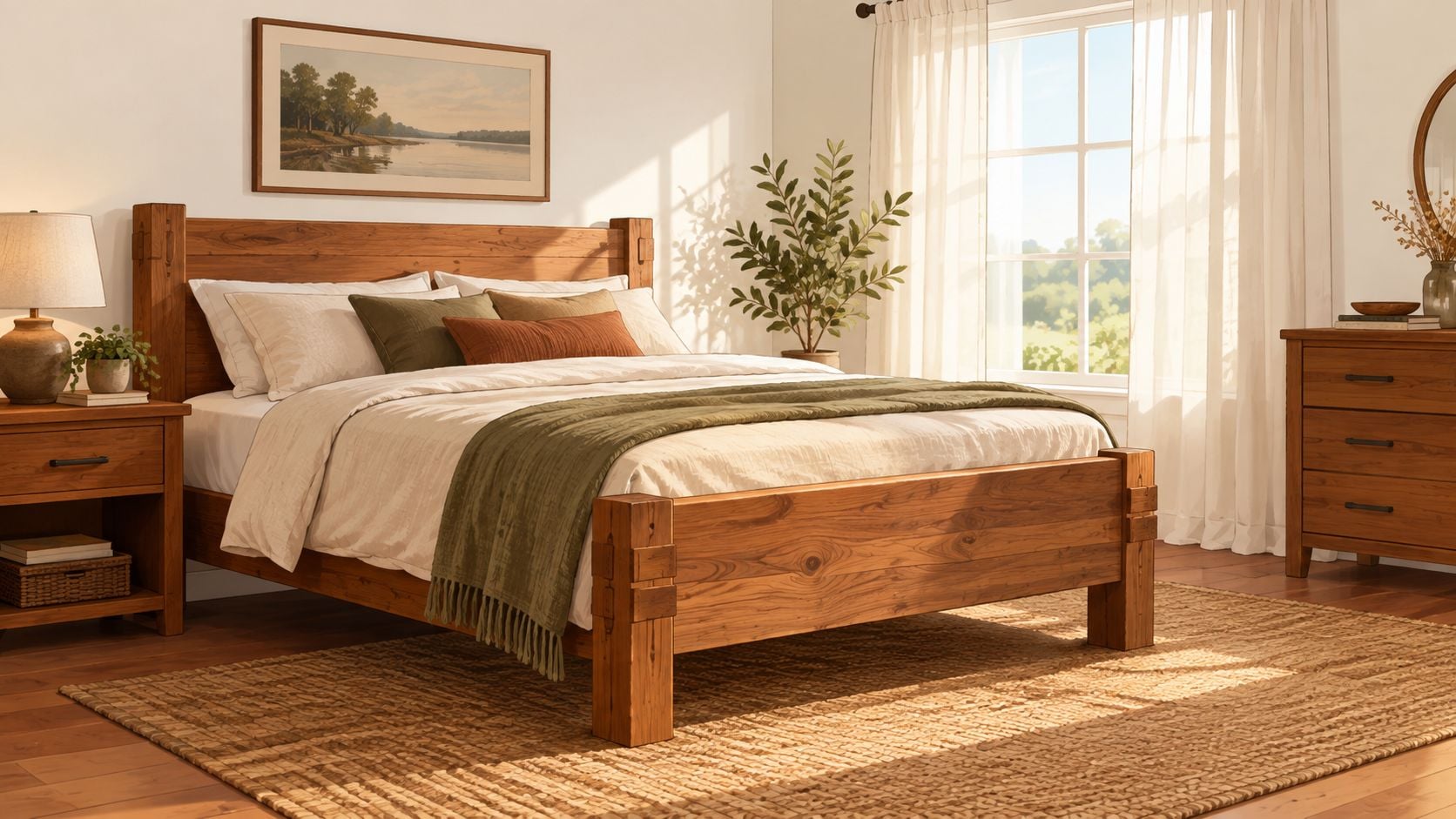
Natural furniture earns its place through use, not decoration alone. A substantial dresser can organize clothing without disposable components, while a properly proportioned bed can remain useful as the household changes. A piece may move from a primary bedroom to a guest room, then into another home, provided its dimensions and construction continue to suit the space.
Common hardwood choices include oak and maple, with each offering a different grain pattern, color, and working character. The dedicated species comparison can address those differences in detail. Here, the practical question is whether the selected wood, dimensions, storage capacity, and finish match the room and the way the furniture will be used.
Practical rule: “Solid wood” is a starting point, not a complete quality inspection. Check the joints, panel design, drawer operation, finish, movement provisions, and care instructions before deciding.
Value comes from continued usefulness
Lifetime ownership changes the calculation. A well-built piece may be repaired, refinished, moved into another room, or passed to another household. Industry service-life estimates commonly range from roughly 30 to 100 or more years for solid hardwood furniture and approximately 5 to 25 years for engineered-wood furniture, though those ranges are not guarantees. Construction quality, moisture exposure, use, and maintenance still determine the result. This industry overview of furniture quality provides that context.
Evaluate the purchase price alongside delivery, maintenance, expected years of use, and the cost of replacing a short-lived piece. That approach does not assume the highest price represents the best value. For families in Dyer, Crown Point, St. John, Schererville, or Munster, the sound choice is furniture that fits the room, handles daily demands, and remains adaptable as household needs change.
The Heritage of Amish Craftsmanship
The Amish furniture tradition grew alongside a major occupational shift in communities such as Holmes County, Ohio, home to the world's largest Amish settlement. In 1973, only 3% of Amish heads of household worked in the secondary wood sector, while 14% did so by 1997. When primary and secondary wood manufacturing were combined with other manufacturing, approximately 35% worked in those sectors in 1997, compared with 16% in 1973. During that period, agriculture-related occupations fell from 48% to 21%. The U.S. Forest Service study on Amish occupational change connects that transition with rising farmland costs, limited availability, and the growth of small manufacturing businesses.
That history helps explain why Amish-made furniture is associated with specialized woodworking rather than only farm-based production. Many small firms developed in rural communities, serving regional customers while distributing finished furniture more broadly. Made-to-order work became a natural fit because smaller workshops could respond to different dimensions, species, stains, hardware choices, and room requirements.
Small workshops can have a large material footprint
Ohio's Amish furniture cluster shows how a network of small firms can form a substantial manufacturing base. Research estimated annual hardwood consumption at approximately 44 million board feet, equal to about 11% of Ohio's total hardwood-lumber production and 19% of the state's hardwood lumber used in appearance-based applications. The cluster employed roughly 2,991 people, including manufacturers, finishers, and distributors. The U.S. Forest Service research on Ohio's Amish furniture cluster documents those figures.
The same study found that the median firm employed 4 workers in 2005, and the median business had been established in 1996. During 2006 to 2008, 71% of firms expanded, while 46% began by retrofitting existing buildings, often farm structures, and 56% later expanded by constructing new facilities. These details matter because they show a manufacturing tradition built from many focused businesses, not a single standardized factory model.
What the heritage means for a buyer
The label should lead to useful questions, not automatic trust. Buyers can ask who builds the piece, which wood species are available, how panels are joined, what finish system is used, and whether repairs or refinishing are supported. A clear answer is more valuable than a broad claim about craftsmanship.
For families comparing options in NWI, this explanation of what Amish furniture means can provide helpful background before a showroom conversation. The practical takeaway is straightforward: Amish-made represents an established small-business manufacturing tradition with measurable roots extending back at least five decades, but each individual piece still deserves its own construction review.
Understanding Wood Construction and Movement
Solid wood is hygroscopic, which means it gains or loses moisture in response to indoor relative humidity. Below its fiber-saturation point, that moisture exchange causes dimensional change. The USDA Forest Products Laboratory explains that properly drying, handling, and storing lumber reduces later moisture changes, and furniture made at a moisture content suited to its service environment is less likely to develop serious movement problems. The USDA guidance on wood moisture and dimensional change provides the technical foundation for that approach.
This matters in Northwest Indiana because homes experience heated winter interiors and humid summers. Finishes slow moisture exchange, but they don't stop it. A dresser top, headboard, drawer front, or bed panel therefore needs a design that lets the wood move rather than trapping it rigidly.
Joinery matters more than the label
Wood moves far more across the grain than along its length. Tangential movement in flat-sawn material is typically greater than radial movement, so board orientation affects the behavior of wide panels. USDA technical guidance gives a useful illustration: a 300-millimeter flat-sawn oak panel can move approximately 5 millimeters across the grain between substantially different moisture conditions. The USDA technical discussion of wood movement and stability explains why rigidly attached panels can split, bow, or stress fasteners.
A buyer inspecting a dresser or bed should look for:
- Floating panels: Panels should have room to expand and contract across the grain.
- Elongated fastener holes: These allow a fastener to hold the piece while accommodating movement.
- Framed or breadboard construction: These approaches can support wide panels without locking every edge in place.
- Sound drawer construction: Drawer boxes should remain square, and bottoms should be fitted for the expected movement.
- Consistent reveals: Even gaps and smooth operation indicate careful fitting and acclimation.
A mortise-and-tenon joint can be part of a strong construction system, but no single joint makes a piece automatically superior. This guide to mortise-and-tenon joinery helps explain how the joint works and why the surrounding design still matters.
What proper acclimation looks like
Furniture should be manufactured from properly dried and acclimated stock, not assembled immediately after lumber arrives from a different climate. After delivery, the piece should settle in the conditioned room where it will be used. A household can reduce stress by keeping indoor humidity reasonably stable and placing furniture away from radiators, HVAC outlets, exterior dampness, and other concentrated sources of heat or moisture.
Movement isn't a defect by itself. Small seasonal changes are part of solid wood's behavior. The concern is whether the construction gives those changes a controlled path. Smooth drawers, stable joints, and panels that remain flat are better signs than an unqualified promise that the furniture will never move.
Choosing the Right Wood Species
The right species depends on the room, the desired visual weight, and how the finish will interact with the grain. Oak, cherry, brown maple, and walnut are common North American hardwood choices for Amish bedroom furniture. Each also behaves differently as the room's light, humidity, and furnishings change. A hardwood selection guide for longevity and style can help organize those trade-offs before you order.
A useful comparison starts with character rather than a simple ranking. Every species can produce a durable, attractive bedroom, but each creates a different relationship between the furniture and the rest of the room. The choice affects more than appearance. It also influences how strongly the grain shows, how the finish develops, and how the piece fits the household's long-term plans.
Oak for pronounced grain and traditional presence
Oak has visible grain that gives a dresser or bed a defined, familiar appearance. It suits traditional, mission, and farmhouse interiors where the wood should contribute noticeable texture. Oak can make a substantial piece feel visually active, so a room with patterned bedding or busy flooring may call for a simpler profile.
Its practical advantage is finish versatility. Oak can support a range of stains and forms, but the final appearance depends on the specific boards and finish system. Samples viewed under showroom lighting may look different beside a bedroom window. Compare the sample with the room's natural and artificial light before making the final choice.
Cherry for warmth that develops over time
Cherry offers a smoother visual character and a warm tone that can deepen with exposure to light. It often works well in transitional bedrooms where the furniture should feel refined without looking overly formal. Its changing color is part of the ownership experience, not a flaw.
Choose a cherry bedroom set with that evolution in mind. If the household wants the furniture to look exactly the same for many years, another species or finish may be more suitable. If natural change is welcome, cherry can add depth as the room matures.
Brown maple for a quieter canvas
Brown maple generally has subtler grain than oak. That makes it useful when the finish color, silhouette, or hardware should lead the design rather than a pronounced pattern. It can suit bedrooms that combine upholstered elements, painted walls, and restrained wood tones.
Maple and cherry can accept stain differently, so the same color name may produce distinct results across species. Brown maple can provide a calm base, but the selected finish still needs to be evaluated as part of the complete design.
Walnut for a darker focal point
Walnut brings a rich, dark tone and a strong sense of presence. It can make a bed or dresser the visual center of a room, particularly beside lighter walls, textiles, or flooring. The darker color may also show dust or surface marks more readily, so consider the household's care routine before ordering.
The decision involves grain, light, room size, and the furniture's intended role. A quieter species may blend into the room, while walnut can command attention and remain a long-term focal point. Choosing well means balancing the initial look with how the piece will function and age throughout its ownership.
Customization and Financing Options
A bedroom should fit the household, not force the household to work around a showroom standard. Custom ordering can solve practical problems such as a narrow walkway, a low window, an unusual wall length, or a need for deeper storage. It can also bring visual consistency to a room through coordinated wood, finish, hardware, and proportions.
At Groen's Fine Furniture, the custom process includes Amish solid-wood options and other furniture programs. The same showroom also offers Flexsteel for durability, Canadel custom dining, Bassett for style, and sleep products from Serta and Beautyrest. These categories serve different needs, so the useful question is which construction and comfort choices fit the room rather than which label sounds most familiar.
Design it your way
A made-to-order bedroom may allow decisions about:
- Dimensions: Adjust case goods to preserve walking space and drawer clearance.
- Wood species: Select oak, cherry, brown maple, walnut, or another available hardwood.
- Finish: Coordinate the furniture with flooring, trim, wall color, and existing pieces.
- Hardware: Choose pulls and knobs that support the room's style and daily use.
- Storage: Specify drawer arrangements and interior organization where the collection permits it.
The custom bedroom furniture service gives Northwest Indiana shoppers a place to begin that conversation. Custom doesn't mean every request is automatically practical. Oversized pieces may be difficult to move, darker finishes may require more visible upkeep, and unusual dimensions can affect future room flexibility. A good design discussion includes those trade-offs before an order is placed.
Fit the purchase to the household budget
Quality furniture is a significant purchase, and paying over time may help a household choose the right construction instead of replacing an unsuitable piece later. Special Financing is available, subject to credit approval, and can provide additional buying power while the buyer evaluates the full cost of the bedroom project.
Financing should still be treated as a planning tool, not a reason to ignore the total obligation. A clear conversation should cover the selected pieces, delivery, care needs, expected use, and payment terms. Honest pricing and multigenerational ownership matter because the process should feel personal and understandable, not rushed.
Care and Maintenance for Longevity
Solid wood rewards consistent care, but it doesn't need complicated treatment. The finish is the furniture's first line of defense, and the safest routine begins with following the maker's instructions rather than applying a familiar household product automatically.
A simple care routine
-
Dust with a soft, clean cloth. Abrasive debris can dull the finish when it's rubbed across the surface.
-
Clean small spills promptly. Use the method recommended for the specific finish, and avoid leaving moisture around drawer fronts, joints, or edges.
-
Use conditioning products selectively. Utah State University Extension identifies surface treatments such as lemon oil and surface wax as options for cleaning or reconditioning finished furniture. Its wood furniture maintenance guidance also supports matching the product to the existing finish.
-
Protect the room environment. Keep pieces away from radiators, direct heat, HVAC outlets, exterior dampness, and areas with repeated moisture changes. Stable indoor conditions reduce stress on wide panels, finish films, and joints.
For additional practical guidance, this wood furniture care guide can help a household establish a routine suited to the piece. Lemon oil or wax isn't universally appropriate, and applying an incompatible coating can alter the appearance or protection of the finish.
Safety belongs in the setup
A heavy dresser can still tip if a child climbs, a drawer is pulled forcefully, or the furniture isn't secured properly. The U.S. Consumer Product Safety Commission reports that 46 percent of furniture tip-over deaths occur in bedrooms, making anti-tip anchoring an essential step for dressers and chests. The CPSC furniture safety guidance recommends anchoring furniture, placing heavier items in lower drawers or shelves, and keeping tempting objects away from the top.
Anchoring should happen after delivery and placement, not as an afterthought. The household should follow the hardware instructions, attach the restraint to an appropriate wall structure, and confirm that drawers operate without causing the piece to shift. Safe placement protects both the family and the furniture.
Start Your Bedroom Transformation Today
Choosing Amish solid wood bedroom furniture becomes easier when the decision is based on construction, movement, species, room dimensions, care, and lifetime value. A bed or dresser should feel right in person, and a showroom visit lets shoppers examine grain, operate drawers, compare finishes, and discuss custom dimensions without pressure.
Families in Dyer, Crown Point, St. John, Schererville, Munster, and surrounding Northwest Indiana communities can visit Groen's Fine Furniture to explore American-made and Amish furniture, White-Glove Delivery options, Interior Design guidance, and the Helpful Mattress Guide for healthier, more comfortable rest. Shoppers furnishing a flexible guest room or a compact living space may also find it useful to browse heavy-duty adult bunk beds from Park City Bunk Beds with Nationwide Delivery when vertical sleeping arrangements make sense.
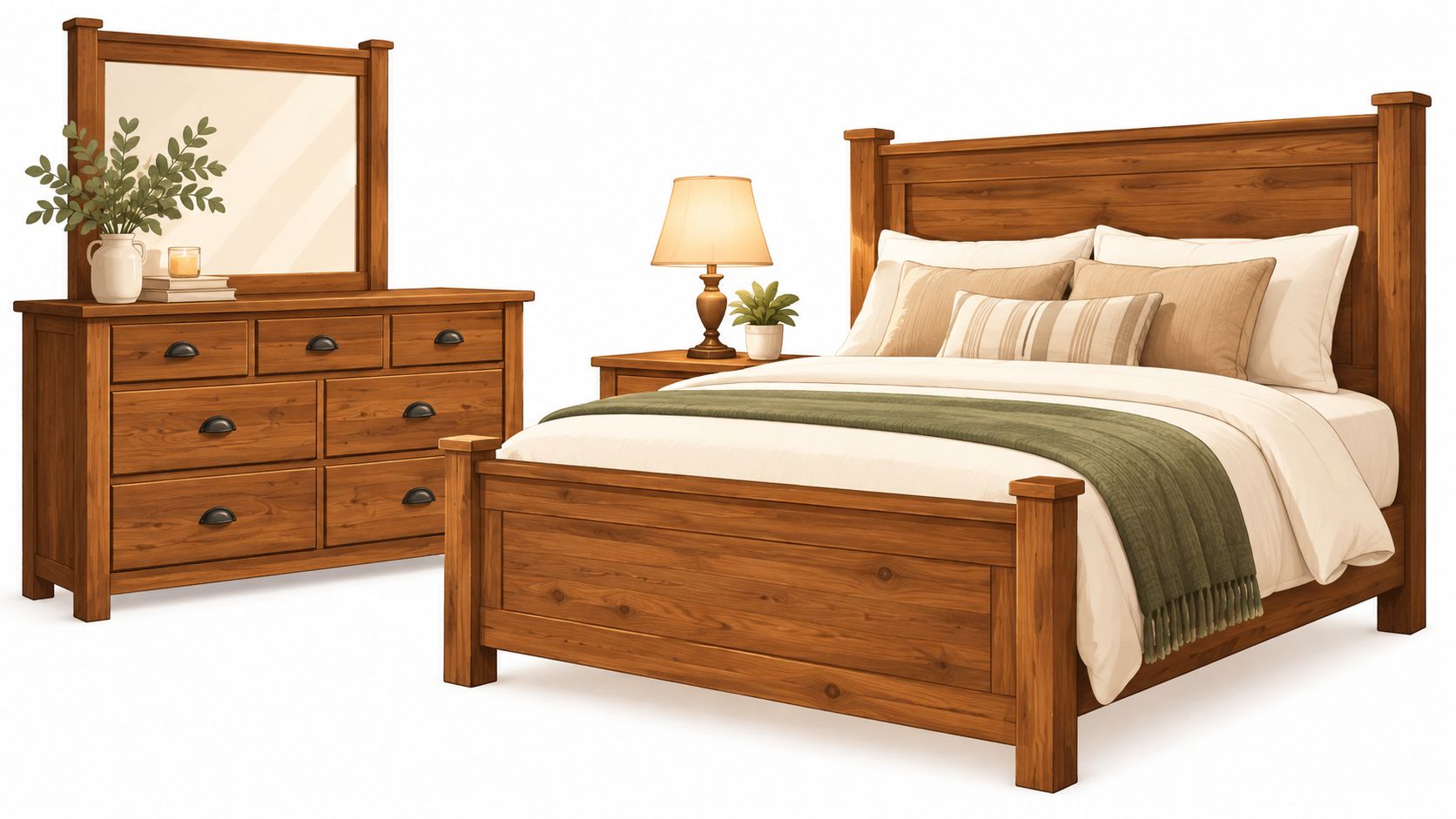
Visit Groen's Fine Furniture in Dyer or Crown Point to compare Amish solid wood bedroom furniture, custom options, and comfortable sleep solutions with a family-owned team serving Northwest Indiana since 1983. Ask about Special Financing, subject to credit approval, and let the team help create a bedroom that fits the room, the budget, and the way the household plans to live.