
Blog
Curved TV Stand: Sizing, Weight Limits & More

For homeowners in Dyer and Crown Point, the moment usually arrives the same way. A new curved TV is sitting in the room, the old entertainment center suddenly looks too small, and the question becomes simple, does the TV need a curved stand, or just the right stand?
The honest answer is the one a lot of glossy product pages skip. A curved TV stand is not automatically about matching the shape of the screen. It's about fit, stability, viewing angle, and room layout, which matters even more in Northwest Indiana homes where living rooms, corners, and sectional seating rarely follow a showroom script. Our family has helped NWI homeowners make those decisions since 1983, and the best setups are almost never the most decorative ones.
Why Your Curved TV Deserves the Right Foundation
A homeowner in Crown Point can bring home a sleek curved TV and still feel stuck the second the box is open. The old cabinet may be too narrow, the center shelf may sit too high, or the room may not give every seat the same sightline. That starts the decision, and the question is not the curve of the screen. It is the foundation under it.
Curved TVs earned attention in the early 2010s. Samsung and LG introduced some of the first mass-market curved sets at CES 2013, and Samsung later unveiled the world's first Curved UHD TV at IFA 2013, then followed with a 105-inch Curved UHD TV in 2014. Samsung also matched that design with the Aero stand built with the same 4200R curvature, or 4.2 meters. That history matters because it shows the stand was once part of a coordinated design language, not an afterthought.
The real question is fit, not just shape
Start with the room before you chase a matching look. A curved screen still needs the right width, the right height, and enough clearance for cables and ventilation. If the stand is wrong, the whole setup feels off, even when the TV itself looks impressive.
Practical rule: if the stand does not support the TV safely and sit comfortably with the room, the curve does not matter.
For families in Dyer, Munster, or Schererville who want the room to feel finished, that means thinking like a furniture buyer. A good foundation keeps the TV secure, keeps the seating comfortable, and keeps the entertainment area from feeling like a temporary fix. If you want a clear way to judge that fit, our guide on how to shop for TV stands lays out the basics homeowners should check before they buy.
What a Curved TV Stand Actually Is
A curved TV stand began as a premium furniture answer for curved displays, not as a separate category that every curved TV now demands. In the early years of curved home theater design, the stand was often shaped to echo the screen so the full setup felt planned and complete. That idea still matters, but only as a design cue. The better question for a homeowner is whether the piece fits the room, supports the television safely, and leaves enough room for daily use.
Today, the term gets used more loosely. It can mean a console with a curved front, a support platform shaped for the same visual effect, or a sturdy piece of furniture built to hold a curved panel safely. The shape alone does not define the job. The job is to support the set without strain and to keep the viewing position comfortable.
The key question is fit, not just shape
A freestanding floor stand uses a bracket system and must match the TV's VESA pattern and weight. A traditional media console uses shelves, a broad top, and a low center of gravity to carry the television and its components. Those are different solutions, even when they are sold under the same broad search term.
The practical details tell the story. A representative floor stand for 23-inch to 55-inch displays supports VESA patterns from 100×100 to 400×400, a maximum TV load of 35 kg, and a height-adjustable mounting range of 868 to 1068 mm (Techly floor stand specs). That kind of spec sheet is why size alone never settles the choice.
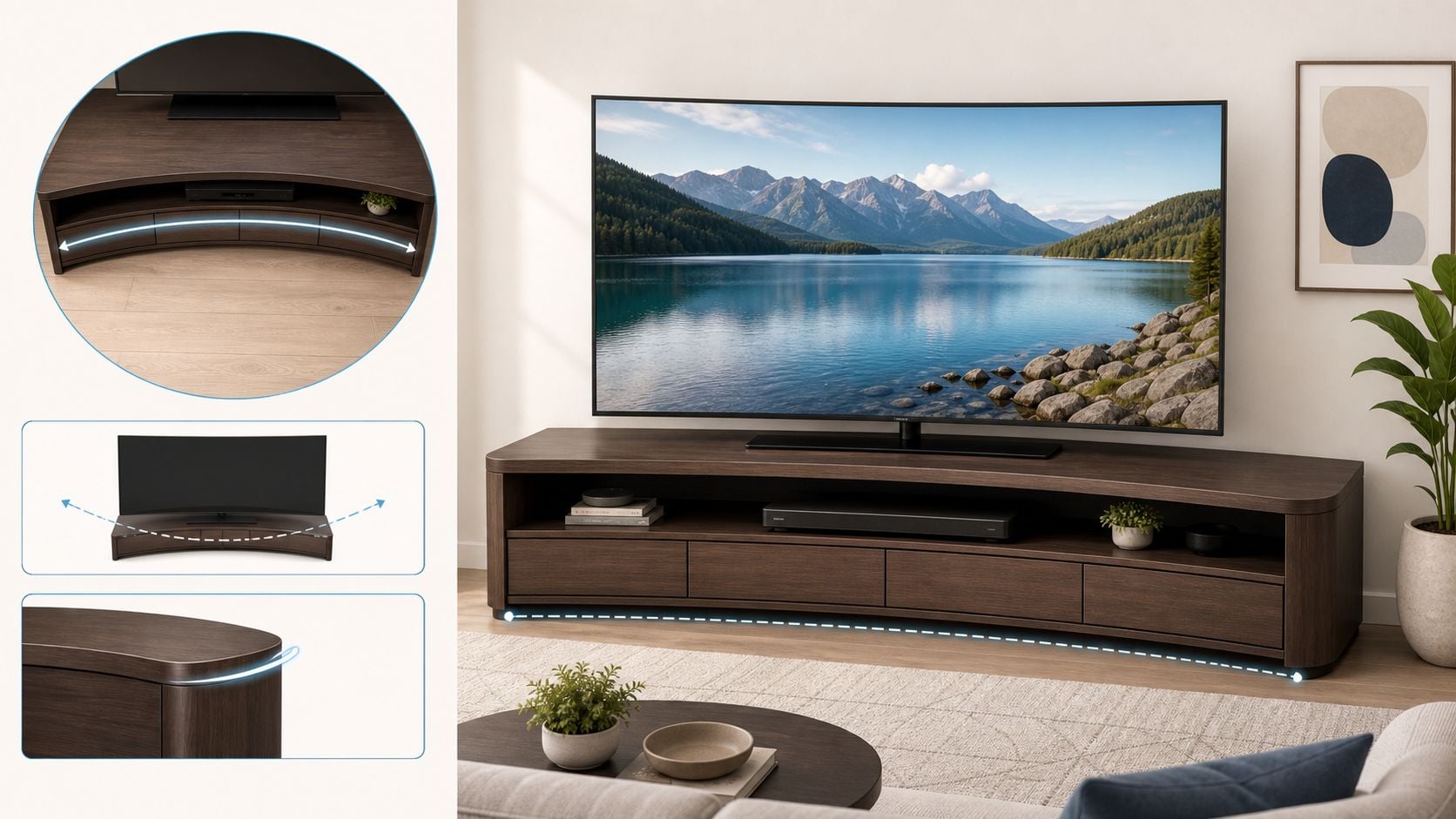
A curved console may look more cohesive with a premium screen, but the core value is still structural. If the room needs storage, speaker space, or future flexibility, a straight console can be the smarter buy. For homeowners who want a tighter fit around the room layout, this corner media console buying guide is a useful place to start.
Curved Console Versus Straight Console for Your Curved TV
A lot of shoppers assume the TV's curve demands a matching curved cabinet. That sounds neat, but it's not the practical way to shop. The better question is whether the room benefits more from visual harmony or from storage, speaker placement, and long-term flexibility.
A curved-front console can look polished with a curved TV because the sightline feels unified. That matters in a formal living room where the entertainment center is a focal point. A straight console, though, usually wins on function. It's easier to center a soundbar, easier to store media gear, and easier to repurpose later if the TV changes.
What matters more than the cabinet shape
The picture itself depends on seating in the TV's sweet spot, not on whether the stand curves. SANUS' curved-TV guidance emphasizes centered viewing and notes that off-center seating can create viewing-angle issues. That means the room layout carries more weight than the furniture silhouette.
A curved console may make sense when the owner wants the display to feel like a statement piece. A straight console makes more sense when the family needs storage, a wider top for electronics, or a cleaner upgrade path for a future flat display. For many homes, especially open-concept rooms, the straight option is the safer bet.
| Feature | Curved-Front Console | Straight Console |
|---|---|---|
| Visual look | Matches the soft arc of a curved screen | More neutral and easier to blend with existing décor |
| Storage flexibility | Often more style-led than space-led | Usually better for components, speakers, and décor |
| Future TV upgrades | Can feel tied to one design trend | Easier to reuse with a different TV style |
| Speaker placement | May limit exact placement options | Usually simpler for centered audio gear |
| Room fit | Strong for focal-point rooms | Better when the layout changes often |
If the home needs a corner-friendly or layout-aware solution, the broader buying question is often answered better by a well-sized console than by a curved façade. A helpful breakdown of that thinking appears in Groen's corner media console buyer's guide.
A stand should serve the room first and the styling second.
For many families in Northwest Indiana, that's the clearest rule. Buy the furniture that holds the TV well, not the furniture that merely echoes the screen's shape.
How to Measure for Fit and Weight Capacity
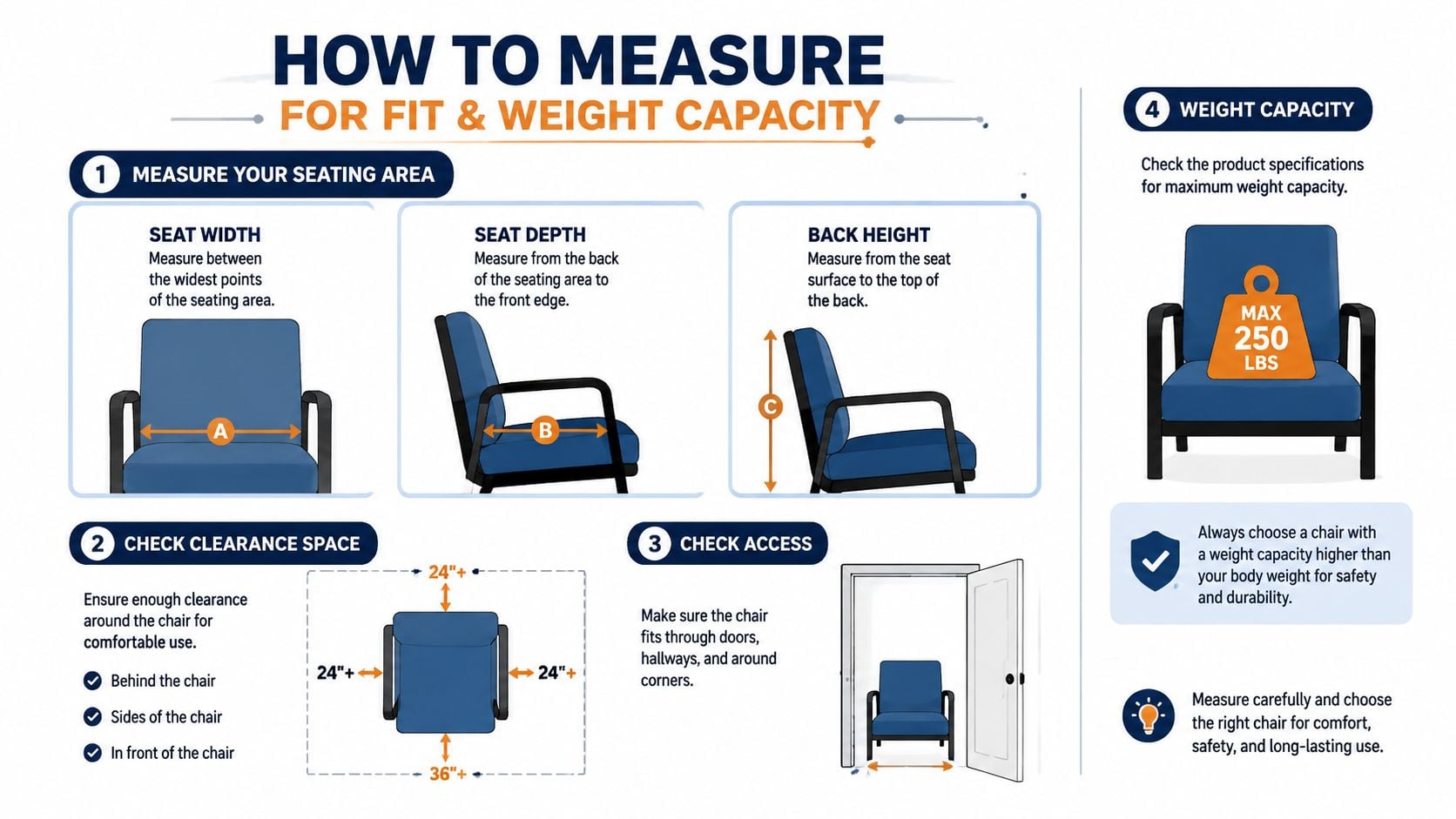
The three measurements that matter are width, weight, and mounting compatibility. Skip one of them and the whole setup becomes a gamble. Get all three right, and the TV feels built into the room instead of balanced on it.
A buying guide recommends the stand be 2 to 3 inches wider than the TV on each side, and it classifies medium stands as roughly 58 to 70 inches wide, usually 15 to 18 inches deep and 22 to 30 inches tall (Belleze size guide). That gives buyers a real starting point for proportion and clearance. For broader sizing guidance, measurements for your TV stand can help homeowners compare the room to the furniture before they shop.
Check the numbers in this order
A curved TV still uses the same mounting standard as a flat one. The curve affects viewing geometry, but it doesn't change the VESA pattern. That's why one representative stand for 35-inch to 85-inch TVs uses a VESA 600 x 400 mm mount, supports up to 150 lbs, and offers 15 degrees of left-right swivel and 12 degrees of up-down tilt (TransDeco curved stand specs).
- Width first: the stand should leave breathing room on both sides of the screen, not crowd the edge.
- Weight second: the TV rating and shelf ratings both matter, because storage loads can change the balance.
- VESA third: the bracket must match the TV's mounting pattern exactly.
A separate curved stand example shows why this triple check matters. One model is rated for a 55 kg maximum TV weight with a 55 kg top shelf load and 15 kg on each of two lower shelves, while another limits the TV to 25 kg with 10 kg shelf capacity (AVF curved stand specs). Those are not decorative details. They decide whether the unit is safe for the load it's carrying.
If the TV sits too high or too low, a guide to Groen's TV stand height advice can help narrow the fit. Height tuning is often what separates a setup that feels right from one that feels awkward.
Placement Strategies for Real Living Rooms
Corner placements cause more trouble than most shoppers expect. An off-center wall can push the TV away from the main sofa, while open-concept rooms can leave some seats too far to one side for a comfortable view. In those cases, the stand's shape matters less than whether it lets the screen sit at the right angle and height.
Swivel bases and adjustable mounts solve problems that fixed consoles can't. If the room has a sectional, a breakfast nook nearby, or a second seating zone, rotation can matter more than the cabinet's front profile. A compact stand built for a corner can also free up floor space, but only if it stays stable and leaves enough room for cables.
Layout first, furniture second
The right setup usually starts with the primary seat, not the TV wall. If the main viewing position is off-center, the screen needs a little more adjustment freedom. If the TV sits in a corner, the base should fit the angle without making the room feel cramped.
For homeowners thinking about a media-heavy family room or game room, 2026 game room setup ideas can be a useful layout prompt before any furniture is ordered. The point is simple. A good stand supports the way the family uses the space.
Corner rooms reward compact footprints and flexible mounts, not oversized statements.
That's especially true in Northwest Indiana homes where living rooms often serve more than one function. A setup that looks balanced from one couch and terrible from another is the wrong setup. Adjustable placement beats visual symmetry when the room has multiple watching positions.
Materials and Styles That Last Generations
A curved TV stand should be built like real furniture, not treated like disposable electronics support. That means stable construction, durable surfaces, and a footprint that resists tipping when the TV or accessories are loaded on top. Wider bases help because they spread the load and reduce flex, which matters when a larger curved panel extends the visual mass of the setup.
Multi-material construction handles that job well. A stand with a powder-coated steel frame and engineered wood surfaces can control deflection under load better than a flimsy single-material piece. A heavier console can also keep vibration down when the shelves hold a cable box, a game system, or a soundbar.
Style should follow the room, not a trend
For homeowners who want something built to fit existing décor, custom order services are the smarter route. Groen's offers custom furniture, including Amish solid wood pieces made to exact specifications, which makes sense for families who want a piece that lives with the room instead of fighting it. That's the right approach for a media space that needs to feel finished for years, not just until the next TV upgrade.
The same design mindset applies to the rest of the room. A thoughtful homeowner will coordinate the entertainment piece with wall color, flooring, and window treatments, the same way someone would use smart shopping for window treatments to pull a room together without wasting money on mismatched pieces. Furniture and finishes work best when they're planned together.
Family rule: buy the piece that fits the room you live in, not the room you wish you had.
For shoppers who want more context on how material choice affects longevity, wood furniture explained is a strong place to start. And for households that need to fit the purchase into the budget, special financing can make heirloom-quality entertainment furniture more accessible, subject to credit approval.

Cable Management and Installation Tips
Clean installation starts with the cables, not the décor. A good stand should give cords a path that keeps them from hanging loose, snagging, or pressing against moving parts. Integrated cable management is worth using every time because it keeps the entertainment center tidy and lowers the risk of strain on the wiring.
Heaviest components belong on the lowest shelf. That keeps the center of gravity down and helps reduce flex that can nudge the screen out of alignment. It also keeps the stand from feeling top-heavy when the TV is paired with a receiver, game system, or media player.
Avoid the mistakes that cause headaches later
- Don't overload the shelves: the TV rating and the shelf rating are both real limits.
- Don't block the signal path: decorative items can interfere with IR-friendly components.
- Don't leave cables slack near corners: angled setups need tighter routing and cleaner bends.
- Do leave ventilation space: electronics need air, especially when they sit inside enclosed storage.
- Do check the lower shelves first: heavier gear should stay closest to the floor.
A curved TV stand with swivel or height adjustment should be installed carefully so the viewing angle feels natural from the main seat. One stand with a height-adjustable range from 868 to 1068 mm shows why that adjustment matters (Techly floor stand specs). The wrong height can make a good room feel strained.
If a corner setup is involved, route the cables before the final placement. That keeps the back of the unit accessible and avoids tugging the cords when the stand is moved into position. A clean installation doesn't just look better, it lasts better.
Visit Groen's to Find Your Perfect Entertainment Setup
A curved TV deserves more than a guess. It deserves the right width, the right support, and a layout that works for the way the family watches TV in Dyer, Crown Point, St. John, Schererville, Munster, and across Northwest Indiana. That's where a real showroom helps, because it lets homeowners see the materials, compare storage, and test the stability before they buy.
Groen's Fine Furniture has served NWI since 1983 with multigenerational ownership and 5-star service, and that local experience matters when the room has to fit a real house, not a catalog page. Shoppers can look through entertainment console options and talk through custom needs, room dimensions, and special financing options subject to credit approval. Bring the TV specs, bring the room measurements, and let a knowledgeable team help narrow the choices.
Our family keeps the focus on practical comfort, honest guidance, and furniture that lasts. If the curved screen is already in the house, the next step is finding the stand that makes it feel right.
Visit Groen's Fine Furniture in Dyer or Crown Point to explore custom options, compare entertainment pieces, and ask about special financing plans. Let our family help you choose a curved TV stand that fits your room, your TV, and the way your home really works.