Home Office Furniture Contemporary: A Buyer’s Guide

In 2023, 13.8% of American workers, roughly one in seven, usually worked from home, more than double the 5.7% recorded in 2019, according to the U.S. Census Bureau. The home office is now a permanent room in many Northwest Indiana houses.
Around Dyer, Crown Point and the rest of the region, the practical question is which pieces can take a full workweek and still sit naturally beside living room and bedroom furniture. Start with fit. A stylish desk fails if chair height, monitor distance and knee clearance push you into bad posture by midafternoon. Choose the chair and measurements first, then let finish, color and hardware earn their place.
What Makes Home Office Furniture Contemporary
In the first quarter of 2024, 35.5 million people teleworked or worked at home for pay, equal to 22.9% of everyone at work, and those teleworkers averaged 27.2 hours a week at home, according to the U.S. Bureau of Labor Statistics. That's a part-time job's worth of hours spent in a room that also has to look like somebody lives there.
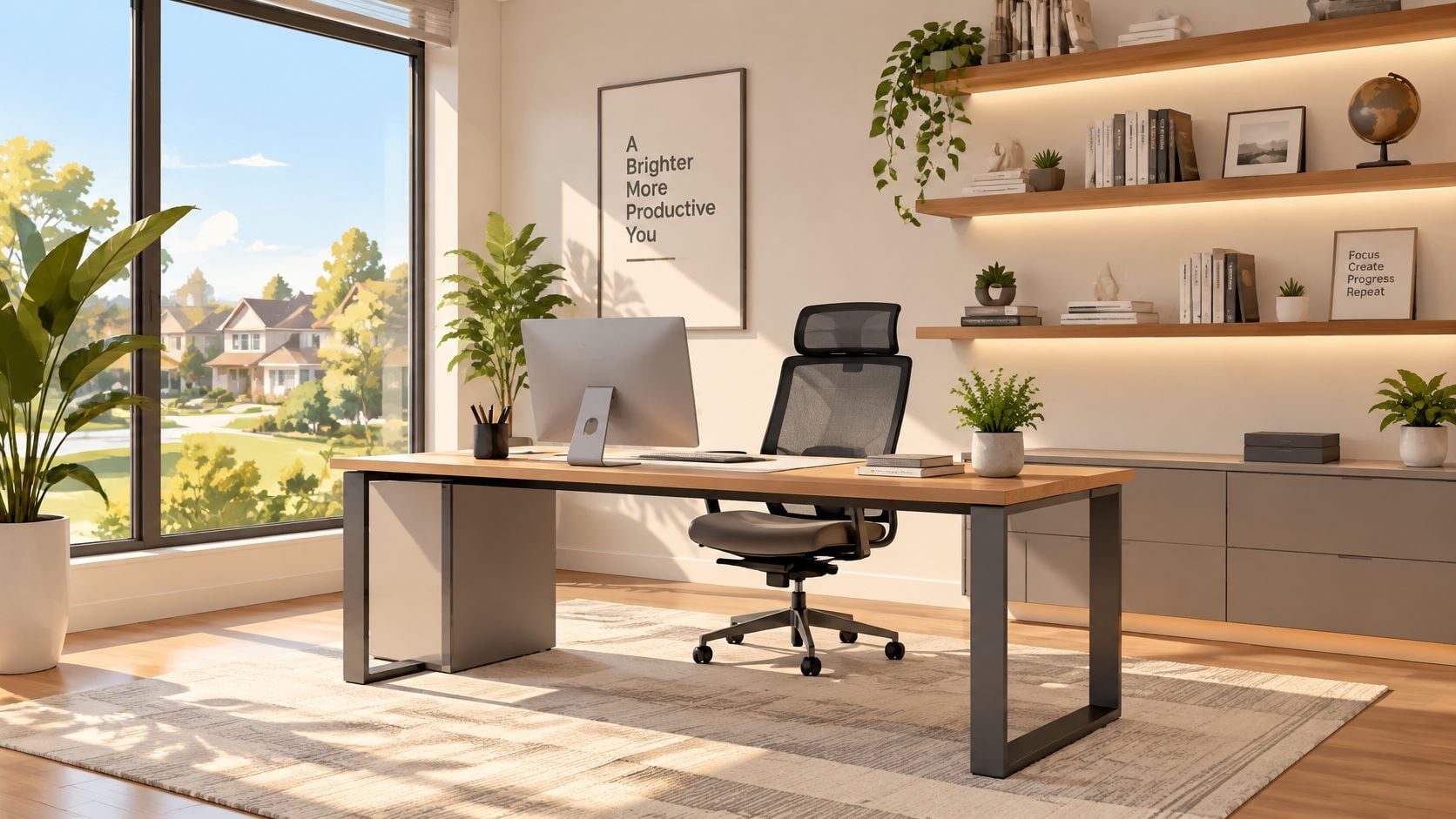
Contemporary styling for a home office comes down to five decisions: clean lines and slim frames, a restrained palette of neutral upholstery paired with wood and matte metal, closed storage instead of open clutter, cable management that disappears behind a panel, and performance fabrics that handle daily use without a fuss. The look reads modern because nothing in the room is shouting.
Buying office furniture that looks modern but feels residential means treating the desk, chair and storage as one system. Buy the chair first, then the desk that fits it. Measure the room before either.
The tailoring test: a contemporary office should fit the body and the room before it impresses the eye. A beautiful desk that pushes the screen too close has stopped being a workstation.
A spare bedroom in Schererville and a loft in Munster will need different footprints, but both reward the same instinct: fewer pieces, better chosen, each doing two jobs. A credenza that holds files and serves as a landing spot for keys. A desk that reads as a writing table when the laptop closes. A file pedestal on casters earns its keep too, sliding under the desk during work hours and out of sight when the room hosts overnight guests.
If the line between contemporary and traditional still feels blurry, this comparison of contemporary and traditional design styles covers the tells. Groen's Fine Furniture has been family-owned and serving Northwest Indiana since 1983, and the guide below follows the same order of operations its team walks through in the showroom.
Measurements That Make a Contemporary Office Work
Width and finish are the last things to compare. These are the first.
| Measurement | Target range | Why it matters |
|---|---|---|
| Monitor distance from eyes | At least 20 in (50 cm) | Prevents leaning in and neck strain |
| Eye-to-monitor range | 19.7-27.6 in (500-700 mm) | Keeps the screen at a readable distance |
| Workstation height | 27.6-31.5 in (700-800 mm) | Supports level forearms at the keyboard |
| Chair seat height | 15.0-20.5 in (380-520 mm) | Keeps feet flat and hips and knees neutral |
| Chair seat width | At least 17.7 in (450 mm) | Leaves room to shift position during long sessions |
| Lumbar backrest width | At least 14.2 in (360 mm) | Supports the lower back across the spine |
| Lumbar height above seat | 5.9-9.8 in (150-250 mm) | Matches the natural curve of the spine |
| Backrest recline | At least 15 degrees, lockable | Allows posture changes during long sessions |
Desk Depth Decides Everything Else
OSHA's desk guidance recommends a work surface deep enough to hold the monitor at least 20 inches (50 centimeters) from the eyes, with the keyboard, mouse and screen within easy reach. A shallow top does two bad things at once. It pulls the screen closer than the eye can comfortably focus, and it leaves no room for the forearms to rest while the trunk stays upright.
The cause and effect is mechanical. When the screen moves in, the head follows, and the neck spends the afternoon tilted. When the desk is too high, the shoulders hike to reach the keyboard. Neither problem is fixed by a nicer finish.
Height and Reach Ranges to Write Down
The OSHA computer workstation purchasing guide collects the working ranges worth carrying into any showroom: a workstation height of 27.6 to 31.5 inches (700 to 800 mm), a chair seat height of 15.0 to 20.5 inches (380 to 520 mm), and a practical eye-to-monitor range of about 19.7 to 27.6 inches (500 to 700 mm). A fixed-height desk or a chair without adjustment locks the user out of all three.
Place the Monitor Before You Choose the Desk
Preferred viewing distance for a desk-mounted screen sits in the 20 to 40 inch (50 to 100 centimeter) window, per OSHA's monitor placement guidance, with the display directly in front of the user and no more than 35 degrees to either side. That's why the monitor arm matters as much as the desktop: it lets a slim desk hold the screen at the right depth without eating surface area.
Ask for the test report, not the photo. The BIFMA standards list names ANSI/BIFMA X5.5-2021 for desk and table products, including height-adjustable tables and monitor arms, plus BIFMA X10.1-2024 for furniture dimensions built around computer use. Any retailer can answer whether a piece was tested to those.
The Three-Step Check Anyone Can Run
- Measure eye height while seated. Sit in the chair you own, feet flat, and note the height of your eyes from the floor. That number sets your desk height.
- Confirm desk depth against the 20-inch rule. Add the monitor's own footprint, not just its screen size.
- Test the chair last. Adjust seat height, then lumbar, then recline. If the settings fight each other, the chair is wrong regardless of how it looks.
A tape measure and five minutes will settle more than a catalog photo ever will, which is why measuring furniture before buying is worth doing at home before the showroom visit.
Desks, Storage and Accents That Fit the Look
Match the desk to the workday before you judge the silhouette. A deep-top writing desk suits a spare bedroom where the door closes at six. A height-adjustable table earns its footprint when you alternate sitting and standing through the day. A tilt-top or keyboard table fits a laptop-plus-monitor setup where the screen needs its own plane. A compact computer desk works in a shared room only if it still passes the seated fit checks covered in the measurements section once the keyboard tray drops.
Measure the top before falling for the finish. The surface has to hold the monitor, keyboard, mouse, paperwork and a monitor arm while leaving knee clearance at your seated height. A desk that clears those checks earns the right to be judged on looks. Finish comes second.
Storage That Disappears
Closed storage keeps a contemporary office looking contemporary. A credenza with doors hides the printer, the files and the cable nest, and in a dining corner it passes as a sideboard. Slim bookcases and wall-mounted cabinets with concealed channels do the same job vertically, and vertical storage costs almost no floor area in a small room. Open shelving works in small doses: a few curated objects rather than a wall of bins. Desks, office chairs, office storage and bookcases sit together in our home office category, so the full arrangement can be compared in one visit.
Lighting and the Finishing Layer
Choose an LED task lamp for the desk. The U.S. Department of Energy's LED adoption report estimated LED adoption would produce 1.3 quadrillion British thermal units of annual U.S. energy savings in 2018, about $14.7 billion in consumer cost savings. An LED produces the same light on a fraction of the electricity an incandescent draws, so a lamp that burns six hours a day returns the difference on the utility bill month after month.
For accents, lay a rug that defines the work zone, pick a matte-metal or wood-tone lamp, and add one warm material, such as a walnut-finished top or a solid wood shelf, to balance the cooler metal and fabric. That single warm note keeps home office furniture contemporary and lived-in.
Materials and Finishes That Hold Up
Green labels don't build confidence on their own. In a survey reported by Home Accents Today, 57% of surveyed U.S. furniture purchasers said they'd be likely to buy furniture labeled sustainable and 43% described themselves as environmentally conscious, yet price was the leading barrier at 55%, 27% worried about durability or quality, 23% about limited availability and styles, and 15% about insufficient information on sustainability claims. Interest in refurbished furniture runs lower still, which shows how much of this market rides on what a buyer can inspect firsthand.
Shoppers want sustainability claims they can verify. A label no one can check is decoration. The materials below pass a stricter test: you can see the joint, feel the finish and ask for a number before money moves.
| Material | Durability | Best use in the office | What to verify |
|---|---|---|---|
| Solid wood | Very high; can be refinished | Desktops, storage and heirloom pieces | Joinery, finish and wood species |
| Veneer over engineered core | Good when sealed; edges can chip | Desks and cabinet fronts for clean lines | Edge banding and core density |
| Engineered panels (MDF or particleboard) | Moderate; sensitive to moisture | Budget shelving and closed storage | Panel thickness and weight rating |
| Performance fabric | High; resists stains and fading | Chair and sofa seating | Abrasion rating and cleanability |
| Metal frames | High; stable under load | Slim desk legs and chair bases | Weld quality and finish coating |
| Second-hand or refurbished | Follows the base material | Storage and accent pieces | Structural check and finish safety |
Why Solid Wood Wins the Long Argument
A desktop takes elbows, coffee rings, monitor clamps and a decade of sliding keyboards. Solid wood can be sanded and refinished rather than replaced, which is the one sustainability claim that survives contact with a real household. Veneer gives the cleaner line contemporary styling wants, and it's a legitimate choice, but its edges have to be sealed or moisture finds the core. Engineered panels earn their place inside closed storage where nothing leans on them hard; a daily-use top is where they fail first.
The sticker price is the down payment. Cost per year of service is the real number. Judge a material by what one year of daily use does to it.
Three Checks Before Money Changes Hands
Joinery. Look underneath. Dovetail drawers, corner blocks, mortise-and-tenon joints and glued-and-screwed rails tell the truth faster than any finish sample.
Finish. Run a fingernail along an edge and a damp thumb across the surface. A finish that lifts or clouds under moisture won't survive a coffee cup, and a contemporary desk lives under one daily.
Weight rating. Ask what the shelf, drawer and desktop are rated to hold, then add the monitor arm, the printer and the stack of files you own. A rating is a figure a sales associate can quote. No rating means the piece was built for photos, not work.
Each check produces something measurable: a joint type, a surface that passes a wet-thumb test, a load figure. Let those answers set the price bracket, and the contemporary look becomes the reward for a frame that earned it.
Planning a Home Office in Shared Rooms
Half of U.S. employees hold jobs that can be performed remotely, and 60% of those employees prefer a hybrid arrangement, according to Midwest Design Magazine's report on hybrid work. Hybrid is the hard case. It asks one room to be a workspace on Tuesday, a guest room on Friday and a family room every evening.
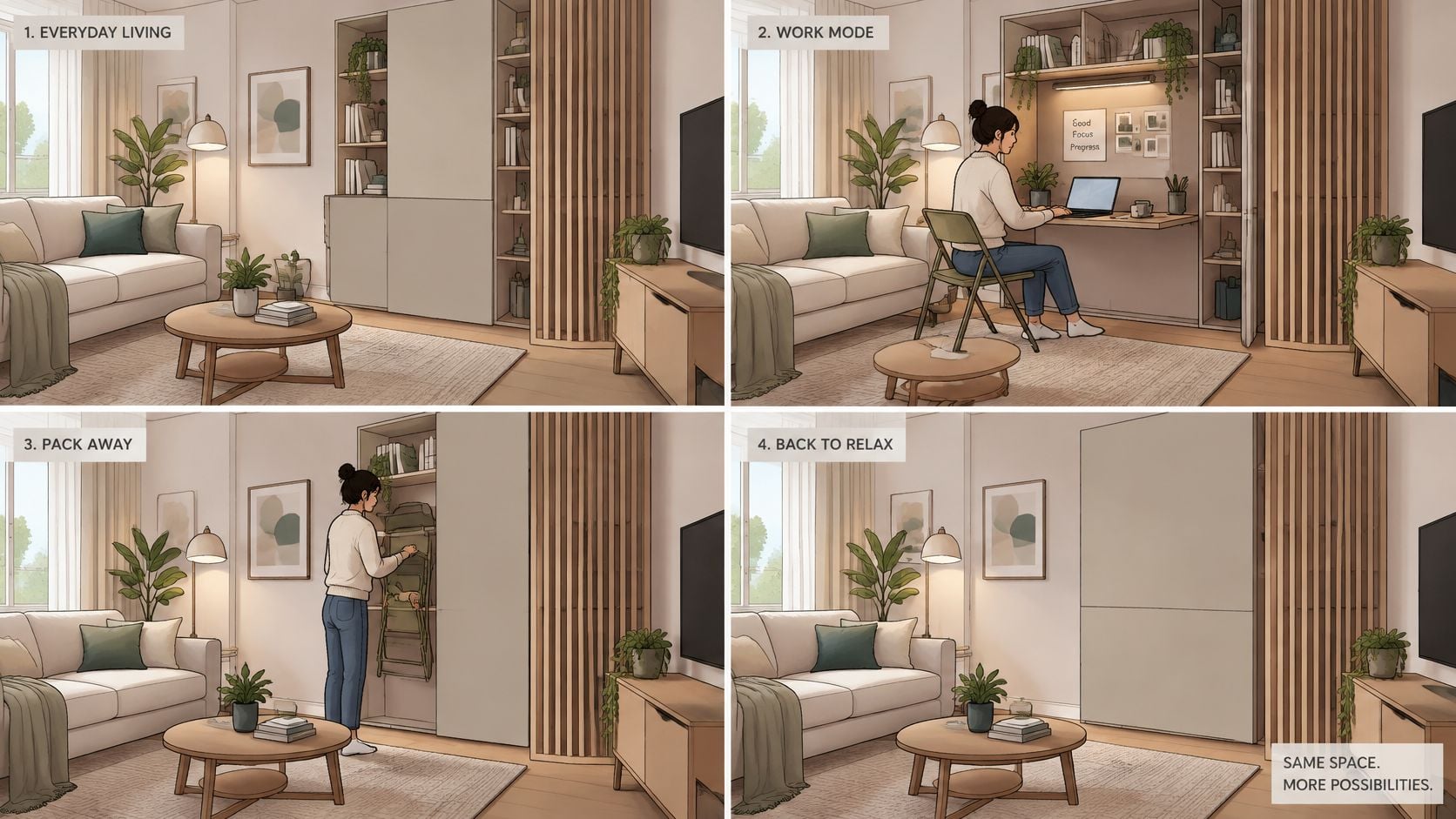
Smaller rooms usually need fewer pieces, not more. A writing desk, a credenza that doubles as storage, nesting tables and a chair that rolls out of the way will outperform a matching suite that swallows the floor.
| Room | Footprint and layout | Furniture that fits | Main issue to plan for |
|---|---|---|---|
| Spare bedroom | Full room, door can close | Desk with deep top, task chair, closed storage | Keeping the work zone separate from sleep |
| Dining corner | Table edge and wall, shared with meals | Writing desk, slim credenza, movable chair | Clearing the surface at the end of each day |
| Living room nook | Open space, shared with family | Compact desk, nesting tables, cable-managed storage | Noise and visual clutter from the rest of the room |
| Loft or landing | Open edge, often with a rail or wall | Narrow desk, storage wall, task lighting | Acoustic privacy and a camera-friendly background |
Camera, Noise and Cable
Video calls expose everything the room hides. Sit in the chair and open the laptop camera before you commit to a desk position: the background should be a wall or a shelf, not a hallway with traffic. A rug and an upholstered chair absorb some of the household noise that hard floors bounce around, and a door that closes is worth more than any acoustic panel.
Route cables before the furniture arrives. A credenza against the wall with a channel behind it hides the power strip, the router and the charging cables, and it means nothing has to be drilled into a wall you may want back later. Movable pieces solve the same problem with less commitment.
Light the face, not the screen. Put the desk perpendicular to the window so daylight falls across the keyboard, and place the task lamp on the side opposite your writing hand.
A Plan You Can Start This Weekend
Sketch the room to scale and mark the work zone, including the chair's swing when it rolls back. Note where the outlets are, then decide which wall can hold a desk without blocking a door or a heat register. Choose one flexible piece to start, live with it for a week, and add the second piece once you know how the room gets used.
A two-person office raises different questions about sharing surface and sound, which planning a home office desk for two covers in more detail.
Choosing a Chair and Testing It in Our Showroom
Lumbar support has to match a body, not a photograph. OSHA's guidance on chairs asks for a backrest that follows the spine's natural curve, provides lumbar support, and reclines at least 15 degrees with the option to lock. The Canadian Centre for Occupational Health and Safety's office chair guidelines add the numbers that make those qualities testable: a seat width of at least 450 mm (17.7 inches), a lumbar-region backrest at least 360 mm (14.2 inches) wide, lumbar support positioned 150 to 250 mm (5.9 to 9.8 inches) above the seat, and at least 50 mm (2 inches) of vertical lumbar adjustment.
That last figure decides comfort for most sitters. A chair with a fixed lumbar pad fits one body type and presses into another, and pressure is what produces the slouch people blame on their own posture. Height-adjustable lumbar support is the feature to insist on.
Three Chair Families Worth Comparing
The order matters here: fit first, looks second. Slim-frame task chairs with mesh backs suit long sessions and warm rooms. Upholstered executive chairs in performance fabric read warmer and hide wear. Wood-accented chairs bridge a contemporary desk and a traditional room, and they earn their place where the chair is seen as much as sat in. Upholstered options from Flexsteel and Bassett hold up well and sit comfortably in a contemporary scheme, but a chair enters the plan only after the fit check passes.
The Sit Test, in Order
- Bring your numbers. Room width and depth, monitor size, the desk footprint from the measurement table, and how many hours a day you sit.
- Sit for twenty minutes. Not twenty seconds. Three chairs, twenty minutes each, with your own laptop if possible.
- Set the seat height first. Feet flat on the floor, then check that the front edge of the seat doesn't press behind the knee. A rounded seat edge helps here.
- Adjust the lumbar, then recline. The back should move independently of the seat so you can change posture without sliding forward.
- Check the arms and the reach. Forearms level, shoulders down, mouse within easy reach.
The pass mark: feet flat, back supported, forearms level, no pressure behind the knees. A chair that needs a cushion to pass is the wrong chair.
The showroom's home office selection covers desks, office chairs, office storage and bookcases, so a chair can be tested against the desk it will live with rather than in isolation. Roll it up to the desk height you measured, then check knee clearance and the reach to the keyboard together. Groen's Fine Furniture is a family-owned business with showrooms in Dyer and Crown Point, and the staff's decades of combined sales experience turn a spec sheet question into a fit decision. Sitting in the chair first is the practical advantage of choosing an office chair for long hours in person.
Custom Orders and Special Financing for Your Office
Nobody has to accept a stock desk in a stock depth. Custom ordering fixes the one dimension that matters most: the distance from the front edge to the back, where the monitor sits. A custom depth can meet the 20-inch monitor clearance without making the desk look like a conference table, because the extra inches go behind the screen, not in front of the user.
The order itself runs in four steps.
- Measure the room and the footprint. Wall to wall, plus the chair's roll-back space.
- Write down the target dimensions. Desk height, top depth, monitor distance and seat height from the measurement table.
- Choose the species, finish and fabric. Wood tone sets the warmth, fabric sets the durability, and both should answer to the room next door.
- Ask about special financing. It is buying power, subject to credit approval, and it lets a better piece land in the room now rather than after another year of saving.
Amish-crafted solid wood desks are built to exact specifications, which is the difference between a desk that fits the room and a room arranged around a desk. A custom order also keeps the office in step with the household: upholstery can be matched to the same chair plan across Flexsteel and Bassett frames, so the room that shares a wall with the den doesn't drift into a different decade.
Why Custom Beats Compromise
A stock piece forces three compromises at once: depth, height and finish. Custom ordering removes all three, and a solid wood top can be refinished decades later instead of replaced. The fit argument carries as much weight as the durability one. A desk built to the room's numbers keeps the monitor at the tested distance and the chair's roll-back space clear, which no stock size can promise for a specific spare bedroom.
Groen's Fine Furniture welcomes custom orders, and sales associates help customers match the right item to the room, including guidance on furniture financing options for larger orders. Rates and terms depend on credit approval and change over time, so the showroom is the place to get current figures. Bring the wall-to-wall measurements and the desk footprint numbers with you, and the exact configuration gets priced on the spot.
Visit Groen's Fine Furniture in Dyer or Crown Point to sit in the chairs for a full twenty minutes, put a tape measure against the desks and see how a wood finish reads in daylight before it lands in a spare bedroom. Ask for a custom-depth quote on an Amish-built desk and a financing review in the same visit, and the office you measured on paper leaves the showroom as an order instead of a compromise.