Custom Dining Table and Chairs: A Step-by-Step Guide

A homeowner in Dyer can spend weeks choosing the perfect wood tone, only to discover that the chairs block the hallway and nobody can sit comfortably beneath the table. That's the most common custom dining mistake. Buyers focus on style first, then try to make the room work around a piece that was never measured for the household.
A custom dining table and chairs should be planned around real life, body comfort, traffic flow, and long-term use. Groen's Fine Furniture has served Northwest Indiana since 1983, helping families in Dyer, Crown Point, St. John, Schererville, and Munster make those decisions with practical guidance, custom-order options, solid wood construction, and five-star service.
Why a Custom Dining Set Starts With How Your Room Actually Works
A Dyer homeowner recently falls for the look of a long trestle table online. The table appears generous and welcoming, but the dining nook measures only 9 by 10 feet. Once chairs are pulled out, they clip the hutch. Someone standing from the table blocks the path to the patio door, and the family starts eating at the kitchen island instead.
The problem isn't the table's style. The problem is that the table was chosen before the room's job was understood. Custom dining starts as a fit decision, not a finish decision.
Decide how the room works every day
A formal dining room used only for holidays has different requirements from a kitchen-adjacent table that handles breakfast, homework, craft projects, and evening meals. A family with young children may value rounded corners and durable upholstery more than a delicate edge profile. A household that hosts often may prioritize extension leaves, comfortable end chairs, and clear circulation around the table.
Three questions should guide the first showroom conversation:
- What happens at the table daily? Meals, homework, remote work, board games, entertaining, or occasional holiday gatherings all affect dimensions and materials.
- How many seats are needed? A table that technically seats eight may crowd the room if six people use it every day.
- Where does traffic move? Identify the routes between the kitchen, hallway, living room, garage entry, and patio doors before selecting a base or chair shape.
A narrower table may preserve a walkway. A rounded or oval top may improve circulation where square corners create collisions. A pedestal can give more flexible legroom than a four-corner leg design, while a carefully proportioned apron can preserve structure without interfering with knees or chair arms.
Practical rule: A dining table should support the household's movement, not force everyone to walk around it.
Custom dimensions also solve problems that an off-the-floor set can't. The table can be made to fit an unusual nook, the edge can be softened for a busy family, and the chair clearance can be checked against the tabletop and apron before the order is entered. Homeowners looking for a broader planning framework can also review Groen's dining-room design guide and these hospitality furniture tips from Simply Hospitality for practical ideas about circulation, durability, and guest comfort.
Measuring Your Space and Locking In the Right Table Dimensions
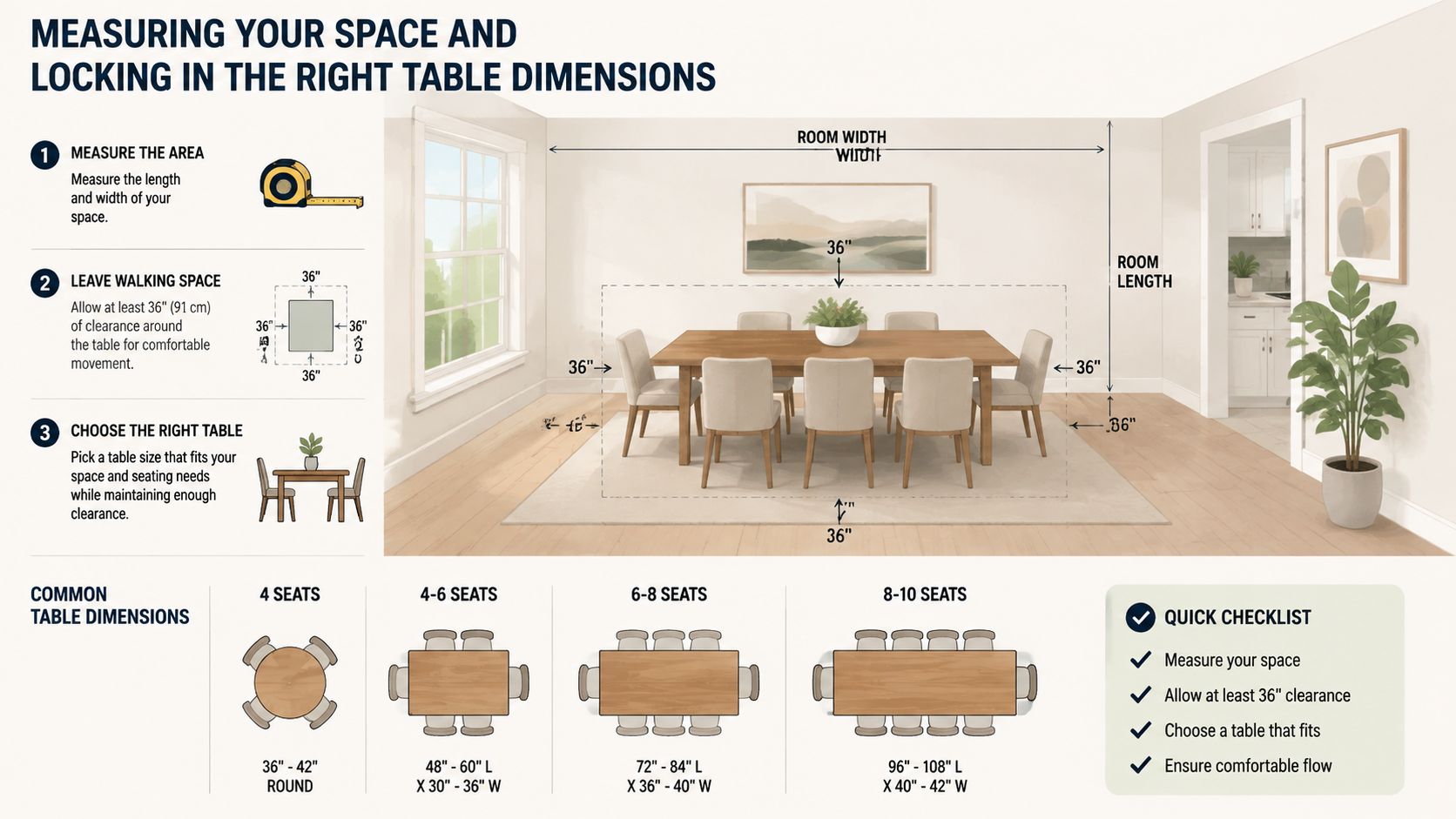
A table can fit on paper and still fail in the room. Before choosing a shape, base, or chair, use a tape measure and painter's tape to test the full furniture footprint, including how people pull out seats and walk past them.
Mark the room before choosing the table
Measure the room's length and width. Record door swings, windows, HVAC vents, radiators, built-in cabinets, and furniture that will stay. Trace the main paths between the kitchen, dining area, hallway, living room, garage entry, and patio doors.
Tape the proposed tabletop directly onto the floor. Mark the complete length and width, not only the base. Set temporary chairs along the edges, then pull them out as diners would during a meal. This exposes cramped corners before the dimensions reach the order form.
Use these checkpoints:
- Chair clearance: Allow about 36 inches around each side of the table for a chair and ordinary movement.
- Standing space: Plan for at least 42 inches behind each chair where someone must push back and stand.
- Overhang: A 10-to-12-inch overhang gives diners useful elbow room without making the top look heavy.
- Seat-to-table gap: Aim for 10 to 12 inches between the chair seat and tabletop, a range supported by Eureka Ergonomic's table and chair measurements.
Check the underside, too. A thick top, low apron, or upholstered cushion can reduce knee and arm clearance even when the overall table dimensions look standard. Bring the chair measurements to the showroom, especially if you plan to reuse existing seating. A chair that looks right beside the table can still feel wrong after a full meal.
Bring a simple worksheet to the showroom
Write down:
- Room size: Length and width.
- Fixed obstacles: Doors, vents, windows, cabinets, and radiators.
- Usable footprint: The largest taped table length and width that preserves circulation.
- Daily seating: The number of people who normally eat together.
- Occasional seating: The number needed for guests.
- Chair dimensions: Existing chair width, depth, and seat height if chairs are being reused.
- Table clearance: Seat height compared with the underside of the tabletop and apron.
- Extension needs: Whether leaves will be used weekly, seasonally, or rarely.
Use Groen's furniture measuring guide for a more detailed preparation checklist. A written sheet keeps the showroom discussion practical and helps the salesperson confirm table size, chair fit, and extension requirements before the order is entered.
Canadel Custom Dining Versus Amish Solid Wood Construction
Canadel and Amish solid wood furniture solve different problems. Canadel suits the buyer who wants broad visual control, coordinated dining pieces, and a made-to-order program with extensive combinations. Amish furniture suits the buyer who prioritizes solid hardwood, substantial construction, and a piece intended to remain in the family for years.
Canadel is known for dining-room furniture and describes its products as handcrafted in North America on its official dining furniture site. Its custom program lets buyers work through size, shape, base, wood tone, finish, and related dining-room details. That makes it a strong choice for a homeowner who wants a specific two-tone appearance, a particular silhouette, or a table that doesn't match stock dimensions.
Amish construction takes a more traditional route. Solid hardwood options can include oak, brown maple, quarter-sawn white oak, and cherry, with construction details such as dovetailed drawers and mortise-and-tenon joinery. These pieces tend to feel heavier and more substantial, and their pricing reflects the labor, material, and joinery involved. A useful explanation of the difference between standardized and custom construction appears in The Cabinet Coach guide to cabinet selection, where the central lesson is to match construction choices to the homeowner's priorities.
Compare the two programs honestly
| Factor | Canadel Custom Dining | Amish Solid Wood |
|---|---|---|
| Best fit | Buyers who want many coordinated style and finish choices | Buyers who want substantial hardwood construction and heirloom character |
| Customization | Broad choices in size, shape, base, finish, and dining components | Deep specification of wood, dimensions, profiles, and construction details |
| Construction character | Handcrafted, made-to-order dining furniture | Solid hardwood furniture made by craftsmen |
| Finish direction | Strong choice for coordinated, painted, stained, or two-tone looks | Strong choice for natural wood character and traditional stain tones |
| Timing | Often selected when design flexibility and a more moderate production window matter | Often selected when construction depth matters more than speed |
| Trade-off | More choices require careful decisions before order entry | More substantial construction can require greater budget and patience |
Current custom-furniture market data reinforces why this category deserves careful consideration. The global custom furniture market is estimated at USD 44.76 billion in 2026 and projected to reach USD 115 billion by 2035, implying an 11.2% CAGR, according to Business Research Insights. The choice between Canadel and Amish isn't about declaring one universally superior. It's about deciding whether the priority is visual flexibility, construction tradition, or a balance of both.
Homeowners can also read what Amish furniture means before comparing samples in person. Groen's Fine Furniture offers both Canadel custom dining and Amish solid wood options, allowing buyers to compare the weight, finish, joinery, and chair comfort directly.
Designing the Table and Choosing Finishes, Fabrics, and Hardware
A custom order form turns vague preferences into fixed decisions. Buyers should arrive ready to discuss more than “dark wood” or “farmhouse style.” The important choices include proportions, storage, edge treatment, base design, upholstery, and the protective details that determine how the set will live with a family.
Separate appearance decisions from comfort decisions
Length and width determine the footprint, while extension leaves determine how the table changes when guests arrive. Self-storing leaves are convenient because the leaves remain with the table. Separate leaf storage can work well when the household has a dedicated closet or storage room, but the owner must plan for lifting and storing the pieces.
The tabletop edge matters more than many shoppers expect. A softened edge feels friendlier in a high-traffic space, while a sharper profile can create a more refined appearance. Pedestal bases offer flexible placement for legs, while leg bases can create a more traditional or architectural look. Apron height must be checked against chair arms and thigh clearance before the design is finalized.
| Category | Common Options | Notes |
|---|---|---|
| Top shape | Rectangle, oval, round, pill-shaped | Choose based on circulation and seating needs |
| Extension system | Self-storing leaves, separate leaves | Decide how often extensions will be used |
| Base | Legs, pedestal, trestle | Check leg placement against chairs and knees |
| Edge profile | Rounded, eased, square, shaped | Test the edge with a forearm before ordering |
| Wood finish | Stain, painted finish, two-tone treatment | View samples under showroom lighting |
| Chair seat | Wood, upholstered, leather | Consider cushion feel, cleaning, and daily use |
| Hardware | Nailhead trim, levelers, decorative pulls | Hardware changes character and practical stability |
| Protection | Standard finish, upgraded protective topcoat | Useful for households expecting heavy use |
Canadel's program demonstrates how extensive a custom dining order can become. Buyers may choose among details such as width, drawer style, door style, foot style, wood finish, hardware finish, and the option to add a hutch, as shown on its custom dining furniture program. The lesson applies broadly: customization is a series of connected choices, not a single color selection.
Ask the questions that prevent expensive revisions
For chairs, compare wood seats with upholstered or leather seats by sitting for several minutes, not by touching the sample briefly. If a household supplies its own material, ask whether the program accepts customer's own material, commonly called COM, and confirm the required yardage and approval process. Performance ratings can help compare durability, but the showroom test still matters because fabric texture and cushion firmness affect daily comfort.
Levelers are practical on older or uneven floors. Nailhead trim can add definition but may be less forgiving in homes with active children. Protective topcoat upgrades can be sensible for frequent meals and spills. Finish choices should be reviewed alongside the guidance in Groen's dining room table finishes guide.
Once the order is entered, dimensions, wood, finish, upholstery, and hardware may be difficult or impossible to change without cost or delay. Confirm every one of those choices in writing before approving production.
Placing the Order, Lead Times, Special Financing, and Delivery
A custom furniture purchase becomes easier when the operational steps are clear. The process usually moves from showroom selection to a written quote, deposit, factory order entry, production, warehouse receipt, and delivery scheduling. Each stage matters because a small change made early can be simple, while a change after production begins may not be available.
Understand the production window
Lead time depends on the program, the design, the finish, factory capacity, and whether a component is temporarily unavailable. Trade coverage reports that custom furniture lead times have grown by 41% and that complex pieces can take 10 to 14 weeks or 12 to 16 weeks, as discussed in the 2026 dining chair forecast. Those ranges are useful for planning, but the written estimate for the specific order should control expectations.
A careful order review should confirm:
- The exact dimensions: Table length, width, height, leaf size, and chair measurements.
- The finish specification: Wood species, stain, paint, sheen, and any two-tone placement.
- The upholstery details: Fabric, leather, performance requirements, and nailhead selection.
- The delivery address: Include stairs, narrow entries, elevators, and room placement.
- The estimated window: Ask what can affect the schedule and how updates will be communicated.
The financing conversation belongs at the beginning, not after the order is chosen. Groen's Fine Furniture offers Special Financing subject to credit approval, which can give a household more buying power while it plans a quality dining set. Retail financing commonly includes a pre-qualification step, illustrated by the Furniture Mart USA pre-qualification information, but shoppers should review the specific terms, promotional period, payment requirements, and total cost before accepting an offer.
Treat delivery as part of the purchase
White-Glove Delivery should include careful handling, room-of-choice placement, packaging removal, and an in-home review. Before signing the delivery paperwork, the homeowner should inspect the furniture under strong, angled light and check the following:
- Table alignment: Confirm the top sits evenly and the base is stable.
- Leaf fit: Insert each leaf and check that seams close properly.
- Chair glides: Verify that glides sit flat and chairs don't rock.
- Finish consistency: Look for unexpected marks, scratches, or finish differences.
- Placement: Confirm that the table and chairs fit the taped or planned footprint.
The custom-order starting guide from Groen's Fine Furniture can help shoppers prepare questions before committing. A written order, realistic timing, and a deliberate inspection protect the investment without making the process complicated.
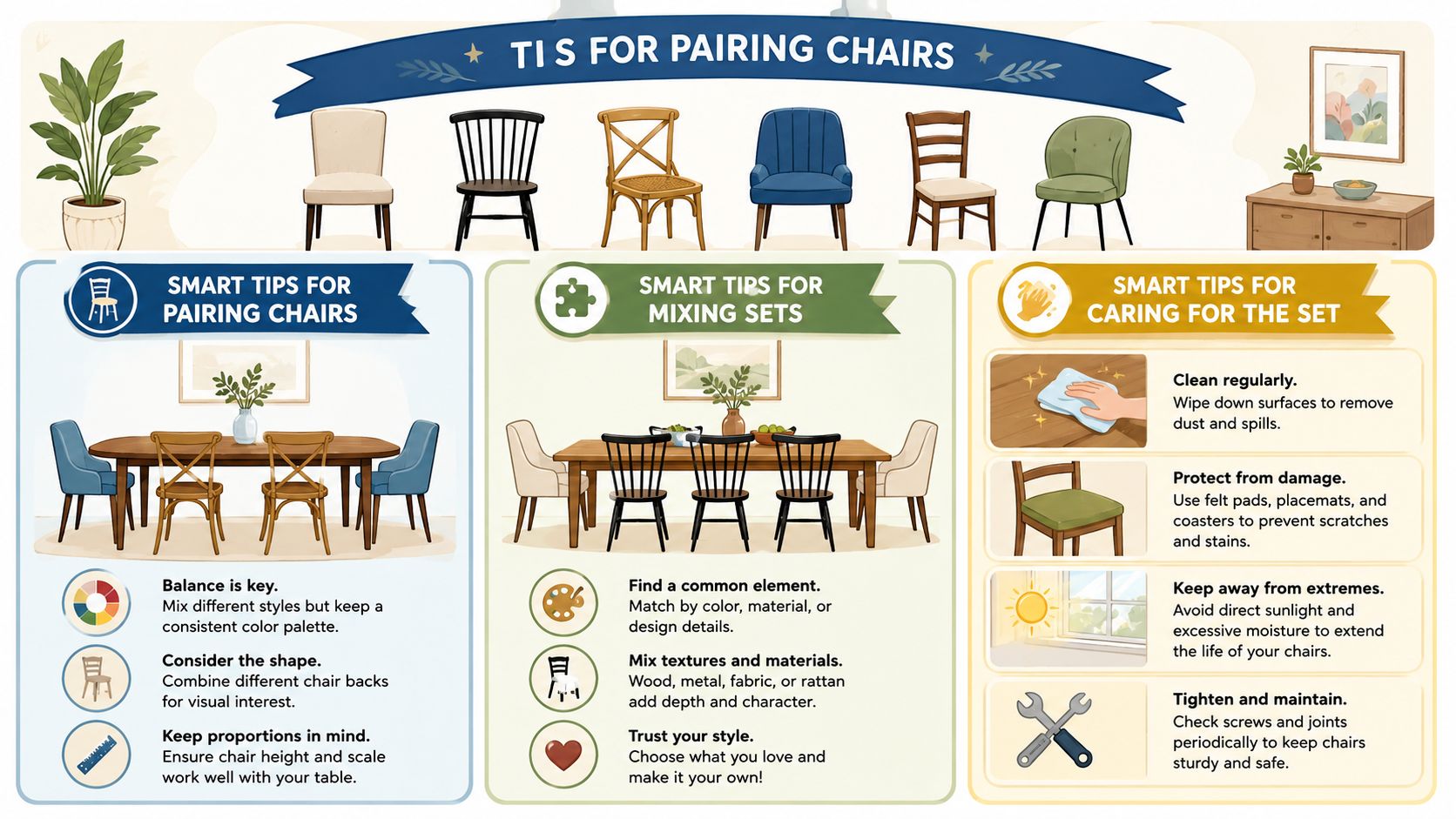
Smart Tips for Pairing Chairs, Mixing Sets, and Caring for the Set
A dining room can look polished without using the same chair at every position. The table and chairs should share a visual connection, while each seat serves the way your household eats, works, hosts, and moves through the room. Decide the seating roles first, then choose finishes and shapes that support them.
A solid wood table pairs well with upholstered side chairs for daily comfort and more supportive host chairs at the ends. Lighter chairs reduce the visual weight of a substantial table, while rounded backs can echo a softened tabletop edge. In a smaller dining area, varied chair shapes can improve movement and keep the room from feeling overly formal. Specify those differences on the order form, including which chairs need arms, which need upholstery, and whether every seat must slide beneath the table.
Make the comfort test a firm requirement
A showroom test should last longer than a quick perch. Sit normally, pull the chair beneath the table, place both feet on the floor, and check whether the apron presses against your knees. Armchairs need enough clearance to slide fully beneath the table, or enough space at the ends to avoid restricting circulation.
Ask these questions aloud:
- Does the seat height feel natural? Keep the previously discussed gap of about 10 to 12 inches between seat and tabletop in mind, then judge the fit with the actual table and chair together.
- Does the seat depth support relaxed posture? Dining chairs commonly use a seat depth of about 16 to 18 inches, according to the earlier dining table and chair dimension guidance. Use the measurement as a starting point, not a substitute for sitting.
- Does the cushion stay comfortable? Remain seated long enough to notice whether it supports you or collapses too readily.
- Do the arms clear the apron? Check seated comfort and whether you can pull the chair in completely.
- Does the finish work with the home? View samples from several showroom angles before approving the combination.
The heirloom dining furniture tips from Lewis and Sheron Textiles also reinforce the value of treating seating as a long-term part of the room rather than a disposable accessory.
Plan for care and future changes
Solid wood responds to its surroundings. Follow the manufacturer's care instructions, avoid harsh cleaners, and use coasters, placemats, and felt pads where appropriate. Store leaves as directed, rotate them when recommended, and protect them from excessive heat, moisture, and direct sunlight. The finish determines whether polishing or waxing is suitable, so do not apply a generic routine to every table.
Decide whether to order every chair now or add chairs later. Ordering the full set preserves consistent fabric and finish. Adding later can suit a growing household or changing room use, but matching depends on continued availability and accurate records. Before approving the order, record the exact finish, fabric, chair model, and relevant specifications so a future addition has the best chance of coordinating.
Your Next Step at Groen's in Dyer or Crown Point
The most productive showroom visit begins before a shopper walks through the door. Homeowners should bring room measurements, a few photos taken from the main entry points, and a short description of how the table will be used each day. Notes about children, pets, homework, holiday hosting, mobility needs, and existing furniture give a design specialist information that a style photograph can't provide.
Both Groen's Fine Furniture locations serve homeowners across Northwest Indiana, including Dyer, Crown Point, St. John, Schererville, and Munster. The team can help shoppers compare Canadel custom dining samples with Amish-built solid wood pieces, examine finish tones side by side, and test chairs at the actual table height rather than relying on catalog dimensions.
Use the visit to settle the decisions that photographs can't answer
A productive consultation should include:
- A layout conversation: Review the taped footprint, traffic paths, chair clearance, and extension needs.
- A comfort test: Sit in the chair, check seat depth, test arm clearance, and compare cushion firmness.
- A finish review: Hold wood and paint samples near the room photographs and view them under showroom lighting.
- A construction discussion: Compare the weight, joinery, wood character, and maintenance expectations of each program.
- A written quote: Confirm dimensions, finish, upholstery, delivery, and the expected production window.
- A financing review: Ask about current Special Financing options, credit approval requirements, promotional periods, and payment terms.
The broader living-and-dining furniture category is estimated at USD 256.10 billion in 2026 and projected to reach USD 314.43 billion by 2031, with a 4.19% CAGR, according to Mordor Intelligence's category analysis. Wood represented 38.73% of the category in 2025, while North America accounted for 32.64%, and Asia-Pacific was the fastest-growing region at a 4.72% CAGR through 2031, all from the same source. Those figures point to a practical truth for local homeowners. A dining set is a major home-furnishing decision, and the material, fit, and construction deserve the same attention as the room's color scheme.
Groen's multigenerational ownership, five-star service, Interior Design support, American-Made and solid wood options, Flexsteel durability, Bassett style, and complete home-furnishing services give families a place to discuss the whole project. The showroom visit is where a homeowner can test the seat height, feel the edge profile, compare finishes, and confirm that the chosen custom dining table and chairs work before the order is placed.
Groen's Fine Furniture offers Canadel custom dining, Amish solid wood furniture, Interior Design guidance, White-Glove Delivery, and Special Financing subject to credit approval for homeowners planning a dining room around real comfort and fit. Visit Groen's Fine Furniture in Dyer or Crown Point with room measurements and photos, then schedule a consultation or stop in to test-drive the chairs and table options.