
Mattress Pad Buying Guide for 2026: Fit, Care and Value

For homeowners in Dyer and Crown Point, mattress protection deserves attention before the first spill: 49% of 1,000 UK consumers who'd purchased a bed or mattress in the previous 12 months also bought a mattress protector, according to the National Bed Federation's 2025 Consumer Bed Buying Survey. But protection and comfort aren't the same purchase. A pad chosen for softness might do nothing to stop liquid.
For Northwest Indiana families, a useful mattress pad buying guide starts with the sleep problem, then screens products for safety documentation, fit, and laundering. Only after those checks should fabric, cushioning, and cooling claims decide the purchase.
Match Your Pad to the Problem It Must Solve
A mattress pad is a small purchase that can change how a bed feels, but it isn't a dependable cure for poor sleep. In Consumer Reports' 2022 sleep survey, 28% of respondents who purchased a mattress pad said it was "not too" or "not at all" helpful for improving sleep. A pad bought for the wrong job reads as wasted money, which is why the complaint has to come before the product.
Start by naming the problem: a scratchy or firm surface, clammy bedding, nighttime accidents, or dust-mite exposure. Each calls for a different construction, and each construction has a ceiling on what it can deliver.
Sleep need, pad type and limits
| Sleep need | Pad type | What it changes | What it cannot fix |
|---|---|---|---|
| Softer surface | Quilted or fiber-filled pad | Adds cushioning and a plusher feel | Cannot correct sagging or weak support |
| Breathability | Lightweight cotton or open-weave pad | Improves airflow over the sleep surface | Cannot cool a mattress that holds heat in its core |
| Spill protection | Waterproof protector with membrane | Blocks liquids from reaching the mattress | Adds little cushioning |
| Softer and protected | Quilted waterproof pad | Cushions and blocks liquid in one layer | Thickness must fit the sheet pocket |
| Dust-mite control | Zippered allergen-impermeable encasement | Limits mattress allergen exposure | Does not guarantee symptom relief on its own |
For slight surface firmness, quilting is a sensible starting point. For heat, piling on more fill works against the sleeper, because extra padding holds what an open weave would let escape. The breathability cost of waterproof membranes is a materials question, and it gets its fuller treatment under Materials, Thickness and Cooling Trade-offs.
For spills, check that the label says waterproof and names a membrane or laminate, since an absorbent top alone still lets liquid reach the mattress. Groen's Fine Furniture lays out the practical benefits of a mattress protector in a way that keeps protection claims separate from cushioning claims.
A quilted waterproof pad combines functions, so judge it as two products sharing one fitted sheet: the backing decides protection, the fill decides feel. Allergy-focused purchases ask a different question altogether, whether the cover fully encloses the mattress. A pad that only sits on top leaves the sides and underside unsealed.
Separate bedding discomfort from other sleep problems
Jaw or neck discomfort shouldn't automatically trigger a pad purchase. When head support is the concern, the Pain and Sleep Therapy Center's resource on better pillow support for jaw tension is the more relevant starting point, and the mattress pad can wait until the pillow question is settled.
Once the right construction is on the shortlist, the care label becomes the last filter. A perfectly matched pad that demands an impractical washing routine will spend its life in the closet instead of on the bed.
Practical rule: A pad refines a supportive mattress. It cannot restore support that a sagging mattress has already lost.
Safety Labels and Care Checks Before You Buy
Certification comes before comfort. The Consumer Product Safety Commission's mattress and bedding guidance explains that 16 CFR Part 1632 requires mattress pads to resist ignition from a lighted cigarette, with no char extending more than 2 inches, or 5.1 centimeters, in any direction from the cigarette's nearest point. General-use pads also require a General Certificate of Conformity documenting compliance.
That documentation often sits with the manufacturer or retailer rather than on the pad itself, so ask to see it before you pay. A reassuring phrase on the package says nothing about test results.
A store-ready screening checklist
- Certificate of Conformity: Ask for the Certificate of Conformity and confirm it names the product and the standard it meets; a fabric description does not count as certification.
- Established retailer: Choose a retailer that can identify the manufacturer, explain the labels, and pull product documentation on request.
- Care label: Read the permitted water temperature, bleach restrictions, and drying instructions before buying. If the routine asks more of the household than it can give, pick a simpler pad.
- Washer and dryer capacity: Check whether the pad can move freely inside the machines. A crowded drum leaves detergent residue in thick fill and slows drying enough to invite mildew.
- Pad or protector designation: Confirm whether the product provides cushioning, a liquid barrier, or both. A quilted top signals padding; waterproofing has to be stated in the construction.
Make laundering part of the purchase
Wash and dry settings belong to the care label, and waterproof linings are the first casualty of high heat. A membrane dried too hot can crack or peel, after which the barrier leaks even though the surface fabric looks fine. Low-heat cycles take longer, so plan laundry time around them rather than reaching for the hottest setting.
Photograph the care label and keep the receipt with the warranty paperwork, since both are what a retailer will ask for if a defect shows up later. Before removing the packaging, check seams, backing, and elastic for visible flaws while a return is still simple.
Groen's mattress maintenance and cleaning tips can help households coordinate pad care with the rest of the bed, so the whole sleep surface follows one workable routine.
How to Measure Size and Depth for a Pad
Standard mattress sizes with dimensions
| Mattress size | Where it fits |
|---|---|
| Twin, 38 × 75 inches | Single beds and kids' rooms |
| Twin XL, 38 × 80 inches | Longer single beds and dorm-style setups |
| Full, 54 × 75 inches | Guest rooms and smaller doubles |
| Queen, 60 × 80 inches | Most common size for couples |
| King, 76 × 80 inches | Wide sleep space for two |
| California King, 72 × 84 inches | Longer, narrower frames |
These standard dimensions are a starting point, not a substitute for measuring the actual mattress. Split sets, specialty beds, and unusual corner shapes need the manufacturer's dimensions.
A Queen label confirms a general footprint; it doesn't establish whether the skirt reaches beneath a tall pillow-top. Pocket depth, elastic placement, and the shape of the mattress edge determine whether the pad stays anchored.
Measure with the bed assembled
- Check width and length: Remove loose bedding and run a tape measure across the mattress, not the frame. Keep the tape straight rather than following the curve of rounded corners.
- Measure the profile: Check height at the edge and through the center using a straightedge across the top. Don't compress the quilting while measuring.
- Account for added layers: Include any topper or existing pad that will remain. Measure the assembled stack, or add separately measured heights without counting a layer twice.
- Allow room underneath: The Sleep Foundation's bed-sheet sizing guide supports allowing roughly 1–2 inches beyond the combined mattress-and-topper depth so elastic can wrap beneath the edge.
- Check after sleeping: Inspect the corners after the first night. The skirt should remain tucked under, without pulling the pad diagonally or lifting the fitted sheet.
Read the pocket specification carefully
Look for the supported mattress-depth range rather than relying on a deep-pocket description. Stretch fabric can accommodate different heights, but overstretched corners put tension on seams and make installation unnecessarily difficult.
Groen's mattress thickness guide helps distinguish overall profile from mattress size. Pillow-top, hybrid, and foam beds can have quite different heights despite sharing the same width and length.
Fit the pad without forcing it, smooth the top, and then install the sheet. Sit near the edge and turn over on the bed to check whether the layers move independently.
Buy for the assembled bed, not just the size printed on its label.
A shallow pocket can pull upward and let the pad slip. An excessively loose skirt can bunch, so extra depth shouldn't mean accepting a poor fit.
Materials, Thickness and Cooling Trade-offs
Pad materials compared
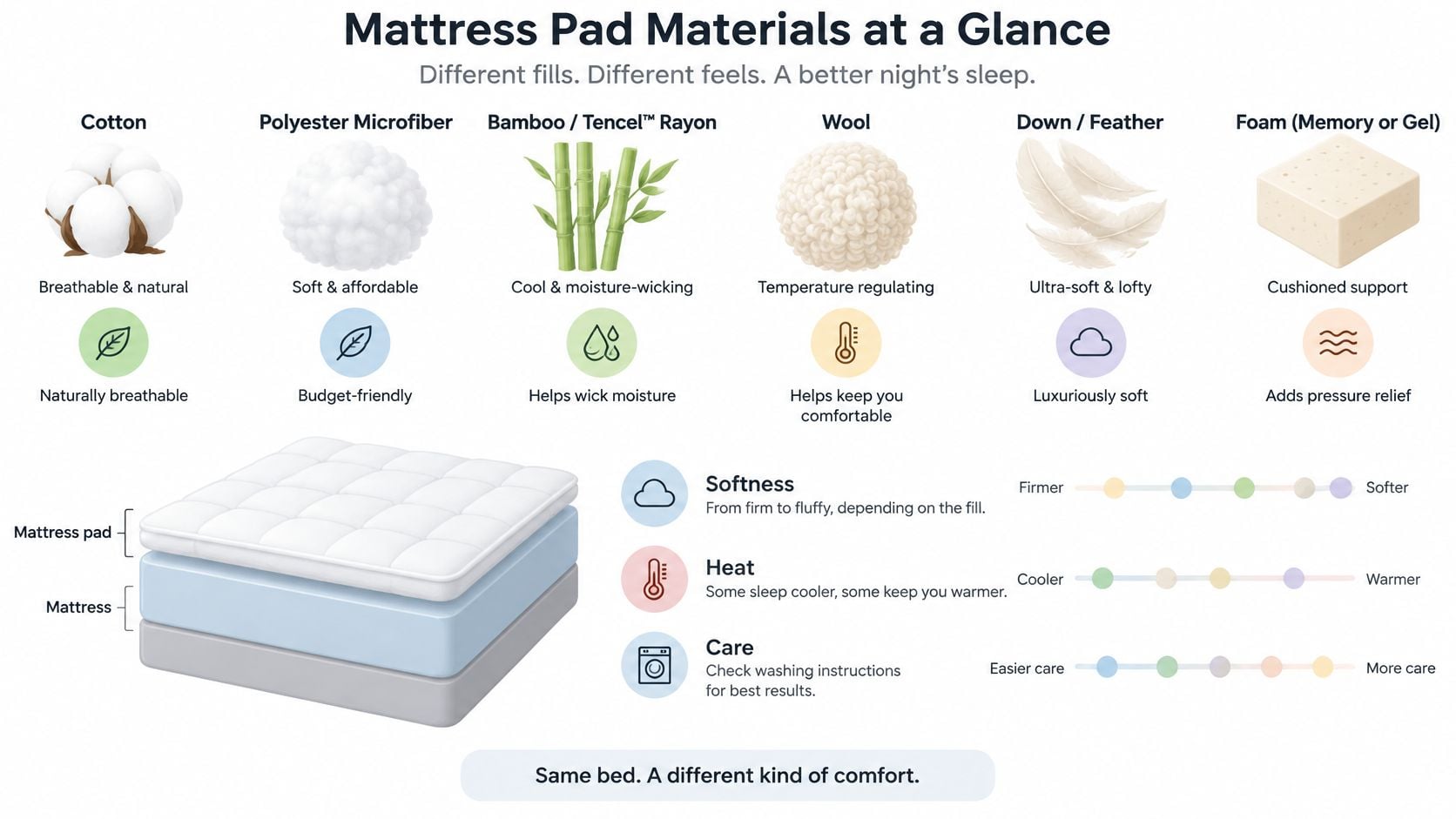
| Material | Feel | Breathability | Care note |
|---|---|---|---|
| Cotton | Soft, natural | Good in lightweight weaves | Warm wash and low-heat tumble dry when permitted by label |
| Polyester microfiber | Smooth, light | Moderate; dense construction can trap heat | Machine wash and low-heat drying when permitted |
| Bamboo or Tencel-type rayon | Smooth, cool to the touch | Good in breathable constructions | Follow label; avoid high heat |
| Wool | Warm, resilient | Helps moderate moisture | Gentle or professional care as specified |
| Down or feather fill | Soft, lofty | Better with airy fill and a permeable shell | Dry thoroughly so moisture doesn't remain inside |
| Foam cushioning | Contouring, firm to plush | Lower unless designed with open structure | Never place foam in a dryer |
Fabric names don't describe the whole pad. Shell weave, fill quantity, quilting, and backing can make otherwise similar materials behave differently.
Cool touch isn't the same as better sleep
A 2025 study of a temperature-controlled mattress cover found improvements in perceived sleep quality and thermal comfort, but no significant differences in objective sleep metrics or biometric measures. That was an actively controlled cover, not an ordinary passive pad, so its findings shouldn't become a promise about cooling fabric.
A passive pad may feel less clammy without lowering bedroom temperature or resolving every cause of sweating. For temperature changes associated with hormonal transitions, Sleep All Nite's perimenopause sleep guide provides context beyond bedding selection.
Match the construction to the sleeper
A hot sleeper on memory foam should consider lightweight breathable cotton before adding another thick foam layer. A side sleeper seeking modest surface cushioning may prefer plusher quilting and accept a warmer feel.
Waterproof membranes can reduce breathability, while thick quilting can hold more warmth. Choose the thinnest construction that delivers the needed benefit, rather than treating loft as an automatic upgrade.
Care also changes the comparison: mattress-pad cleaning guidance distinguishes washable pads from foam components and emphasizes thorough drying for down or feather fill. A lofty pad that stays damp inside isn't a practical comfort improvement.
The store question is specific: What problem does this construction address, and what comfort or maintenance trade-off comes with it?
Allergy Protection and Realistic Expectations
Allergy buyers usually ask one question: will this pad help me wake up less congested? A washable pad gives you a removable surface layer. A zippered, allergen-impermeable encasement surrounds the whole mattress. Each one does a different job.
In a one-year randomized trial published in The New England Journal of Medicine, impermeable covers lowered mattress dust-mite allergen in dust-mite-sensitized patients with allergic rhinitis, while rhinitis symptoms showed no significant improvement. That is exposure control: useful, limited, measurable. A barrier can reduce a trigger reservoir without changing every downstream symptom.
Choose coverage rather than a reassuring adjective
- For routine surface cleaning: A washable pad leaves the mattress sides and bottom open, yet still gives you a layer that comes off for regular laundering.
- For dust-mite exposure control: Look for an allergen-impermeable encasement with a complete zipper closure and clearly specified barrier construction.
- For a household allergy plan: Combine laundering, bedroom cleaning and clinician-directed measures so the cover has one defined job.
Fiber origin comes second to closure and weave. Cotton, wool and down can feel comfortable and still need a separate barrier if mite exposure is the target, so check the zipper, pore specification and care label before judging softness.
Keep the cleaning goal realistic
Households managing asthma, young children or pets should identify the relevant triggers before choosing bedding. Hot-water laundering belongs in the plan only where fabric labels permit it, because heat that damages a barrier removes the reason for buying it.
Professional cleaning sits in its own category. Renue Systems Four Points' information about cleaner mattresses for hospitality properties describes sanitation and soil removal for commercial beds, a separate task from enclosing a mattress or predicting allergy relief.
The practical screen stays consistent: confirm the barrier claim, the fit and the wash method first, then compare feel. A clinician can help decide which bedroom controls matter for the individual household.
Pairing Pads With Your Mattress Type and Warranty
Memory foam needs a light touch. A thin, breathable pad preserves more of the mattress's contouring feel. Heavy quilting can separate the sleeper from that response, while additional soft cushioning may create deeper sink.
An innerspring mattress presents a different opportunity. A plush pad can soften its surface, but excessive loft may make the perimeter feel less stable when sitting down or getting out of bed.
Match the layer to the bed's movement
| Mattress or base | Sensible starting point | What to test |
|---|---|---|
| Memory foam | Thin, breathable pad | Whether turning over remains easy |
| Innerspring | Lightly plush quilted pad | Surface softness and seated edge stability |
| Hybrid or pillow-top | Low-bulk construction with suitable pocket depth | Secure corners without excessive compression |
| Adjustable base | Flexible pad compatible with articulation | Bunching or tension when the base changes position |
Hybrid and pillow-top mattresses already include substantial comfort layers. Adding more cushioning should solve a defined surface complaint, not duplicate what the bed already provides.
For adjustable bases, raise and lower the bed with the pad installed. Watch the hinge areas and corners, and confirm that separate sides of a split setup can move without pulling against shared bedding.
A suitable foundation matters independently of the pad. Groen's guide to a foundation for a Tempur-Pedic mattress addresses the support underneath the sleep surface, which shouldn't be confused with cushioning above it.
Use a reversible comfort experiment
Consider a hypothetical couple with a supportive but firm innerspring bed. They choose a 1-inch quilted cotton pad and plan a week of comparison under their ordinary bedding, balancing one partner's wish for softness against the other's sensitivity to heat.
The useful observations aren't just whether the bed feels luxurious at bedtime. They include whether either partner struggles to turn, feels less secure at the edge, or wakes uncomfortable.
Read the actual warranty
Warranty terms differ by model, including individual Serta and Beautyrest mattresses. Check how the document handles stains, spills, support requirements, and body impressions; don't assume every visible impression is excluded or that every model requires the same protector.
Keep the mattress receipt, pad receipt, care label, and warranty together. If discomfort increases, remove the pad and reassess rather than treating an added layer as something that must be tolerated.
Budget, Financing and Custom Options
Pick the construction that solves your problem, then stop paying for thickness you will not use. Compare the shell, fill, stitching, pocket design, and cleaning requirements before deciding whether a higher-priced pad offers a meaningful benefit. A washable layer that fits both your machine and your mattress depth serves a household better than a bulky specialty pad that rarely gets cleaned.
The sticker price is only part of the cost. A taller bedding stack may need deeper-pocket sheets, and a pad with professional-care requirements creates an ongoing bill every time it needs cleaning. Price the whole ownership picture, not just the product.
Separate essential spending from optional upgrades
- Required function: Pay first for the protection or comfort change the mattress needs, plus a secure fit on your measured depth.
- Practical ownership: Favor care requirements that match your household's laundry equipment and schedule.
- Optional feel: Consider premium texture or additional loft only after the functional checks pass.
Groen's Fine Furniture offers special financing, subject to credit approval, and publishes mattress financing options for households folding a pad into a larger mattress or adjustable-base purchase. Its Custom Order Services cover made-to-order pieces such as Amish solid wood furniture and Canadel custom dining, alongside brands including Flexsteel, Bassett, Serta, and Beautyrest. Those services apply to furniture and mattresses; pads are sold as finished products.
Design it your way without buying everything at once
Custom furniture earns its price when room dimensions, storage needs, or daily routines demand a specific solution. Canadel's dining program offers thousands of combinations of sizes, shapes, and finishes, while locally crafted Amish pieces are built to exact specifications. If a piece's origin matters to you, confirm it on that item rather than assuming one standard applies across the showroom.
Groen's Fine Furniture has served Northwest Indiana since 1983, with showrooms in Dyer and Crown Point. That local history supports a straight conversation about honest prices and buying power, so you can fix the actual sleep problem without replacing an entire bedroom.
For larger purchases, clarify access and setup when you budget for delivery. Groen's premium delivery service carries a purchase from inspiration to installation, which matters more for a full bedroom set than for a single pad you can carry home yourself.
Pre-Purchase Checklist and Showroom Trial
Five minutes on a showroom mattress makes almost any plush pad feel like the right answer. Two weeks under your own sheets, at your own bedroom temperature, is the test that counts. Settling a short list before you leave home is what makes the store visit useful.
Decide these before you shop
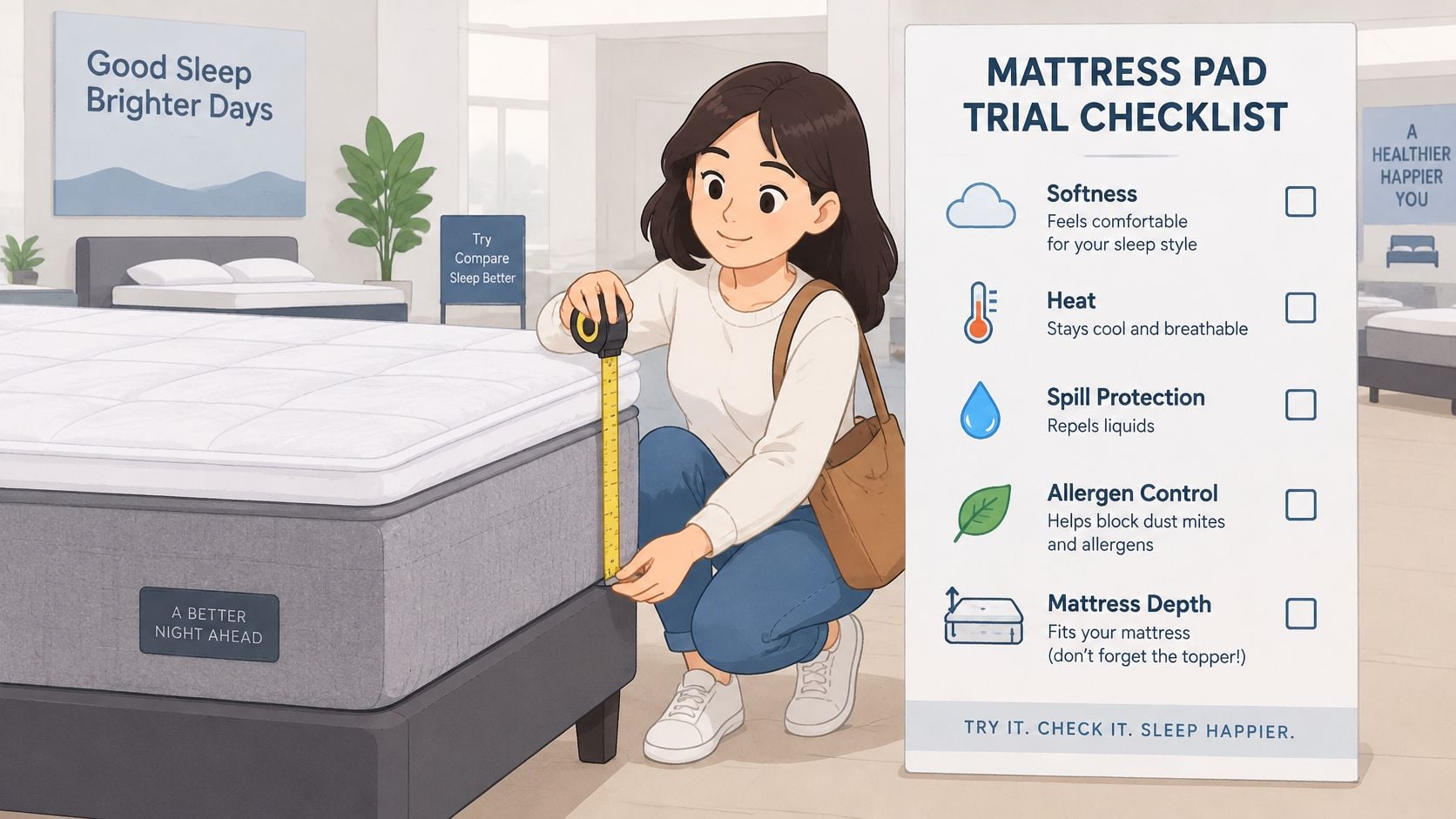
The label, care, and mattress-depth checks belong to your at-home prep; bring those written results with you so the visit is comparison, not re-measuring. What remains to settle on the day itself is short:
| Decide | What "settled" looks like |
|---|---|
| The problem | One line naming the single job the pad must do, such as cooling, cushioning, or spill protection |
| The construction | Extra loft only, a waterproof top, or a full encasement |
| The spending limit | The pad's price plus any new sheets or special laundering it will need |
At the store, Groen's Fine Furniture lets you compare mattresses by size, comfort, and type, including Gel, Memory Foam, Innerspring, and Memory Foam Pillow Top. You can call or text the furniture and mattress experts with questions before visiting. Once there, ask whether a candidate pad can be tried on a showroom mattress close to your own; comfort options run from Extra Firm to Ultra Plush, so a near-match is usually possible.
Compare under ordinary conditions
Ask about return terms before you open or wash the pad. When the terms allow, trial the pad for at least a week at home with the same sheets and the same bedtime routine. Changing the pad and the sheets at once tells you nothing about which change helped.
Record heat buildup, awakenings, morning stiffness, and how easily you change position. A controlled home study described by RTI found substantial individual differences in preferred mattress surfaces, which is why your own trial notes outrank any single comfort specification on a tag.
For families in St. John, Schererville, and Munster, the Dyer and Crown Point showrooms offer a local place to talk through those notes, with the multigenerational service and five-star reviews Groen's Fine Furniture has built across Northwest Indiana.
Visit Groen's Fine Furniture in Dyer or Crown Point to try mattress comfort in person and discuss a pad that matches your bed's fit, protection, and care needs. Careful measurements and an honest home trial beat a five-minute showroom lie-down every time.