Mattress Firmness for Stomach Sleepers: What Feels Right

The hardest mattress isn't automatically the best choice for a stomach sleeper. For homeowners in Dyer, Crown Point, and across Northwest Indiana, better rest starts with matching the bed to the sleeper's weight, build, and posture, not choosing the firmest surface on the showroom floor.
Mattress firmness for stomach sleepers is a balancing act: enough support beneath the torso, enough cushioning at the front of the body, and a pillow that doesn't force an awkward head position. Groen's Fine Furniture's family-owned approach puts that personal fit ahead of a firmness label.
Starting Firmness Ranges for Stomach Sleepers by Body Weight
A useful starting point is a weight-based range rather than a single recommended firmness. A lighter sleeper may barely compress a mattress that a heavier sleeper experiences as noticeably yielding. Neither person's impression is wrong.
The stomach-sleeper starting ranges in the Sleep Foundation's firm-mattress guide are 4-6 for sleepers under 130 pounds, 5-7 for those weighing 130-230 pounds, and 7-9 for those over 230 pounds. These are shopping guides, not medical prescriptions.
Starting firmness by body weight for stomach sleepers
| Body weight | Firmness rating (1-10) | Typical feel | Watch for |
|---|---|---|---|
| Under 130 lb | 4-6 | Medium-soft to medium-firm | Hips sinking too far if the rating is set too low |
| 130-230 lb | 5-7 | Medium to firm | Pressure at ribs or pelvis if the surface is too firm |
| Over 230 lb | 7-9 | Firm to extra-firm | Pelvic sinkage on softer comfort layers |
| All stomach sleepers, general benchmark | 5-8 | Supportive medium-firm to firm | Judge by hip alignment, not the label alone |
The general 5-8 starting zone reflects common stomach-sleeper guidance summarized alongside the support discussion in the Lancet trial notes; the clinical trial itself doesn't establish that range as a stomach-sleeper prescription.
How to use the ranges
Start with the appropriate weight row, then compare a gentler and a firmer option within that band. The comparison is more useful than treating the middle rating as an automatic answer.
Body shape deserves equal attention. Someone who carries more weight around the abdomen may need a different support arrangement than someone of similar weight whose load is distributed more evenly. Groen's Fine Furniture's guide to choosing a mattress for a body type provides another way to organize that decision.
Firmness scales aren't standardized across brands, and lighter sleepers commonly need more cushioning while heavier sleepers need greater resistance to compression, as the Sleep Foundation's stomach-sleeper guide explains. A label is therefore a starting description, not a measurement of personal fit.
Starting-point check: A promising mattress keeps the pelvis comfortably supported relative to the chest without creating sharp pressure at the ribs or knees.
A sleeper shouldn't have to choose between a sinking midsection and a painfully rigid surface. The right starting choice makes both problems less noticeable, rather than solving one by creating the other.
Why Firmness Controls Your Hips and Lower Back
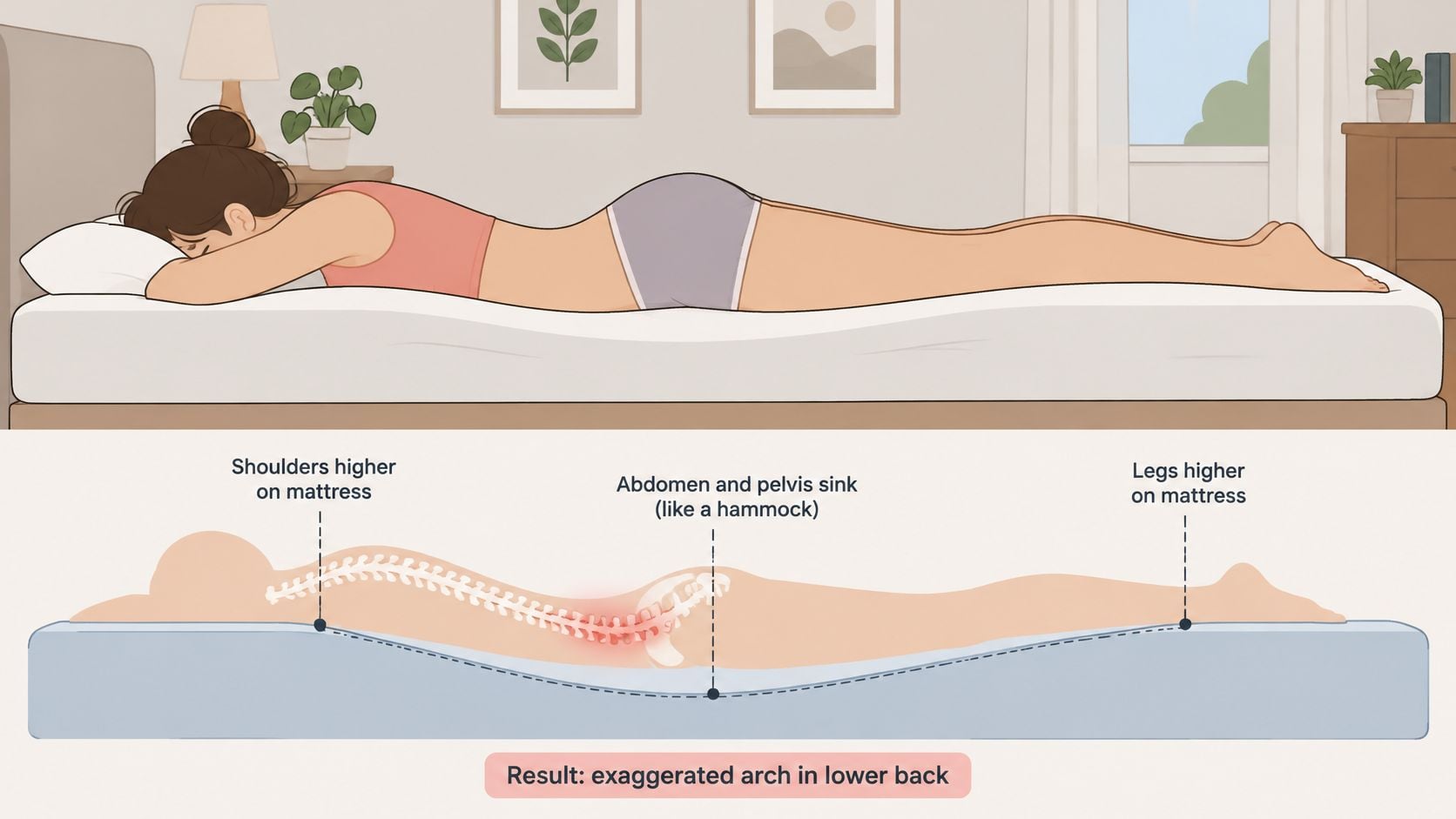
A week on a soft pillow top can leave a stomach sleeper waking each morning with a dull ache across the lower back. The explanation is mechanical. The abdomen and pelvis carry most of the body's weight in this position, and when they sink deeper than the chest, the lumbar spine follows them down.
That drop forces the lower back into a more pronounced arch. A sleeper may feel it as compression, tension, or a persistent urge to shift positions through the night. Swapping to the hardest surface in the store creates a different problem: a rigid top concentrates load at the few points of the body that make contact first, trading morning stiffness for sore spots by midnight.
What the biomechanics can establish
A 2019 biomechanical review summarized a study in which a custom mattress with zoned elasticity produced a thoracolumbar angle of 4.10 degrees, compared with 8.90 degrees on a firm surface and 12.66 degrees on a soft surface, according to the peer-reviewed mattress-design review. Larger angles may indicate poorer spinal neutrality, but those measurements don't establish a universal ideal angle or prove that every zoned mattress is superior.
The same review found insufficient evidence for a universally valid numerical threshold for spinal alignment or pressure distribution. Body shape, sleeping posture, and construction all affect the result. Two sleepers of the same height can need meaningfully different firmness if one carries weight around the abdomen and the other carries it elsewhere.
The goal is neutral posture with pressure relief.
That distinction separates firmness from support. Firmness describes how resistant the surface feels; support describes how effectively the whole mattress accommodates the sleeper without excessive sagging or distortion. A rigid top isn't proof of a suitable support system underneath.
Discomfort needs the right interpretation
Ordinary surface pressure should also be distinguished from symptoms that deserve medical attention. Restore Osteopathic Medicine's information about red flags for hip and leg symptoms offers context when hip discomfort comes with leg symptoms instead of simple tenderness where the body meets the mattress.
The practical evaluation is straightforward: notice where the body settles, where pressure develops, and whether the lower back feels relaxed. A partner checking that the hips sit level with the shoulders tells a stomach sleeper more than trying to reproduce a laboratory angle.
How Mattress Materials Change the Feel Under Your Torso
Four construction details decide how the same firmness label feels under a stomach sleeper's torso: the support core, the comfort materials, the thickness of the top layers, and the edge reinforcement. The deeper core sets the limit for hip sink, while the upper layers determine how sharply pressure lands on the ribs, pelvis, and knees.
That is why the firmest bed is often the wrong answer. A lighter sleeper may barely engage the comfort layers and feel every hard edge, while a heavier sleeper may compress those layers quickly and need stronger resistance underneath. Match the construction to build first, then check whether the hips stay level.
How common mattress materials feel for stomach sleepers
| Material | Feel for stomach sleepers | Firmness risk | What to check |
|---|---|---|---|
| Innerspring | Firm, responsive support that resists hip sinking | Can feel hard at ribs and pelvis without a suitable comfort layer | Coil gauge and quality of the comfort layer on top |
| Hybrid | Coil base with foam comfort layers for balanced support | A thick pillow top can let the pelvis sink | Thickness of the top foam and strength of edge support |
| Memory foam | Close contouring with a slower response | Soft foam can allow excessive midsection sinking | High-density core and a firm base layer beneath the comfort foam |
| Gel memory foam | Similar close contouring, sometimes with a cooler initial feel | The same sinking risk as standard memory foam | Density information and compression beneath the hips |
| Latex | Responsive, buoyant cushioning that can remain even under heavier loads | Can feel firm against a lighter sleeper's chest | Material specifications and whether the latex sits over support coils |
| Pillow top | A plush surface layer added over a support core | Surface softness can disguise excessive hip sinkage | Cushion thickness and how the top is attached |
Read the whole construction
Foam density and foam firmness measure different things. Density describes the material; firmness describes how it feels under load. A useful specification discussion includes each layer's purpose and position, because a dense layer can still be arranged to feel plush near the surface.
Gel in memory foam is a comfort detail. The sleeper still needs to judge pelvic support and temperature after the surface settles. For a closer look at how coil systems differ from foam cores, use Groen's Fine Furniture's innerspring-versus-memory-foam explanation.
Practical rule: A plush top over a supportive core can work. A soft top over a yielding core deserves closer scrutiny.
Edge support helps when getting into bed or resting near the perimeter. A sturdy edge still leaves the center open to evaluation, so check the middle of the mattress where the torso rests.
Treat specialized support as an option to test
Zoned and adjustable-firmness designs change resistance by region or by setting. They can add resistance beneath the pelvis while leaving the surface easier on the chest. Treat them as configurations to compare: if the hips still drop or the ribs take sharp pressure, that design has not solved the fit.
The winning construction keeps the midsection from drifting down while the front of the body stays comfortable enough to remain still.
How to Test Firmness in the Showroom and at Home
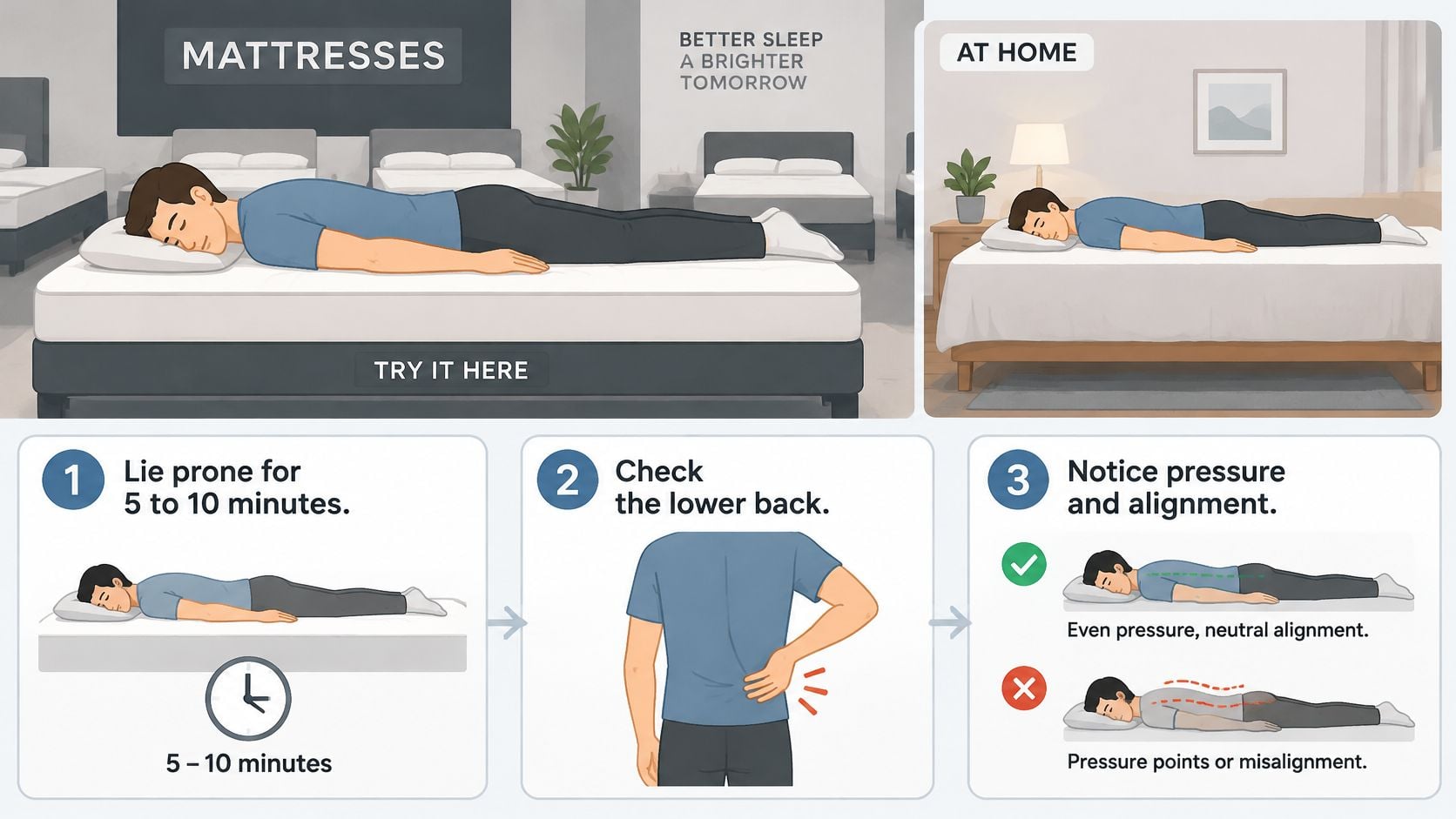
Begin in the actual sleeping position. Lie prone with relaxed arms and a pillow similar to the one normally used at home. Remain long enough for the surface to settle beneath the torso, rather than judging the mattress by a brief sit on its edge.
Notice the lower back. A compressed feeling, an exaggerated arch, or an obvious downward drop beneath the pelvis can indicate inadequate support for that sleeper. These are fit clues, not a diagnosis of the cause of back pain.
Check the front of the body. Sharp pressure against the ribs, pelvis, knees, or shoulders suggests too little surface accommodation. Constantly repositioning to escape a pressure point is a reason to compare a different feel.
Test the other positions used during sleep. Side and back positions deserve attention for anyone who changes posture overnight. The pillow should keep the head comfortably aligned in each position rather than lifting or tilting it awkwardly.
Compare a medium-firm and a firm candidate. Testing contrasting options during the same visit makes small differences easier to recognize. Keep the pillow and posture consistent so that the comparison stays useful.
Confirm home-trial terms before purchasing. Available trials, exchanges, fees, and foundation requirements should be understood before a decision. A showroom impression can't establish how a mattress will feel throughout a normal night at home.
Keep a simple morning log. Record stiffness, pressure locations, awakenings, and overall restfulness during the evaluation period. A pattern across nights is more informative than an isolated good or bad morning.
Give comfort claims a fair test
In a 2022 controlled trial, participants with low-back pain reported an 18% lower pain score while lying and a 25% higher comfort rating on an experimental mattress than on their own mattresses, according to the Sleep Science and Practice study. Pain and stiffness on rising and overall sleep quality didn't differ significantly, and the relationship between sleep position and pain remained inconclusive.
That distinction matters: immediate comfort doesn't guarantee better mornings. Groen's Fine Furniture's mattress-shopping tips can help shoppers prepare for a more deliberate comparison.
Room conditions should remain reasonably consistent during a home evaluation. Maximum Health Products' guidance to create a better sleep environment offers a companion checklist so that bedding, light, and other surroundings receive attention alongside the mattress.
The decision rule: favor the option that maintains comfortable posture without pressure hot spots and produces a better pattern of mornings, not merely the most impressive first impression.
When Stomach Sleeping Causes Pain and What to Change
A firmer mattress isn't always the cure for morning soreness. Stomach sleeping can keep the neck turned and the lower back extended even when the bed provides reasonable support.
The Sleep Foundation's stomach-sleeping guidance notes that people with back pain who switched to side or back sleeping experienced less pain. That doesn't guarantee relief for every sleeper, but it makes a position change a reasonable consideration before purchasing the hardest bed available.
Match the change to the problem
- Surface-pressure discomfort: Tenderness where the ribs or pelvic bones contact the mattress calls for a closer look at cushioning. Moving toward a more accommodating surface within the starting weight band may be more useful than adding firmness.
- Alignment discomfort: A dropping pelvis or uncomfortable lower-back arch calls for a support assessment. Firmer pelvic support may help; a thin pillow beneath the pelvis or lower abdomen is another adjustment to try gently.
- Position-driven discomfort: A neck held to one side may remain uncomfortable regardless of mattress construction. Reducing time spent prone addresses something a support core can't correct.
Make position changes gradually
A side sleeper can try a pillow between the knees to make the position more comfortable. A back sleeper can try a pillow beneath the knees. The head pillow should suit the chosen position without forcing the neck into a noticeable bend.
For someone who continues sleeping prone, a thin pelvic pillow should be treated as an experiment, not a treatment. Any adjustment that increases discomfort should be stopped. Gradually spending less time on the stomach may be more manageable than attempting an immediate all-night change.
Groen's Fine Furniture's guide to mattress firmness and back pain can help distinguish a comfort-shopping decision from a promise of pain relief. A mattress can improve the sleeping setup, but it can't establish why pain occurs.
Persistent pain, numbness, or tingling warrants assessment by a qualified clinician. Those symptoms shouldn't be managed solely by changing mattresses, pillows, or sleep positions.
Choose Your Firmness Level With Our Team in Dyer or Crown Point
A practical mattress decision follows a clear sequence: identify a starting weight band, select a construction that suits the sleeper's build, and compare contrasting comfort options in person. The final choice should reflect the sleeper's response, not a salesperson's preference for a particular firmness label.
Groen's Fine Furniture has served Northwest Indiana since 1983, with showrooms in Dyer and Crown Point. Its family-owned history and attentive, multigenerational service support a personal approach for households across the wider NWI community.
Arrive with useful observations
A shopper who can describe a sinking sensation, a tender pressure point, or a preferred sleeping position gives the furniture and mattress experts a clearer starting point. Bringing the usual pillow, where practical, also makes the comparison more representative of home.
Groen's Fine Furniture's local mattress-store guide provides context for planning a visit. Customers can call or text the furniture and mattress experts for help before shopping, including questions about how to organize a comfort comparison.
A successful showroom visit ends with a clearer understanding of personal fit.
Comfort and services that fit the room
Groen's Fine Furniture offers Extra Firm, Ultra Plush, Plush, Medium, and Firm comfort levels, with mattresses shopped by size, comfort, and type. Serta and Beautyrest provide comfort options to compare by feel, while the store's helpful mattress guide keeps the discussion focused on rest and fit rather than specifications alone.
The broader bedroom decision can include the bed frame, usable room space, and furniture that fits everyday routines. The store's services connect those practical needs with a coordinated room:
Custom Order Services: "Design it your way" means bespoke, made-to-order choices rather than settling for an unsuitable size or finish. Locally crafted Amish furniture offers solid wood pieces built to exact specifications, while the Canadel custom dining program extends that personal approach to gathering spaces.
Special Financing: Available subject to credit approval, financing offers buying power that can help quality furnishings fit a household budget. Honest pricing and a clear explanation matter more than an advertised monthly figure without context.
Premium Delivery: The store's premium delivery service carries the purchase from showroom selection to its place in the home, taking a shopper from inspiration to installation. Room access and the intended bed arrangement are useful details to discuss beforehand.
Five-Star Reviews: Attentive guidance is reflected in the store's five-star reviews and dedication to the NWI community. The same wider-home selection includes Flexsteel for durability, Bassett for style, and Amish Furniture for solid wood craftsmanship.
A coordinated bedroom doesn't require every decision at once. Selecting the sleep surface first gives the remaining room choices a practical reference, whether the household wants custom dimensions on a solid wood piece or a call-or-text answer to a sizing question before the visit.
Groen's Fine Furniture offers mattress comparisons, custom furniture options, and Special Financing subject to credit approval to help households balance comfort and budget. Visit Groen's Fine Furniture in Dyer or Crown Point to test-drive supportive comfort, explore custom options, and ask about financing plans. Let the Groen family help create a home that feels comfortable and personal.