
Rug Size for Sectional Sofa: A Complete Guide

You've bought the sectional, or you're standing close to buying one, and now a wall of rug samples has turned a simple decorating decision into a measuring exercise. The tags show 8×10, 9×12, and 10×14, but none of those numbers mean much until they're compared with the sofa's full span, chaise depth, and the open floor around it.
For homeowners in Dyer, Crown Point, and throughout Northwest Indiana, Groen's Fine Furniture approaches the decision the same way a family showroom advisor would, with a tape measure, a practical eye, and clear recommendations. The right rug size for a sectional sofa depends on three things: how to measure the entire configuration, which standard size matches its footprint, and whether the room calls for front legs on the rug, all legs on the rug, or a centered floating arrangement. The advice below covers compact L-shapes, standard sectionals, oversized modular pieces, and U-shaped layouts.
The Rug and Sectional Question We Hear Every Week
A sectional changes the geometry of a living room. A conventional sofa can sit neatly above a small area rug, but an L-shaped or U-shaped sofa stretches in two directions and often includes a chaise that reaches farther into the room. That's why a rug chosen only for the coffee table usually looks undersized once the sectional is in place.
The showroom conversation starts with the sofa, not the rug pattern. A rug should connect the seating pieces into one visual island, leave enough visible flooring to frame the arrangement, and support the coffee table without creating a cramped edge near a wall or walkway. Guidance from this sectional sofa buying guide is useful before purchase because the sofa's configuration affects every later measurement.
Three decisions make the purchase easier
First, measure the full footprint. The longest arm-to-arm span and deepest return matter more than the nominal sofa name. A “three-piece sectional” can occupy far more floor than another three-piece model if its chaise is deeper or its arms are wider.
Second, match the footprint to a standard rug size. Compact L-shapes usually start at 8×10 feet, standard L-shapes commonly move to 9×12 feet, and large or U-shaped layouts often require 10×14 feet or larger. These recommendations follow the sectional's actual footprint and the need for a visible floor border, not an arbitrary decorating rule. Sectional rug sizing guidance ties the recommendation to extending the rug beyond the sofa's outer edges on the open sides.
Third, choose the layout that suits the room. Front legs on the rug are the dependable everyday choice. All legs on the rug create a more complete, anchored look when the room allows it. A floating rug can work, but only when the seating arrangement is deliberately centered and the surrounding furniture doesn't force the rug against a wall.
Showroom rule: If the rug doesn't visually connect every section of the sofa, it's too small for the job.
Measuring Your Sectional the Right Way
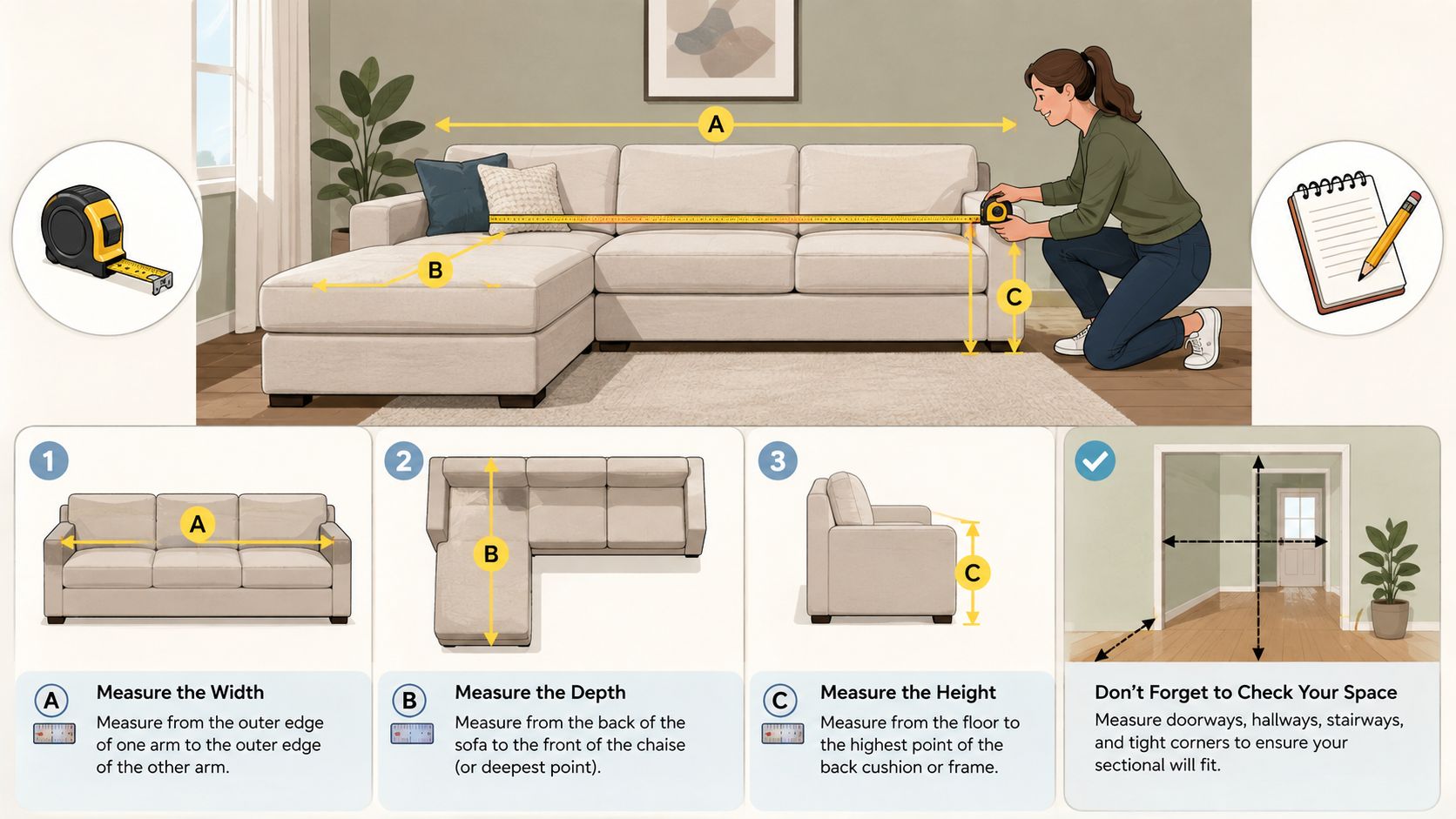
The safest way to choose a rug is to measure the sectional as a complete floor plan. Don't measure only the main sofa section and assume the chaise will fit. The chaise return is often the part that exposes an undersized rug.
Three measurements control the decision
Measure the longest span. Run the tape along the front of the sectional from the outside edge of one arm to the farthest outside edge of the opposite section. Include the chaise return if it contributes to the sofa's overall front-to-back footprint. Record the number in inches.
Measure the deepest point. Measure from the front edge of the seating area to the back cushion or rear frame at the deepest point, usually the chaise. This number tells the homeowner how much rug must travel beneath the seating zone rather than stopping at the coffee table.
Add an open-side border. Plan for roughly 12 to 18 inches beyond the sectional on the open sides when the room allows it. Broader rug guidance commonly places the visible floor or rug border in the 6 to 12 inch or 12 to 24 inch range, depending on the layout and source, so the correct choice depends on whether the rug is being used for front-leg placement or full containment. A practical sofa rug measurement guide also emphasizes measuring the longest span and deepest return before choosing a standard size.
Consider a sectional measuring 108 inches across with a 65-inch chaise return. An 8×10-foot rug may cover the compact seating zone with the front legs placed correctly, but a 9×12-foot rug is the stronger choice. It gives the chaise more visual support, leaves a more convincing border on the open sides, and keeps the coffee table and seating connected.
Test the footprint before ordering
Use painter's tape to mark the proposed rug dimensions on the floor. Place the tape where the rug edges would land, then check the wall border, walkway, coffee table, and chaise position. This simple mockup reveals a rug that feels too small or crowds the room before a purchase is made. Groen's guide on measuring for a sectional can support the same process when homeowners are working from a floor plan or shopping remotely.
Matching Rug Size to Your Sectional Shape
The rug market has settled around a practical group of rectangular sizes that works for many living rooms: 5×7, 8×10, 9×12, and 10×14 feet. For sectional seating, the smallest of those sizes is usually an accent option rather than a complete anchoring rug. The sofa's full footprint determines whether the rug can connect the seating or merely sit beneath the coffee table.
| Sectional Type | Typical Sofa Span | Recommended Rug | All-Legs Upgrade |
|---|---|---|---|
| Compact L-shape | Under 90 inches | 8×10 feet | 9×12 feet |
| Standard L-shape | Around 100 to 120 inches | 9×12 feet | 10×14 feet |
| Large L-shape | Over 120 inches | 10×14 feet | 12×15 feet or larger |
| U-shaped sectional | Broad, enclosing footprint | 10×14 feet or larger, or custom cut | 12×15 feet or a custom format |
| Modular sectional | Varies by assembled footprint | Match the largest assembled footprint | Move up one size when the room allows |
Compact L-shapes need connection, not excess
A compact L-shape under 90 inches typically pairs with an 8×10-foot rug. The baseline is to place the front legs of every sectional segment on the rug, including the chaise side. A 9×12-foot rug becomes the upgrade when the room has enough exposed floor and the homeowner wants the coffee table and side tables to sit comfortably within one defined zone. Rug sizing guidance for living rooms identifies compact sectionals as the main situation where an 8×10 can work without looking lost.
Standard and large L-shapes move up quickly
A standard L-shape around 100 to 120 inches needs a 9×12-foot rug for a balanced front-legs-on-rug arrangement. A large L-shape over 120 inches should move to 10×14 feet, especially when the chaise is deep or the room is open to a dining area. A retailer placement guide illustrates this footprint issue with a six-seat corner sectional measuring roughly 11'6" by 8'2", a size that can outgrow an 8×10 rug. Standard rug size guidance for sectional layouts reinforces the hierarchy between 8×10, 9×12, 10×14, and 12×15 formats.
U-shaped sectionals almost always need 10×14 feet or larger. The rug must define the interior seating zone while supporting the outer arms, so a small rectangle creates a disconnected center. Modular sectionals follow the same rule as their largest assembled footprint, not the dimensions of one individual module.
Left-facing and right-facing chaise orientations don't change the math. They do change which corner of the rug receives the chaise, so the taped floor outline should reflect the actual orientation planned for the room.
Choosing the Right Layout for Your Room
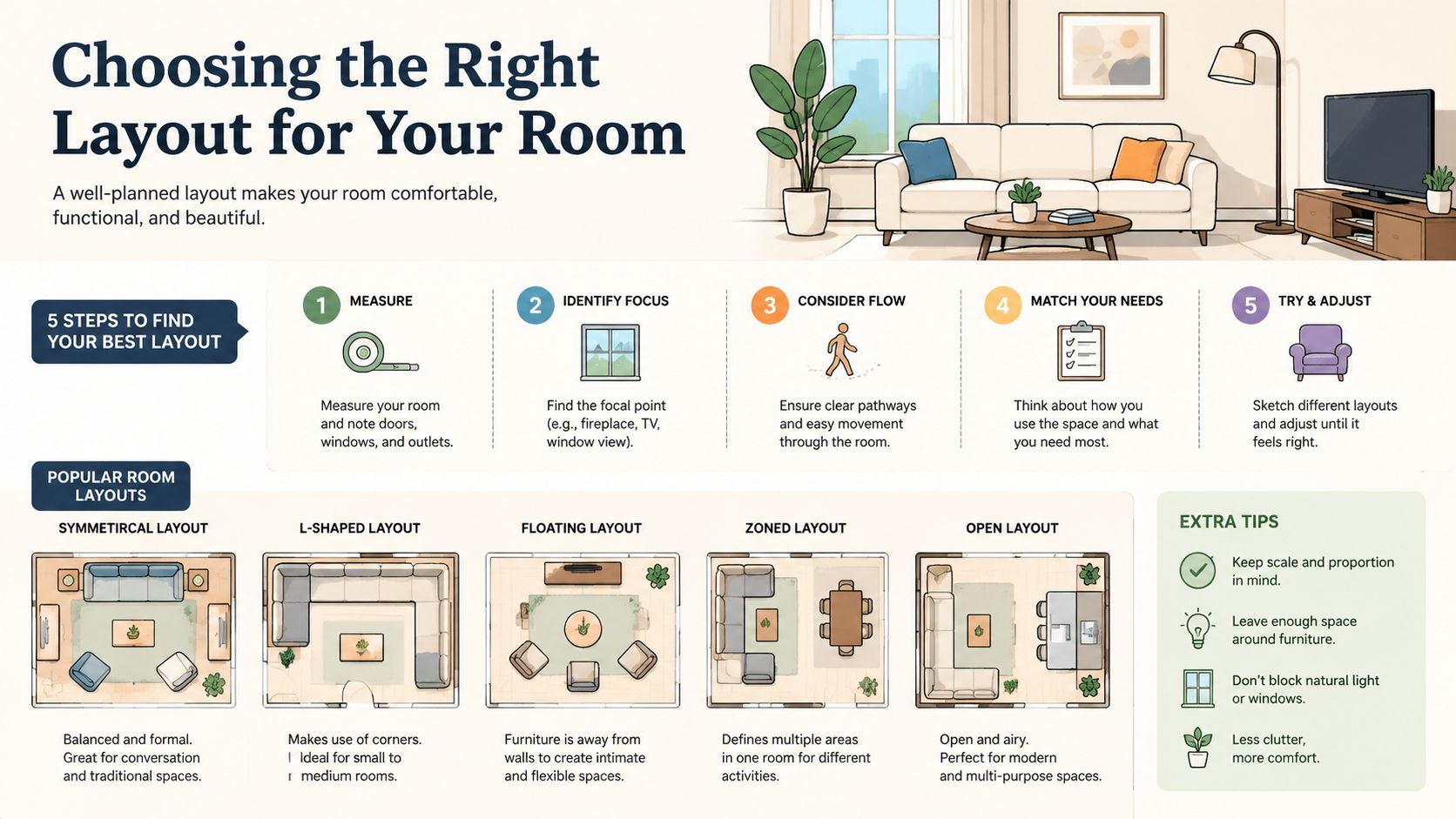
The best layout depends on the room's boundaries, not just the rug's label. Three arrangements deserve consideration, but they aren't equally dependable.
Front legs on the rug
This is the everyday default for most L-shaped sectionals. The rug slides beneath the front legs of every sectional segment while the back legs remain on the floor. The arrangement anchors the seating without requiring the rug to swallow the entire room, and it leaves a useful floor frame around the furniture.
This layout suits most L-shapes in rooms under 14 by 18 feet, provided the rug reaches far enough beneath the chaise and coffee table. The rug edge should also preserve a clear walking path rather than stopping directly in a doorway or narrowing the route around the sofa.
All legs on the rug
The all-legs-on approach creates a fuller, more formal seating island. It works best with larger sectionals, U-shaped configurations, and open-concept rooms where the rug needs to define the living area apart from the dining or kitchen zone. A format of 10×14 feet or larger is generally the practical starting point for placing all legs on the rug. Room arrangement inspiration from Interiors by DeX can help homeowners compare how furniture groupings, circulation paths, and open floor affect the overall composition.
This layout requires careful attention to the wall border. Leave roughly 12 to 24 inches between the rug edge and surrounding walls when the room permits it, so the rug reads as an intentional island rather than wall-to-wall carpeting. The coffee table should sit fully on the rug, with enough room around it for the sectional to feel connected.
Floating and centered
A floating rug sits in front of the sectional without touching any sofa legs. It's the least forgiving choice and should be reserved for a square room with a centered seating arrangement, exposed legs on every piece, and no console or TV stand pushing the furniture against a wall.
The coffee table must center the seating zone, and the rug needs enough surrounding floor to look deliberate. In a typical wall-oriented family room, this approach makes the rug look like a small island disconnected from the sectional. Groen's sectional sofa layout ideas offer another useful reference for testing furniture placement before committing to the rug.
Why Texture Changes the Size You Actually Need
A larger rug isn't automatically the better rug. Pile height, texture, and pattern change visual scale, so two rugs with identical dimensions can create very different impressions in the same room.
A thick wool, shaggy, or heavily handcrafted rug carries substantial visual weight. Under a deep sectional in a modest room, that texture can make the seating zone feel crowded, especially when the rug already reaches close to the walls. In that situation, moving down one standard size can restore breathing room while keeping the front legs connected.
A flatweave or low-pile rug has the opposite effect. It tends to recede into the floor, which means a larger size can look proportional instead of oversized. That makes a low-pile 9×12 a persuasive choice where a thick 10×14 would dominate the room.
Pattern matters as much as pile
Patterned rugs also occupy more visual space. Strong geometry, layered color, or a high-contrast design competes with the sectional's upholstery, so the room may look balanced with a smaller format than a quiet, tone-on-tone rug. Subtle texture and neutral earth tones recede, allowing a larger rectangle to define the room without becoming the main event.
Current design coverage highlights neutral and earth-tone rugs, chunkier dimensional textures, shaggy looks, and handcrafted styles as active directions for 2025 and 2026. Coverage of rug trends for 2025 is helpful for seeing why a trend-driven rug can read larger or smaller than its printed dimensions.
Texture adjustment: Choose one tier smaller for a visually heavy pile or bold pattern, and one tier larger for a flat, quiet rug that disappears into the floor.
The adjustment should never override the sectional's basic footprint. A rug still needs to connect the seating and support the selected leg placement. Material knowledge, including how upholstery and rug texture work together, is also covered in this upholstery materials guide.
Common Mistakes and How to Avoid Them
The same sizing problems appear repeatedly in living rooms, even when the rug itself is attractive. Each one comes from measuring the wrong object or ignoring how the sectional occupies the floor.
Mistake one, sizing to the coffee table
A homeowner centers the rug beneath the coffee table, then discovers that the sectional sits outside the seating island. The result looks like an undersized mat rather than a foundation.
Fix: Measure the sectional first. Pull the rug beneath the front legs of every section and extend it at least 8 inches beyond the front legs where the open side allows it. The coffee table should join the same visual zone, not define the rug by itself.
Mistake two, ignoring the chaise return
The chaise often extends farther than the main sofa, so a rug sized to the long sofa wall can stop short of the chaise. That makes the L-shape look like two unrelated pieces.
Fix: Measure the deepest return, then extend the rug past the chaise end or shift the layout so both the main sofa and chaise sit securely on the rug. The rug's rectangle should support the full seating footprint.
Mistake three, eliminating the wall border
A rug that touches baseboards or slides beneath a console can make the room feel crowded. The eye loses the floor frame that separates an area rug from permanent flooring.
Fix: Keep at least 6 to 8 inches of flooring visible on open sides, then use a broader 12 to 24 inch perimeter where the room allows it and the layout calls for a fully contained seating island. The exact border depends on furniture placement, but no-border placement is rarely persuasive.
Mistake four, choosing a round rug
A round rug fights the long, straight footprint of an L-shaped or U-shaped sectional. It can leave one arm unsupported while placing too much emphasis beneath the coffee table.
Fix: Use a rectangle for most sectional layouts. A custom shape can solve an unusual floor plan, but it should respond to the room rather than mirror the sectional in a complicated outline.

Before clicking buy, check the longest span, deepest chaise return, leg placement, open-side border, wall clearance, and rug texture. Homeowners considering a rug over existing flooring can also review the area rug over carpet guide before finalizing the placement.
Bringing It All Together With a Custom Fit
The decision becomes straightforward when the measurements stay in the right order. Start with the sectional's longest arm-to-arm span, then record the depth of the chaise return, and finally decide how much border should remain between the rug and the wall or surrounding furniture.
Those numbers often land between standard sizes. A sectional may technically fit an 8×10, but the chaise can make a 9×12 more comfortable. A large modular layout may need more width than a standard rectangle provides, while a thick, high-texture rug may need a smaller visual footprint to keep a modest room open.
A custom-cut rug can solve that mismatch. Shape, pile, and color can be coordinated with the seating instead of forcing the room into a standard rectangle that leaves one side unsupported. Groen's Fine Furniture offers custom furniture conversations alongside options for Flexsteel durability, Bassett style, American-Made and solid wood craftsmanship, and Amish Furniture made to order. Custom order services are especially useful when a homeowner wants a cohesive room rather than a rug selected in isolation.
Budget also belongs in the conversation. Special Financing is available, subject to credit approval, giving homeowners additional buying power when the correct rug size, sectional, or coordinated furniture requires a larger planned purchase. The same showroom guidance can extend to sleep wellness through a Helpful Mattress Guide, with Serta and Beautyrest options selected around rest and health rather than specifications alone.
Bring the room measurements, a quick floor sketch, and photos showing the chaise orientation to the showroom team. A conversation in Dyer or Crown Point is more reliable than guessing from a rug tag, and White-Glove Delivery can carry the process from selection through placement for customers in NWI communities including St. John, Schererville, and Munster.
Visit Groen's Fine Furniture in Dyer or Crown Point to review rug and sectional proportions, custom-order options, and Special Financing subject to credit approval. The family-owned team has served Northwest Indiana since 1983 with multigenerational ownership, five-star service, and a showroom where homeowners can test drive comfort before choosing the pieces that complete their room.