Decorative Trays for Ottomans: A Homeowner’s Guide


For homeowners in Dyer, Crown Point, and throughout Northwest Indiana, an ottoman often works harder than it gets credit for. It may be a footrest, extra seating, a place to set a book, or the center of a family room, yet its upholstered surface isn't always ready for coffee cups and remotes. The right decorative tray for an ottoman gives that soft piece a steady purpose without adding another table to a busy room.
A good choice balances proportion, shape, material, and daily practicality. It should look at home with the upholstery, stay stable when the cushion compresses, and lift easily when the ottoman needs to return to footrest or seating duty. The following guide walks through those decisions in the same practical way a furniture consultant might on a showroom floor.
Why a Decorative Tray Belongs on Your Ottoman
A Northwest Indiana homeowner stands in the living room with a mug in one hand and a remote control in the other. The ottoman sits directly in front of the sofa, comfortable and inviting, but there's nowhere level to set either item. A decorative tray changes that small moment. It gives the ottoman a defined surface while preserving the comfort that made the ottoman useful in the first place.

A soft coffee table without another furniture piece
The tray creates a firm platform for drinks, snacks, books, and small accessories. It also anchors a vignette, so a vase, candle, and box feel grouped rather than scattered across the cushion. A raised edge adds a visual boundary that makes everyday objects appear considered, even when the tray is holding nothing more than remotes and coasters.
An ottoman tray can serve several roles around the home:
- Living room surface: It supports drinks and books while keeping the upholstered top protected from rings and crumbs.
- Entryway catchall: On a firm bench-style ottoman, it can gather keys, sunglasses, and mail.
- Bedroom bench accent: It can hold folded textiles or a small decorative arrangement at the foot of the bed.
- Older ottoman refresh: A flat tray can disguise a slight cushion dip and give an aging piece a cleaner visual line.
The tray also pulls a room's color story down to seat height. A warm wood finish can connect an ottoman to an Amish solid wood accent or flooring, while a metal or mirrored finish can echo lighting and hardware. For more guidance on arranging grouped objects, Groen's coffee table decorating guide offers principles that translate well to ottoman surfaces.
Practical rule: The tray should make the ottoman more useful, not turn it into a permanent storage pile.
That flexibility is the true appeal. A family can lift the tray away for movie-night feet, move it to the kitchen when guests arrive, or restyle it as the room changes. Among the many updates a living room can receive, decorative trays for ottomans are one of the smallest changes with one of the clearest styling payoffs.
Getting the Size Right for a Stable, Beautiful Fit
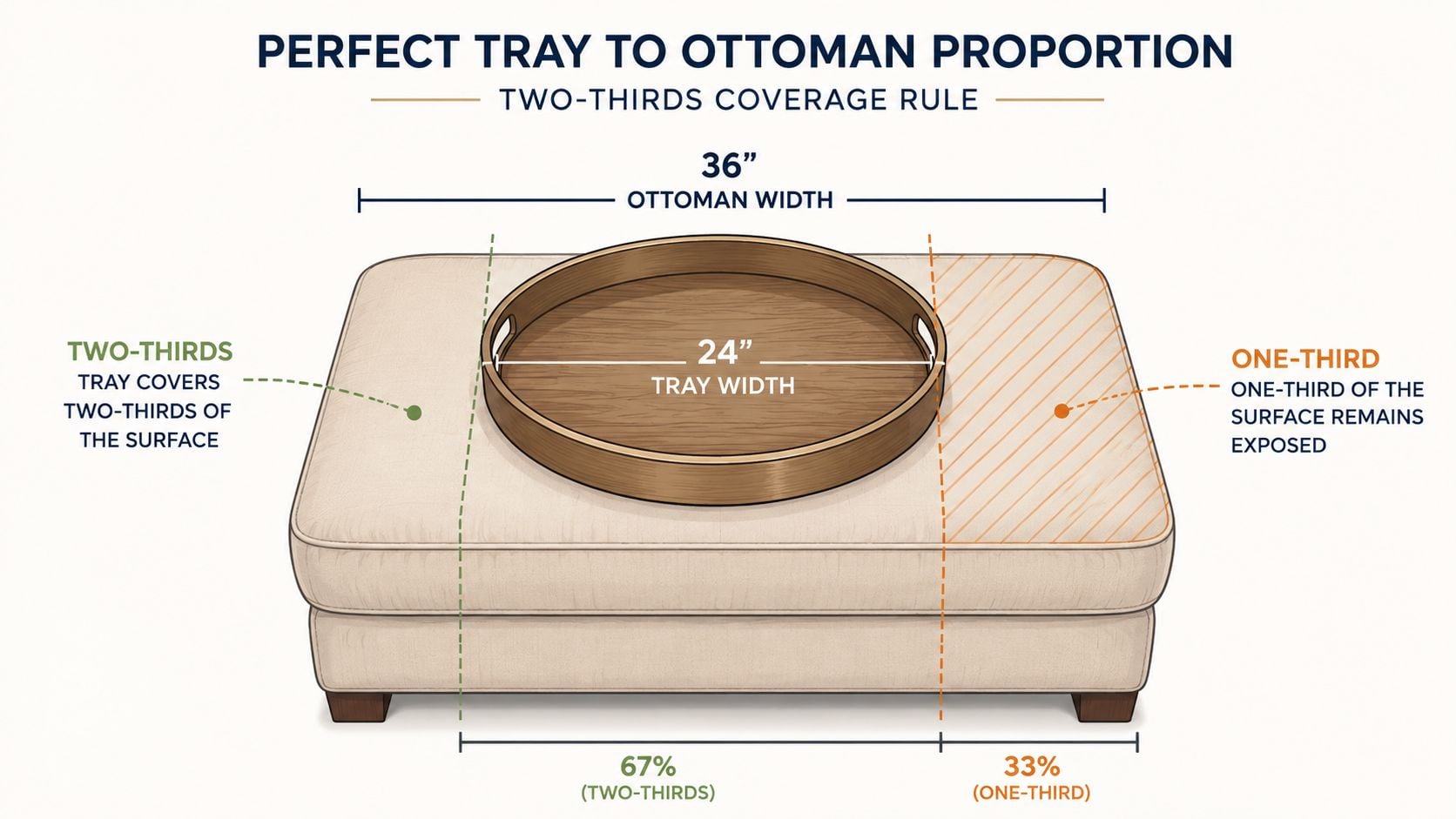
A tray can be attractive and still be wrong for an ottoman if its footprint creates rocking or awkward overhang. A practical benchmark is to choose a tray about two-thirds the width of the ottoman, while maintaining a meaningful contact zone of roughly one-third of the ottoman's surface so the tray remains supported as the cushion compresses. Neutral interior guidance for ottoman trays also places a useful display area around 50 to 60 percent of the top surface, leaving clearance around the edges.
For a concrete example, a 36-inch ottoman would generally suit a tray around 24 inches wide, because 24 inches is two-thirds of 36 inches. That leaves a visible border on the longer sides rather than making the tray look like a fitted lid. The contact area matters because plush foam yields under stationary weight. If the tray extends too far toward unsupported edges, a glass can make the surface tilt.
A simple measuring process
Measure the usable top. Record the ottoman's length and width, excluding sloped upholstery or rounded sections that won't support a tray evenly. A homeowner can keep those measurements with other notes by using this practical furniture measuring guide.
Apply the proportion first. Start near two-thirds of the width, then check the tray's length against the available surface. The tray doesn't need to fill every inch.
Inspect the underside. A flat-bottom tray spreads weight broadly. Raised feet create more concentrated contact points, which may work well on firm upholstery but can sink into a plush cushion.
Consider the lip. A modest lip helps contain objects and minor spills. A taller lip offers more containment but can make it harder to slide a laptop, book, or plate on and off.
Testing before purchase
At home, books can mimic the weight of a tray and its contents. Place them on a board or firm surface in the intended footprint, sit near the ottoman, and watch whether the setup rocks when a hand presses near the edge. A showroom test is even more useful, because the tray can be lifted, shifted, and tested against the actual cushion feel.
Avoid matching the tray's full width exactly. Equal edges may sound tidy, but the result often looks heavy and leaves no comfortable border for feet, hands, or visual breathing room.
Matching Tray Shape to Ottoman Shape
Shape matching is one of the quickest ways to make decorative trays for ottomans look intentional. Round ottomans generally pair best with round trays, while square and rectangular ottomans usually suit trays with matching straight edges. Shape-matching guidance for ottoman trays repeats this rule because mirrored proportions reduce awkward overhang and help the tray feel designed for the furniture.
A round tray on a round ottoman creates a relaxed, continuous outline. On a square ottoman, that same round tray softens the corners and can suit traditional, collected, or coastal rooms. A square tray on a square ottoman takes the opposite approach. Its aligned edges feel crisp, modern, and architectural.
| Ottoman Shape | Round Tray | Square Tray | Rectangular Tray |
|---|---|---|---|
| Round | Coordinated and easygoing | Can create pointed gaps | Usually looks undersized or uneven |
| Square | Softens corners and adds contrast | Tailored and structured | Works when the ottoman is broad enough |
| Rectangular | May look too small unless generously scaled | Can leave narrow exposed strips | Balanced and naturally aligned |
| Oval | Echoes the curved profile | Adds deliberate contrast | Works well when the length follows the ottoman |
What works on longer ottomans
A rectangular tray aligns especially well with a bench-style ottoman. Its elongated surface can organize drinks, books, or accessories without forcing everything into a tight central cluster. That arrangement also makes sense when the ottoman sits before a longer sofa or sectional.
Awkward combinations usually come from scale rather than strict design rules. A small round tray can disappear on a large rectangular ottoman, while a square tray may leave odd slivers of exposed cushion along the ends. On a generous ottoman, two smaller trays can offer a flexible alternative. One can hold drinks, while the other remains styled or moves elsewhere as needed.
The quick rule is simple: match angles for a sleek look, and contrast angles for a relaxed look. The tray should support the ottoman's silhouette, not compete with it.
Choosing Materials and Finishes That Fit Your Home
Material affects more than appearance. It changes the sound of a glass being set down, the way a spill is handled, the amount of care required, and how the tray feels against upholstery. A Northwest Indiana showroom may present several strong directions, but the prettiest finish isn't always the most comfortable choice for a busy family room.
Comparing the everyday options
Solid wood brings warmth, texture, and a quieter feel. It works naturally with leather, performance upholstery, and traditional rooms, and it can connect visually with solid wood furniture. Unfinished softwood is less forgiving, though, because coffee rings and moisture can mark the surface.
Metal offers a cleaner, more contemporary impression and generally handles quick spill cleanup well. The tradeoff is tactile. Metal can feel cold, and an unprotected edge may scratch leather or polished upholstery if the tray is dragged instead of lifted.
Mirrored glass reflects light and can brighten a dim corner. It also shows fingerprints, smudges, and dust quickly, so it suits homeowners willing to keep glass cleaner and a lint-free cloth nearby.
Ceramic or stone gives the arrangement a sculptural, grounded presence. It feels intentional and substantial, but its weight requires careful handling on a soft ottoman. A dropped stone tray can compress foam or damage the upholstery.
| Material | Strengths | Weaknesses | Best For |
|---|---|---|---|
| Solid wood | Warm, quiet, versatile | Can stain if unfinished | Traditional, farmhouse, and mixed-material rooms |
| Metal | Modern, easy to wipe | Cold feel, possible scratches | Contemporary rooms and frequent serving |
| Mirrored glass | Reflects light, decorative | Fingerprints and careful cleaning | Dim rooms and formal styling |
| Ceramic or stone | Sculptural and weighty | Heavy, may need sealing | Display-focused arrangements |
For collectors or homeowners seeking a one-of-a-kind natural surface, an Indonesian petrified wood tray for collectors can provide geological variation that a uniform manufactured finish can't replicate. The key is to treat such a piece as both décor and a handled object, especially when it rests on a cushion.
Homeowners comparing wood options can also review Groen's explanation of wood furniture and hardwood longevity. The broader lesson is practical: match the tray to the ottoman's upholstery, the room's light, and the household's tolerance for upkeep.
Styling Ideas for Every Decor Style
A tray looks finished when its contents have varied height, a clear focal object, and enough empty space for practical use. The rule of three helps, but it doesn't require identical objects. A useful arrangement often combines one tall or sculptural piece, one low container, and one small functional item.
Farmhouse
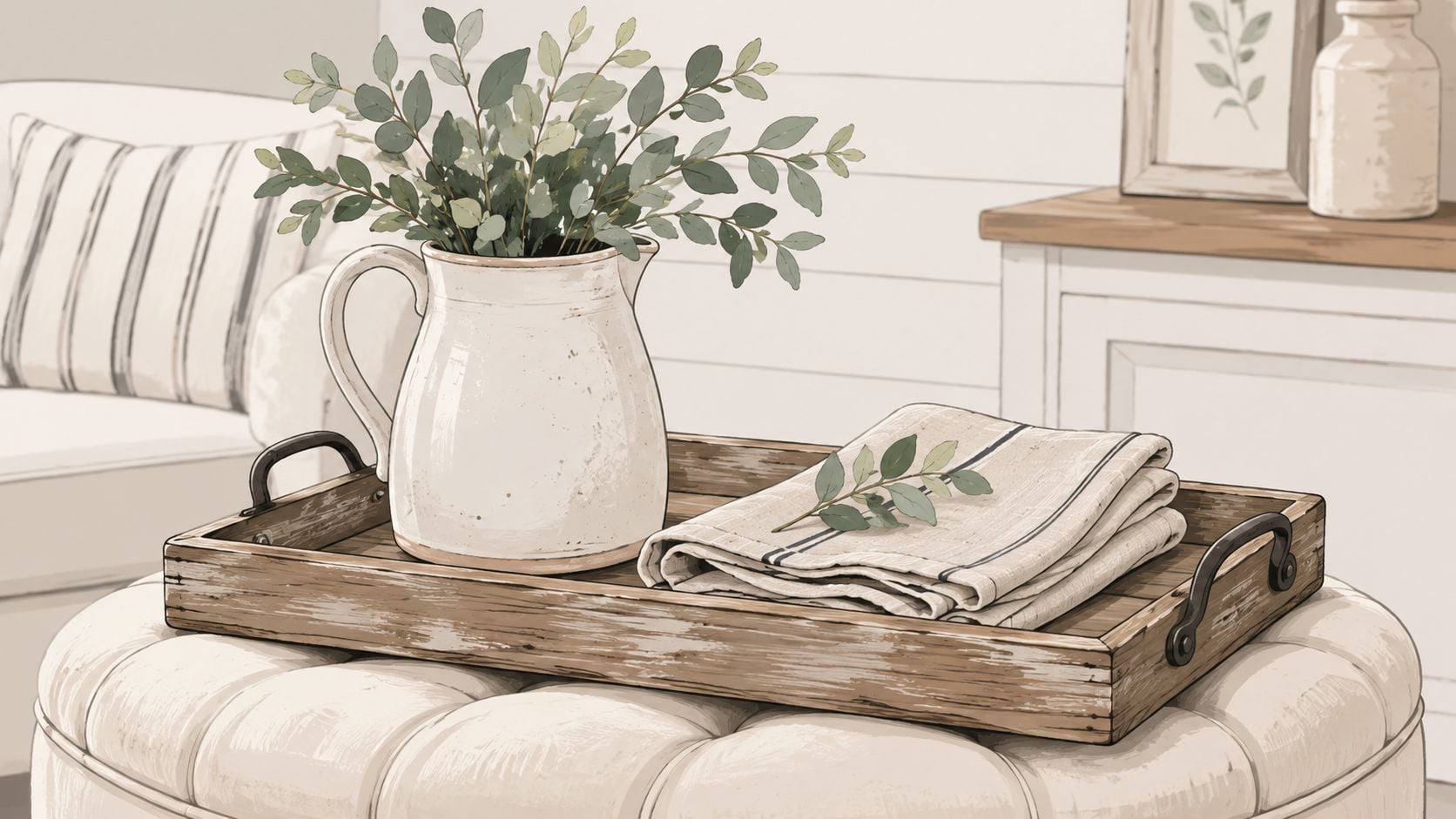
A weathered wood tray sets a relaxed foundation. Add a stoneware pitcher, a folded linen napkin, and a small potted herb. The pitcher supplies height, the linen softens the arrangement, and the herb brings a living note without filling every corner.
Modern
A sleek round metal tray can hold a single sculptural object, a candle, and a stack of two design books. The limited palette keeps the display quiet, while the different heights prevent it from looking flat. Leave a clear area for a drink so the tray remains useful rather than purely decorative.
Coastal
A whitewashed rectangular tray works with a blue glass bottle, a bowl of seashells or citrus, and a rolled throw. The bottle creates a vertical accent, the bowl gives the eye a rounded form, and the throw introduces texture. The arrangement feels lighter when the tray's edges remain visible.
Traditional
A dark wood tray can anchor a brass-handled magnifying glass, a leather-bound box, and a short stack of coasters. The box hides small items, while the brass and leather add depth without demanding bright color. A small amount of negative space keeps the grouping from becoming formal clutter.
For adjacent entertaining areas, these fresh bar cart styling ideas can provide inspiration for balancing display pieces with serving items. Similar thinking applies to an ottoman, but the lower height makes reach and stability more important.
A homeowner can explore additional room direction through Groen's guide to style trends for the home. The most successful tray arrangement still reflects the room's existing upholstery, wood tones, and daily habits.
Making the Tray Work as a Daily Tool
At the start of a weeknight, a Northwest Indiana family settles into the living room with drinks while dinner finishes. The ottoman sits in the center of the seating area, and a tray with a raised lip gives each glass a stable landing place. If condensation gathers, the lip helps keep the moisture from moving directly onto the upholstery.
After the television comes on, remotes become the next challenge. A divided tray or compartmentalized insert keeps clickers from sliding between cushions, while a small box can conceal chargers or other small objects. The ottoman remains visually calm because the items have a home.
The tray changes jobs throughout the evening
Movie-night snacks bring another test. A wipe-clean finish handles crumbs and drink rings more easily than a porous or unfinished surface, and handles allow an adult to carry the tray to the kitchen without dragging it across the ottoman. That lifting motion protects both the tray and the upholstery.
Later, a laptop may replace the snack bowl while someone answers after-hours email. A broad, stable base matters more than decoration here. The lip should contain small objects without blocking the laptop or making it awkward to remove.
At wind-down, the laptop leaves and a candle and book take its place. The same tray has served drinks, organized remotes, supported snacks, and created a quiet reading arrangement. That multi-function role is often overlooked when homeowners choose only by color or finish.
Daily-use test: A tray should be easy to lift with one hand, steady when a glass is set down, and simple to wipe after the room returns to ordinary family life.
Three features deserve close attention:
- Handles: They improve portability and reduce the temptation to drag the tray across leather or fabric.
- Raised lip: It helps contain minor spills and keeps round objects from rolling away.
- Wipe-clean finish: It shortens cleanup and lowers the risk of stains from everyday drinks and snacks.
For a family room that functions as both a style space and a high-traffic zone, beauty works best when it supports these ordinary moments.
Care and Maintenance That Keeps It Looking New
Care should follow the tray's material, not a generic cleaning routine. A few simple habits prevent moisture, grit, and neglected edges from shortening the useful life of the piece.
Wood care
Dust a wood tray weekly with a dry microfiber cloth. Rotate the tray's position when sunlight reaches the ottoman so one area doesn't fade more than another. A paste wax or beeswax conditioner can be applied every six months to nourish the finish and help disguise fine surface marks.
Wet glasses shouldn't sit directly on wood, especially when the finish is worn or the surface is unfinished. Avoid soaking the tray and skip harsh sprays that can cloud or strip the finish. For products and guidance intended for furniture surfaces, Groen's furniture cleaner resource is a useful reference.
Metal and mirrored surfaces
Metal trays need a damp-cloth wipe followed by immediate drying to prevent water spots. If a powder-coated edge develops a chip, matching touch-up should happen early, before moisture reaches the exposed area and encourages rust.
Mirrored trays need a streak-free glass cleaner sprayed onto the cloth rather than directly onto the glass. Dry with a lint-free towel, paying attention to the perimeter. Excess liquid near the edge can affect the backing over time and contribute to darkening along the border.
Ceramic and stone
Blot spills promptly instead of allowing them to sit. Porous travertine or marble should be sealed annually, while glazed ceramic generally needs only gentle wiping unless the manufacturer provides different instructions. Heavy pieces should be lifted rather than dropped onto a cushion.
A cluttered tray also receives more friction, which increases scratching. Keep daily-use arrangements simple, remove objects before cleaning, and give the tray a quick weekly microfiber pass. That short routine keeps the finish visible and makes seasonal restyling easier.
Finding the Right Tray at a Local Showroom
Online images can narrow the field, but they can't tell a homeowner how a handle feels, how much a tray weighs, or whether its lip sits securely against a particular cushion. An ottoman tray that looks balanced on a screen may feel oversized in person, especially when the upholstery is plush or the ottoman has rounded edges.
A local showroom makes those details testable. Homeowners can bring the ottoman's measurements, a phone photo of the room, and a small notebook for recording finish and proportion ideas. The tray can then be placed on a comparable ottoman, lifted by its handles, and checked from the same angles used at home.
What to test on the floor
- Fit: Set the tray on the ottoman and inspect the border on every side. The two-thirds benchmark should guide the choice, but the actual cushion and silhouette still matter.
- Stability: Press gently near the tray's edges and set down a full water glass. Any rocking deserves attention before purchase.
- Handling: Lift the tray by its handles and notice whether the grip feels secure and balanced.
- Surface behavior: Run a hand across the finish and consider whether fingerprints, crumbs, or water marks will be easy to manage.
- Room connection: Place the tray near a coffee table piece or upholstery sample to see whether the finish supports the existing palette.
Custom sizing is especially useful for oversized sectional ottomans. Many standard trays don't follow the desired proportion, while a custom furniture conversation can address dimensions, finish, or hardware more precisely. Groen's Fine Furniture offers custom furniture guidance, including made-to-order Canadel dining and Amish solid wood options, so a homeowner who is updating a living room can discuss coordinated materials rather than choosing each piece in isolation.
The same visit can become a broader design appointment. Interior design support, in-home swatches, White-Glove Delivery, and Special Financing subject to credit approval can help families plan purchases around both comfort and budget. Those services matter to homeowners in Dyer and Crown Point, as well as nearby NWI communities such as St. John, Schererville, and Munster, because a tray often reveals questions about the ottoman, sofa, lighting, and room layout.
Groen's multigenerational ownership, family presence, and five-star service reflect a local approach rather than an endless catalog experience. The team can discuss Flexsteel for durability, Bassett for style, solid wood Amish craftsmanship, and the broader room plan without turning a small accessory decision into a sales pitch.
Visit Groen's Fine Furniture in Dyer or Crown Point to compare decorative trays for ottomans, test proportions and handling in person, and explore custom options for a coordinated room. The family-owned team can also explain White-Glove Delivery and Special Financing, subject to credit approval, so each choice fits the home, comfort needs, and budget.