
Wall Saver Recliners: Space-Saving Comfort for Real Rooms

A homeowner in Dyer or Crown Point often starts with a simple goal: keep a comfortable recliner close to the wall without sacrificing the walkway. The chair looks like it fits, the wall measurement seems right, and then the footrest opens into the coffee table or the delivery crew discovers that the doorway is too narrow. That's the mistake wall saver recliners can prevent, but only when the entire room and the person using the chair are measured carefully.
For families across Northwest Indiana, NWI, St. John, Schererville, and Munster, the right purchase isn't just a chair with a small wall-gap requirement. It's a daily-use seat that clears the wall, extends safely, supports standing, fits through the home, and feels comfortable after more than a quick showroom sit.
Why Wall Saver Recliners Solve the Wrong Problem
A homeowner in Northwest Indiana can measure the space behind a recliner, find a model that appears to need only a few inches, and still end up with a layout that doesn't work. The chair may clear the baseboard while fully upright, but the footrest can reach into a doorway, the armrest can crowd a side table, or the delivery path can fail before the chair reaches the living room.
Wall clearance is only half the calculation. A wall saver recliner changes the direction of the reclining motion, but it doesn't erase the chair's front footprint, width, height, or delivery dimensions. The chair still needs room to open, room for a person to transfer in and out, and a route through the front door and interior passages.
Start with the whole layout
A quick room check should include four separate areas:
- Behind the chair: Measure from the wall to the back frame, not just the cushion.
- In front of the chair: Mark the footrest's full extension with tape on the floor.
- Beside the chair: Leave enough practical space for arm movement, a side table, and standing or transferring.
- Along the delivery route: Measure the doorway, turns, hallways, and any narrow passage between the entry and final position.
A room can look open on graph paper and feel blocked once a recliner is fully extended. The same issue appears in rooms where the chair clears the wall but interferes with a baseboard, outlet, heating vent, media console, or nearby sofa.
Practical rule: Measure the chair in its most demanding position, not its smallest upright position.
For broader layout ideas, the small-room planning guide can help homeowners think beyond one wall and evaluate the entire circulation path. The rest of the buying process should follow that same discipline. A chair works only when the wall, floor, side space, person, and delivery route all cooperate.
What Wall Saver Recliners Actually Are
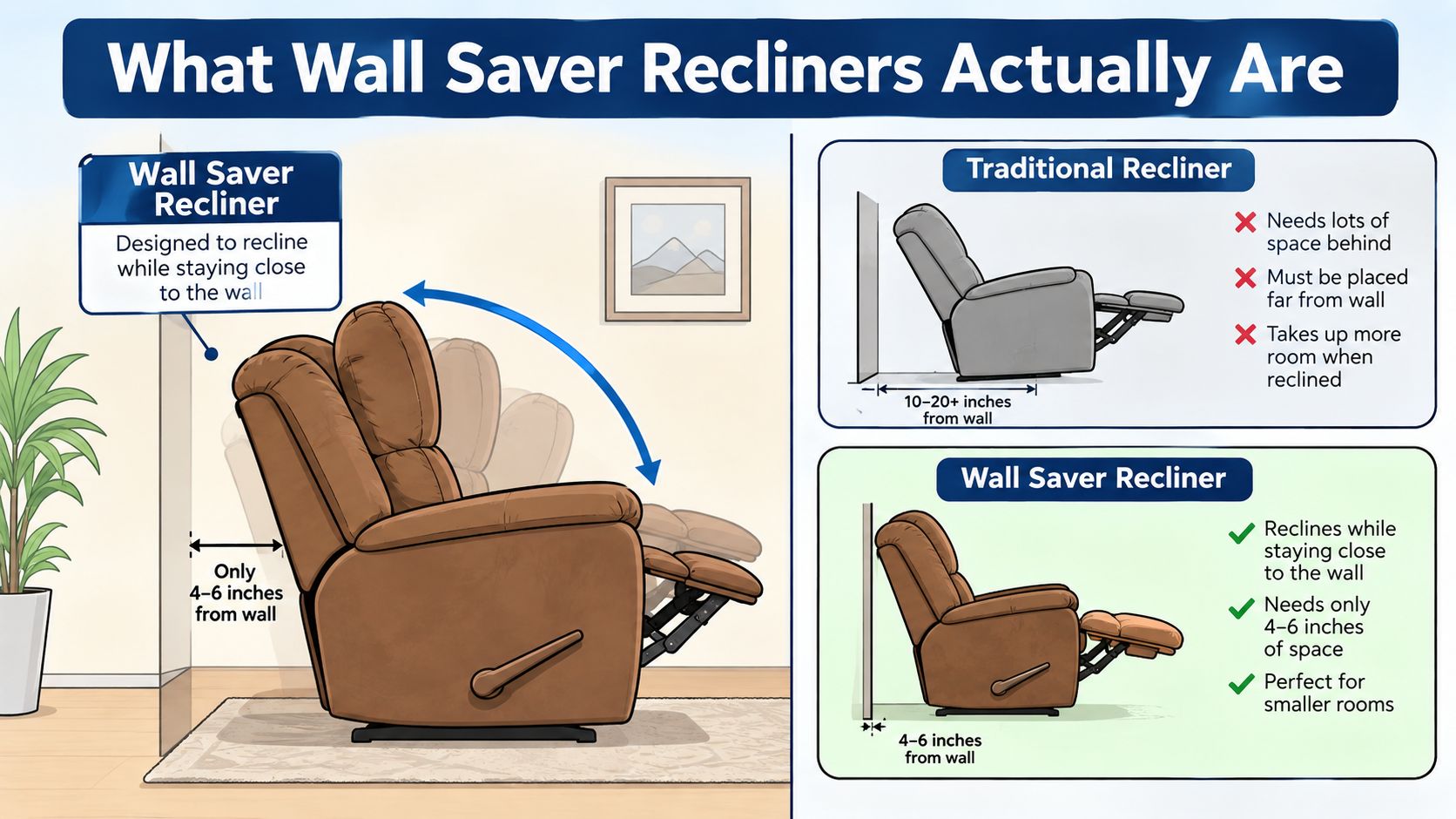
A wall saver recliner, also called a wall-hugger or wall-saver recliner, uses a forward-sliding seat track. Instead of tipping the backrest straight toward the wall, the seat glides forward while the back reclines. That movement lets many models operate with about 4 to 6 inches of wall clearance, compared with the 12 to 18 inches commonly associated with traditional recliners, according to recliner clearance guidance.
The mechanism is easier to understand when compared with a sliding patio door. The door moves along its track instead of swinging into the room. A wall saver recliner follows a similar principle, although its linked track and reclining components move the seat forward as the back changes angle.
Why the older name still appears
Wall-hugger and wall-saver styles first appeared in the 1970s, as furniture makers responded to smaller rooms and tighter home layouts, as documented in the same wall-clearance reference. The older “wall hugger” term still appears on specification sheets, retailer pages, and product descriptions, so shoppers should treat both names as part of the same general category.
Some true zero-clearance designs can require as little as 1 to 2 inches behind the chair, although the exact requirement belongs to the individual model. One powered example lists about 3 inches at the headrest and 4 inches to fully recline, while reaching a full recline depth of roughly 62.5 inches. Its listed electrical requirement is 110V and about 75 watts, showing that the compact wall placement comes from the drive design rather than a shortened recline range, as shown in this powered wall-hugger specification.
A wall saver isn't automatically a rocker recliner, swivel glider, or zero-gravity chair. Those terms describe rocking, swiveling, gliding, or a body-positioning style. A wall saver describes how the chair moves in relation to the wall. One chair can combine several categories, but shoppers should identify the wall-saving mechanism first and then evaluate the other comfort features separately. Groen's guide to what a wall-hugger recliner is gives shoppers another useful way to distinguish the motion types before comparing models.
Wall Saver Recliners vs Standard Recliners
A wall saver earns its floor space when the chair must sit near a wall, behind a sofa, in a compact den, or inside a smaller living room. A standard recliner makes more sense when open floor space is available and the buyer values a basic manual mechanism, a wider seat, or a deeper lounging posture.
The difference is how each chair travels. A wall saver uses a forward-moving track, so the seat and back move away from the wall as the chair reclines. A standard recliner sends more of its backrest toward the wall. That mechanism saves rear clearance, but it does not solve every fit problem. Check the seat height, footrest swing, doorway width, and the comfort of getting in and out before choosing.
Wall Saver vs Standard Recliner at a Glance
| Feature | Wall Saver Recliner | Standard Recliner |
|---|---|---|
| Wall clearance | Many models work with about 4 to 6 inches, while some true zero-clearance designs require as little as 1 to 2 inches, according to clearance guidance | Commonly associated with about 12 to 18 inches of rear space |
| Overall footprint | Leaves more usable space behind the chair, but still needs room for the extended footrest and full reclined depth | Usually needs more open space behind the back as it reclines |
| Mechanism type | Forward-sliding seat track linked to the reclining motion | More direct rearward reclining motion |
| Reclining positions | Can provide a full recline, depending on the model and mechanism | Can offer a broad range, with some buyers preferring the feel of a traditional deep recline |
| Price band | Quality models generally occupy the same price band as standard recliners, so the space-saving feature alone rarely sets the cost | Varies with frame, upholstery, power, construction, and brand |
For older adults and buyers with limited mobility, seat height can outweigh the wall specification. A low seat may feel comfortable once seated but make standing difficult. A high seat can simplify transfers while leaving shorter users without proper thigh support. Have the user sit fully back, place both feet on the floor, and rise without pulling hard on the arms.
The footrest also needs a clear path. A wall saver can protect the rear wall while its footrest reaches into a walkway, blocks a coffee table, or leaves too little room for another chair. Measure the chair's full open depth and test the swing of the footrest, not just the upright footprint. Doorway width matters too. A chair that fits the room may still fail at the entrance, hallway turn, or stair landing.
Reclining chairs represented about $3.8 billion in U.S. retail spending in 2010, up from $3.7 billion in 2009, and accounted for about 5% of the furniture and bedding market, according to Furniture Today's recliner statistics. Those figures show the category's scale, not a reason to favor one mechanism.
For a broad look at manual, powered, conventional, and space-conscious designs, browse the Futonland recliner collection. Choose a wall saver when rear clearance controls the layout. Choose a standard recliner when open space matters less than seat shape, deep recline feel, or a simpler mechanism.-vesm
Measuring Your Room for a Wall Saver Recliner
Measure the chair fully open, not just upright. Upright width and height show whether the chair fits its spot, but they do not show where the footrest ends, how far the seat moves, or whether a person can pass safely beside it.
Wall-hugger models commonly need about 4 to 8 inches behind the back, compared with about 8 to 20 inches for standard recliners, according to this wall-hugger space guide. Specific wall-saver models may call for roughly 4 inches or 10 to 12 inches, while traditional recliners can require 10 to 20 inches or more, as shown in this recliner clearance comparison. Use the model's own specification as the final authority.
Four measurements that decide the layout
| Measurement | Wall Saver Check | Standard Recliner Check | What to Check |
|---|---|---|---|
| Rear wall gap | About 4 to 8 inches, unless the model specifies otherwise | About 8 to 20 inches or more | Measure to the back frame, including baseboards and trim |
| Footrest extension | Use the exact fully reclined depth in the model specification | Use the exact fully reclined depth in the model specification | Mark the front reach with painter's tape and protect the walkway |
| Side clearance | Leave room for armrests, transfers, and nearby furniture | Leave room for armrests, transfers, and nearby furniture | Check tables, sofa arms, outlets, and door swings |
| Doorway route | Confirm the packaged and assembled chair can reach the room | Confirm the packaged and assembled chair can reach the room | Measure the entry, hallway, turns, and final opening |
A rear gap of 4 inches supports a wall-saver layout. A gap of 11 inches may allow a standard recliner, but only when its back, footrest, and walkway fit together in the actual room. Clearance figures are starting points, not promises.
Check the obstacles people forget
Baseboards can reduce usable wall space. Outlets and heating vents can restrict placement or airflow. A side table that fits next to the upright chair may block the arm, footrest, or transfer path after reclining.
Doorway width deserves its own check, especially for older adults or buyers with limited mobility. Measure the narrowest entry and tightest turn, then mark the chair's open depth on the floor. Use this furniture measuring guide before shopping and bring every measurement to the showroom.
The chair also needs a clear footrest swing. Test where the footrest reaches, where feet land, and whether someone can walk past without catching a shin or moving furniture. A chair that clears the wall but blocks the room is the wrong chair.
Fit for the Person Using the Chair
A wall saver recliner can be perfect for a room and wrong for the person. Older adults and mobility-sensitive users need a chair that supports standing, offers stable arm support, and places controls within easy reach. The mechanism matters, but the daily transfer into and out of the seat matters more.
Seat height deserves early attention. A seat top around 18 to 20 inches from the floor is commonly discussed as a useful range for standing comfort, but the right height depends on the user's leg length, hip strength, and mobility needs. Armrests should be firm enough to support a controlled push-off without collapsing under pressure.
Test the chair like a daily user
A showroom test should follow this sequence:
- Sit fully back. Check whether the lower back is supported without forcing the shoulders forward.
- Place both feet flat. The knees should feel comfortable rather than sharply raised or dangling.
- Operate the controls. Confirm that the handle or power buttons are reachable without twisting.
- Recline and read for ten minutes. A chair that feels pleasant for a moment may feel too shallow, too firm, or poorly supported during longer use.
- Stand without using the hands. If that isn't comfortable, the chair may need more height, firmer support, or a power lift function.
Manual wall savers require the user to initiate the motion and supply leg strength. Power controls make angle adjustments easier, especially for someone with arthritis or limited reach. A power lift chair goes further by helping the user rise, but a regular power recliner should not be treated as a lift chair unless the model specifically includes that function.
Capacity, seat depth, cushion firmness, and arm support all belong on the checklist. Capacity ranges are commonly presented around 250 to 400 pounds, but the exact limit must come from the product specification, not a guess based on appearance. Taller users should compare seat depth and headrest position, and the recliner guide for taller people can help frame that evaluation.
A chair should make standing feel controlled, not like a test of balance and leg strength.
Care and Buying Considerations That Matter
The best wall-saving mechanism can't compensate for weak construction or neglected upholstery. Buyers should inspect the frame, suspension, cushions, cover, warranty, and delivery plan with the same attention given to wall clearance.
Construction choices affect daily feel
A hardwood frame gives a different foundation from a plywood or softwood frame. Kiln-dried hardwood is generally selected for stability, while lower-grade materials can be more vulnerable to movement as the chair receives daily use. Sinuous springs usually provide a more structured suspension than basic webbing, which can lose shape or tension over time.
Cushion materials deserve equal scrutiny. High-resilience foam can maintain support more effectively than basic polyurethane, while a softer cushion may feel appealing in the showroom but lack the firmness a mobility-sensitive user needs for standing. A removable cover simplifies some cleaning tasks, while a code-cleanable-only cover demands closer attention to the manufacturer's care instructions.
The ultimate recliner buying guide is useful for organizing these questions before a purchase. Quality wall savers generally sit in the same broad price band as standard recliners, so the clearance feature itself rarely adds cost. Construction, upholstery, power options, customization, and warranty coverage usually matter more.
Match care to the upholstery
- Performance fabric: Vacuum gently and address spills promptly with the manufacturer-approved cleaner.
- Leather: Dust regularly, use suitable leather care products, and keep the chair away from sustained direct heat.
- Microfiber: Blot rather than scrub, and follow the fabric code before applying moisture.
Mechanisms should stay free of debris, especially around tracks and footrest linkages. Lubrication should follow the manufacturer's schedule and product instructions, not a casual household routine. A warranty that covers only the frame while excluding the motor, track, or reclining mechanism deserves close reading.
Delivery is part of the purchase. White-Glove Delivery can include placement, packaging removal, and inspection, while threshold drop-off leaves more responsibility with the household. On arrival, the buyer should check upholstery, seams, feet, power cords, controls, wall clearance, and the full reclining motion before signing off.
Common Questions Buyers Bring to the Showroom
Can a wall saver recliner reach a full recline? Often, yes. The forward-sliding track changes the path of the seat and back, not necessarily the chair's available recline range. The exact position depends on the model, so the specification sheet and an in-person test should settle the question.
Does a wall saver feel smaller than a traditional recliner? It can. Many space-conscious models use a shallower seat or a more compact frame, which helps them fit a tighter room but may feel less generous to a taller or broader user. A smaller outside footprint doesn't guarantee a smaller seat, and it doesn't guarantee a comfortable fit.
Room placement questions
A wall saver is a strong candidate for a compact living room, apartment, condo, behind-sofa arrangement, or seating zone pressed close to a media wall. It's a poor candidate when the fully reclined footrest would block the only walkway, when the room has an awkwardly angled wall, or when the delivery route includes a turn the chair can't clear.
A heat vent or sunny window also deserves attention. Heat can affect upholstery and comfort, while blocked vents can disrupt airflow. The chair should remain clear of the vent and should not sit where prolonged direct sunlight will stress the cover.
Durability and household use
A wall saver can handle daily use when its frame, suspension, track, motor, and upholstery are properly matched to the household. Buyers with children or pets should favor durable, cleanable upholstery and inspect the fabric's care code before choosing a color or texture. Protected leather and performance fabrics can be practical options, but the correct choice still depends on cleaning habits and the manufacturer's instructions.
Taller users should check headrest adjustability and back support rather than relying on overall chair height. Power headrests can improve positioning, but only if the controls are easy for the user to reach.
The showroom questions usually reveal the real checklist: clearance, footrest space, fit, controls, fabric, delivery, and maintenance.
Finding the Right Wall Saver Recliner for Your Home
The right wall saver recliner balances clearance, human fit, construction, and budget. Chasing the smallest wall-gap number alone can produce a chair that clears the wall but crowds the room or leaves the user fighting to stand. The better approach is to bring the measurements and test the chair as it will be used at home.
A showroom visit in Dyer or Crown Point should include three practical checks. First, test the seat height and arm support from a seated position. Second, recline fully and evaluate lumbar support, footrest reach, headrest placement, and control location. Third, stand up and walk around the chair to confirm that the motion doesn't interfere with the intended circulation path.
Use a simple decision sequence
- Room first: Bring the rear wall gap, full available depth, side clearance, and narrowest delivery measurement.
- Person second: Match seat height, seat depth, arm support, capacity, cushion firmness, and control style to the user.
- Construction third: Ask about the frame, suspension, foam, upholstery care, mechanism coverage, and delivery inspection.
- Budget last: Compare value rather than selecting the cheapest chair. Special Financing is available, subject to credit approval, which can provide more buying power without pretending that every model costs the same.
Groen's Fine Furniture carries living-room options that include Flexsteel for durability, Bassett for style, power wallsaver recliners, and custom furniture guidance. The same showroom approach applies when a household is furnishing other rooms. Canadel custom dining supports made-to-order choices, and Amish solid wood furniture brings craftsmanship and bespoke design to dining and occasional pieces.
Small-room planning also benefits from comparing the sofa's footprint, not just its style. A practical resource on choosing a small couch in Australia offers another perspective on keeping compact seating layouts usable. The principle applies locally too, especially in NWI homes where one living room may need to serve as a television area, conversation space, and main walkway.
Bring the measurements, sit in three chairs for at least five minutes each, and ask about custom order options when the standard size or fabric doesn't fit. A made-to-order solution can match the room and the household more effectively than forcing an almost-right chair into place.
Visit Groen's Fine Furniture in Dyer or Crown Point to test wall saver recliners, compare seat heights and controls, and ask about custom furniture options and Special Financing, subject to credit approval. Our multigenerational family team has served Northwest Indiana since 1983 with five-star service, White-Glove Delivery, and honest guidance for creating a comfortable home that lasts.