Fireplace Media Consoles for Northwest Indiana

For homeowners in Dyer, Crown Point, and throughout Northwest Indiana, a fireplace media console can solve several living-room problems at once. A family may be dealing with an outdated TV stand, scattered game systems, visible cords, and a blank wall that feels disconnected from the seating area. The right console brings the television, enclosed storage, electric flame effect, and a stronger sense of comfort into one coordinated piece.
That doesn't mean every home needs a permanent built-in. Some households need a movable furniture solution that can follow a future move or room rearrangement. Others are ready for a semi-custom or custom media wall that becomes a lasting architectural feature. The practical choice depends on room dimensions, viewing height, electrical access, heat expectations, and how long the layout needs to serve the household.
Why a Fireplace Media Console Changes the Room
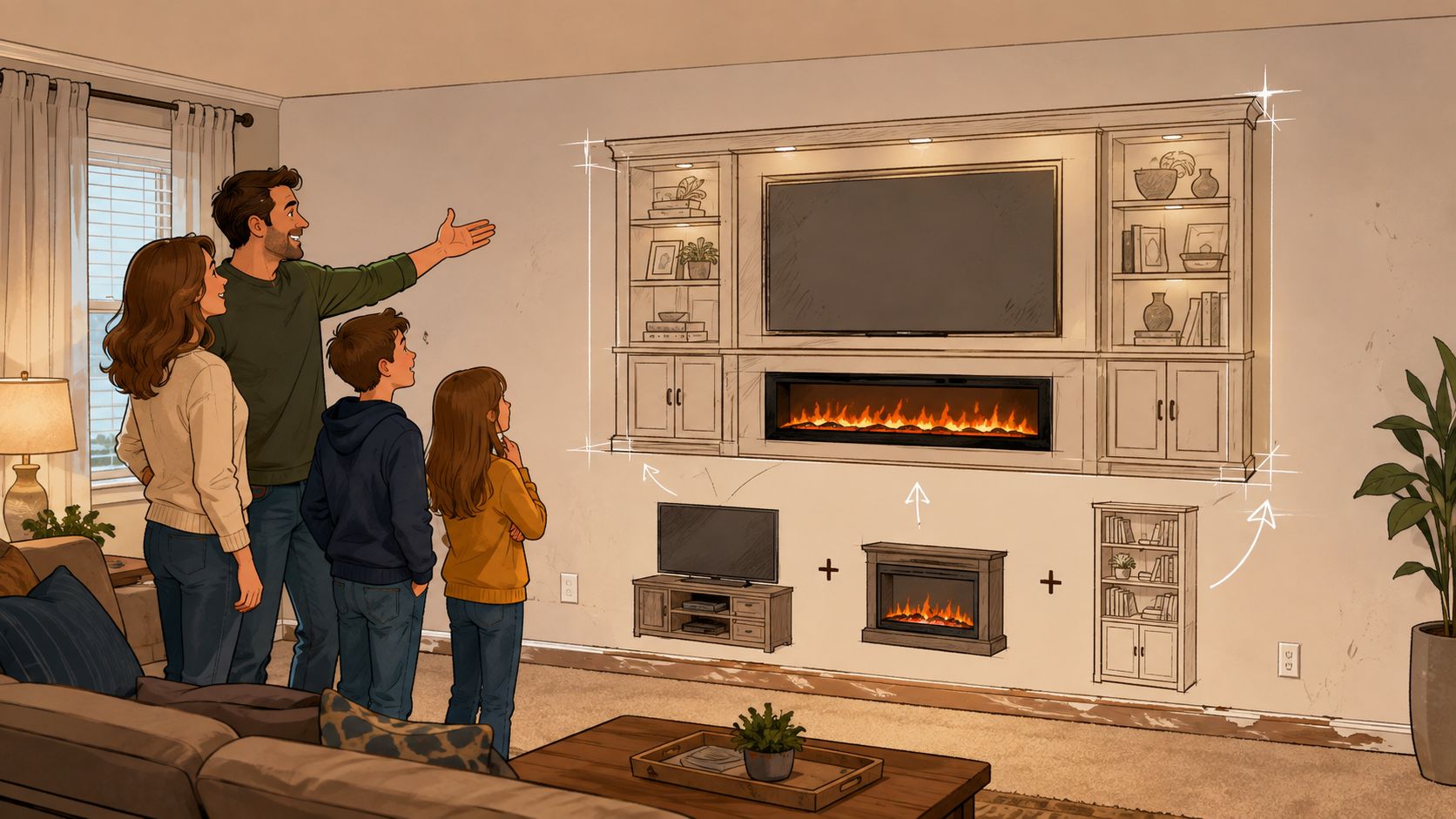
A Munster family might begin with a familiar arrangement: a television balanced on an aging baseboard cabinet, speakers sitting beside it, blankets in a basket, and gaming equipment spread across open shelves. The wall works, but it doesn't feel finished. A fireplace media console can replace the separate TV stand, storage piece, and supplementary heat source with one visually connected focal point.
The console anchors the seating area without requiring a masonry project. Its cabinet doors hide remotes, components, and accessories, while the upper surface frames the television and gives the wall a deliberate center. The flame display adds visual warmth during a January evening, but flame-only operation can also create atmosphere in warmer months when supplemental heat isn't wanted.
One focal point instead of separate fixes
A freestanding electric stove can add warmth and character, but it usually leaves the television, storage, and component organization as separate design decisions. A wall-mounted fireplace has a clean profile, yet the homeowner still needs a cabinet or shelving plan underneath and around it.
A fireplace media console handles those relationships in one footprint. In a room with a tall ceiling, a substantial console can visually ground the lower wall. In an open-concept space, it can define the conversation area without adding a full partition. That makes the piece useful beyond its heating function.
A helpful overview of the components and planning considerations appears in this fire media kit overview, especially for homeowners trying to understand how the firebox and media furniture work together.
Room-planning insight: The console should support the way the household gathers, not simply fill the wall beneath the screen.
Comfort in every season
Electric flame effects make the fireplace element more flexible than a strictly seasonal decoration. The visual glow can stay on while the heater stays off, allowing the room to feel layered during summer movie nights or early fall evenings. Enclosed storage also keeps the entertainment area calmer, which matters in homes where the living room serves as a family room, guest space, and gathering spot.
The broader home media consoles market was valued at $14.2 billion in 2025 and is projected to reach $21.8 billion by 2034, implying a 5.2% CAGR. Fireplace media consoles fit within this broader multifunctional furniture category, where display, storage, and room-focal-point design increasingly work together.
For more ideas about coordinating seating, storage, and entertainment furniture, homeowners can review Groen's living room essentials. The next decision is less about whether a fireplace console looks attractive and more about whether a standalone, semi-custom, or built-in configuration suits the room's future.
Understanding the Main Console Options
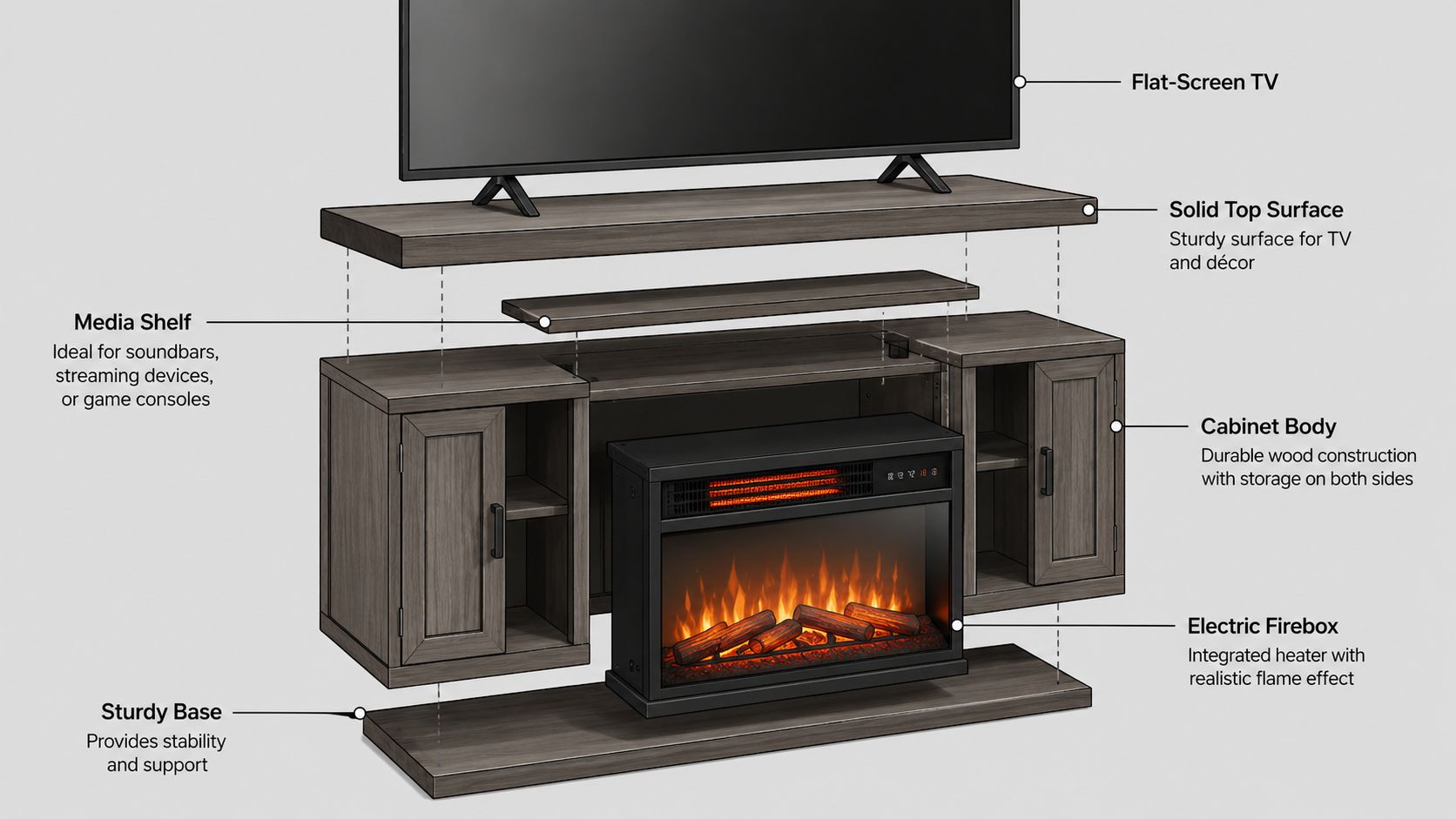
A useful way to evaluate fireplace media consoles is to think of the piece as a small furniture-and-electrical system. The cabinet body provides storage, the firebox supplies flame visuals and optional supplemental heat, the top surface supports the television, and openings or channels help move warm air and route cords. Every part affects the others, so a beautiful finish can't compensate for a console that lacks component space or safe airflow.
Standalone furniture for flexible rooms
A standalone console is generally a prebuilt piece with established dimensions, finishes, storage arrangements, and firebox specifications. It works well for renters, first-time buyers, and homeowners who expect to rearrange the room or move later. The main advantage is clarity. The dimensions and appearance are known before purchase, and the unit can typically be placed without committing the entire wall to construction.
The trade-off is limited flexibility. A console may be slightly too wide for one wall or leave unused space on another. Its shelf openings may also be less accommodating for an unusually deep receiver or a soundbar with a particular shape. A guide to shopping for TV stands can help shoppers organize those measurements before comparing finishes.
Semi-custom choices for imperfect walls
Semi-custom furniture keeps a defined base design while allowing selected changes, such as width, finish, door style, hardware, or firebox upgrades. This tier suits a homeowner whose wall isn't a standard fit or whose television and components require a more precise arrangement.
The benefit is targeted adjustment rather than unlimited design work. A homeowner may solve the exact problem that matters most, such as adding shelf width for a soundbar or selecting a finish that coordinates with existing trim. Timelines and cost expectations depend on the available options and the manufacturer's process, so the showroom should confirm them before an order is placed.
Media walls for long-term integration
A media-wall layout treats the console as the lower or center portion of a larger composition. Side towers, bridging shelves, lighting, speakers, and concealed wiring can extend the design upward or across the entire wall. This approach is suited to homeowners who want the television and fireplace to read as permanent infrastructure rather than movable furniture.
The visual payoff is substantial, but flexibility decreases. A future television change, room redesign, or component upgrade needs to work within the planned openings. A custom layout also requires more decisions before installation, including wall conditions, outlet locations, trim transitions, and the relationship between the screen and seating.
A standalone console solves a furniture problem. A media wall solves a room-architecture problem. The right choice depends on which problem the household actually has.
Comparing Styles and Materials
Style should begin with the architecture already present in the home. Traditional fireplace media consoles often use raised panels, crown molding, fluted pilasters, and warmer wood tones that echo a classic mantel. They can make a formal living room feel settled, especially when the surrounding furniture includes turned legs, detailed upholstery, or darker finishes.
Transitional designs remove some of that visual weight. Simpler lines, restrained hardware, mixed materials, and neutral stains can fit a modern farmhouse, a renovated ranch, or an updated 1970s tri-level common across the Region. Modern and contemporary consoles usually move toward flat fronts, slab doors, matte hardware, painted surrounds, and stone-like surfaces that complement large flat-panel televisions.
Material selection affects more than appearance. Solid hardwood is durable, repairable, and substantial, but it also weighs more and may require careful handling during delivery. Hardwood veneer over an engineered core offers a stable surface and can respond well to humidity changes in Northwest Indiana homes. MDF with laminate can provide a clean, accessible finish, but it deserves more caution around concentrated heat and moisture. Painted finishes create a crisp look, while touch-ups may become more visible as busy households use the cabinet.
| Material | Durability | Maintenance | Best For |
|---|---|---|---|
| Solid hardwood | Long-lasting and repairable, with a heavier build | Dusting and finish-appropriate cleaning | Heirloom-minded homes and long-term furniture plans |
| Hardwood veneer over engineered core | Stable construction with a consistent surface | Gentle cleaning and protection from moisture | Homes with seasonal humidity changes |
| MDF with laminate | Practical surface with less tolerance for heat or moisture exposure | Wipe spills promptly and avoid abrasive cleaners | Value-conscious rooms with controlled placement |
| Painted finish | Strong visual impact, with touch-ups more noticeable over time | Careful cleaning and prompt repair of chips | Clean, coordinated interiors and lighter palettes |
Homes with children, pets, or frequent entertaining may favor enclosed doors and resilient finishes over delicate open shelving. A quieter household may prioritize display space and fine grain matching. Groen's wood furniture guide gives shoppers a useful foundation for connecting hardwood choice with longevity and style.
The best material is the one that matches the room's actual use. A formal finish that requires constant protection may frustrate a busy family, while a highly practical laminate may feel underwhelming in a room designed around solid wood Amish Furniture and carefully chosen upholstery.
Finding the Right Size and Layout
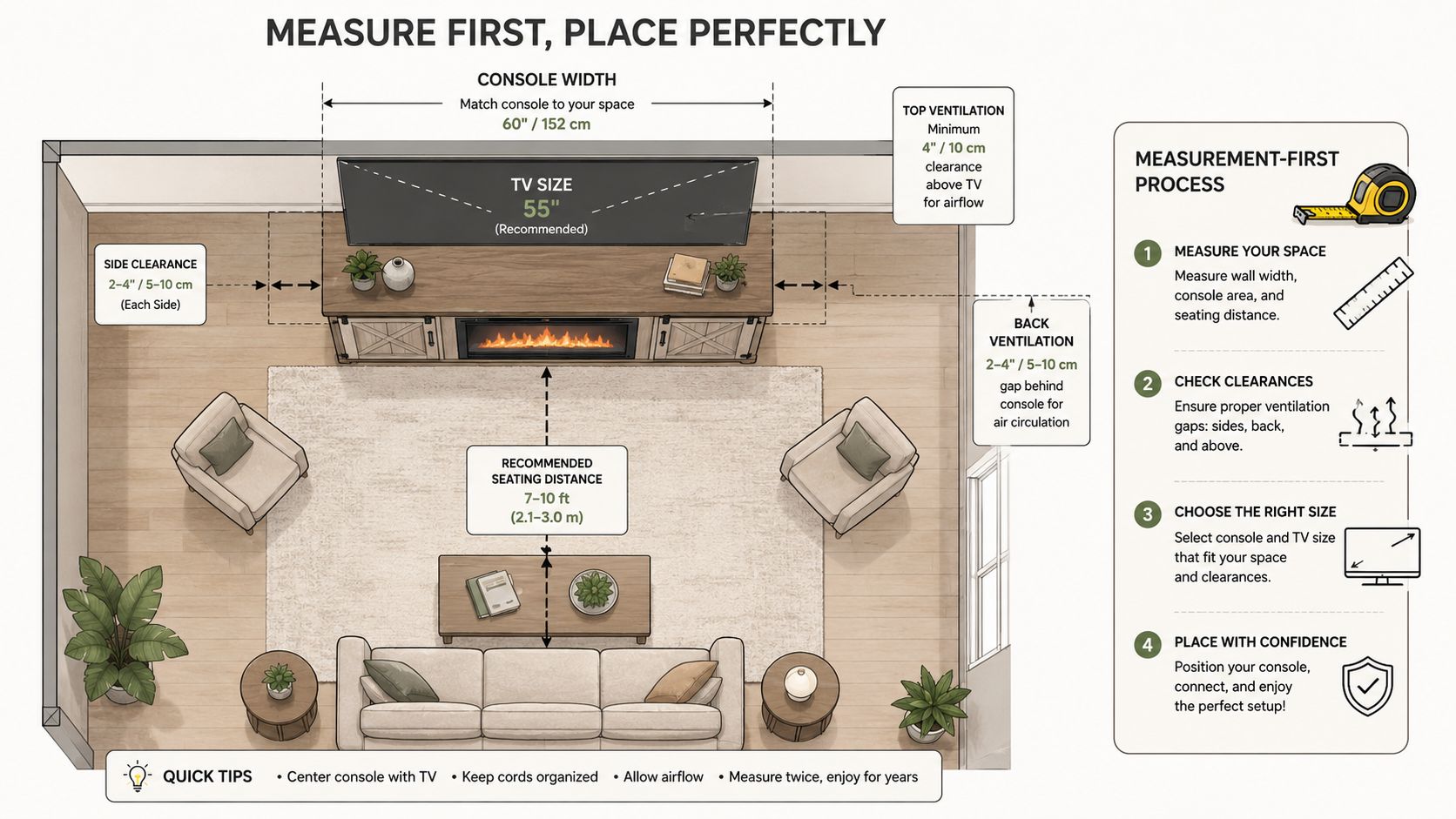
A fireplace media console should be measured as part of the entire viewing wall, not selected by appearance alone. The screen, console, seating, firebox, side clearances, outlets, and cable paths all need to work together before the order is finalized.
Start with the actual footprint
Measure the wall's usable width, then record baseboards, door swings, windows, vents, and nearby furniture. A spec sheet may list the console's overall width, but the usable interior width for components can be narrower. Depth matters just as much. One retailer lists a model measuring 75.5 inches wide, 21.5 inches deep, and 27.8 inches high, while another lists a model measuring 81 inches wide, 14.5 inches deep, and 26 inches high, demonstrating how much depth and height can vary within the category. (Costco product specifications)
Record the television's actual width, including its feet or stand, and verify the console's weight rating. The screen shouldn't just fit on paper. It needs stable support, enough surface area for the stand, and a sensible relationship to the firebox and mantel.
Check height, sightlines, and cable paths
A television mounted too high can make everyday viewing uncomfortable, particularly when the fireplace pushes the screen upward. Groen's TV stand height guide can help homeowners think through the screen's centerline, seating position, and furniture height before choosing a layout.
Cable routing deserves a drawing, even if it's a simple pencil sketch. Mark the path from the television to the outlet, soundbar, streaming device, and game system. Look for rear openings, removable backs, and channels that keep cords away from the heater and prevent a tight bend behind the cabinet.
Use the room as the final test
An apartment or compact den usually benefits from a shallow standalone console with enclosed storage and a flame-only setting. An average Northwest Indiana living room may support a wider piece that balances the screen with side furniture while preserving walking clearance. A large great room with a tall blank wall may be better served by a semi-custom arrangement that fills the composition without leaving an awkward strip of unused wall.
For fireplace placement, manufacturer instructions take priority. A commonly cited safety guide gives examples of 400 mm minimum clearance for combustible beams or shelves above solid-fuel or gas appliances, 300 mm for inset or cassette fireplaces, and 250 mm for non-combustible faux beams. (Fireplace clearance guidance) Electric units have different requirements, so the specific manual remains the controlling document.
Planning Heat, Power, and Safety
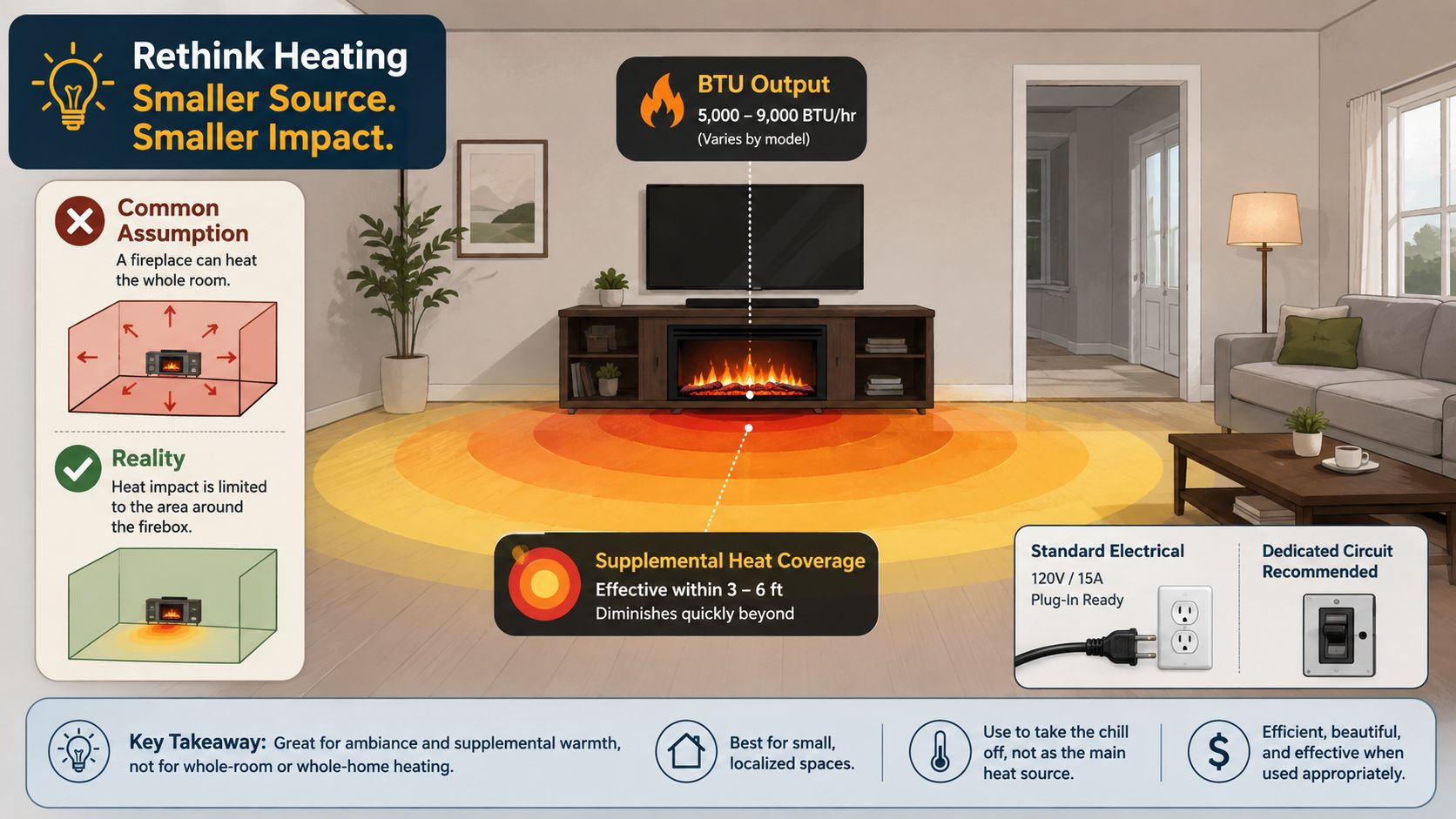
The most common misunderstanding is that a fireplace media console will heat an entire home or even every corner of a large living room. Most units are better understood as zone-heating furniture, meaning they can add comfort near the console while the result depends on insulation, open doors, drafts, and how warm air circulates through the room.
Most fireplace media consoles use a standardized 120V electric heater rated around 1,400 to 1,500W, producing roughly 4,600 to 5,118 BTU/hr and commonly specified for approximately 400 to 1,000 square feet. Those figures describe the unit's rated output and stated coverage, not a guarantee for every floor plan. (Real Flame product specifications)
Treat the heater as supplemental
A well-insulated room with the doors closed may feel noticeably more comfortable near the console. An open great room with high ceilings and frequent traffic between spaces may experience a much lighter effect. Flame-only operation remains useful when the household wants the glow without adding heat.
Electric inserts don't produce combustion gases, but they still need unobstructed airflow. A media-wall guide notes that vents usually aren't required for electric fireplace media walls, while emphasizing that the heat outlet must remain open and that only a few centimetres of clearance may typically be needed for efficient operation and an integrated appearance. The exact clearance should always come from the insert's instructions. (Electric media-wall ventilation guidance)
Plan the electrical load before delivery
Manufacturer guidance can require a dedicated 15-amp, 120-volt grounded outlet, along with proper grounding and load handling. Flammables should remain at least 3 feet away, and vents must not be blocked. (Manufacturer use and care guide)
That guidance affects furniture placement. Extension cords shouldn't become the permanent solution for a heater, television, soundbar, and media components. The outlet should be reachable without pinching cords behind the cabinet, and surge protection should be selected for the electronics without placing the heater on an overloaded power strip.
Protect people and equipment
Look for features such as automatic shut-off, cool-touch glass, tip-over restraint options, and controls that can be kept away from children and pets. Curtains, rugs, blankets, baskets, and decorative objects shouldn't rest against the heat outlet or crowd the insert.
A television above the fireplace needs its own clearance plan. One placement guide states that 4 to 6 inches is often recommended between the mantel top and the bottom of the TV, with the mantel generally at least 12 inches above the firebox opening. (TV-over-fireplace placement guidance) The insert manual and television manufacturer requirements should take precedence when they differ.
For homeowners considering storage around the entertainment wall, Groen's bookcase placement guidance offers another reminder that tall furniture needs careful anchoring and attention to surrounding openings.
Installing, Placing, and Maintaining the Console
A successful installation begins before the delivery truck arrives. Measure the entry door, hallway turns, stairways, and the final wall. Large fireplace media consoles can be awkward even when their listed width appears manageable, so the delivery path deserves the same attention as the finished room.
Clear the final resting spot and mark the console's footprint with painter's tape. This simple test shows whether doors can open, people can walk past, and the television will face the main seating area rather than a secondary angle. Confirm that the nearby outlet is grounded and suitable for the planned load, and arrange electrical work before furniture delivery if the existing setup isn't appropriate.
Prepare the room in a practical order
- Measure the route: Check doorways, corners, stair landings, and ceiling height before scheduling delivery.
- Mark the footprint: Use tape to test depth, side clearance, and access to cabinet doors.
- Plan the screen: Decide whether the television will sit on the console or mount above it, then verify height and clearance.
- Protect the cords: Identify the route for power, sound, and media cables before the cabinet reaches the wall.
Assembly varies by construction. Smaller standalone pieces may require limited setup, while larger units may need two-person handling because of their weight and shape. A console that could tip should be anchored to a wall stud using the restraint specified by the manufacturer, particularly in a home with children or active pets.
Built-in cable channels, rear openings, or cord covers can keep the finished wall tidy. Cords shouldn't be crushed behind the cabinet, draped across a heat outlet, or run where they create a tripping hazard.
Keep the furniture dependable
Dust the cabinet with a soft cloth and use only cleaning products suited to its finish. Clean insert glass according to the manufacturer's instructions, inspect vents for dust or obstruction, and check cords for fraying or heat damage. Seasonal adjustments to flame brightness and ember settings can keep the display comfortable rather than overly bright.
A fireplace media console often becomes the visual center of a room, so surrounding artwork and lighting need balance. Homeowners arranging shelves or wall décor can benefit from these professional art layout and lighting tips, particularly when a media wall includes asymmetrical storage or accent lighting.
Professional help becomes worthwhile when the wall has difficult wiring, uneven flooring, unusual trim, or a planned built-in transition. A local furniture and interior design team can identify problems before they become delivery-day surprises.
Designing a Custom Look with Groen's
A made-to-order approach becomes sensible when the room has a specific constraint that standard furniture can't solve cleanly. The issue might be a narrow wall between windows, a soundbar that needs a particular shelf height, trim that demands a matching wood tone, or a television that would look unbalanced above a standard console.
Groen's Fine Furniture sells the Craftsman 50-inch Media Console, and its entertainment selection includes TV stands and corner media cabinets for television setups. For homeowners who need more than a fixed configuration, the team's custom furniture process can help connect the console's proportions, finish, and storage plan to the room's existing pieces.
Design it your way
A practical consultation can address:
- Wood coordination: Match the console's tone to existing trim, flooring, tables, or seating rather than choosing a finish in isolation.
- Front detail: Select door fronts and hardware that support a traditional, transitional, or contemporary room.
- Component storage: Adjust shelf widths and openings for a soundbar, receiver, game systems, or concealed accessories.
- Firebox relationship: Choose an insert size and console proportion that leave the television comfortably supported above it.
Those decisions reflect the earlier fit checks. Customization isn't useful because more choices exist. It earns its value when it resolves a dimension, storage, safety, or style problem that would otherwise remain visible every day.
Groen's is a family-owned furniture retailer serving Northwest Indiana since 1983, with showrooms in Dyer and Crown Point. The multigenerational ownership model supports a more personal process, including interior design guidance, local service, and White-Glove Delivery for homeowners who want help moving from selection to setup.
Special Financing is available, subject to credit approval, which can give shoppers additional buying power while fitting a custom furniture plan into the household budget. The same showroom also carries Flexsteel for durability, Bassett for style, Canadel custom dining, solid wood Amish Furniture for craftsmanship, and Serta and Beautyrest mattresses for shoppers building a broader home plan.
Next Steps for Northwest Indiana Homeowners
A productive showroom visit starts with a small folder of information. Homeowners in St. John, Schererville, Munster, and nearby NWI communities should bring the television's width and weight, the wall's usable width, the available depth, ceiling height, outlet location, and a few photos showing trim, flooring, and nearby furniture.
A home consultation makes more sense when the wall has unusual angles, built-in shelving, a tight delivery route, or a planned media-wall treatment. A quick showroom visit may be enough for a movable standalone piece, but semi-custom and custom orders benefit from discussing the entire wall before finishes are selected.
Custom-order lead times depend on the design, materials, manufacturer schedule, and approval process. The showroom team can explain the expected timeline, delivery scope, assembly needs, anchoring questions, and warranty or service procedures before the order is finalized.
The strongest purchase decision is the one that still makes sense after the television changes, the room is rearranged, and everyday storage needs grow.
Groen's Dyer and Crown Point showrooms give local homeowners a place to compare scale, finishes, storage, and comfort in person. That personal guidance can make the difference between a console that merely fits and one that feels designed for the home.
Groen's Fine Furniture offers fireplace media console solutions, custom furniture guidance, interior design support, and White-Glove Delivery for homeowners across Northwest Indiana. Visit Groen's Fine Furniture in Dyer or Crown Point to explore options, bring room measurements and photos, and ask about Special Financing, subject to credit approval.