Blog
Finding Your Perfect Fit: The Ultimate Guide to Bench Seat Depth


For homeowners here in Northwest Indiana, it’s those little details that really turn a house into a home you love for years to come. From Dyer to Crown Point, our family at Groen's Fine Furniture knows that when you’re picking out seating, one of the most overlooked—yet absolutely critical—measurements is bench seat depth. It’s simply the distance from the front edge of the seat to the backrest.
Getting that depth right means everything for comfort. Get it wrong, and even the most beautiful, handcrafted bench can feel awkward and unusable. This guide will help you find the perfect fit, ensuring your new furniture is as comfortable as it is beautiful.
Your Guide to Bench Seat Depth

Here at Groen’s Fine Furniture, our family has been helping folks from Dyer to Crown Point find their perfect pieces since 1983. We’ve seen firsthand how the right bench seat depth can create the coziest breakfast nook or a perfectly functional mudroom. Think of it like a great pair of shoes; the fit is everything.
What Is the Ideal Bench Seat Depth?
While there isn't a single magic number that works for everyone, most benches do fall within a standard range. The real key is matching the depth to how you plan to use the bench. A bench built for lingering over dinner needs to feel very different from a deep, cushy window seat designed for curling up with a book.
To give you a starting point, here are the dimensions our team typically recommends:
- Dining Benches: You’ll usually find these between 16 and 18 inches deep. This shallower depth is intentional—it lets you sit upright and reach the table comfortably without having to lean way forward.
- Entryway & Mudroom Benches: These are often a bit slimmer, around 14 to 17 inches. The goal here is to give you a practical spot to sit without jutting out too far into a busy walkway.
- Lounge & Window Benches: This is where you get those deeper, more inviting dimensions, anywhere from 19 to 24 inches. It’s all about creating a cozy retreat with plenty of room for plush cushions.
Standard Bench Seat Depth at a Glance
For a quick reference, this table breaks down the common depth ranges for different types of benches. It’s a great starting point for figuring out what will best suit your lifestyle and your home.
| Bench Type | Recommended Depth Range (Inches) | Best For |
|---|---|---|
| Dining Bench | 16" – 18" | Sitting upright at a dining table for meals. |
| Entryway/Mudroom Bench | 14" – 17" | Quick sits in high-traffic areas; putting on shoes. |
| Window Seat Bench | 19" – 24" | Lounging, reading, and relaxing with cushions. |
| Outdoor/Garden Bench | 15" – 18" | Comfortable, upright posture for outdoor seating. |
| Kitchen Banquette | 17" – 20" | Casual dining and breakfast nooks with back support. |
This chart should help you narrow down your options, but remember that personal comfort and the scale of your room are just as important.
But what if a standard size just doesn't feel right for your space or your family? That’s exactly where our expertise comes into play. We firmly believe customization is key, and you should never have to settle for something that’s just "good enough."
At Groen's, we specialize in bespoke furniture. Our team can help you design a bench with the perfect depth, length, and style, creating a piece that is truly made to order for your home.
Whether you’re dreaming of a beautifully crafted Amish solid wood bench or a versatile piece from Canadel’s custom dining collection, our team is here to help. We make it easy to design furniture that not only looks stunning but feels incredibly comfortable for years and years to come.
Why Bench Seat Depth Is the Key to Comfort
Have you ever sat down on a bench and immediately started fidgeting, unable to find that sweet spot of comfort? Chances are, the bench seat depth was the culprit. This single measurement is the unsung hero of good seating design, playing a huge role in your posture, comfort, and how long you can happily sit and relax.
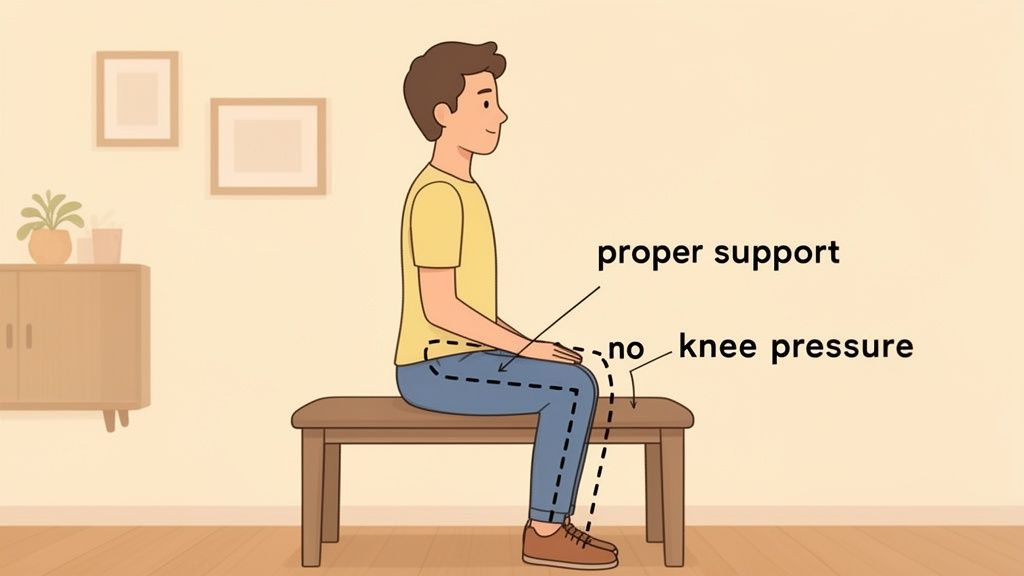
Here's the simple way our team explains it: the perfect seat depth should support most of your thigh without the edge digging into the back of your knees. This sweet spot allows you to lean back fully against the backrest while keeping your feet flat on the floor—the very foundation of good posture.
A bench that's too shallow leaves your legs hanging, forcing your muscles to work overtime and almost always leading to slouching. But a bench that's too deep is just as bad. It can press into your calves, cut off circulation, and make it impossible to use the backrest without your feet dangling like a little kid's. For our neighbors in St. John and Schererville, this is the difference between a bench being a quick, awkward perch and a place where family wants to gather and stay awhile.
The Connection Between Depth and Back Support
Seat depth and back support go hand-in-hand. If the depth isn't right, you simply can't get the full benefit of a backrest. A seat that's too deep will likely have you sitting on the edge, with your back completely unsupported and rounded into a C-shape. That’s a fast track to back pain and fatigue.
Correct bench seat depth is ergonomic common sense: it allows your spine to align naturally against the backrest, promoting comfort and reducing strain during everything from family dinners to morning coffee.
Industry standards have long settled on a bench seat depth between 15 and 20 inches (38-50 cm) to provide the best comfort for most adults. This range strikes a great balance, accommodating the average person's thigh length. For specific uses, like dining, that range narrows to 16-18 inches (41-46 cm). This lets you sit close enough to the table to eat without leaning uncomfortably forward.
How Cushions and Fabrics Affect Comfort
Adding cushions is a fantastic way to make a bench cozier, but don't forget that they change the functional depth. A plush, three-inch back cushion will eat up three inches of seating space. The type of filling matters, too. A firm foam cushion won't compress as much as a soft, down-filled one, which will change how the bench feels and supports you.
When you're choosing a bench, you have to look at the whole package—the frame, the cushions, and the upholstery. To get a better feel for how different textiles can affect both the look and comfort, check out our guide on https://groensfinefurniture.com/everything-you-need-to-know-about-upholstery-materials/. Many of these principles apply to all kinds of seating, and you can find more great tips in this practical guide on how to choose a sofa.
Measuring for the Perfect Bench in Your Home
Getting the right bench seat depth isn't about just picking a number off a chart; it’s about creating a piece that fits your body and your home like a glove. Here at Groen's Fine Furniture, our family believes in empowering our customers with the knowledge to make confident choices. Taking a few simple measurements is the first step in ensuring your new bench will be a source of lasting comfort.
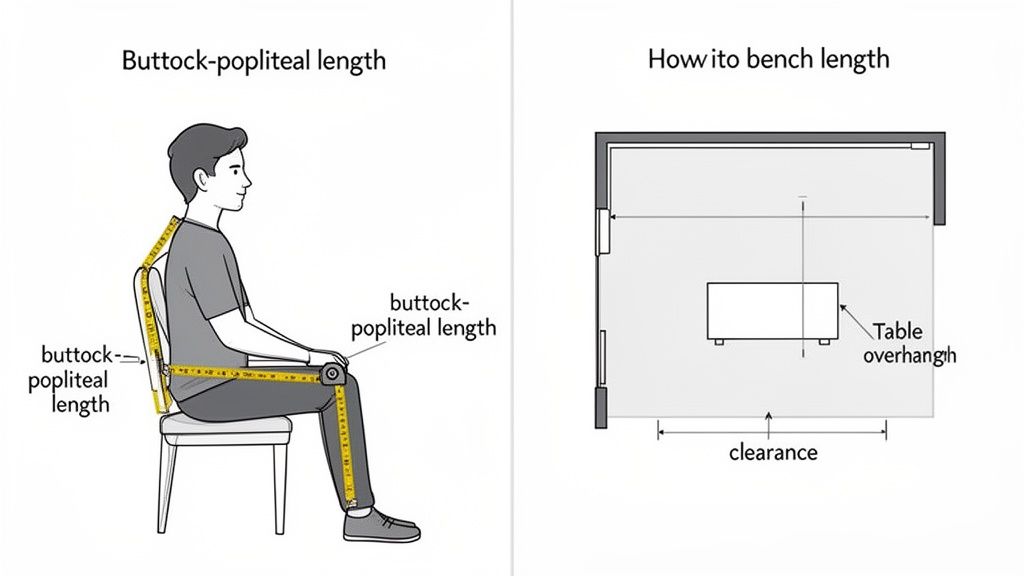
Before you even start shopping, it's a great idea to measure yourself. This little bit of prep work guarantees the piece you choose will feel like it was made just for you.
How to Find Your Personal Seat Depth
The key ergonomic measurement here is your buttock-popliteal length. It sounds a bit technical, but our team can show you how simple it is to find, and it makes all the difference in comfort.
- Sit Down: Grab a straight-backed chair and sit down with your feet flat on the floor, keeping your knees bent at a 90-degree angle.
- Measure Straight: Using a tape measure, find the distance from your lower back all the way to the back of your knee.
- Subtract a Little: Now, subtract about two inches from that number. This final measurement is your ideal bench seat depth, giving you full thigh support without the edge of the seat pressing into your calves.
Measuring Your Space for a Flawless Fit
Next up, it’s time to measure the room where your new bench will live. Whether it's destined for a cozy breakfast nook in a Dyer ranch home or a grand entryway in a new Crown Point build, getting the room dimensions right is crucial.
- For a Dining Nook: Measure the length of the wall where the bench will sit. Don't forget to check the depth of your table, too—you'll want the bench to slide underneath with a few inches of clearance so it isn't bumping into the table legs or base.
- For an Entryway: Think about walkway clearance. A good rule of thumb is to leave at least 36 inches of clear walking space in front of the bench. This keeps the area feeling open and prevents it from becoming a bottleneck.
Measuring is the first step toward getting custom-fit comfort. It’s the difference between furniture that just fills a space and a piece that truly completes it.
Understanding how to measure properly is a skill that applies to all furniture, not just benches. To ensure your new piece fits perfectly into your home, it's essential to understand the basics, much like when you're looking at Australian 3 seat sofa dimensions for a living room. For a more detailed walkthrough, our team put together a helpful resource on how to measure furniture to prepare your home for its newest addition.
Common Bench Depths for Every Room
Picking out the right bench is about so much more than just how it looks—it’s about matching the piece to the rhythm of your daily life. Think about it: the perfect bench seat depth for your dining room is going to feel completely different from the one in your mudroom, and for good reason. At Groen's, our family has spent years helping homeowners across Northwest Indiana figure out this exact puzzle, because we know every room has its own unique demands.
Let’s walk through how these dimensions shift depending on where a bench is going to live in your home.
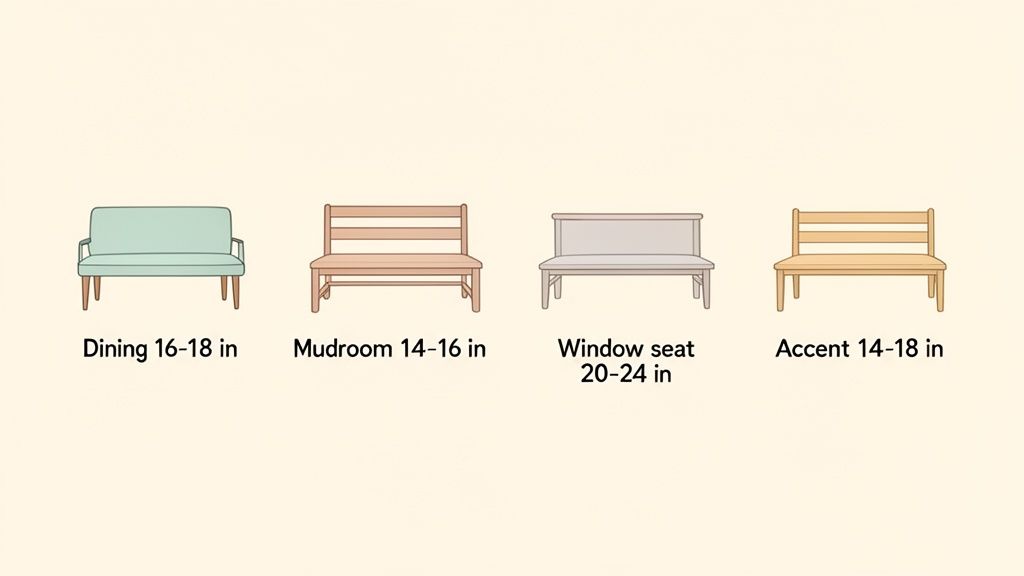
Dining Room Benches
For family dinners and holiday gatherings, a dining bench has to do two things well: encourage good posture and allow for easy movement to and from the table. This is where a shallower depth is your best friend.
- Typical Depth: 16 to 18 inches
- Why it Works: This dimension lets you sit upright comfortably, keeping your back supported while staying close enough to your plate. It's the sweet spot that prevents slouching and ensures everyone can linger over a meal without feeling awkward or cramped.
Entryway and Mudroom Benches
In those busy, high-traffic zones like your entryway or mudroom, a bench is all about function. It's a "perch-and-go" spot, not a place for lounging. Because of this, a slimmer profile is non-negotiable to keep walkways clear and uncluttered.
- Typical Depth: 14 to 17 inches
- Why it Works: This provides just enough real estate to sit down and tie your shoes without jutting out and becoming a tripping hazard. It’s a practical depth that respects your floor space, which is a huge plus in the cozier entryways we often see in homes around Dyer and Crown Point.
Window Seats and Lounge Benches
Now, when the goal is pure relaxation, a deeper, more generous seat isn't just a nice-to-have; it's a must. A window seat should be an invitation to escape—a cozy nook perfect for curling up with a good book and a warm drink.
- Typical Depth: 19 to 24 inches
- Why it Works: All that extra room is exactly what you need for plush back cushions and a few throw pillows, transforming a simple bench into a luxurious little retreat. A well-designed bench here can even become the star of a corner breakfast nook with storage, pulling double duty for comfort and organization.
The function of the space dictates the ideal bench seat depth. An active dining area needs a practical depth, while a quiet reading nook invites a deeper, more relaxed dimension.
You can see this principle in action everywhere. Public space experts at the Project for Public Spaces note that large, functional benches often average around 17.1 inches deep. Meanwhile, a recent analysis of kitchen built-ins found that a whopping 60% of homeowners are choosing deeper 19–22 inch seats, specifically to make room for thick, comfortable cushions. It all comes back to how you plan to use it.
When "Standard" Just Doesn't Cut It: The Groen's Custom Difference
While standard dimensions work beautifully in many homes, our family at Groen's Fine Furniture knows that sometimes, "standard" just isn't the right fit. Maybe you're a bit taller and need a deeper seat to get truly comfortable. Or perhaps you have a uniquely shaped breakfast nook in your Schererville home that calls for a custom solution.
This is where our passion for custom furniture really comes into play. We believe your furniture should fit your life, not the other way around. That’s why we offer our Custom Order Services—empowering you to design it your way and create a piece that is truly made for you.
American-Made Amish Craftsmanship
For a bench that’s destined to become a family heirloom, nothing comes close to the quality of our solid wood Amish furniture program. This isn't just about picking a color; it's about building a piece of furniture from the ground up, exactly as you envision it.
- Specify Your Perfect Dimensions: You tell us the exact bench seat depth, length, and height to fit your body and your space flawlessly.
- Choose Your Wood: Select from beautiful, durable hardwoods like oak, cherry, or maple.
- Select Your Finish: Complete the look with a stain or paint that perfectly matches your home's decor.
This hands-on process ensures your bench is not only comfortable but also a lasting piece of American-made craftsmanship you'll be proud to own.
Versatile Designs with Canadel
Another one of our favorite custom programs comes from Canadel. They are masters of incredible versatility in dining furniture, allowing families to create a fully coordinated dining set that feels like it was designed just for them.
Their benches can be tailored to match your table, chairs, and room layout, ensuring a harmonious and perfectly scaled look. Whether you're in Dyer, Crown Point, or anywhere in Northwest Indiana, you can create a dining space that is uniquely yours from top to bottom.
When an off-the-shelf piece won't do, custom-ordering is the answer. It’s how our team ensures every customer leaves with furniture that looks beautiful and feels just right for their family.
Our team is passionate about making this process straightforward and even fun. We’ve put together a guide that explains everything you need to know about how custom furniture is made simple at Groen's. We invite you to explore the possibilities and see just how easy it is to bring your vision to life with us.
Making Your Dream Bench an Affordable Luxury
Bringing a piece of heirloom-quality furniture into your home is a big decision for any family. We get it. When you’re investing in something built to last, especially a custom-designed bench, you want it to be perfect. Here at Groen’s Fine Furniture, our family has always believed that you shouldn’t have to choose between quality and your budget.
Our whole approach is built on the idea of "affordable luxury." It’s about making sure every family in Northwest Indiana can bring home beautiful, long-lasting furniture. We want you to find that perfect American-made Amish bench or stylish piece from a brand like Bassett and feel completely comfortable and confident in your choice.
Fitting Quality into Your Budget
We're your neighbors, and we want to help you find a solution that works for you. That’s why our team is proud to offer flexible payment solutions to make the process easier.
We believe that financial planning shouldn't stand in the way of creating a home you love. Our goal is to empower you with the buying power to invest in comfort that lasts for generations.
To bring this vision to life, we provide Special Financing options, subject to credit approval. Think of it as a tool designed to help you get the furniture you truly want without having to wait. It lets you spread out the cost over time, turning that dream dining set or perfect entryway bench into a manageable reality.
Our team in Dyer and Crown Point is ready to walk you through the simple application process right in our showroom. We'll skip the complicated jargon and focus on finding a plan that makes sense for you and your family.
You can learn more about our different furniture financing options online and see just how easy it is to invest in lasting quality. Let our family help yours find the perfect fit—both for your space and your budget.
Frequently Asked Questions
Here are some of the questions we hear all the time from our neighbors in Dyer and Crown Point. Our team has been helping families think through these little details for decades, so let's clear up a few common points about finding that perfect bench.
How Do Cushions Affect the Bench Seat Depth I Should Choose?
That's a fantastic question, and it's one we get a lot. Cushions make a huge difference in how a bench actually feels when you sit down. A thick, comfy back cushion that's 2-3 inches deep will eat into your usable seat space by that exact amount.
If you're dreaming of a cozy, lounge-like feel with plush back cushions, you'll want to start with a deeper bench—maybe something in the 19-20 inch range. On the other hand, if you're just adding a thin seat pad to a dining bench, the impact is pretty small. When you visit our showroom, let us know what you have in mind, and we can match the right bench and cushions for comfort that lasts.
What Is the Best Bench Depth for a Small Entryway or Mudroom?
For those tighter spots, like the entryways in many Northwest Indiana homes, a shallower bench is almost always the way to go. You want enough room to sit and tie your shoes, but not so much that the bench becomes an obstacle. We usually find a bench seat depth between 14 and 17 inches is the sweet spot.
This is where a custom piece really shines. Our American-made Amish furniture program lets us build a solid wood bench to your precise measurements, guaranteeing it will fit your home like a glove.
Can You Help Me Design a Bench That Fits My Family's Unique Needs?
Absolutely! That’s what our family has loved doing since 1983. We’ve always believed that furniture should fit your life, not the other way around. Customization is key, and you should never have to settle for something that's just "close enough."
Whether you need a specific depth for family members of different heights, an exact length for a breakfast nook, or a certain style to match your home, we can make it happen. From Canadel's versatile dining options to a one-of-a-kind Amish piece, we'll help you design it your way.
Is There a Standard Height for a Dining Bench Seat?
Yes, there is. Just like a dining chair, a dining bench has to fit comfortably under a standard dining table (which is usually 28-30 inches tall). The ideal seat height for a dining bench is between 17 and 19 inches from the floor to the top of the seat. This gives you plenty of legroom and keeps you at a comfortable height for eating. Our team will make sure your bench from a great brand like Bassett or Canadel is the perfect match for your table.
Visit Groen’s Fine Furniture in Dyer or Crown Point today to explore our custom options and ask about our special financing plans. Let our family help you create a home you love.