Canadel Dining Room Set: Canadel Dining Room Sets: Design

You may be looking at your current dining room and thinking, “We eat here every day, but it still doesn’t feel like us.” Maybe the table is too small for holidays, too large for the room, or close enough in color but not quite right with your floors. That’s usually where the search for a canadel dining room set begins.
For many families in Northwest Indiana, the dining table isn’t just another piece of furniture. It’s where homework lands, coffee lingers, birthdays happen, and weeknight dinners somehow turn into long conversations. When a table has to do all of that, “good enough” usually stops feeling good enough.
That’s why custom dining matters. A made-to-order set gives you the chance to choose the size, shape, finish, and seating that fit your home and the way your family lives. If you’ve never ordered custom furniture before, the process can sound complicated. It doesn’t have to be. Once you understand how Canadel builds and customizes their dining sets, the choices start to feel practical instead of overwhelming.
What Makes a Canadel Dining Set a Generational Choice
Some furniture is bought for a season. Some is chosen with the hope that your kids will remember it years from now.
Canadel comes from that second tradition. The company was founded in 1982 in Quebec, Canada, and it remains family-owned. Canadel also employs over 700 skilled workers and has built its name around hand-assembled, hand-finished custom solid wood dining furniture, with each dining table made to measure for the customer, according to Canadel’s company background.

That story matters because it changes how you look at the finished piece. A canadel dining room set isn’t built like a one-size-fits-all package sitting in a warehouse. It starts with the idea that different homes need different answers.
Why family ownership shows up in the furniture
Family-owned businesses tend to think in longer timelines. They worry about reputation, repeat customers, and whether a product still looks good years later. That’s one reason many homeowners connect with Canadel so quickly. Their approach feels personal.
A dining set built this way is easier to think about as an heirloom piece. Not in a stiff, formal sense. In a real-life sense. It’s the table where your family sits now, and the one you can still picture in the home later.
A dining table becomes a generational piece when it still fits the family after the paint colors, routines, and ages around it have changed.
What “heirloom” means in day-to-day life
Heirloom quality sounds lofty until you bring it back to ordinary use. It means a table that’s meant for repeated meals, pulled-out chairs, extension leaves, elbows on the edge, and seasons of constant use. It means you’re buying for durability and memory at the same time.
A few signs that homeowners often look for in a lasting dining set:
- Solid construction: You want real substance, not something that feels temporary when you slide a chair in.
- Custom fit: A table that fits your room properly gets used more comfortably and stays in your home longer.
- Timeless styling: Flexible design ages better than trend-driven shapes that feel dated quickly.
- Finish choice: The right color and sheen can help the piece settle naturally into your home over time.
That’s also why it helps to think beyond appearance alone. Longevity comes from materials, finish, construction, and whether the table suits your daily routines. We’ve written about that broader idea in our guide on how long furniture should last, and dining furniture is one of the clearest places where quality shows itself over time.
A table with a job to do
A good dining set has to do two things at once. It has to look right in the room, and it has to hold up as the center of family life. Canadel’s long history of made-to-order dining furniture gives it a strong place in that conversation.
When shoppers ask what makes a custom set worth considering, this is usually the answer. It isn’t only about style. It’s about choosing a table that still makes sense years from now.
Design It Your Way The Canadel Customization Program
The easiest way to understand Canadel’s customization program is best understood as building a meal instead of ordering a preset combo. You start with the main piece, add the right sides, and adjust the details until it fits your taste and your household.
Canadel’s custom dining program includes over 200 table designs, more than 1,000 chair options, and over 50 finishes in solid birch, which gives homeowners a wide range of ways to tailor size, shape, and seating needs, as described in this guide to Canadel furniture collections. That same source notes that pedestal or trestle leg tables can help seat up to 6 people comfortably around round or oval shapes without leg interference.
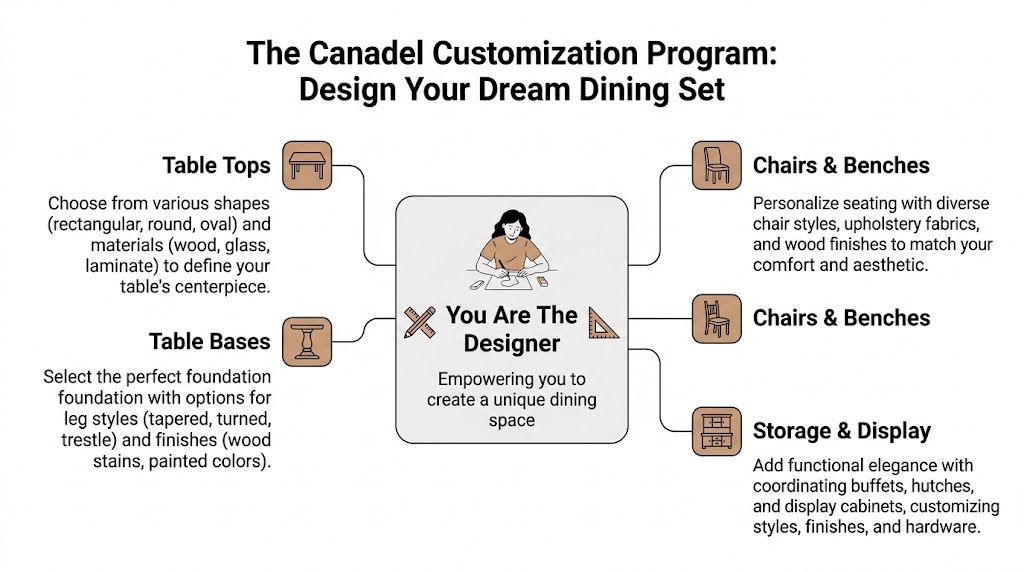
That sounds like a lot, and it is. The trick is not trying to choose everything at once.
Start with the room, not the finish
Often, the desire is to begin with color because it feels fun. In practice, shape and size should come first. The room decides more than the stain does.
Ask these questions first:
- How many people sit here most days? Daily seating needs are different from holiday seating needs.
- What shape fits the traffic path? A rectangle works differently from a round top in a narrower room.
- Do you need flexibility? If your guest list changes often, leaves matter.
- How do chairs move in the space? A base style affects comfort more than many people expect.
A round or oval table often helps soften a room and improve movement around it. A rectangular top can feel more structured and can be easier to place in long dining rooms. If your family regularly bumps knees or deals with awkward chair placement, base design becomes a practical choice, not just a style choice.
Then choose the table personality
Once the basic footprint is set, the table starts to take on character. Shoppers usually relax then, because the choices begin to feel visual.
Here’s a simple way to sort the table details:
| Choice area | What you’re deciding | Why it matters |
|---|---|---|
| Table shape | Round, oval, rectangular, and other available forms | Affects flow, seating pattern, and how formal the room feels |
| Base or legs | Pedestal, trestle, or legs | Changes leg room, seating flexibility, and style |
| Height | Standard dining or other available options | Impacts comfort and how the set works with your household |
| Edge profile | Softer or more tailored edge looks | Small detail, big effect on whether the set feels casual or refined |
| Leaves | Fixed size or extendable top | Helps one table serve daily meals and larger gatherings |
A pedestal table is a good example of where people get pleasantly surprised. Many shoppers assume it’s mostly a style decision. It’s also a seating decision. Without legs at the corners, chairs can tuck in more freely, which can make family dinners feel less cramped.
Practical rule: If you host a few bigger gatherings each year but don’t want an oversized table every day, prioritize an extension option before you worry about decorative details.
Chairs are where comfort and style meet
The chair decision can feel even bigger than the table because that’s where comfort, silhouette, and fabric all meet. Some families want all wood chairs for a cleaner, more classic look. Others want upholstered seats because meals and conversation tend to stretch longer in their home.
Shoppers often do better when they sort chairs into three categories:
- Visual weight: Do you want the chairs to blend with the table or stand out?
- Cleaning habits: Is a wood seat easier for your household, or would upholstery feel better to use every day?
- Use pattern: Are these chairs mostly for quick family dinners, or do people sit for a long time?
A dining set that looks beautiful in a photo can still miss the mark if the chair back doesn’t feel supportive for your family. That’s one reason custom ordering helps. You’re not forced to take the exact seat paired in a showroom vignette.
Finish choices should support real life
The set takes on a personal touch. A darker finish can add contrast and warmth. A washed look can brighten a room and show more grain character. Matte finishes tend to feel softer and more relaxed, while more polished looks can read more formal.
If you’re new to custom furniture, don’t try to memorize every finish. Narrow it by your room.
- Light flooring often pairs well with finishes that create some contrast.
- Busy open-concept spaces usually benefit from finishes that connect with nearby cabinetry or flooring.
- Homes with children, pets, or frequent use may call for a finish choice that feels forgiving in daily life.
The process gets much easier when you can handle samples and compare them side by side. That’s also why many homeowners find it helpful to read a primer on getting started with custom order furniture before making final decisions.
Custom doesn’t mean complicated
A custom canadel dining room set isn’t about making hundreds of tiny design decisions for the sake of it. It’s about making a few meaningful choices in the right order. Start with the room. Match the table to the way you gather. Finish with the details that make it yours.
That’s when custom furniture stops feeling intimidating and starts feeling like common sense.
The Hallmarks of Quality Canadel Materials and Craftsmanship
A dining set can look good in a photo and still disappoint in daily use. The true test happens when you sit in the chair, pull the table open, wipe down the top, and live with it through regular family routines.
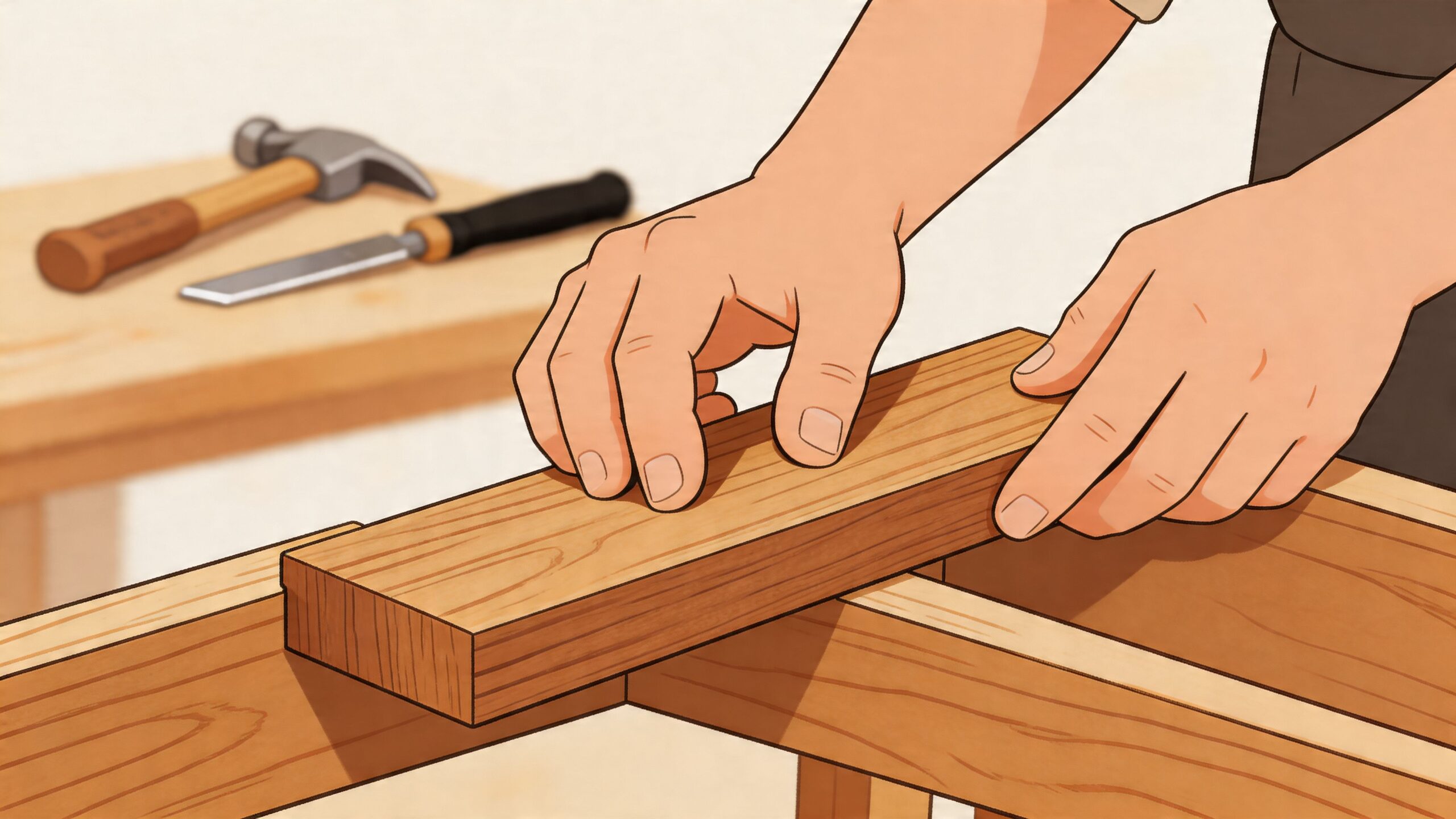
Canadel’s construction details help explain why many shoppers treat the brand as more than a style purchase. On one documented product listing, a Canadel set uses solid wood construction, includes a seat height of 18.25 inches for ergonomic comfort, uses table locks on extensions to help prevent separation, and features UV-resistant finishes that protect against fading in home environments, according to this Canadel Core dining set listing.
Why solid wood changes the experience
Solid wood has a different feel from lighter, more temporary construction. You notice it when the chair feels planted instead of flimsy, and when the table has the presence people expect from a true dining centerpiece.
That matters most in rooms that see constant use. A family table gets pulled, leaned on, expanded, cleaned, and used in ways display furniture never does. Solid wood is part of what helps a custom set feel substantial enough for that role.
A few craftsmanship details are worth paying attention to:
- Hand-finished surfaces: The finish doesn’t just affect color. It also affects how the wood looks in changing light.
- Extension stability: Table locks matter because an extendable top should still feel secure during use.
- Chair ergonomics: Seat height influences whether people feel comfortable staying at the table.
Small construction choices have a big payoff
The 18.25-inch seat height is a useful example. Numbers like that can sound technical, but they point to everyday comfort. If a chair sits at a practical height, meals feel better, posture is more natural, and guests are more likely to linger.
The extension system matters for the same reason. Many people love the idea of a leaf table but worry that the table will feel uneven or separated once it’s opened. Table locks help address that concern by keeping the sections aligned and stable.
If you plan to use leaves more than occasionally, don’t treat the extension hardware as a minor detail. It directly affects how the table feels over time.
Finish isn’t only about color
Finish conversations often drift toward appearance alone, but protection matters just as much. A UV-resistant finish helps the surface stand up better in homes where sunlight reaches the dining area. That can be especially important in rooms with large windows or bright morning light.
Here’s a quick way to think about finish quality in a dining room:
| Finish concern | Why homeowners care |
|---|---|
| Fading | Sun-exposed rooms can change the appearance of wood over time |
| Surface wear | Dining tables face repeated wiping, contact, and daily traffic |
| Visual consistency | A good finish helps the wood look intentional from every angle |
| Long-term satisfaction | The right finish helps the set keep its character with use |
Many shoppers also ask about joinery and how wood furniture stays strong at stress points. That’s a smart question. If you want to understand one of the classic construction methods used in quality furniture, our article on what a mortise and tenon joint is gives a helpful overview of why strong joinery matters.
Comfort should be part of craftsmanship
People sometimes separate comfort from quality, but they belong together. A canadel dining room set isn’t successful if it looks refined and nobody wants to sit there for long.
The better custom sets handle both jobs at once. They offer material integrity, stable extension design, protective finishing, and seating dimensions that support actual use. That combination is what turns craftsmanship from a buzzword into something you can feel every evening at the table.
How to Choose the Perfect Set for Your Northwest Indiana Home
The right dining set for a home in Crown Point, St. John, Schererville, or Munster isn’t chosen in the abstract. It has to work with your room, your climate, and the way your household behaves on an ordinary Tuesday.
That’s where many buyers go wrong. They shop by style first, then try to force the set into their room and routines later. A better approach is to choose from the inside out. Start with how the room functions, then match the Canadel options to that reality.
Measure for movement, not just table size
A table can technically fit in a room and still feel wrong every day. Chairs need to slide back. People need to walk around them. Doorways, nearby islands, hutches, and traffic lanes all matter.
If you want a visual reference before narrowing your options, this dining table sizes guide from Room Sketcher is useful for understanding how table shape affects spacing and seating. Pair that with a more local planning approach using our own dining table size guide, especially if you’re comparing different room layouts and trying to decide whether a round, oval, or rectangular top makes more sense.
A simple measuring checklist helps:
- Mark the table footprint on the floor: Painter’s tape helps you see the table in real scale.
- Pull out nearby chairs you already own: This gives you a better sense of traffic space than a paper measurement alone.
- Check the room during real use: Measure when people are walking through the space, not when the room is empty.
Match the finish to your household, not just your mood board
This is especially important in Northwest Indiana. Many care guides talk about cleaning but don’t spend enough time on how finishes hold up in real family homes. Canadel-related guidance and retailer feedback note that rustic finishes can show wear in humid Midwest climates like Northwest Indiana, which is why finish selection should reflect your home’s environment and daily use, as noted in the Canadel FAQ context.
That doesn’t mean rustic finishes are a bad choice. It means they should be chosen knowingly. If your dining space gets heavy traffic, frequent wiping, pet activity, or a lot of seasonal humidity change, you’ll want to compare finish looks with maintenance expectations.
Homes with kids, pets, and active daily dining usually benefit from finish choices that feel forgiving rather than precious.
Use your family habits as the deciding factor
A beautiful set that doesn’t support your routine becomes frustrating fast. The best way to narrow your choices is to think through use patterns realistically.
Consider how your home works:
- Weeknight families: If dinner happens quickly and often, prioritize easy-clean seating and a shape that supports everyday movement.
- Hosts and holiday gatherers: Put extension features higher on the list and think about where extra chairs will go.
- Pet households: Avoid choosing purely on appearance if claws, fur, or frequent brushing against chair legs are part of daily life.
- Open-concept homes: Look at the dining set from adjoining rooms so the finish doesn’t feel isolated from the rest of the space.
Local context matters more than people think
Midwestern homes ask a lot from dining furniture. Seasonal changes, tracked-in moisture, indoor heating, and active family use all affect how a set looks and feels over time. That’s why custom ordering can be so helpful. You’re not stuck accepting a generic finish, fixed shape, or seat style that was designed for someone else’s room.
For Northwest Indiana homeowners, the smartest canadel dining room set is usually the one that balances style with tolerance for real life. If your set suits your space, your climate, and your habits, you’ll enjoy it longer and worry about it less.
The Groens Advantage From Showroom Design to White-Glove Delivery
Custom dining furniture is exciting at the beginning and often stressful near the end. People enjoy choosing the finish and chair style. They get less excited when questions about timing, freight, and setup start piling up.
That’s the gap between browsing and getting a table into your home. Online tools can help with ideas, but they don’t answer every practical question. Guidance tied to real service matters here.
Why local showroom help changes the process
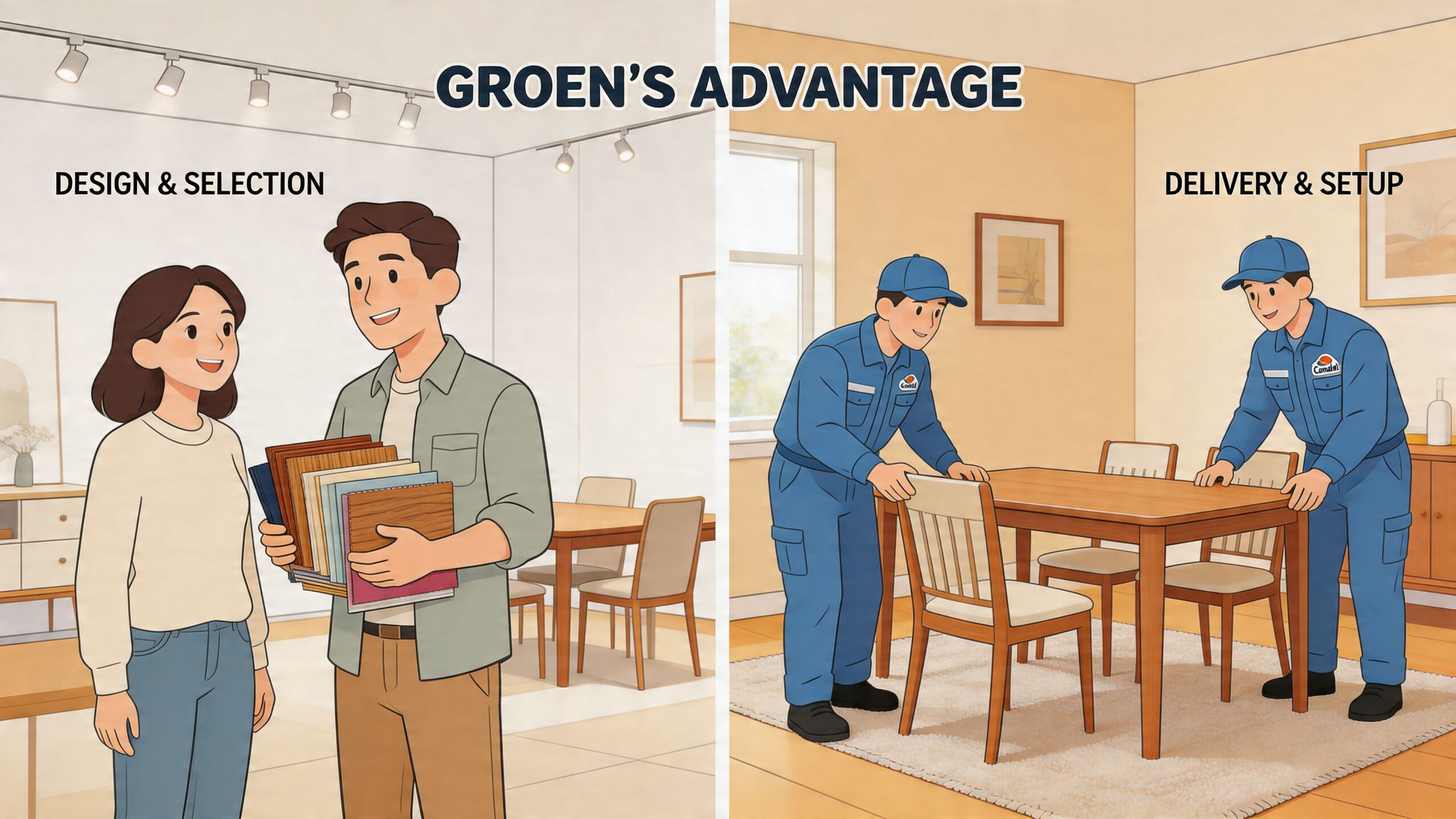
One verified point worth knowing is that online configurators don’t solve logistics such as production lead times, often 6 to 12 weeks, or freight costs, while local service can help Northwest Indiana shoppers manage those details with more transparency, according to the provided Canadel-related logistics note. That’s where in-person support becomes more than a convenience.
Seeing finish samples in person can prevent a lot of second-guessing. Wood tone, sheen, and texture often read differently on a screen than they do under real lighting. Chair comfort is even harder to judge online. A seat back that looks elegant may feel too rigid for your family once you sit in it.
This is also where Groen’s Fine Furniture fits into the process as a local option for custom dining orders in Dyer and Crown Point. The showroom setting lets shoppers compare materials, ask practical questions, and plan delivery with a real team rather than guessing through a product page.
The difference between delivery and completion
Many people think delivery is the finish line. It isn’t. The finish line is having the set placed, assembled, and ready to use without damage, confusion, or leftover guesswork.
That’s why white-glove delivery matters so much with a custom canadel dining room set. The product is made to order. It deserves a careful handoff into the home.
A strong delivery experience usually includes:
- Clear communication: You know what stage the order is in and what to expect next.
- Room-of-choice placement: The set goes where it belongs, not just to the front door.
- Setup support: Extension pieces, chairs, and table parts are handled properly.
- Less risk at home: You avoid dragging heavy furniture through hallways and door frames yourself.
Good custom furniture service doesn’t end when the order is placed. It ends when the table is standing where your family will use it.
Personal guidance reduces expensive mistakes
The practical value of local help often comes down to avoidance. It’s easier to avoid ordering the wrong scale, the wrong sheen, or the wrong chair feel when you have someone walking through the decisions with you.
If you want a broader overview of what that kind of service looks like, our page on the Groen’s advantage explains the customer experience in more detail. For many shoppers, that’s what turns a custom order from a gamble into a comfortable decision.
Making It Yours Financing and Caring for Your Investment
A custom dining set is a meaningful purchase. That’s exactly why it helps to think about it in two practical parts. First, how you make room for it in the budget. Second, how you care for it once it arrives.
Using financing as buying power
Many families know what they want but hesitate because they’re trying to line up timing, budget, and the rest of the house all at once. That’s where special financing, subject to credit approval, can be useful. It gives some buyers more flexibility to order the dining set that fits their home now instead of compromising on size, construction, or finish just to keep the purchase smaller in the short term.
The key is to treat financing as a planning tool, not a reason to rush. Before you place a custom order, ask yourself:
- Is this the table size we’ll still want later?
- Are we choosing the chair style we prefer, or the one that feels like a temporary compromise?
- Would spreading payments out help us buy the right piece once instead of replacing a lesser fit sooner?
That’s often the most helpful mindset. Custom furniture tends to reward patience and clarity.
Daily care should be simple enough to keep doing
The best care routine is the one your household will follow. For most families, that means consistent light maintenance, not complicated rituals.
A straightforward approach works well:
- Wipe spills promptly. Dining tables are for eating, and accidents happen.
- Use gentle cleaning habits. Soft cloths are easier on finished wood surfaces than rough scrub materials.
- Lift rather than drag items. Decor, serving pieces, and leaves should be handled carefully to protect the surface.
- Pay attention to the room. Sunlight, seasonal dryness, and humidity can all affect wood over time.
- Store extension parts carefully. If your set includes leaves, keep them protected when not in use.
Care choices should match the finish you selected
Not every finish lives the same way in a home. A more textured or rustic look may show wear differently than a smoother, more polished surface. Upholstered seats also ask for a different kind of care than all-wood seating.
Here’s a useful way to think about long-term upkeep:
| Part of the set | What to watch |
|---|---|
| Table top | Spills, repeated wiping, heat, sunlight |
| Chair seats | Crumbs, fabric wear, pet contact, everyday friction |
| Chair frames | Scuffs from movement and contact |
| Leaves and extensions | Proper storage and careful opening and closing |
Protecting the piece without treating it like a museum object
A canadel dining room set should be used, not tiptoed around. Good care doesn’t mean making the room feel untouchable. It means building a few sensible habits so the set keeps looking like part of your home instead of a project you’re constantly fixing.
If you buy with your real lifestyle in mind and care for the set consistently, the furniture has a much better chance of becoming exactly what people hope for when they order custom. A lasting centerpiece that still feels welcoming years later.
Your Canadel Questions Answered
Shoppers usually reach the same point near the end of the process. They like the look, understand the customization, and then want a few honest answers before making the final decision. These are some of the questions that come up most often.
Is Canadel better for me than Amish dining furniture
They solve slightly different needs. Canadel is a strong fit for shoppers who want a highly customizable dining program with many style and finish choices in a guided system. Amish furniture often appeals to buyers who want a more workshop-driven custom path and a different construction tradition.
Neither choice is automatically right for everyone. The better question is how you shop. If you want many coordinated options and a structured custom program, Canadel often feels approachable. If you want a different handcrafted look and process, Amish dining may be worth comparing.
Can I make a custom set without feeling overwhelmed
Yes, if you choose in the right order. Most confusion happens when shoppers try to pick stain, fabric, shape, and chairs all at once. Start with room size and daily seating needs. Then move to table shape, base style, chair comfort, and finish.
That sequence usually clears up the process fast.
Most custom-order stress comes from making decisions out of order, not from having too many options.
Are Canadel chairs comfortable enough for long meals
Comfort depends on the chair model you choose, but the construction details matter. Earlier in this article, we noted one verified Canadel seat height specification tied to ergonomic comfort. In practical terms, that tells you the brand is paying attention to how the chair sits, not only how it looks.
The best step is still to sit in a few styles if you can. Back shape, seat feel, and upholstery preference all matter from one household to another.
What if I need the table to work for everyday meals and holidays
That’s one of the biggest reasons people choose custom dining. Extension options and base choices let one table handle quiet daily use and larger gatherings more gracefully than a fixed off-the-floor model often can.
If your dining room has to be flexible, focus on:
- Extension capability
- A shape that supports traffic flow
- A base style that doesn’t fight chair placement
- Chairs that are comfortable enough to use often
Will the finish hold up in a busy family home
It can, but the right answer depends on the finish you choose and how your household uses the room. As noted earlier, some rustic looks may show wear differently in Midwest conditions. That isn’t a defect. It’s part of choosing a finish with your environment and maintenance style in mind.
If you want a lower-stress experience, choose with durability habits in mind rather than selecting only from a sample board’s prettiest color.
Can I add pieces later
In many custom dining programs, adding coordinating pieces later may be possible, but availability can vary by collection, finish, and current offering. That’s a good question to ask before you place the original order, especially if you think you may want extra chairs, a bench, or storage later.
It helps to keep your exact product details recorded. Custom furniture is easier to build onto when the original specifications are documented clearly.
Is custom furniture worth the wait
For many families, yes. A made-to-order dining set asks for more patience than grabbing a stock table, but the payoff is that the piece fits your room and lifestyle more closely. That tends to matter for furniture used every day.
The simplest test is this. If you can already tell that standard options keep forcing compromises on size, seating, or finish, custom is probably worth serious consideration.
What should I bring when I shop
A little preparation helps a lot. Bring room measurements, a few photos of the space, and notes on how many people you seat regularly. If you have flooring or paint samples, even better. Those details make finish and scale decisions much easier.
The more clearly you can describe your daily life at the table, the more useful the design conversation becomes.
Visit Groen’s Fine Furniture in Dyer or Crown Point to explore custom dining options and ask about special financing plans, subject to credit approval. Our family has served Northwest Indiana since 1983, and we’re here to help you create a dining room that fits your home, your routine, and the way your family gathers.