Curtains for Bay Windows in Living Room: Your 2026 Guide


A bay window can be the prettiest spot in your living room and the most frustrating one to finish.
A lot of homeowners around Dyer, Crown Point, Munster, and St. John know this feeling well. The sofa is in place. The rug works. The room is close. Then your eyes land on that wide, angled window, and suddenly nothing off the shelf seems right. Standard rods look awkward. Ready-made panels feel skimpy. If there’s a built-in seat underneath, the whole project gets even trickier.
That is why curtains for bay windows in living room spaces deserve a little more thought than a regular window. When they are done well, they soften the angles, frame the view, and make the room feel finished. When they are rushed, they can block light, drag on a seat, or fight with the architecture.
Our family has been helping Northwest Indiana homeowners with rooms like this since 1983. We’ve seen bay windows in older homes, newer builds, and everything in between. The good news is that you do not need to guess your way through it. A beautiful result usually comes down to a few simple decisions made in the right order.
A Warm Welcome from Your Local Home Experts
A bay window often becomes the heart of the living room without even trying. It brings in extra daylight, opens up the view, and gives the room a sense of character that a flat wall of windows just does not have.
For many Northwest Indiana families, that charm comes with a practical problem. You stand in the living room, coffee in hand, looking at three angled panes and wondering where to even begin. One panel per section? One continuous rod? Floor length or just above the seat? Those are normal questions.
Our team has helped neighbors in Dyer, Crown Point, Schererville, and across NWI sort through these same choices for decades. As a family-run business with multigenerational ownership, we understand many customers are not looking for something flashy. They want curtains that look right, work smoothly, and hold up to real life.
Some homes need a soft, refined look for a formal front room. Others need family-proof function because the bay window is also the reading corner, the dog’s lookout post, or the place where kids climb up after school. Both are valid. Both can be done well.
The key is to treat the bay window as its own design project, not as an afterthought.
Why Your Bay Window Deserves the Perfect Curtains
Bay windows ask more from a window treatment than a standard wall window does. They have angles, depth, and often more glass. That means your curtain choice shapes not only how the room looks, but also how it feels and functions every day.
They change the mood of the room
Curtains do an important visual job in a bay. They soften hard corners and help several window sections read as one intentional feature. That matters in a living room, where you want the eye to settle comfortably.
Floor-length drapery tends to make the room feel calmer and more complete. A well-scaled treatment can also make the whole wall look taller and more polished.
They help with comfort, not just privacy
A lot of homeowners start shopping because they want privacy at night. That makes sense, but privacy is only one piece of the puzzle.
Quality linings can make a bay window much more useful year-round. According to this bay window curtain overview, blackout linings can block nearly 100% of incoming light, and thermal linings with acrylic foam insulation can reduce energy bills by up to 10-20% through better draft prevention. The same source notes a 25% surge in custom window treatment sales post-2020 as homeowners focused more on privacy, light control, and insulation.
That rings true in Northwest Indiana. A bay window is beautiful in January, but it is still a large area of glass. Good curtains help take the edge off winter drafts and strong summer sun.
Practical takeaway: If your living room doubles as a TV room, movie room, or work-from-home space, the lining matters just as much as the fabric you see.
They finish the room in a way few pieces can
Homeowners often spend a lot on the main furniture pieces and then underestimate what window treatments do. But the right curtains can tie the sofa, accent chairs, wall color, and flooring together in a way that makes the room finally feel settled.
If you are refreshing the whole space, our team often recommends thinking about the windows alongside the rest of the room, not last. This guide on putting your living room in the best light is a helpful place to think through how natural light and furnishings work together.
A bay window is already a focal point. Curtains let you decide whether that focal point feels formal, relaxed, cozy, or bright and airy.
Choosing the Right Curtain Style and Header
The words people most often stumble over are not fabric names. They are header names. That is the top part of the curtain, the section that attaches to the rod or track. In a bay window, the header affects both the look and how easily the curtain moves around corners.
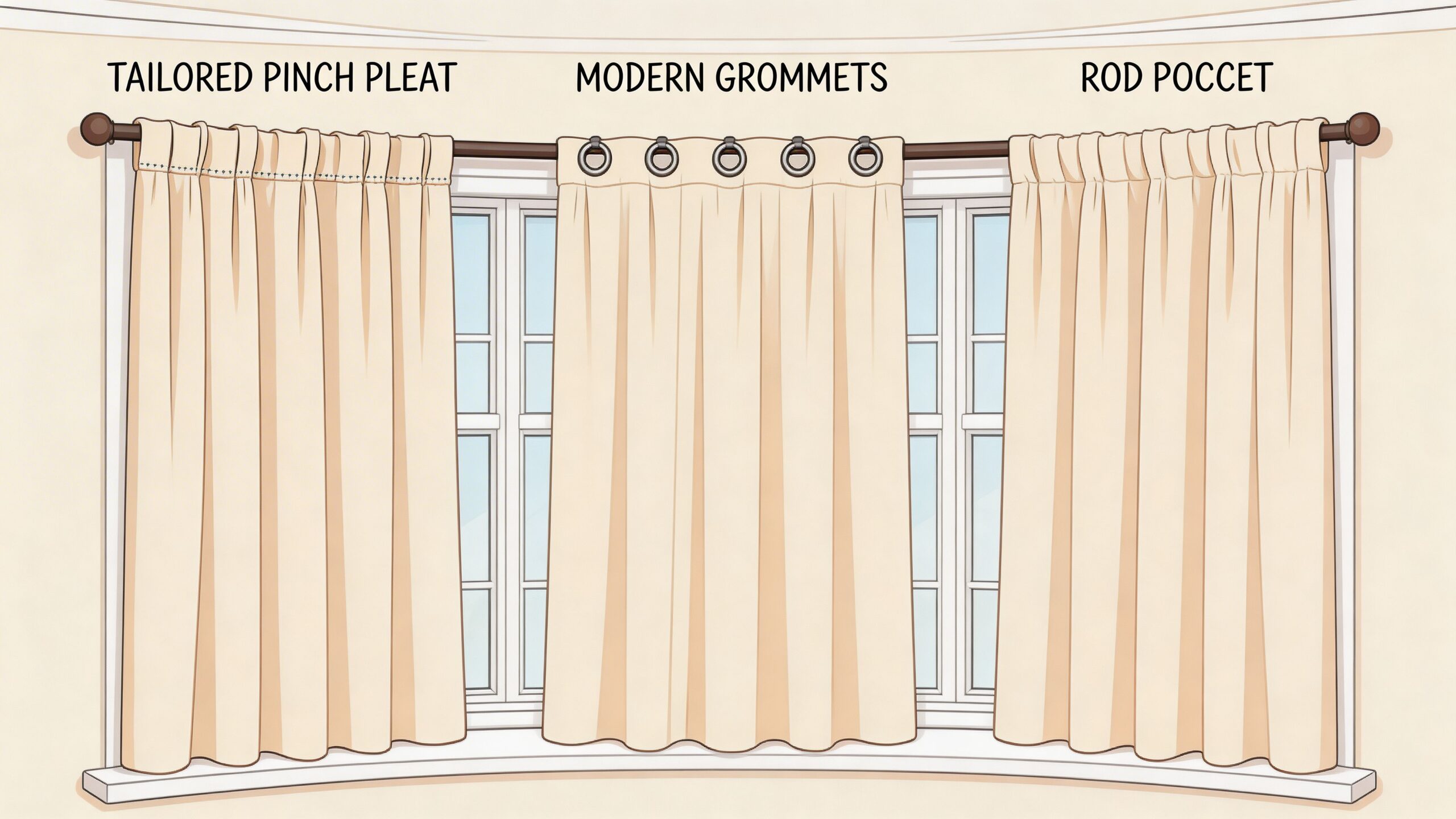
Pinch pleat for a structured look
If you want curtains for bay windows in living room spaces to feel classic and structured, pinch pleat is usually the strongest choice. The pleats are sewn in at the top, so the folds stay neat.
This style works especially well in traditional rooms, homes with detailed trim, and spaces where you want the drapery to look custom rather than casual. It also tends to stack more cleanly when opened.
Pleated styles need enough fabric to drape properly. If they are underfilled, they look flat and skimpy.
Grommets for a simpler, modern line
Grommet panels have metal rings built into the top. They slide directly on the rod and create a very even wave.
They look clean and contemporary, but they are not always the easiest match for a bay. The rod has to be planned carefully so the curtain can move around corners without catching. In many bay windows, the cleaner look is appealing, but the day-to-day glide is less forgiving than a track-based pleated panel.
Rod pocket and tab top for low-movement areas
Rod pocket curtains gather fabric over the rod. Tab tops hang from loops. Both can look charming, especially in casual rooms or cottage-inspired spaces.
The drawback is operation. These styles are usually better when you do not plan to open and close the curtains constantly. In a busy living room, that can become annoying fast.
A quick way to choose
If you are stuck between styles, start with how you live.
- You open and close them daily: Pleated curtains on a quality track usually feel easiest.
- You want a relaxed, decorative frame: Rod pocket or tab top can work.
- You like a cleaner modern line: Grommets may suit the room, but measure and mount carefully.
Designer tip: In a bay window, “pretty” is not enough. The curtain also has to travel well across angles, clear the glass, and stack neatly when open.
Match the header to the room, not just the window
A formal living room with a Bassett sofa and a more traditional layout often looks best with structured pleats. A casual family room with softer upholstery and a reading nook may feel better with a simpler header and more relaxed fabric.
The biggest mistake is choosing a header in isolation. We always encourage homeowners to look at the line of the curtain next to the lines of the furniture, the trim, and the mood of the room. When those details agree, the bay window stops looking awkward and starts looking intentional.
Selecting Fabrics and Linings for Beauty and Performance
Fabric is where many people lead with their eyes, and that is fine. You should love the color, texture, and softness. But in a bay window, fabric also has a job to do.
The right choice depends on how much light you want, how much privacy you need, and how busy your living room is.
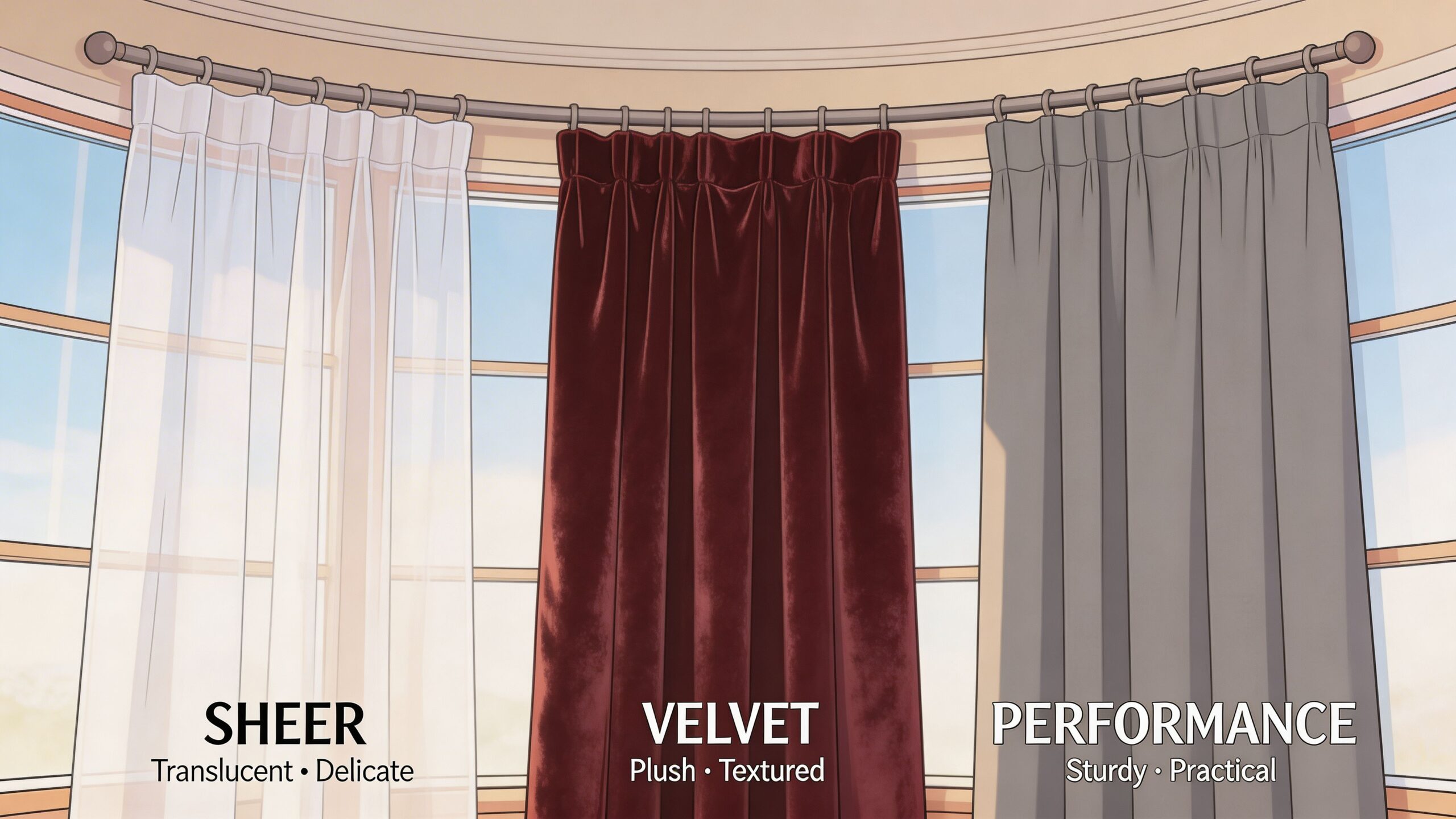
Sheers and light-filtering fabrics
If your goal is softness without heaviness, start here. Sheers and light-filtering fabrics keep the room bright while taking the edge off direct sun and outside views.
According to this guide on bay window curtain materials, modern light-filtering poly-cotton blends provide 50-70% opacity for daytime privacy. That makes them a smart fit for living rooms where you still want a bright daytime look.
These are especially useful if your bay window is the part of the room that gives it its cheerful feeling. You do not want to lose that.
Velvet and heavier statement fabrics
Velvet gives a bay window richness. It adds weight, depth, and a more finished look, especially in rooms with deeper color palettes or more formal furniture.
The same source notes that velvet or blackout options can achieve 95-100% light blockage. That can be helpful if the living room also serves as a media room, or if glare is a daily annoyance.
Heavier fabrics also create a stronger visual frame around the window. In some rooms, that is exactly what is missing.
Why lining deserves more attention
Many homeowners pick the face fabric and barely think about the lining. Our team would reverse that. Lining decides how the curtain performs.
Here is a useful way to consider it:
| Lining type | Best for | What it feels like |
|---|---|---|
| Light-filtering | Bright rooms that still need privacy | Soft, airy, easygoing |
| Thermal | Drafty windows and seasonal comfort | Practical, comfortable, substantial |
| Blackout | TV glare, movie nights, strong sun | Controlled, cozy, more private |
Length changes the whole effect
One of the clearest visual upgrades in bay windows is going longer. The same Curtarra guide reports that floor-length curtains are preferred in 65% of bay window installations because they create an illusion of 15-20% greater room height.
That is why we so often steer people away from curtains that stop at an awkward mid-point. Floor length usually looks more intentional. It also helps unify the multiple sections of the bay into one feature.
If you want inspiration for a warmer, more dramatic palette, our team put together ideas around burnt orange curtains that can translate beautifully to bay windows.
A simple fabric decision tool
Use this quick filter when you are torn.
- Choose linen-like or light-filtering blends if you want softness and daylight.
- Choose velvet if you want drama, depth, and stronger light control.
- Choose performance-minded fabrics if the bay window sits in a high-traffic family space.
Do not choose by sample alone. Hold the fabric up in natural light, think about how often the curtains will move, and picture the room at night, not just at noon.
A Step-by-Step Guide to Measuring and Mounting
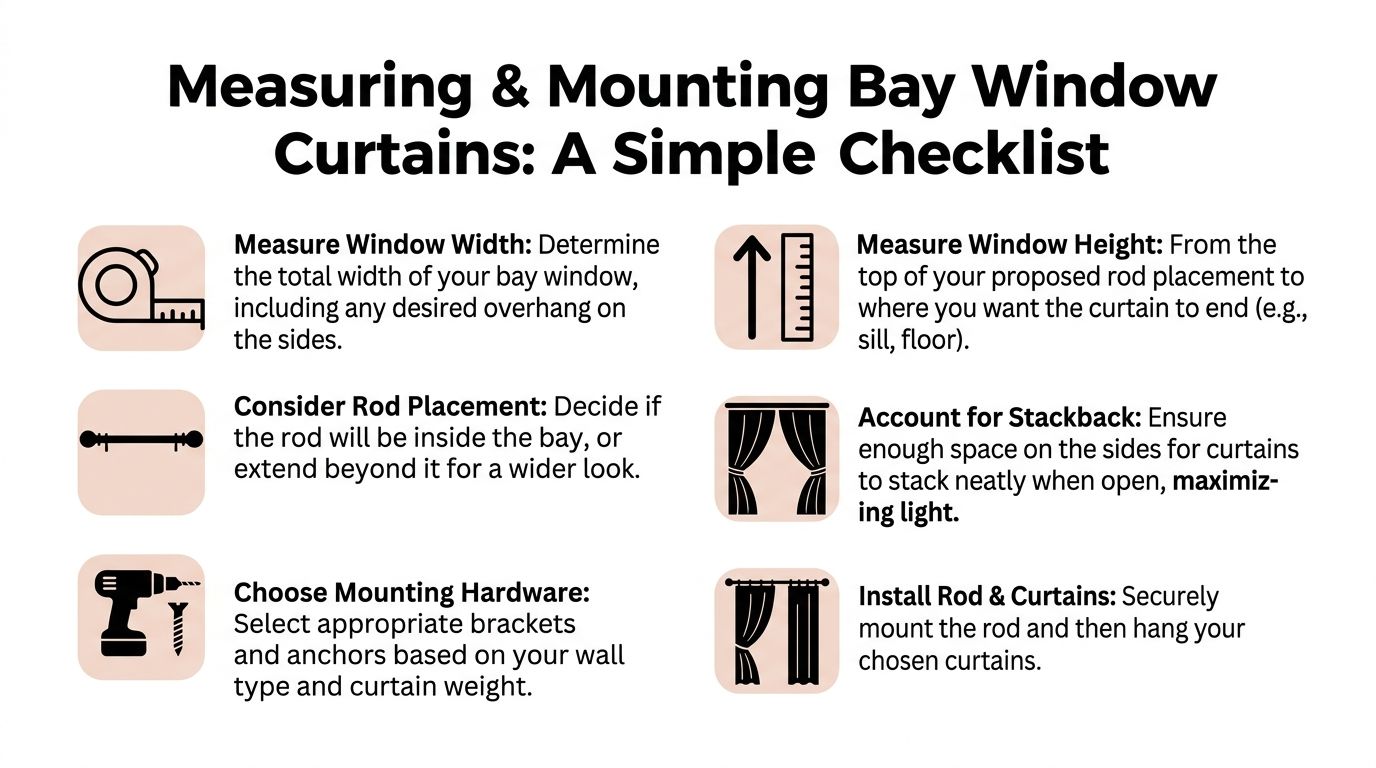
Many bay window projects succeed or fail at this stage. The good news is that measuring a bay window is not mysterious. It just needs patience and a clear order.
Start with the shape, not the curtain
Before you think about panels, identify what kind of bay you have. Most living rooms will have a box, angled, or bow-style bay. Each shape affects where the rod or track sits and how the curtain will stack when opened.
Then measure each pane separately. Do not assume both side sections match.
For general measurement guidance, we like this practical resource on how to measure windows for curtains. It is a helpful companion if you want a second set of instructions while you work.
Measure in this order
A simple order prevents most mistakes.
Width of each window section
Measure the left, center, and right panes separately.Total width across the bay
This helps you estimate how much fabric and how wide the full treatment needs to feel.Depth of the bay
Measure from the front edge back toward the center pane. This matters for rod placement and curtain clearance.Height from rod position to endpoint
Decide whether your curtain will kiss the floor, hover above a seat, or stop at the sill.Stackback space
This is the wall or side room needed for the curtain to sit when open.
Fullness is what gives curtains their richness
This is one of the most common areas of confusion. Homeowners often measure the window width and buy the same amount of curtain width. That is not enough for pleated drapery.
According to Goelst’s bay window track specification guide, curtain fullness should be 2 to 2.5 times the window width for pleated styles. That extra fabric is what gives the curtain proper folds and coverage.
Without fullness, curtains look flat when closed and thin when open.
Quick rule: If you want a precise pleated look, do not shop by finished window width alone. Shop by finished fullness.
Rod or track choices matter more in a bay
In a standard window, many hardware choices can work. In a bay, the hardware has to solve angles.
You generally have two paths.
Custom-bent rod or track
A custom-bent system is shaped to the bay itself. This allows the curtain to move across the full window with fewer interruptions.
The same Goelst guide notes that custom-bent rods can be formed to precise 90-135° angles and reduce friction by 40-50% compared to segmented systems, which helps a single curtain panel travel more smoothly.
This option usually feels cleaner and more unified.
Individual straight rods with connectors
This method uses separate sections joined at the corners. It can work well when you want each pane to operate more independently.
It is often practical for lighter treatments or for rooms where you rarely draw all sections at once. But it can be less seamless in motion, especially with heavier fabric.
A few mounting habits that prevent regret
- Mount high enough for presence: A slightly higher mount often gives the bay more importance.
- Extend beyond the glass where possible: This helps the curtains clear the window when open.
- Use brackets suited to fabric weight: Heavy velvet needs stronger support than airy sheers.
- Check nearby obstacles: Seats, radiators, trim, and vent locations all matter.
If you like to measure carefully before making any custom purchase, our guide on how to measure furniture follows the same principle. Slow, accurate measuring saves frustration later.
The mistake we see most
People focus on front-facing width and forget the side angles. Then the rod projects awkwardly, the panel catches at the corner, or the stackback covers more glass than expected.
Bay windows reward planning. Once the shape, fullness, and hardware are right, the rest of the project gets much easier.
Creative Solutions for Window Seats and Awkward Spaces
A bay window seat is charming until the curtains start getting sat on, tugged, wrinkled, or caught under a cushion.
This is one of the most overlooked parts of planning curtains for bay windows in living room spaces. A pretty fabric is not enough if the area doubles as a daily perch for kids, guests, pets, or your own evening reading routine.

The best length is often just above the seat
In a standard bay, floor length usually wins. But when there is built-in seating below, a hovering length is often the smarter choice.
That keeps the hem from being crushed every time someone sits down. It also keeps the look tidy and easier to maintain.
Family-proof fabric matters here
This is one place where durability becomes a design issue, not just a performance issue.
According to The Shade Store’s discussion of bay window curtains, heavy-duty upholstery fabrics scoring over 30,000 double rubs on the Wyzenbeek test outperform standard curtain materials, reducing wear by up to 50% in households with children. The same source reports that 62% of homeowners with bay seats prefer custom track systems with returns for smoother operation.
That is useful because a window seat area sees more touch, friction, and movement than most drapery locations.
Hardware can protect the fabric
A return on the rod or track helps guide the curtain back neatly. Holdbacks can also keep panels controlled and away from the seat area.
That matters when the bay is used every day. Curtains that are constantly pushed aside by hand tend to show wear sooner, especially at the leading edge.
Our advice: In a busy family room, treat the bay seat area almost like upholstery. Durability, reinforced hardware, and easy movement all matter.
Good solutions for tricky layouts
A few combinations work especially well:
- Window seat plus side panels: Keep the decorative softness without crowding the seat.
- Roman shades plus stationary drapes: Useful when the seat needs full access.
- Durable drapery with custom returns: Good when you want full curtains but need better control.
If your bay is becoming a reading corner, our ideas in this guide to creating the perfect reading nook may help you think through comfort, light, and layout together.
The goal is to make the bay beautiful in a way your family can live with.
Experience the Groen’s Difference with Custom Orders
Bay windows are where “close enough” tends to fall apart.
A standard panel can be lovely on a straight wall. On a bay, small mismatches become obvious fast. The fabric may not stack properly. The rod may not follow the angle cleanly. The hem may hit the seat in the wrong place. This is why custom work matters so much here.
Design it your way
At Groen’s, we believe homeowners in Northwest Indiana should not have to settle for a workaround that almost fits. Bespoke, made-to-order solutions let you choose the right fabric, correct fullness, proper lining, and hardware that matches the window.
Our team helps customers sort through these details every day. In our Dyer and Crown Point showrooms, we can walk you through options that coordinate with trusted names like Flexsteel and Bassett, along with timeless looks that pair beautifully with Amish solid wood furniture.
If you are just beginning, this guide on getting started with custom order gives a clear sense of how the process works.
Practical luxury for real homes
Custom does not have to mean unreachable. It means better fit, better function, and fewer compromises.
That is especially important in a room you use constantly. If your family also wants layered light control or is considering motorized solutions in part of the home, this overview of automated shades offers useful context on another custom route some homeowners explore alongside drapery.
Backed by local service
Our family has served Northwest Indiana since 1983 with honest pricing, white-glove delivery, and the kind of personal help that is harder to find in a big-box setting. We are proud of our 5-star service and our multigenerational ownership because they reflect the way we do business.
We also offer Special Financing available, subject to credit approval, which gives homeowners more buying power when they are ready to create a room that feels finished and lasting.
Frequently Asked Questions About Bay Window Curtains
Some questions come up in nearly every showroom conversation. Here are the answers we give most often.
Common Bay Window Curtain Questions
| Question | Our Recommendation |
|---|---|
| Should I use one continuous curtain treatment or separate panels for each section? | If you want a softer, more unified look, a continuous treatment usually works best. If you want more control over each pane, separate panels may make more sense. |
| Are floor-length curtains always best? | Not always. They are often the most elegant choice, but a bay with built-in seating usually benefits from a shorter hover length above the seat. |
| Can I use ready-made curtains? | Sometimes, but bay windows often expose sizing problems quickly. Ready-made panels can work in simpler setups, while custom usually gives a cleaner result. |
| What header style is easiest to live with? | Pleated styles on a well-planned track are often the easiest for daily use. They tend to move better and hold their shape. |
| Do I need a special rod? | In many bays, yes. The angles often call for a custom-bent rod or a connected system designed for corners. |
| What if my room gets too much glare? | Look closely at lining choices. The right lining can make a big difference in comfort and screen visibility. |
| How do I keep curtains from getting ruined at a window seat? | Choose durable fabric, use supportive hardware, and stop the hem just above the seat rather than letting it fall onto the cushion. |
| Are curtains better than blinds for a bay? | It depends on the look and function you want. Curtains add softness and scale. Blinds or shades can be useful when space is tight or layering is needed. |
A few short answers to common worries
Will curtains make my bay window look smaller
Not if they are measured correctly. In many rooms, they do the opposite. Mounting high and allowing proper stackback helps the glass stay visible when the curtains are open.
What color works best
The best color is usually the one that supports the room, not one that fights for attention. If your furniture already carries the personality, a softer neutral curtain may be right. If the room needs warmth or depth, the bay window can be where you add it.
Should I match the curtains exactly to the sofa
Usually no. A close cousin in tone or texture looks more layered and more natural than an exact match.
Best final check: Stand in the room at different times of day and ask three things. Do I need more privacy, less glare, or more softness? Your answer will point you toward the right treatment faster than trend chasing will.
Let Our Family Help You Create a Home You Love
A well-dressed bay window can change the whole feeling of a living room. It adds softness, control, comfort, and a sense that the room is finally complete.
Reading about fabrics and hardware helps, but touching the materials and seeing the scale in person is different. That is often when the right choice becomes obvious. You can feel the difference between an airy weave and a substantial velvet. You can see how a pleat falls. You can compare finishes and decide what suits your home.
For homeowners in Dyer, Crown Point, and across Northwest Indiana, that hands-on step makes the process easier and a lot more enjoyable.
Visit Groen’s Fine Furniture in Dyer or Crown Point today to explore our custom options and ask about our special financing plans. Let our family help you create a home you love.