Computer Furniture Hutch: The NWI Buying Guide

If your home office feels like it’s doing too much with too little, you’re not alone. Many homeowners in Dyer, Crown Point, and across Northwest Indiana start with a basic desk, then add a monitor, printer, papers, chargers, speakers, and notebooks until the whole space feels crowded.
That’s when a computer furniture hutch starts to make sense. It gives your desk a second level of function without asking the whole room to grow. Done well, it can help you work more comfortably, keep everyday items close at hand, and make the office look like an intentional part of your home instead of a temporary setup.
Our family has been helping NWI households furnish their homes since 1983, and we’ve seen home offices change from occasional-use corners into hardworking daily spaces. The good news is that the right hutch can solve several problems at once. Storage, organization, comfort, and style can all live in the same piece.
Finding Your Perfect Home Office Partner
A lot of people start shopping for a computer furniture hutch after a frustrating workday. The monitor sits too low. Cords spill over the back edge of the desk. The printer takes up writing space. Somewhere under a stack of folders is the notepad you needed an hour ago.
A hutch fixes that by turning a plain desk into more of a workstation. It creates vertical storage, brings order to the surface below, and helps define a specific place for focused work. In many homes around St. John, Schererville, and Munster, that matters because the office often has to share space with guest rooms, bedrooms, or open living areas.
The idea itself is older than many people realize. The computer hutch evolved alongside the personal computer, and by 1984, only 8.2% of U.S. households had a home computer, which helped drive demand for specialized furniture to organize bulky CRT monitors and peripherals, adapting a design that originated in 13th-century Europe (WorthPoint’s history of hutch furniture). What started as an upper storage structure became a practical command center for changing technology.
That long evolution is one reason the piece still works well today. A hutch is not a fad. It’s a furniture form that keeps adapting to how people live and work.
If you’re planning a better workspace, our thoughts on creating an inspiring home office can help you think beyond the desk itself and build a room that feels both useful and comfortable.
More Than Storage Defining the Modern Computer Hutch
The old image of a hutch can be misleading. Many shoppers still picture something heavy, bulky, and overly formal. A modern computer furniture hutch is much smarter than that.
Think of it as a second story
The easiest way to understand a hutch is to picture your desk gaining a second floor. The main work surface stays open for writing, typing, and daily tasks. The upper structure handles the items that need to be nearby but not necessarily in your hands all day.
That simple shift changes how a room works. Your monitor area feels less cramped. Office supplies get assigned homes. Decorative items can live beside practical ones without taking over the desktop.
What a modern hutch really does
A good hutch earns its place in several ways:
- Creates vertical storage: Shelves and upper compartments use wall-adjacent space that would otherwise go unused.
- Defines work zones: One area can hold tech, another paper storage, another reference materials.
- Reduces visual noise: Doors, cubbies, and cable paths help hide the mess that makes a room feel busy.
- Supports focus: A defined workstation often feels easier to “enter” mentally than a desk scattered across a room.
Some people use the upper shelves for a printer and binders. Others create a mix of work and display, with task lighting, books, framed family photos, and a small plant. Both approaches can work if the piece matches the way you use the room.
Tip: If your desktop is always full, do not start by asking how many shelves you want. Start by asking what deserves to stay on the desktop at all.
Why it feels calmer
The biggest benefit is often emotional, not technical. When everything has a place, the desk feels less like a dumping ground. That can make the room more inviting, especially if your home office has to look presentable after the workday ends.
For homeowners comparing desk styles, our guide to multifunctional home office furniture is useful because it looks at how pieces can work harder without making a room feel crowded.
Finding Your Perfect Fit Sizing and Ergonomics
A computer furniture hutch can look beautiful in a photo and still be wrong for your body, your equipment, or your room. Fit comes first.
Many big-box product pages focus on finish and price. They say much less about monitor height, comfortable reach, or whether the shelf spacing will work with the equipment you own. That missing information matters more than many realize.
A 2025 Ergonomics Report found that 68% of remote workers report neck strain from improper monitor heights, a problem often created by fixed-shelf hutches (reported in this market-gap summary). That is one of the clearest reasons to treat sizing as more than a decorating choice.
The measurements to take before you shop
Start with the room, then the desk, then the technology.
Desk width
Measure the full width of the desk top your hutch will sit on or attach to. You want the proportions to feel intentional, not overhung or undersized.Desk depth
This affects more than footprint. It also affects how far your screen sits from your eyes once the hutch is in place.Overall height
Measure from the floor to the ceiling, then account for baseboards, outlets, and nearby windows. A tall hutch can look cramped fast if it nearly touches trim or blocks natural light.Monitor size and shape
Single screen, dual monitor, laptop plus riser, or ultrawide. Each setup needs different clearances.Chair height and seated eye line
Sit how you normally work. Then measure where your eyes naturally land relative to the desk surface.
If you need help gathering those numbers, this practical guide on how to measure furniture can help you avoid the most common sizing mistakes before delivery day.
The ergonomic questions that matter
A hutch should support your posture, not fight it. Ask these questions while you shop:
Will the monitor sit at a comfortable eye level?
If the shelf forces you to look downward or crane upward, the hutch is not doing its job.Can you reach daily-use items without stretching?
The top shelf might be fine for display pieces. It is a poor place for things you grab ten times a day.Will the depth push your monitor too close?
Some hutches eat into usable desk depth. That can make the whole setup feel cramped.Do the shelves leave enough breathing room for cords and accessories?
Tight shelf spacing can turn cable management into a constant annoyance.
A helpful outside resource on office furniture setup and ergonomics walks through the body-position side of the equation in plain language.
Key takeaway: The right hutch should disappear into your routine. You should notice your comfort and organization, not the furniture fighting your setup.
A quick fit checklist
Use this simple shopping test:
| Check | What to confirm |
|---|---|
| Room fit | The hutch suits wall space and ceiling height |
| Desk fit | Width and depth align with your desktop |
| Screen fit | Monitor placement supports a neutral neck position |
| Reach fit | Frequently used items stay within easy reach |
| Workflow fit | Shelves, doors, and storage match how you work |
If even one of those categories feels like a compromise, a custom approach often makes more sense than forcing a standard unit to work.
Built to Last Materials Finishes and Craftsmanship
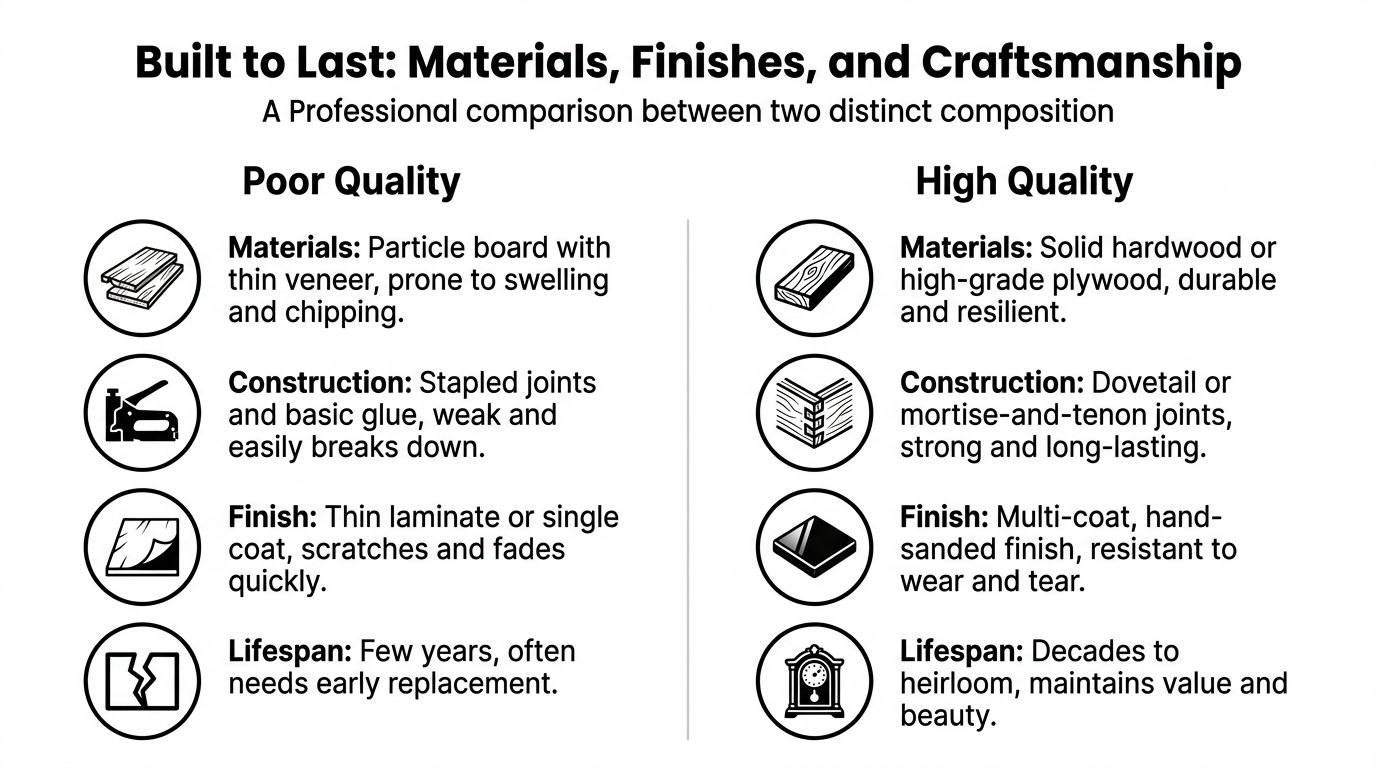
Not all hutches age the same way. Some look tired after a short stretch of daily use. Others settle into a room and keep serving for years with little drama. The difference usually down to what they’re made of, how they’re built, and whether the hardware was chosen for daily life instead of showroom looks.
What the common materials really mean
A shopper usually sees a finish first. A furniture expert looks past the finish to the structure underneath.
Solid wood brings the character many people want most. It has depth, natural variation, and repair potential. If a solid wood hutch gets minor wear over time, the piece can often be refreshed instead of replaced. This is one reason Amish furniture remains such a strong option for homeowners who want long-term value.
Wood veneer can also be a respectable choice when used over a stable core. In a well-made piece, veneer provides a furniture-grade look with more design flexibility. The quality depends on the substrate, the thickness of the veneer, and the way edges and corners are finished.
Laminate over engineered materials can make sense for buyers who want a custom look with easier day-to-day maintenance. Some laminate desks and hutches perform well, especially when the engineering and testing behind them are serious. Others do not. The difference is not the label alone. It is the build quality.
For readers comparing species and wood performance, our article on choosing the right hardwood for longevity and style gives a practical overview.
Construction tells the full story
A finish can hide weak construction for a while. Drawers, doors, and shelves eventually reveal the truth.
Look for these signs of better craftsmanship:
- Joinery that feels intentional: Strong joints matter because a hutch handles weight, vibration, opening and closing, and years of normal use.
- Hardware that operates smoothly: Hinges and drawer slides should feel controlled, not loose or rough.
- Shelves that stay steady: Sagging or flexing under ordinary office items is an early warning sign.
- A finish with depth: A better finish protects the surface while giving the wood or material a more complete appearance.
Why testing matters
When a manufacturer submits furniture to recognized durability testing, that gives shoppers something more useful than marketing language. According to Bush Business Furniture, leading furniture brands test their hutches to ANSI/BIFMA standards, which can include cycling shelves with 50-pound loads 30,000 times without failure and using self-closing Euro hinges that maintain alignment after 100,000 cycles (Bush Business Furniture testing details).
That matters because office furniture gets used in repetitive ways. Doors open every day. Shelves stay loaded. Components get bumped, adjusted, and leaned on. Testing does not replace craftsmanship, but it does show that someone asked the furniture to prove itself.
Tip: Open every door. Pull every drawer. Press lightly on a shelf. Quality often announces itself through feel before you ever ask about specifications.
A simple side-by-side view
| Material or build choice | What it usually offers | What to watch for |
|---|---|---|
| Solid wood | Repairability, warmth, long life | Wood movement if poorly built |
| Veneer on quality core | Furniture-grade look, design flexibility | Thin edges or poor substrate |
| Laminate on engineered core | Easy care, consistent finish | Lower-end versions can chip or feel hollow |
| Better hardware and joinery | Smoother daily use, longer service life | Harder to judge online without seeing details |
One factual example worth noting is the Bush Furniture Cabot 60W model. It uses laminate over composite wood and is designed for real workload demands rather than just appearance. A hutch or desk system in that category can serve well for shoppers who want a practical, tested solution.
At the same time, many NWI homeowners prefer the feel of solid wood because it ages with more grace. That is where heirloom-minded construction stands apart. It does not just survive use. It tends to look more settled and more at home as the years pass.
Customization is Key Designing a Hutch For Your Needs
Standard sizes work for standard situations. Home offices are rarely standard.
One person needs room for dual monitors and a dock. Another wants closed storage so work can visually disappear once the workday concludes. Someone else needs a hutch scaled to a smaller office in a Crown Point spare bedroom, with shelves placed around a window and a printer station tucked out of sight.
That is why custom work matters. A computer furniture hutch should fit your routine, your room, and your equipment. “Close enough” can become a daily irritation.
What you can customize
With a made-to-order approach, you can usually adjust far more than people expect:
- Overall width and height so the piece fits the room instead of overpowering it
- Shelf placement to suit monitors, books, or display items
- Drawer and door configuration for open storage, hidden storage, or a mix
- Wood species and stain so the hutch matches nearby furniture
- Hardware choices to lean more traditional, transitional, or modern farmhouse
- Openings for cords and devices so the piece works with current technology
For a buyer who wants one factual place to start, Groen’s Fine Furniture offers custom order guidance for shoppers comparing made-to-order options.
Why solid wood custom hutches stand out
A custom hutch built in solid wood gives you two advantages at once. First, you get the fit. Second, you get material substance that tends to age better than lighter mass-market alternatives.
That matters even more now because the market is shifting toward pieces that feel responsible as well as useful. “Sustainable computer hutch” searches are up 35% year over year since April 2025, and 52% of Midwest families are willing to pay more for eco-friendly furniture, according to the cited market summary on The Furniture Warehouse website (eco-friendly hutch demand summary). That gives solid wood Amish pieces a meaningful place in the conversation because buyers often want durability, lower-VOC material character, and furniture they do not plan to replace quickly.
Design it your way
A bespoke hutch is especially helpful when:
- your monitor setup is not standard
- you need a precise height to improve comfort
- your office shares space with a guest room or living area
- you want the piece to coordinate with other wood furniture in the home
- you care about long-term ownership, not temporary convenience
Key takeaway: Customization is not about adding extras for the sake of it. It is about removing the compromises that make a piece harder to live with.
In our experience as a family business, this is often the moment when shoppers realize they do not have to settle for a shelf arrangement that is almost right. They can ask for the right scale, the right wood, the right storage mix, and a finish that feels at home in the rest of the house.
Styling Your Home Office Hutch in Northwest Indiana
A hutch should organize the room, but it should also help the room feel finished. In many Northwest Indiana homes, the office is visible from a hallway, bedroom, or shared living space. That means your workstation has to work hard and look composed.
Keep the top half lighter than the bottom
A common styling mistake is filling every upper shelf. That makes the room feel crowded fast. Let the lower desk area do the heavier visual work, and keep the upper hutch shelves more open.
Try a mix like this:
- One practical zone: binders, trays, or work baskets
- One personal zone: framed photo, small art piece, or keepsake
- One softening element: a plant or natural texture
- One open space: empty breathing room matters
Match the hutch to the rest of the home
A hutch does not have to look “office-like.” In Schererville and Munster homes, we often see success when the finish and shape connect to nearby furnishings.
If your home leans classic, a richer wood tone and paneled doors can feel grounded. If you prefer modern farmhouse, lighter woods and simpler lines keep the office approachable. If your style is transitional, clean profiles pair well with brands such as Bassett and Flexsteel, especially when you want the office to blend with adjoining rooms rather than stand apart.
Let function improve the look
Good styling starts with good utility. A well-designed hutch such as the Bush Furniture Cabot 60W can support up to 200 pounds on its desktop and includes integrated wire management that can reduce cable clutter by 40% to 60%, which helps both appearance and everyday order (Cabot 60W product details).
That last part is important. Fewer visible cords usually means the room instantly looks calmer.
Tip: Decorate around your workflow, not against it. If you use a printer daily, give it a logical home. Do not hide it so well that using it becomes annoying.
When the styling is right, a computer furniture hutch stops looking like office equipment and starts reading as part of a complete, well-furnished home.
Bring Your Vision Home with Confidence and Ease
The right computer furniture hutch solves more than one problem. It organizes the workspace, supports better daily habits, uses vertical room wisely, and helps your office feel settled instead of improvised.
Most buying mistakes happen when people focus on appearance first and fit second. A better order is simpler. Start with the size of the room, your desk, and your equipment. Then look at materials. Then think about whether a standard model is enough or whether a custom piece will serve you longer and more comfortably.
Delivery matters too. Few want to wrestle a hutch through doorways, around corners, and onto a desk base after a long workweek. If you like having a checklist before a move or room change, this practical guide on Preparing For Office Furniture Relocation offers useful planning ideas that apply well beyond commercial spaces.
For many households in NWI, value also means buying power. A better office setup can make everyday life easier, and Special Financing available, subject to credit approval, can help fit that investment into your budget more comfortably. Add White-Glove Delivery, and the process becomes much less stressful because the heavy lifting, placement, and setup details are handled with care.
Our family has served Northwest Indiana with multigenerational ownership and personal service since 1983. We know that furniture decisions are not just about filling a room. They are about making daily life run better.
Visit Groen’s Fine Furniture in Dyer or Crown Point today to explore our custom options and ask about our special financing plans. Let our family help you create a home you love.