
Types of Upholstery: Materials, Durability and Best Uses


For homeowners in Dyer and Crown Point looking to refresh a living space, upholstery is not just a final color choice. It's the surface that handles daily sitting, spills, sunlight, pets, and cleaning. The smartest way to compare types of upholstery is by household scenario, not by one impressive durability number or a pretty swatch alone.
Upholstery Types at a Glance
For homeowners in Dyer and Crown Point, upholstery is the choice lived with every day, so the right type matters as much as the color. According to Designers Today's 2025 consumer survey, leather was the most preferred upholstered-furniture material among surveyed consumers at 41%, followed by real-and-synthetic leather combinations at 28%. Preference alone doesn't prove fit, though. A quiet reading chair and a sectional used by kids after school need very different surfaces.
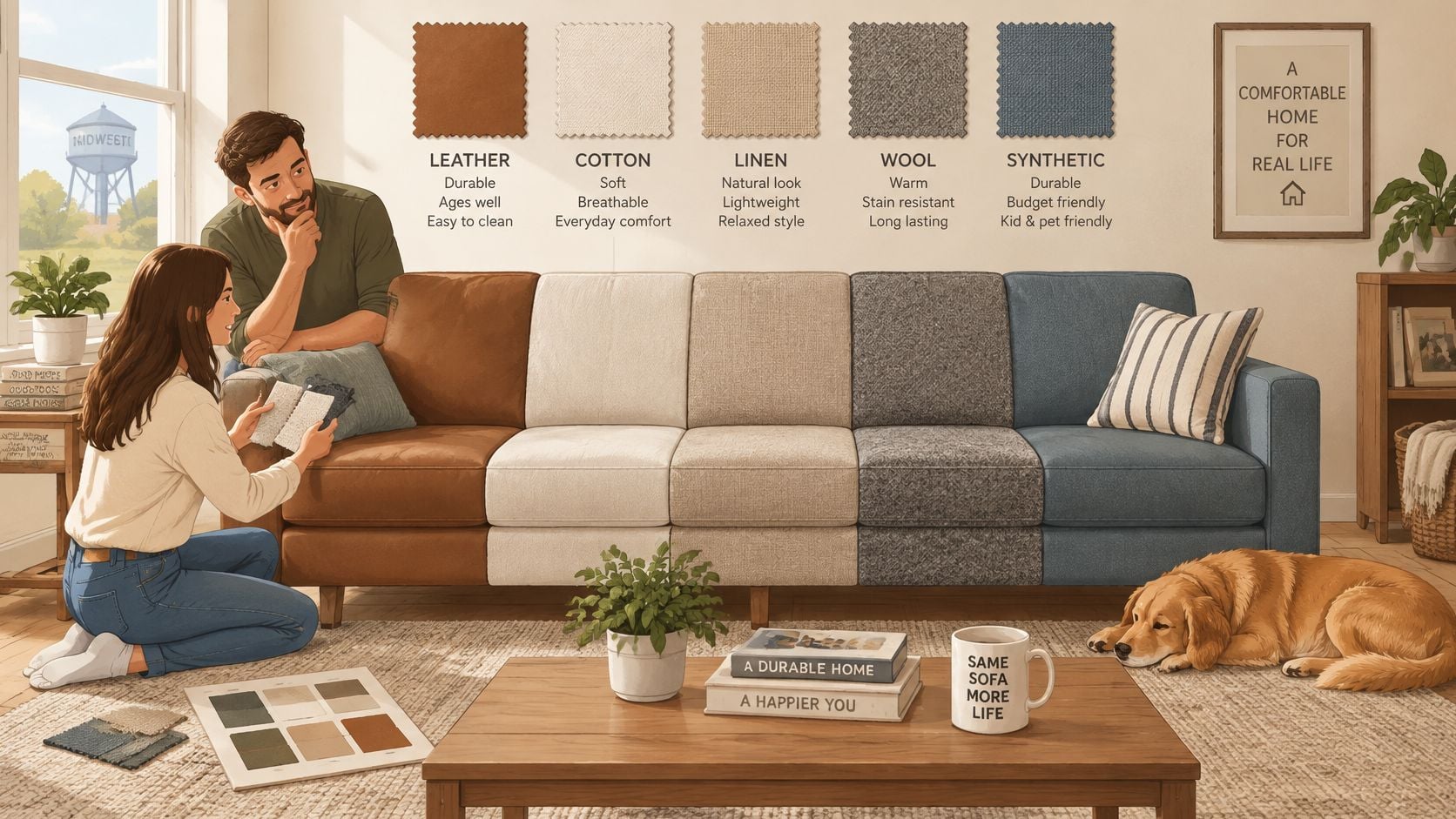
Nine types cover most showroom decisions. They are protected leather, aniline leather, semi-aniline leather, microfiber, solution-dyed performance fabric, cotton, linen, wool, and poly blends. Use the table to build a shortlist of two or three candidates. Then confirm that shortlist against leather grades, weave, durability testing, and cleaning codes before money changes hands.
Quick-reference guide to upholstery types
| Type | Durability rating | Stain resistance | Care level | Best household fit |
|---|---|---|---|---|
| Protected (pigmented) leather | High | High | Low; follow maker's cleaning guide | Pets, kids, daily family use |
| Aniline leather | High; develops patina | Low; absorbs spills | Moderate; gentle cleaners only | Quiet rooms, natural look |
| Semi-aniline leather | Moderate to high | Moderate | Low to moderate | Balanced look with some protection |
| Microfiber (polyester) | High in tested residential grades | High | Low; some covers removable | Pets, kids, entertaining |
| Solution-dyed performance fabric (olefin, polyester, nylon) | High | High; color locked into fiber | Low; check cleaning code | Sunny rooms, heavy use |
| Cotton | Moderate; varies with weave | Low; absorbs spills | Moderate; check cleaning code | Casual rooms, slipcovers |
| Linen | Moderate | Low | Moderate; spot clean | Formal, low-contact rooms |
| Wool | Moderate to high; naturally resilient | Moderate | Moderate; professional cleaning often advised | Formal rooms, textured looks |
| Poly blends (cotton-poly, linen-poly, wool-nylon) | Moderate to high | Moderate to high | Low to moderate | Everyday family rooms with a textured look |
These ratings are relative comparisons, not guarantees. A tight cotton weave can outlast a loose, nubby synthetic in a home with pet claws, even when the synthetic fiber itself sounds stronger. A protected leather can still scratch, and a performance fabric can still hold an oily stain if nobody blots it. The table narrows the field. It doesn't replace the label, the test basis, or a honest look at how a room gets used on a Tuesday night.
Shortlist rule: pick candidates by the hardest real use in the room, not by the calmest day the room ever sees.
Families across Dyer, Crown Point, St. John, Schererville, Munster, and Northwest Indiana (NWI) have been served by Groen's Fine Furniture since 1983. That local history matters during selection because swatches behave differently under home light, against existing wood tones, and next to flooring. Bring the shortlist, a photo of the room, and notes about pets, kids, sun, and entertaining. The right conversation starts with use, then moves to texture and color.
Leather Grades and What Each One Handles
The word leather alone tells a shopper very little. Performance depends on hide selection, finish, thickness, and surface treatment, so two leather sofas can age in completely different ways. One may wipe clean after a juice spill, while another darkens where hands rest and shows every ring from a damp glass. Both can be real leather. The grade and finish explain the difference.
The three grades shoppers meet most often
- Aniline leather: retains a more natural surface, feels soft and warm, and develops patina over time. It also absorbs spills more readily and offers less resistance to staining.
- Semi-aniline leather: adds limited pigment or protective finish while preserving natural character. It's the middle path for households that want a natural hand with some protection.
- Protected or pigmented leather: generally provides greater consistency and stronger resistance to scuffing, staining, and color transfer. It's usually the practical leather for busy seating.
Those distinctions come from FIRA guidance on specifying leather for furniture, which also warns against relying only on labels such as top grain or genuine leather. FIRA identifies BS EN 13336:2022, Leather, Upholstery leather characteristics, Guide for the selection of leather for furniture, as a relevant selection standard. A shopper doesn't need to memorize that number. Asking whether selection and testing align with it quickly separates a sales label from a specification.
Request five specification points before choosing a hide. Ask about tear strength, flexing endurance, finish adhesion, wet and dry rub colorfastness, and lightfastness. Tear strength matters at seams and cushion edges, flexing endurance matters on recliners and seat fronts, and finish adhesion affects peeling or flaking risk. Colorfastness matters when dark denim rubs a light cushion, and lightfastness matters near windows. A seller who can discuss those points gives a buyer something sturdier than a grade name.
Two examples make the trade-off clear. A protected-leather sectional suits a family room with kids and a dog because spills sit on the finish longer and routine wiping is simpler. An aniline reading chair suits a quiet corner where sunlight is controlled, drinks stay on a side table, and gradual patina is part of the charm. Neither choice is better in the abstract. Each one matches a different pattern of contact.
Shoppers comparing smooth hides with napped surfaces can also review the difference between suede and leather before deciding, because suede-like texture changes cleaning expectations. For any leather, obtain the manufacturer's care instructions and test a concealed area before applying cleaners. Aggressive chemicals, excessive moisture, heat, or unapproved conditioning products can alter the finish and invalidate warranty coverage. That concealed-area test takes minutes and can prevent a permanent pale patch in the middle of a cushion.
Microfiber and Performance Fabrics for Heavy Use
Microfiber upholstery is built from very fine polyester fibers packed into a dense construction. That density is why it often feels soft and suede-like while giving liquids less room to dive straight into the cushion. Many microfiber fabrics also use finishes that help repel spills for a limited window, which gives a household time to blot rather than panic. Some lines add removable covers, a practical feature when a seat cushion takes the worst of movie night.
Density also helps with pet hair and daily grit. Hair tends to sit on the surface instead of weaving deep into loops, so a lint roller, damp rubber glove, or upholstery attachment can lift it during routine cleaning. The fine surface can show pressure marks or shading when the nap changes direction, though. A shopper who dislikes that brushed, two-tone look should run a hand across a large cushion in the showroom, not just a small swatch.
What solution-dyed means in plain terms
In a solution-dyed performance fabric, color is built into the fiber before the yarn is woven. Think of the difference between a carrot, colored all the way through, and a radish, colored mainly on the skin. That locked-in color helps solution-dyed polyester, olefin, and nylon resist fading and many common stains in sunny or heavily used rooms. It doesn't make a fabric immune to oil, sunscreen, or a ground-in crayon, but it improves the odds during cleanup.
Performance is still a system, not a fiber slogan. A tight weave resists snagging from claws, rings, belt buckles, and toy edges. A loose bouclé or nubby weave can catch and pull even when the underlying fiber is strong. Shoppers should drag a fingernail lightly across the back of a swatch, look for loose loops, and ask how the fabric behaves at seams. Seams on arms and seat fronts take concentrated stress, so construction matters alongside chemistry.
Flexsteel is one of the brands carried by Groen's Fine Furniture, and durability-focused upholstery lines deserve the same questions as any other line. Brand reputation doesn't certify every individual fabric in a binder. For a deeper look at construction and use cases, readers can review performance upholstery options and care considerations before narrowing colors. The fabric code, weave, and test results for the exact swatch still control the decision.
A strong fiber in a loose weave is still a snag risk. Judge the cloth in hand, not the label in the binder.
Pilling is the quiet drawback to ask about with microfiber and many synthetics. Friction from throws, pet movement, and repeated sitting can raise small fiber balls on seat fronts and arms. Ask for the pilling rating, then ask whether the fabric has been tested on the same construction being ordered. A smooth showroom sample that pills by winter will disappoint faster than a slightly less plush fabric that keeps a clean surface.
Consider a microfiber sofa for a family room with a dog and two children. The dense surface supports quick hair removal, blotting, and frequent vacuuming, while a medium tone hides shading better than a flat black. Contrast that with a solution-dyed olefin chair in a south-facing sunroom, where fading is the main threat and locked-in color earns its keep. In both cases, the winning feature matches the hazard. That matching process matters more than chasing the word performance across the tag.
Before ordering, ask four direct questions. Fiber content: what is the cloth made from, exactly. Weave: is it tight, looped, brushed, or nubby. Pilling: what class was achieved under test. Cleaning: which code applies, and are covers removable. Clear answers turn a heavy-use promise into a specification a household can maintain.
Natural Fibers and Blends Compared
Natural fibers win many shoppers with breathability, texture, and a less uniform surface. Those qualities are real, but they come with specific compromises. The fair way to compare cotton, linen, wool, and blends is to use the same four tests for each one. Strength, stain behavior, care, and feel reveal more than a romantic fiber story.
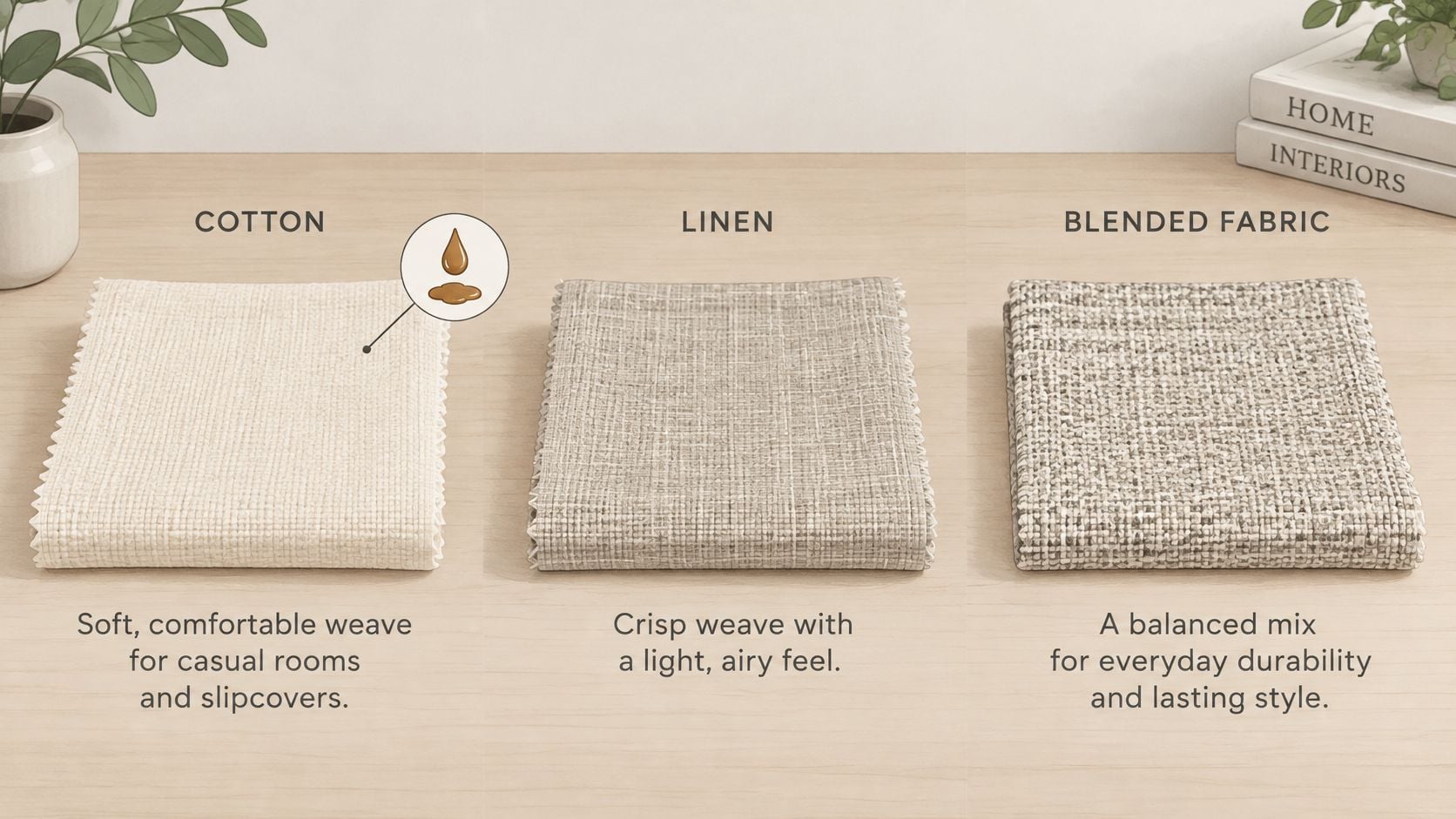
Cotton feels breathable and familiar, takes dye well, and suits casual rooms and slipcovers. Strength varies widely with weave, yarn quality, and finish, so a tight cotton twill and a loose cotton gauze should never be treated as equals. Untreated cotton absorbs spills quickly, which makes fast blotting essential. Removable slipcovers change the equation because the cover can be cleaned away from the frame, provided the care label allows it.
Linen brings a crisp, textured look and a cool hand that suits refined or formal rooms. It can be strong in a well-made weave, but it creases readily and absorbs stains, so seat cushions may show both wrinkles and spills sooner than a busy household expects. Linen often looks best where contact is lighter and the slightly relaxed surface reads as intentional. Readers weighing these two plant fibers closely may find More Sewing's linen and cotton comparison useful context on handle, care, and everyday behavior.
Wool is naturally resilient, meaning the fibers spring back well after compression. That resilience helps textured wool keep its shape on chairs and formal sofas, and the surface can hide minor soil between cleanings. Care is the catch, since many wool upholsteries call for professional or water-free methods. A wool fabric that cannot be cleaned with the products already at home may create more stress than its beautiful texture is worth.
Why blends behave the way they do
Blends such as cotton-poly, linen-poly, and wool-nylon pair a natural face or feel with synthetic strength. The ratio matters, but so do yarn, weave, backing, and finish. Two cotton-poly covers that look identical on a rack can wear differently because one uses a tighter weave and a more durable finish. Ask for the full fiber percentages and construction details rather than accepting a short blend name.
Fire behavior shows the same lesson from another angle. A California Senate background document on flame retardants explains that TB 117-2013 changed the central test method from open-flame testing to smoldering testing and allowed compliance without requiring flame-retardant chemicals. The framework examines the cover fabric, barrier, resilient filling, and decking individually. Natural fibers, synthetics, blends, foam, and barriers cannot be ranked safely by fiber label alone, because finished performance depends on assembled components.
That point applies beyond safety. Cushion shape, seam placement, foam support, and frame geometry all change how a cover flexes and abrades. A linen blend on a tight, low-contact chair back faces an easier life than the same blend wrapped over a recliner footrest. Ask for the complete construction, then judge the fiber inside that real setting.
How Durability Ratings Really Work
Durability ratings confuse shoppers because one large number looks precise, settled, and easy to compare. Abrasion testing is useful, but it measures a narrow form of wear under controlled conditions. It doesn't measure claw snags, oily stains, seam stress, sunlight, or whether a fabric still looks clean after repeated spot cleaning. Treat the number as a screen, not a prophecy.
Two test families dominate upholstery specifications. Wyzenbeek abrasion resistance, ASTM D4157, is reported in double rubs, while Martindale abrasion resistance, ASTM D4966, is reported in cycles. The ASTM textile standards overview supports the key caution that these methods use different abrasives, motion patterns, and reporting conventions. Their results should not be treated as directly interchangeable, so a Martindale figure cannot be converted into a Wyzenbeek figure with a simple multiplier.
Durability benchmarks by use case
| Application | Wyzenbeek double rubs | Martindale cycles | Pilling benchmark |
|---|---|---|---|
| Low-traffic or private use | 15,000 | 20,000 | Class 3 minimum |
| High-traffic or public use | 30,000 | 40,000 | Class 4 to 5 where appearance matters |
| Typical residential range (market data) | 15,000 to 50,000 | Use the stated test basis, not a conversion | Class 3 minimum; Class 4 to 5 preferred |
ACT guidance commonly uses approximately 15,000 Wyzenbeek double rubs or 20,000 Martindale cycles for low-traffic or private applications. For high-traffic or public applications, the benchmarks rise to approximately 30,000 Wyzenbeek double rubs or 40,000 Martindale cycles. The typical residential range in the table gives context, but a family sectional should be judged closer to the high-traffic line when it hosts daily lounging, guests, pets, and homework. Room labels can mislead. Actual traffic decides.
Pilling deserves equal billing because a fabric can resist thinning while looking tired. ACT guidance identifies pilling Class 3 as a minimum benchmark, while Class 4 to 5 is preferable where appearance retention is critical. Seat fronts, arms, and recliner footrests show pilling early because clothing and throws rub the same zones daily. Ask to see the pilling class beside the abrasion result, not buried in a separate binder.
Three more results complete the picture. Seam-slippage resistance shows whether yarns pull apart at stitched joins under load. Colorfastness covers rubbing, light, and cleaning exposure, which matters for dark fabrics against pale clothing and pale fabrics in sun. The cleaning code tells a household whether care is realistic with water-based products, solvent products, either type, or professional help only. Readers thinking beyond the cover can connect those surface results with frame and cushion life in guidance on how long furniture should last.
Practical rule: a high rub rating is not a guarantee against snagging, pilling, seam failure, or discoloration.
Imagine two fabrics for the same sectional. One posts the bigger abrasion number but has loose loops, a low pilling class, and a solvent-only code. The other posts a moderate abrasion result, uses a tight weave, reaches a stronger pilling class, and allows water-based cleaning. For a household with a dog and frequent snacks, the second fabric may look better after real seasons of use. Request the complete test basis for every finalist, including method, result, and fabric construction, then judge the whole file together.
Cleaning Codes and Stain Resistance by Material
Most fabric furniture carries a cleaning code on a label under a cushion or on the deck. That code is the first thing to check before reaching for a spray bottle, because the wrong cleaner can set a stain, leave a ring, or strip a finish. Photograph the label during shopping, not after delivery. If the code conflicts with the way a household cleans, the fabric is a poor fit no matter how attractive the color looks.
Cleaning codes and what they mean
| Code | Meaning | What to use | Avoid |
|---|---|---|---|
| W | Water-based cleaner is safe | Mild water-based upholstery cleaner | Solvent cleaners |
| S | Solvent-based cleaner only | Upholstery solvent in a ventilated room | Water, which can leave rings |
| W/S | Water-based or solvent cleaner is safe | Test first, then either cleaner works | Harsh mixed cleaners |
| X | Vacuum only or professional cleaning | Vacuum or hire a professional | Any liquid cleaner |
Water on an S-coded fabric can leave rings because the liquid spreads soil and dries unevenly. Solvent on a W-coded fabric can damage dyes, backings, or surface finishes. A W/S code offers flexibility, but it still requires a hidden-area test and restraint with quantity. X is the strictest code, so households with frequent spills should think hard before putting X-coded cloth on dining chairs or a family sectional.
Leather doesn't follow these fabric codes. Use the maker's care instructions for the exact finish, since protected, semi-aniline, and aniline surfaces respond differently to moisture and conditioners. General product guidance can help a shopper understand categories, including how to choose a furniture cleaner, but the label on the purchased piece controls the final method. When instructions conflict, the manufacturer's direction wins because warranty coverage may depend on it.
Stain chemistry matters as much as the cleaner shelf. Water-based stains such as juice, coffee, and many food spills are usually easier to lift when blotted quickly with a clean white cloth. Oil-based stains from salad dressing, lotion, or greasy food cling to fibers and may need a code-appropriate solvent or professional treatment. Rubbing spreads both types and can roughen the surface, so blot from the outside toward the center and use small amounts of cleaner at a time.
Picture red wine on a W-coded cotton sofa during a gathering. Fast blotting, a mild water-based cleaner, and patience give the cotton a fair chance, although the absorbent fiber may still hold a shadow. Now picture an oil-based stain on a microfiber chair, where water alone may bead around the grease and leave the mark behind. The code decides whether a solvent step is allowed. Speed helps, but speed with the wrong chemistry can make the damaged area larger.
Performance finishes repel liquids for a limited time and may need maintenance according to the maker's guidance. Stain resistance is not permanent armor, and repeated cleaning, heat, and abrasion can reduce its effect. Ask whether a treatment is water-based or low-emission, what disclosure is available for the finish, and whether the piece carries GREENGUARD certification for low VOC emissions. Those questions matter most in bedrooms, nurseries, and tightly sealed homes where indoor air concerns sit beside stain concerns.
End every cleaning decision with the same safeguard. Test any cleaner on a hidden area first, wait for it to dry, and inspect for color change, stiffness, or ring formation. That small pause protects the visible cushion and keeps a minor spill from becoming a permanent cleaning outline.
Best Upholstery for Pets, Kids and Entertaining
Household use, not the material name, should drive the final pick. The same linen that looks refined in a formal room can become a source of daily frustration beside a snack table. Start with the hardest pattern in the home, then read across for top picks, cautious choices, and the reason behind each one.
Upholstery picks by household scenario
| Household | Top picks | Use with caution | Why |
|---|---|---|---|
| Homes with pets | Protected leather, solution-dyed performance fabric, tight-weave microfiber | Loose cotton or linen weaves, aniline leather | Claws snag loose weaves; oils can mark aniline |
| Homes with young children | Protected leather, performance fabric with a W code | Light-colored natural fibers, delicate velvets | Spills and sticky hands |
| Frequent entertaining | Microfiber with removable covers, performance blends | Aniline leather, unsealed linen | Wine and food stains |
| Formal, low-traffic rooms | Wool, linen blend, aniline leather | Heavily used recliners | Texture and patina suit light use |
| Sunny rooms | Solution-dyed performance fabric, olefin | Untreated natural fibers | Fading from direct sunlight |
Pets create two separate problems. Claws catch loose weaves and loops, while body oils and damp paws challenge absorbent or lightly finished surfaces. Protected leather and tight-weave performance fabrics reduce both risks, although sharp claws can still scratch leather and no upholstery is claw proof. Households designing around animals may also appreciate pet-friendly apartment design by Interiors by DeX for broader finish planning beyond the sofa.
Young children add spills, sticky hands, markers, and repeated climbing at cushion edges. A W code helps when water-based cleanup fits the stain, and removable covers help when a whole seat needs attention. Medium tones and subtle patterns hide the interval between cleanings better than flat ivory. For fabric-specific pet and family considerations, pet-friendly furniture fabrics offers a useful companion checklist before a showroom visit.
Entertaining shifts the risk toward wine, coffee, oils, and guests who may not report a spill immediately. Microfiber with removable covers and performance blends give the host more recovery options after the party. Unsealed linen and aniline leather ask for quicker intervention and calmer use. A formal room can still enjoy wool, linen blends, or aniline leather when traffic stays low and drinks remain on tables.
Sunny rooms need a different filter. Direct light fades many untreated natural fibers and can dry or discolor vulnerable finishes over time. Solution-dyed performance fabric and olefin deserve priority where a chair sits in a bright window for much of the day. Rotating cushions, using window treatments during peak sun, and keeping leather away from heat sources protect any choice further.
Fire safety depends on more than the visible cover. The U.S. Consumer Product Safety Commission FAQ on upholstered furniture explains that TB 117-2013 testing covers the cover fabric, barrier material, resilient filling material, and decking material beneath loose seat cushions. Each component is evaluated for char length, smoldering behavior, and whether smoldering transitions to open flaming. A piece can comply when its cover fabric and filling pass, or when a compliant barrier completely surrounds the filling.
Ask the seller for the flammability label and basic construction details such as foam, batting, interliners, and decking. Internal construction is part of upholstery safety, not a hidden detail beneath the styling. With that label confirmed, return to the matrix and choose by real use. The most suitable type is the one whose cleaning, surface, and construction still make sense after the busiest normal week at home.
Design Your Upholstery Your Way at Groen's
Groen's Fine Furniture is family-owned since 1983, with multigenerational ownership and five-star service for Dyer, Crown Point, St. John, Schererville, Munster, and Northwest Indiana (NWI). Most of the furniture sold can be customized to personal style and comfort. That flexibility matters when the floor sample has the right seat but the wrong fabric for a dog, a sunny window, or a house full of grandchildren.
Custom routes include upholstered pieces from Flexsteel and Bassett with broad fabric and leather choices, plus custom-matched supple leather on selected seating. Canadel custom dining lets a household choose size, shape, and finish for dining pieces, including upholstered dining chair combinations. Amish-made solid wood frames provide another made-to-order path for shoppers who want heirloom construction built to exact specifications. Readers planning a recover instead of a new frame can browse fabrics for reupholstering furniture to understand the range of cloth weights and textures before discussing labor and fit.
Custom ordering makes the most sense for unusual dimensions, a specific performance fabric, matching existing decor, or a household need that standard options don't cover. It also helps when a room needs a particular arm height, seat depth, leather grade, or cleanable cover rather than a compromise. Terms used in the showroom include design it your way, bespoke, and made to order, but the practical value is simpler. The upholstery type gets selected for the household first, then styled around the room.
Special Financing is available, subject to credit approval, giving buyers more buying power to fit a quality piece to a budget. Interior design support and white-glove delivery round out the service from swatch selection to placement at home. Lead times vary by piece and are confirmed at the showroom, so timing should be settled before committing. Honest expectations on fabric, construction, and delivery protect the excitement of a custom order.
Choose Your Upholstery Type Before You Shop
A focused checklist prevents a beautiful swatch from overruling daily life. Run through these steps before visiting a showroom, then test the finalists in person.
- Match use first: choose by pets, kids, entertaining, formality, or sun exposure.
- Check durability: compare the stated Wyzenbeek or Martindale basis, pilling class, and seam performance.
- Confirm cleaning: record the W, S, W/S, or X code and the likely stain types at home.
- Select the leather grade: if leather remains a finalist, decide between aniline character and protected practicality.
- Ask for safety details: request the flammability label and basic internal construction information.
- Choose stock or custom: most furniture sold at Groen's Fine Furniture can be customized, and the Easton sectional is upholstered in supple leather with custom match. Brands carried include Flexsteel, Bassett, Beautyrest, Vaughan Bassett, Amish Furniture, and Serta.
Sit on the fabric or leather, hold a swatch against existing furnishings, and ask the team to walk through every label. Special financing is available, subject to credit approval, so the right piece can fit a budget without lowering the standard. Visit Groen's Fine Furniture in Dyer or Crown Point today to explore custom options and ask about special financing plans. Let the Groen family help create a home that feels comfortable, lasting, honest, and personal.
Groen's Fine Furniture helps Northwest Indiana households compare leather, performance fabrics, natural fibers, and blends by real use, cleaning code, and comfort, with custom options across trusted brands. Visit Groen's Fine Furniture to plan a Dyer or Crown Point showroom visit, test upholstery in person, and ask about custom orders and special financing, subject to credit approval.