Blog
Round and Oval Dining Tables: Find Your Perfect Fit

For many families in Northwest Indiana, the dining table decision starts the same way. You stand in the room, look at the space you have, think about weeknight dinners, then think about holidays, birthdays, and the extra chairs that always seem to appear when people feel welcome.
That's usually when the core question shows up. Not, “Which table looks nicer?” but, “Will a round table make the room easier to live in, or will an oval give us the extra seating we'll wish we had later?” In homes across Dyer, Crown Point, St. John, Schererville, and Munster, that choice affects traffic flow, comfort, conversation, and how flexible the room feels every day.
Our family has been helping NWI homeowners furnish their homes since 1983, and we've learned that round and oval dining tables are both good choices for the right room. The trick is matching the shape to the way you live. A cozy breakfast nook asks different things from a formal dining room. An open-concept home with walkways around the table has different needs than a square room tucked off the kitchen.
Choosing the Heart of Your Home
A dining table earns its place slowly. It hosts quick breakfasts before school, takeout on busy nights, homework spread across the top, and the long conversations that happen after dessert when nobody wants to get up yet.
That's why shape matters more than many shoppers expect. A round table often feels inviting right away because everyone faces inward. An oval table tends to feel more flexible because it gives you that same softened look with added length. Neither one is automatically right. The better fit depends on your room, your hosting habits, and how much space you want to keep open around the table.
Start with daily life, not holiday photos
Shoppers frequently approach this decision backward. They picture the biggest gathering of the year first, then choose a table around that one event. We usually encourage neighbors in Dyer and Crown Point to flip that thinking around. Ask what the table needs to do on an ordinary Tuesday.
A few useful questions help narrow the choice:
- How many people sit there most days? Everyday use should drive the baseline size.
- Where do people walk? If the dining space sits near a kitchen path, patio door, or hallway, shape changes how the room moves.
- Do you want everyone to feel equally included? Some families care a lot about conversation flow.
- Will the table stay in one home for many years? Lasting value often comes from choosing a shape that still works after life changes.
For many homeowners, that last point matters most. A dining table isn't just decor. It becomes part of family routine. That's one reason thoughtful pieces have such staying power, and why resources about crafting wood dining tables resonate with people who want more than a disposable purchase.
A good dining table doesn't just fill a room. It supports the way people gather in it.
Think about the full set, not just the tabletop
The table and chairs have to work together. Chair width, arm style, and how easily people can slide in all affect whether a table feels comfortable or cramped. If you're sorting through shape options, our guide on how to choose dining room chairs helps connect those decisions so the whole set feels right together.
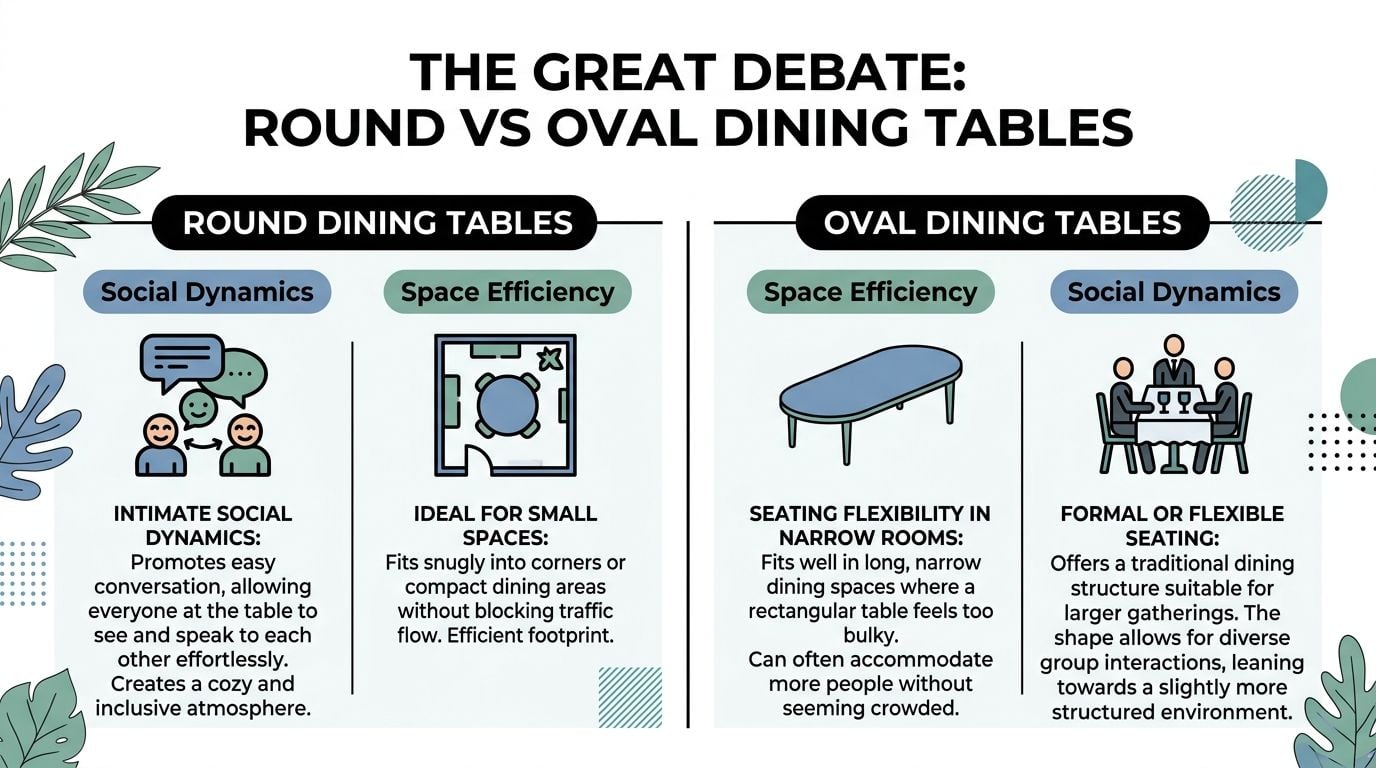
The Great Debate Round vs Oval Dining Tables
A family in Northwest Indiana can love the look of a table and still end up frustrated by it six months later. The usual problem is not the shape by itself. It is how that shape works with the room, the traffic path to the kitchen, and the kind of base underneath the top.
Round and oval tables both soften a dining space. They do it in different ways. Round tables gather people toward a shared center. Oval tables stretch that gathering out so you can keep better walking space in a longer room.
Here's a practical side by side view.
| Consideration | Round dining table | Oval dining table |
|---|---|---|
| Conversation feel | Balanced and inclusive, with everyone facing the center | Social, but a little more directional from end to end |
| Traffic flow | Easy to move around because there are no corners | Gentler than a rectangle, with better length for narrower layouts |
| Best room type | Square or near-square dining areas | Long or rectangular dining areas |
| Visual presence | Centered, compact, and casual to dress up or down | Longer, lighter than a rectangle, often a touch more formal |
| Hosting style | Strong fit for everyday meals and smaller gatherings | Strong fit for regular hosting and added seating without sharp corners |
Where round tables shine
A round table keeps every seat in the same conversation circle. That makes dinner feel more connected, especially for families who use the table for weeknight meals, homework, and long Sunday conversations.
That idea goes back a long way. Historians often point to round tables as symbols of equality because no one sits at a head position, a tradition discussed in the Encyclopaedia Britannica entry on the Round Table tradition. In a dining room, that old principle still shows up in a simple way. Everyone feels included.
Round tables also tend to behave well in square rooms. Design guidance from House Beautiful notes that round tables are often a natural fit for square dining spaces because the shape mirrors the room's proportions and keeps circulation softer around the edges, as explained in this overview of how to choose the right dining table shape.
For many homes around here, that matters more than people expect. If the dining area sits near a patio door, hallway, or kitchen opening, sharp corners become little bump points. A round top removes those trouble spots.
Where oval tables earn their place
Oval tables solve a different everyday problem. They preserve the softer edge people like, but they use length more efficiently in a rectangular room. If your space runs alongside an island, buffet, bank of windows, or main walkway, an oval often fits the room's rhythm better than a large round table.
Hosting is usually where oval tables pull ahead. You can add seats along the long sides without making the table feel harsh or heavy. In many Northwest Indiana homes, especially open-concept layouts and older formal dining rooms, that mix of softness and capacity is exactly what works.
There is also a visual benefit. An oval table gives a room direction without feeling stiff. It helps define the dining zone, but it does not bring the boxy feel a rectangular table sometimes does.
The part people miss most often: the base
Shape gets the attention. Base design decides how comfortable the table is to live with.
A pedestal base often works well on both round and oval tables because it frees up knee space and makes it easier to shift chairs for kids, guests, or mixed seating. A four-leg base can still be beautiful and sturdy, but the legs may land right where someone wants to sit, especially near the ends of an oval. That is one reason two tables with the same top size can feel very different in real use.
If you are comparing options, our dining table size guide for room fit and seating planning helps connect shape, dimensions, and everyday comfort.
The plain-language choice
Choose round if you want a table that keeps everyone in one conversation and handles foot traffic gracefully in a square or tighter space.
Choose oval if your room is longer, you host more often, or you want extra seating without the hard corners of a rectangle.
If both sound partly right, that usually points to a custom answer rather than a compromise. The best table is the one that fits your room, your hosting habits, and the way your family gathers.
Sizing and Seating Capacity Explained
A family in Northwest Indiana can fall in love with a table in the showroom, then get it home and learn the hard part later. The chairs bump the wall. Someone at the end keeps straddling a leg. The path from kitchen to dining room gets tight every time guests stand up.
That usually comes down to three sizing questions, not one. How many people sit there on an ordinary Tuesday? How many do you want to host a few times a year? And what kind of base lets those seats work comfortably once real chairs and real knees are involved?
Real seating benchmarks
For round tables, a 48-inch size is commonly used for four people, and it can handle more only if chairs are narrow and the meal is casual. A 60-inch round usually gives more breathing room and often suits six better than a crowded 48-inch does.
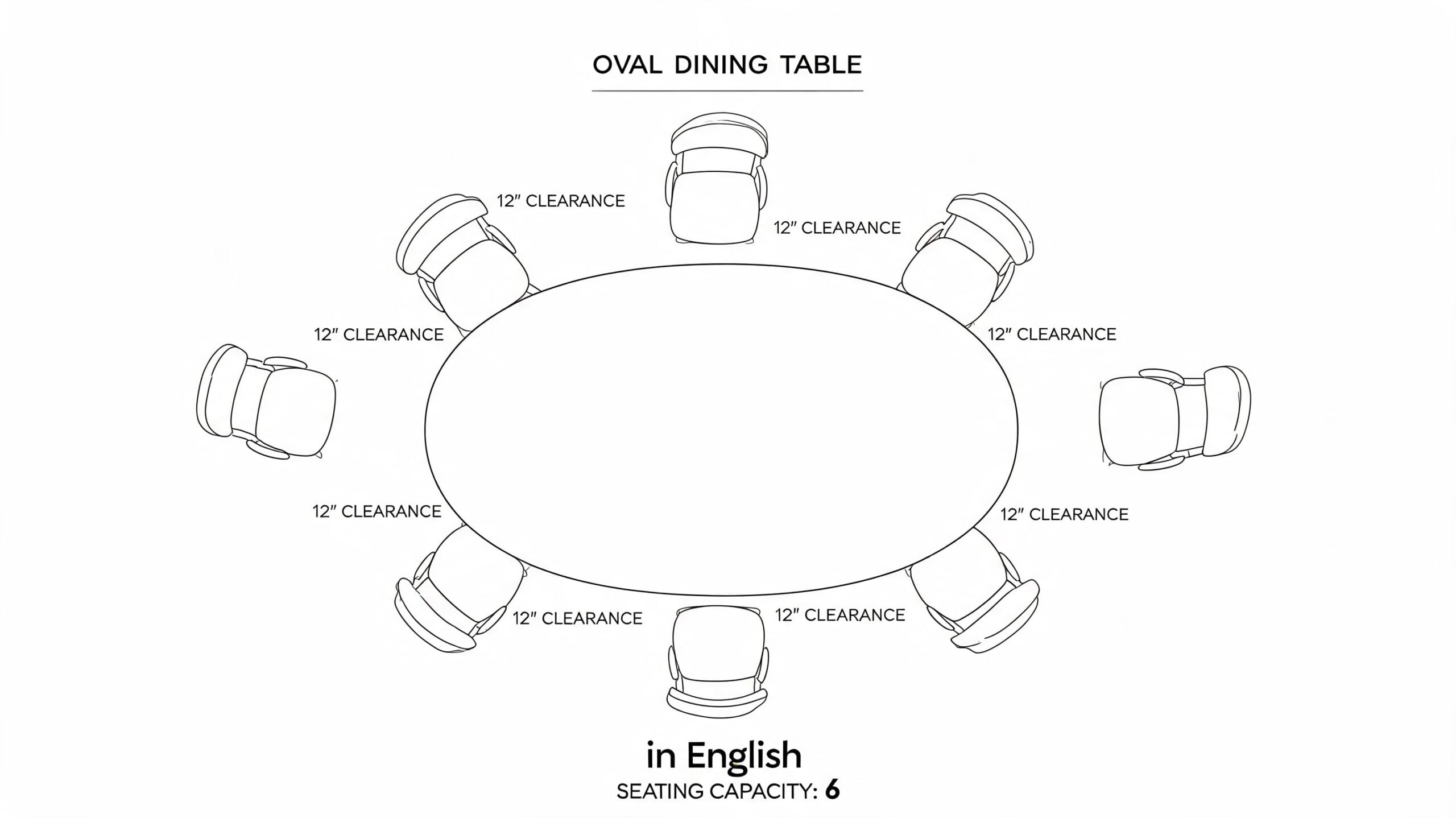
Oval tables follow a different pattern. A 72-inch oval often works well for six, while longer ovals can make room for more guests because they stretch lengthwise without introducing hard corners, as explained in this oval table shape guide.
The base matters as much as the top.
A pedestal base works a bit like clearing the table legs out of the way before dinner starts. It opens up more flexible seating, which can help on round tables and on ovals where someone may need to sit near the end. A four-leg design can still be a strong, beautiful choice, but it asks for more planning because the leg placement can steal a seat that looked available on paper.
The clearance rule that saves people from mistakes
A good seating count can still fail if the room has no space to breathe. In everyday use, most homes need enough open area around the table for chairs to slide back and for people to pass behind someone who is seated. In many Northwest Indiana homes, that matters most near doorways, patio access, and the walkway into the kitchen.
Here is the practical way to measure it:
- Measure the usable room. Include windows, heat vents, hutches, and traffic paths, not just wall-to-wall dimensions.
- Mark off the open space around the table. The room needs space for movement, not just for the tabletop.
- Choose for daily life first. Holiday seating matters, but your everyday fit matters more.
- Check the base and chair placement. Two tables with the same top size can feel very different once chairs are occupied.
If the room is hard to picture, tape the outline on the floor and walk around it with a chair in place. That simple test catches a lot of mistakes before delivery day.
A common sizing mistake
Shoppers in Schererville, St. John, and nearby towns often focus on the posted seat count and stop there. Real comfort comes from the combination of top size, base design, chair width, and room flow.
That is why custom sizing can make so much sense. If a round table keeps walkways open but an oval seats your crowd better, a made-to-order size or base style can split that difference instead of forcing a compromise. If you want help mapping dimensions before you buy, our dining table size guide for room fit, seating, and chair pull-out planning walks through the process in plain language.
Matching the Table to Your Room Shape
A dining table can be beautiful and still wrong for the room. Most shape frustrations come from that mismatch. The room asks one thing, and the table answers another.
Square rooms
Round tables usually make the most sense in square dining rooms. The symmetry feels natural, and the shape keeps the center of the room open and easy to move around.
In homes where the dining room is more compact or nearly square, a round table often feels calmer because it doesn't point strongly in one direction. That balanced look also supports the conversational feel many families want.

Long rectangular rooms
Oval tables tend to fit long rooms better because they use that directional space without adding harsh corners. They borrow some of the seating logic of a rectangle, but they feel softer in motion.
Industry guidance reports that a 72-inch rectangular table can require the full 72-inch length plus chair pull-out space, while a 72-inch oval can reduce the effective footprint by about 6 to 10 inches at the ends because the curved ends pull back from the walls and walkways, making ovals especially useful in longer rooms, as noted in this discussion of oval versus round table footprints.
That doesn't mean every rectangular room needs an oval. It means the oval often handles a narrow dining zone with more grace than a rectangle would.
Open-concept layouts
Open-concept homes across Northwest Indiana create a different challenge. The dining area may not have four walls defining it. Instead, it sits between the kitchen, living room, patio door, or a main walking lane.
In those spaces, use this rule of thumb:
- Round works well when the table sits in a central shared zone and people circulate around multiple sides.
- Oval works well when the dining area runs along a longer visual line and needs more seating without stiff edges.
- Either shape can work if the base and chair placement support easy entry and exit.
The room doesn't care what's trending. It cares whether people can move through it comfortably.
A quick room-match shortcut
If you're trying to decide quickly, ask yourself which sentence sounds more like your home:
- “Our dining area is almost square, and people pass through it all day.” Round is often the cleaner fit.
- “Our room is longer, and we need a shape that stretches without looking hard-edged.” Oval usually makes more sense.
- “We host sometimes, but not every week.” Lean toward flexibility, not maximum size.
That last answer often points people toward custom or extendable options rather than a one-size-fits-all shape.
Beyond Shape Materials Bases and Lasting Quality
Once shape is settled, the construction details decide whether the table feels comfortable for ten years or annoying after ten days. Many people underestimate the importance of the base, the wood, and the way the table is built.
Why the base changes everyday comfort
Most articles frame round and oval dining tables as a style decision. In real homes, the base changes daily life just as much as the top. Retail merchandising repeatedly highlights pedestal bases for round and oval tables because they provide clean lines, extra legroom, and a more open, airy look, a point covered in this overview of pedestal-focused dining table merchandising.
That matters for a few reasons:
- Pedestals help chair spacing. You're not working around corner legs.
- Legroom improves. Knees and chair placement have fewer conflicts.
- The room feels lighter. The center support can make the whole piece seem less bulky.
A four-leg table can still be a smart choice, especially when you like a traditional look or a strong architectural frame. But if your room is tight, or you want flexibility for guests, pedestal support is worth serious consideration.
A table can be the right size on paper and still feel awkward if the base fights every chair.
Material is about more than appearance
The top material changes how a table ages. In a family home, that matters. Solid wood develops character. Veneers and mixed materials can be attractive too, but buyers looking for heirloom potential often keep coming back to solid wood for its repairability, warmth, and staying power.
Our team often sees the difference in how people shop once they touch the materials in person. A solid Amish-made table doesn't only look substantial. It usually feels grounded, dependable, and built with the expectation that it will stay in the family a long time.
If you're interested in the broader logic behind base stability and support, even commercial resources can be helpful. This guide on choosing table bases for restaurants is useful because it shows how much the support structure affects usability, balance, and seating comfort in high-use settings.
Lasting quality is a construction decision
When families want a table they won't replace in a few years, three things usually matter most:
- Joinery and wood quality
- A base that supports the way they sit
- A finish that can handle daily life
That's why “lasting quality” isn't just a phrase. It's a series of construction choices. If you're weighing short-term style against long-term value, our article on how long furniture should last offers a useful framework for thinking beyond the showroom floor.
Custom Furniture Designing Your Perfect Dining Table
You find a table that looks right in the showroom. Then you get it home and the actual questions start. Can two more chairs fit at Thanksgiving? Does the pedestal leave enough knee room, or are guests bumping feet all evening? Does the table still feel comfortable on an ordinary Tuesday when it is only four of you?
Custom furniture helps solve those real-life problems before the order is placed. Instead of picking a shape first and hoping everything else works out, you can build around how your household eats, hosts, and moves through the room.
When custom makes more sense than compromise
Round and oval dining tables often bring people to this point. A round table can feel friendly and easy for daily meals because everyone is within reach and conversation flows naturally. An oval can give you more length for guests while softening the corners that make a rectangular table feel heavier in the room.
The catch is that shape alone does not answer the hardest questions. In many Northwest Indiana homes, the better answer depends on three things working together. How many people you host most often, how traffic moves around the table, and what kind of base supports the top without getting in the way of chairs and legs.
That is why extendable designs matter. A table that stays compact for everyday use and opens for holidays solves a very different problem than a table that looks good in one size. The extension is only part of the story, though. You still need the opened table to seat people comfortably and the base to support that larger top without creating awkward seat positions.
Design it your way
Made-to-order dining is useful because it lets you adjust several decisions at once. Shape is one piece. Size, base style, wood species, finish color, edge profile, and extension format all affect how the table lives in your home.
For example, a family may prefer the softness of a round top but need a pedestal base so chairs can slide around more freely when extra guests come over. Another household may want an oval top because the room is long and narrow, yet still need a base placement that keeps end seats usable. Those are practical fit questions, not decorating details.
Canadel is one custom route many homeowners consider because it offers a wide range of combinations in size, shape, and finish. Amish solid wood furniture is another path, especially for buyers who want durable construction and a table built around long-term daily use. If you are weighing the difference between custom-order and standard furniture, this guide to what bespoke furniture means explains why made-to-order pieces often fit the home more naturally.
One local option worth considering
For Northwest Indiana shoppers comparing custom dining choices, local retailers like Groen's Fine Furniture offer custom-order dining through Canadel and Amish solid wood makers, with options to tailor shape, finish, and construction to the room.
That matters when your best answer is not round or oval. It may be a round table that expands for holidays, or an oval with a base designed to keep every seat comfortable. A good custom process helps you sort that out on paper before you live with it for years.
Making Quality Affordable for Your Family
A dining table is one of those purchases that sits right in the middle of emotion and practicality. You want something beautiful. You also want something that makes sense for your budget.
In our experience, many families in Crown Point, Dyer, and across NWI don't mind investing in quality. What they want is buying power and a clear path to get the right piece without feeling pushed into a rushed decision.
Value means fit, not just price
The least expensive table isn't always the most affordable over time if it needs replacing, never fits the room properly, or frustrates you every holiday. Honest value usually comes from buying the shape, scale, and construction that will keep serving your household well.
That's one reason custom and solid wood options can make sense for many homes. They're often chosen not because they are flashy, but because they solve a problem more accurately. A better fit can be more economical in the long run than buying twice.
Financing can widen your options
Special financing, subject to credit approval, can help families choose the table they want rather than the one that only fits the moment. Used thoughtfully, financing creates room in the budget for better materials, a more suitable size, or a custom solution that matches the home more closely.
If you're reviewing payment options as part of the process, our page on furniture financing options explains how many shoppers use financing to manage a purchase over time while keeping the focus on long-term comfort and value.
The simplest way to choose well
If you're still deciding between round and oval, keep these final takeaways in front of you:
- Choose round when conversation, compact footprint, and smooth circulation matter most.
- Choose oval when you need a softer shape with more hosting range in a longer room.
- Pay attention to the base because legroom and chair placement can change daily comfort.
- Think about normal life first and occasional hosting second.
- Don't settle if a made-to-order table would solve the fit issue properly.
Our family has seen this for decades. The right dining table doesn't just look right on delivery day. It keeps feeling right after the novelty wears off and real life takes over.
Visit Groen's Fine Furniture in Dyer or Crown Point today to explore our custom options and ask about our special financing plans. Let our family help you create a home you love.