Blog
12 Inch Cabinet Guide for NWI Homes

You're standing in the kitchen, tape measure in hand, looking at that awkward gap at the end of a cabinet run. It's too small for a standard cabinet, too visible to ignore, and too valuable to waste. That's the moment a 12 inch cabinet starts sounding less like a minor detail and more like the answer.
Around Northwest Indiana, we see this all the time in older homes with quirky layouts, newer homes where storage somehow still falls short, and remodels where every inch has to earn its keep. A narrow cabinet can solve a real problem, but only if you understand what kind of 12 inch cabinet you're shopping for, what it can realistically hold, and when it's the right call versus a compromise you'll regret.
Your Guide to Small-Space Solutions in Northwest Indiana
For homeowners in Dyer, Crown Point, and across NWI, small-space planning often starts with one frustrating question. What do you do with the leftover space that doesn't fit a standard piece but still affects how the whole room works?
A lot of people assume a 12 inch cabinet is just a filler. Sometimes it is. But often, it's a smart little workhorse that can turn dead space into organized storage for trays, spices, towels, bottles, or cleaning tools.
Why this cabinet gets so much attention
Small cabinets matter because tight spaces magnify every decision. A cabinet that's only a little too deep, a door that swings the wrong way, or a shelf that's technically there but practically useless can make a kitchen feel clumsy every day.
That same thinking applies outside the kitchen, too. If you're also trying to make a compact bath feel more useful, these expert small bathroom decor ideas offer practical inspiration for getting more function from a limited footprint.
For broader room-by-room ideas, our own guide to small space storage furniture solutions is a good companion if you're trying to make several areas of the home work harder.
Practical rule: In a small room, the best storage piece isn't the one with the biggest box. It's the one that fits the space and the way you actually live.
The real opportunity
A 12 inch cabinet shines when the goal is precision. It can finish a run cleanly, create a home for narrow items that usually get stacked awkwardly, or support a layout that needs breathing room more than bulk storage.
That's why this topic confuses so many homeowners. The phrase sounds simple, but it covers several very different cabinet types. Once that clicks, the buying decision gets much easier.
Decoding the 12 Inch Cabinet
The first surprise is that 12 inch cabinet doesn't always mean the same thing. In one conversation it may refer to width. In another, it may refer to depth. If you don't sort that out first, it's easy to order the wrong piece.
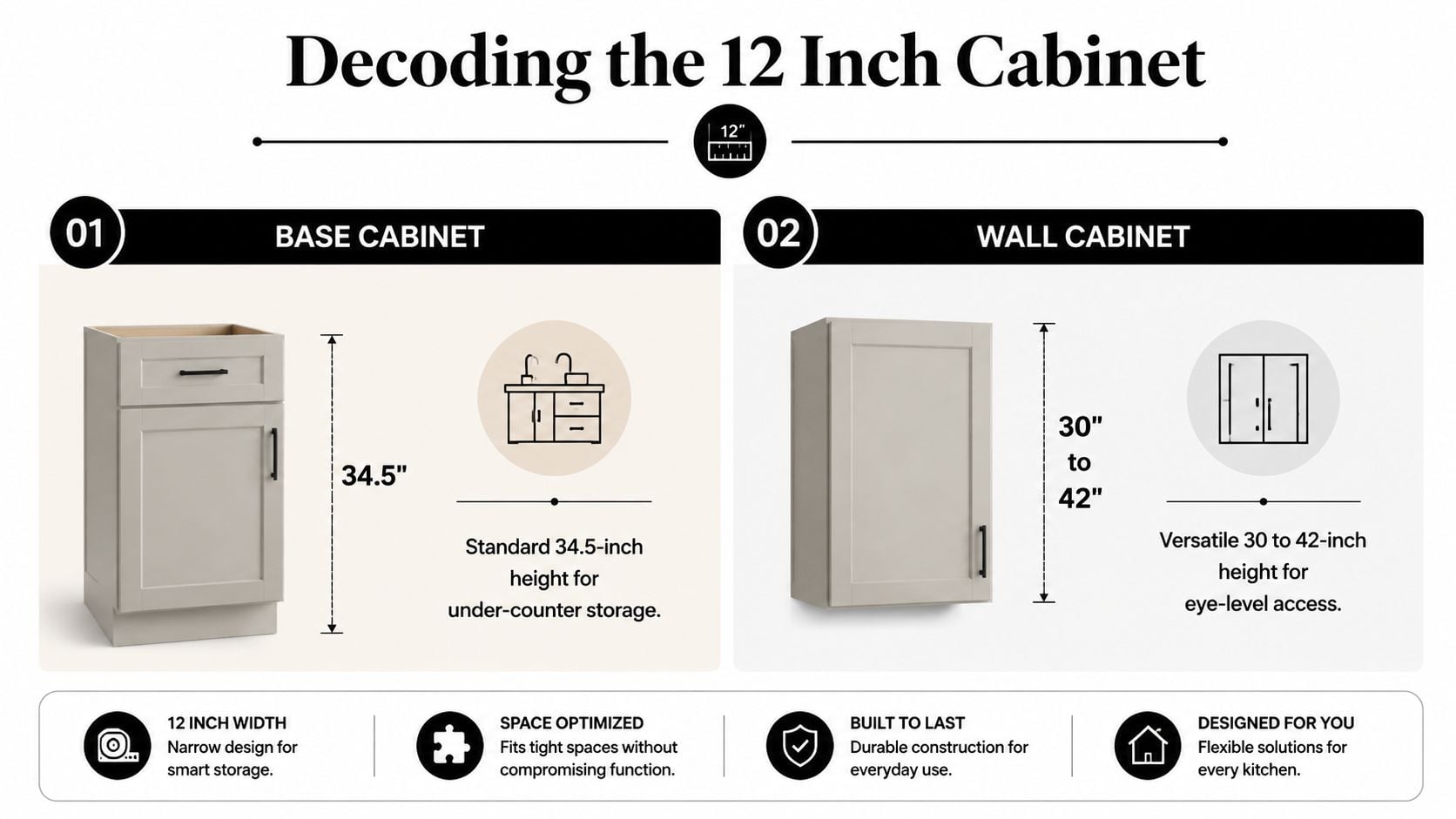
A good way to think about it is this. Base cabinets sit on the floor and support the countertop. Wall cabinets hang above the counter. The term “12 inch” points to different dimensions depending on which one you mean.
Base cabinet versus wall cabinet
According to this standard cabinet measurement guide, a 12-inch cabinet is a standard modular size, but its meaning changes by type. Wall cabinets are commonly 12 inches deep, while 12-inch base cabinets are usually measured by their narrow width. The same guide notes that standard base cabinets are about 24 inches deep and 34.5 inches high, which supports the long-standing 36-inch finished countertop height when countertop material is added.
That's the core distinction.
If someone says, “I need a 12 inch cabinet over the coffee station,” they may mean a wall cabinet with standard depth. If they say, “I've got a 12 inch opening next to the range,” they usually mean a narrow base cabinet.
A simple comparison
| Cabinet type | What “12 inch” usually means | Typical role |
|---|---|---|
| Base cabinet | Width | Narrow storage in a tight floor run |
| Wall cabinet | Depth | Everyday upper storage that doesn't crowd the counter |
This is one reason homeowners get tripped up when browsing online listings. The label sounds consistent, but the use case isn't.
Why these standards exist
Cabinet sizing wasn't chosen at random. Standard dimensions let designers, builders, and installers plan kitchens in predictable modules. That modular thinking is what makes it possible to combine appliance openings, drawers, doors, and corner units without every project becoming a one-off puzzle.
If you're trying to make a compact room feel less cramped overall, this guide on making a small room feel bigger pairs well with cabinet planning because proportion matters as much as storage.
A 12 inch cabinet sounds small. In the wrong spot, it feels cramped. In the right spot, it solves a layout problem that larger cabinets can't.
The important takeaway is straightforward. A 12 inch wall cabinet is usually normal. A 12 inch base cabinet is usually specialized.
Smart Storage Solutions for Narrow Cabinets
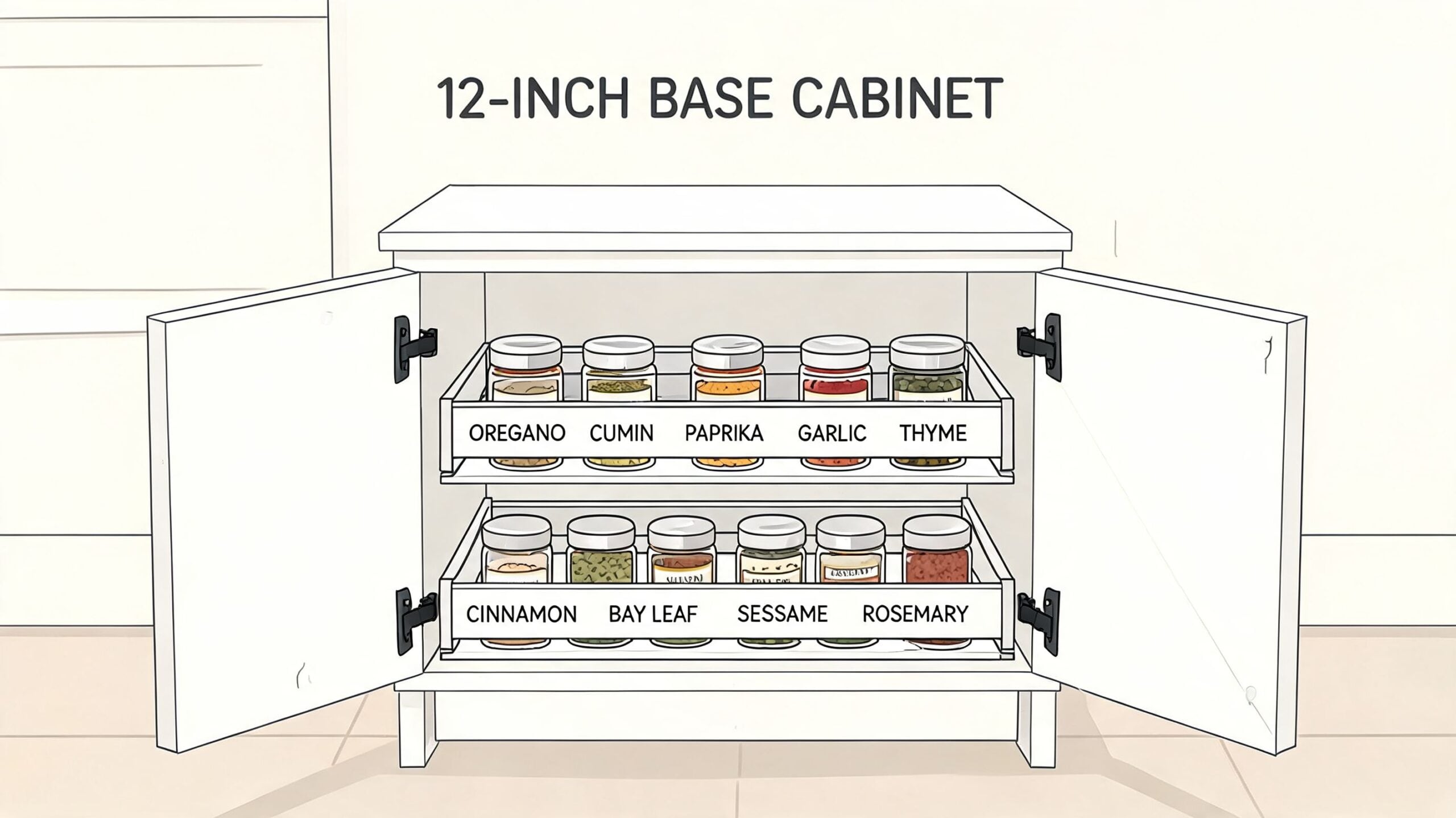
Once you stop treating a narrow cabinet like a miniature version of a regular one, its purpose becomes much clearer. A 12 inch base cabinet works best when you give it a focused job.
A broad, catch-all approach usually disappoints. A specialized setup often feels brilliant.
What narrow cabinets do well
This cabinet sizing guide makes the practical point clearly. The effect of a 12-inch width is a sharp reduction in usable volume, so these cabinets are best for vertical storage, pull-outs, or accessories rather than bulk items. It also notes that they still need to follow standard alignment rules so they fit properly with neighboring cabinets and appliances.
That's exactly how we advise people to think about them. Don't ask, “How much can I cram in here?” Ask, “What narrow category of item needs a proper home?”
Strong uses for a 12 inch cabinet
- Spice pull-out storage works beautifully because jars are small, numerous, and hard to organize in deep cabinets.
- Tray and cutting board storage makes sense because these items are flat and stand upright well.
- Bottle storage can work in a bar area or beverage station where vertical clearance matters more than width.
- Cleaning supply storage fits nicely near a sink or utility area if the products are tall and narrow.
- Accessory storage is often the sleeper success. Foil, wraps, rolling pins, reusable bags, and hand towels finally stop drifting around the kitchen.
For readers thinking about hardware details inside these slim units, this overview of 10 inch drawer slides can help you understand why the right glide and pull-out setup matters in a narrow cabinet.
Where people make the wrong call
A 12 inch cabinet usually disappoints when you expect it to store broad, bulky items. Large mixing bowls, stock pots, oversized appliances, and giant pantry packages don't use that footprint well.
Here's a quick decision guide:
| If you want to store | 12 inch cabinet fit |
|---|---|
| Spices and oils | Excellent |
| Baking sheets and boards | Excellent |
| Cleaning bottles | Good |
| Pantry overflow in slim containers | Good |
| Pots and pans | Poor |
| Bulk groceries | Poor |
Narrow cabinets reward organization. They punish random stacking.
That's why inserts matter so much. Vertical dividers, pull-out shelves, and internal racks turn a skinny box into useful storage. Without them, a 12 inch base cabinet can become the place where things disappear and rattle around.
If clutter is the bigger issue in your home, not just one cabinet opening, our guide on how to solve clutter issues once and for all can help you think beyond the kitchen and create storage systems that stay manageable.
The hidden advantage
A narrow cabinet can also improve flow. In a galley kitchen or a squeezed end run, preserving walking space is sometimes more valuable than adding another wide cabinet. That's the strategic side of this choice. You're not always maximizing raw storage. Sometimes you're improving how the room feels and moves.
Choosing Materials and Finishes That Last
When a cabinet is narrow, the material matters even more. A slim pull-out or frequently used door puts stress on joints, hardware, and fasteners in a concentrated way. If the cabinet box or face materials are weak, that wear shows up faster.
Why fit matters as much as finish
One of the biggest frustrations with stock cabinetry is that the listing title sounds exact while the installed reality isn't. This product-page analysis notes that a “12-inch cabinet” label often doesn't match the exact installed footprint, and that nominal sizes can differ from actual dimensions. It also points out that door swing and clearance details are often overlooked, which creates trouble in tight layouts. That's why a custom-fit approach can solve problems that mass-market listings leave vague, as discussed in this example of nominal versus actual cabinet dimensions.
That issue shows up constantly in corners, end runs, and near appliances. A cabinet may technically fit the width on paper but still fail once the door opens or the hinge projects into the traffic path.
Material choices that hold up
Solid wood remains a practical choice for cabinets that see regular use because it handles fastening hardware well and can be refinished or touched up over time. For homeowners who want something made to order, Amish-built solid wood pieces are especially appealing because they can be customized for a specific opening and a specific use.
If you're weighing wood species and durability, our guide to choosing the right hardwood for longevity and style gives a clearer picture of how different woods perform in daily life.
A few finish decisions matter more than people expect:
- Door style: A simple profile often blends more easily with existing cabinetry.
- Stain match: Close enough usually isn't close enough in a highly visible kitchen run.
- Hardware selection: Knob and pull placement affect comfort on a narrow door or pull-out.
- Interior finish: Lighter interiors can make small storage areas easier to use.
Planning before you order
These RBA Home Plans kitchen layout tips are helpful if you're still figuring out clearances and cabinet relationships before committing to a size.
The smaller the opening, the less room there is for a sizing mistake.
That's the heart of it. In a large kitchen, a slight mismatch can be hidden. In a 12 inch space, every fraction feels bigger.
Design It Your Way with Groens Custom Solutions
A narrow cabinet often asks a custom question. Is this space better used as a pull-out spice unit, an end cap, a slim pantry section, or a corner connector? The answer depends on what sits beside it, what needs to go inside it, and how often you'll use it.
That's where local guidance helps more than a stack of product pages.
One size label, several real jobs
This product-category discussion points out that modern kitchens and utility rooms use 12-inch cabinets in several roles, including corner connectors, end caps, and narrow pantry storage, but shoppers rarely get clear guidance on which option offers the best trade-off in accessibility and wasted space. That's the gap expert consultation can fill, as noted in this overview of angled and specialty 12-inch cabinet uses.
That distinction matters. A cabinet that works well as an end piece may be a poor corner solution. A narrow pantry idea may look efficient but feel annoying if the items inside are hard to reach.
When custom is the smarter path
Custom work makes sense when any of these apply:
- Your opening is unforgiving and stock sizing leaves visible gaps.
- You need a very specific interior such as tray dividers, pull-outs, or bottle storage.
- You're matching existing cabinetry and don't want the new piece to look added-on.
- A hinge side or door swing matters because traffic flow or nearby trim limits movement.
"Design it your way" is more than just a nice phrase. It is practical. The cabinet can be built for the space you have, not the one a catalog assumes.
A local option for NWI homeowners
For Northwest Indiana homeowners who want made-to-order solutions, Groen's Fine Furniture offers custom furniture options, including Amish solid wood pieces and custom-order programs, with showrooms in Dyer and Crown Point. That kind of bespoke approach can be useful when a 12 inch cabinet needs to match existing materials and solve a very specific storage problem.
Multigenerational ownership also matters here. Families in St. John, Schererville, Munster, and nearby communities often aren't looking for a generic cabinet. They want a piece that fits the room, suits the home, and lasts.
A few practical advantages of going custom:
| Need | Why custom helps |
|---|---|
| Tight opening | Built to the actual space |
| Odd layout | Better door and clearance planning |
| Existing cabinet match | More control over wood, stain, and style |
| Specialized storage | Interior setup can match the items you own |
Special financing, subject to credit approval, can also make a custom project easier to fit into the household budget. That's important because quality materials and a customized fit are long-term decisions, not impulse purchases.
Common Questions from NWI Homeowners
Homeowners in Dyer, Crown Point, and St. John tend to ask very practical questions about a 12 inch cabinet. That's a good sign. These cabinets are useful, but only when expectations match reality.
Can I put a sink in a 12 inch cabinet
In most standard kitchen situations, a 12 inch wide base cabinet is too narrow for a sink basin and the plumbing that goes with it. Narrow base cabinets are generally much better as storage units than as sink bases.
That answer makes more sense once you know cabinetry follows long-established modular rules. The standardization of kitchen cabinetry expanded through the 20th century and cemented common sizes like 12-inch depth for wall units and 24-inch depth for base units, creating a predictable planning system across North America, as explained in this history of standard kitchen cabinet sizes.
Is a 12 inch cabinet good for pots and pans
Usually, no. You might fit a very small piece of cookware, but that's not where this cabinet performs well. It's a better home for tall, narrow, or flat items that don't need broad shelf space.
Can a 12 inch cabinet still be worth it
Absolutely, if it solves the right problem. A narrow pull-out next to a range can be far more useful than a wider cabinet stuffed with mismatched items. In a small kitchen, specialized storage often beats general storage.
If a cabinet has one clear job, it usually gets used well.
Can a new cabinet match what I already have
Yes, but matching takes more than picking a similar stain from a screen. Door profile, wood grain, hardware style, and the way the cabinet fits the opening all affect whether the new piece looks integrated or obvious.
What should I measure before shopping
Bring more than the opening width. You'll want:
- Opening size: Width matters, but so do height and available depth.
- Nearby obstacles: Trim, appliances, outlets, and walls can affect fit.
- Door clearance: Check how far a door or pull-out can travel comfortably.
- Intended contents: What you plan to store should shape the interior design.
A little extra measuring up front saves a lot of frustration later.
Visit Groen's Fine Furniture in Dyer or Crown Point today to explore custom options and ask about special financing plans, subject to credit approval. Our family has served Northwest Indiana since 1983, and we're always glad to help neighbors create a home that fits beautifully and works hard every day.