Blog
Best Sleep Pillows: A Complete Buyer’s Guide


For homeowners in Dyer and Crown Point trying to stop another restless morning before it starts, the pillow aisle can feel like a trap. Too many labels promise comfort, but the question is simpler, which pillow keeps the head, neck, and shoulders in a position the body can live with all night.
That's why the best sleep pillows are not really about fill type alone. They're about fit, support, heat control, and whether the pillow still feels right after the third wake-up of the week, not just the first five minutes in a showroom. Our family has seen enough shoppers in Northwest Indiana to say this plainly, a pillow that looks premium on paper can still be the wrong one for the sleeper using it.
Groen's Fine Furniture has served NWI since 1983, with showrooms in Dyer and Crown Point, and the same honest approach applies here as it does to mattresses and living room furniture. A good pillow purchase starts with a decision framework, not a marketing slogan. For a broader sleep routine, their Helpful Mattress Guide for better sleep habits fits the same practical mindset.
Why Choosing the Best Sleep Pillow Feels Harder Than It Should
The hard part isn't that pillows are complicated, it's that the category is full of half-truths. One shopper wants something plush, another wants a pillow that won't trap heat, and a third wakes up with a stiff neck and needs support more than softness. Those are different problems, so the same pillow can't solve all of them.
A family in Crown Point might come in after trying three “comfortable” pillows at home and still waking up sore. That doesn't mean they failed to choose well, it means they started with the wrong question. The better question is whether the pillow keeps the sleeper's neck neutral, stays comfortable as the night warms up, and still feels supportive when the body shifts.
Practical rule: Start with the body, not the packaging. If the pillow does not match the sleeper's position and pain pattern, the rest doesn't matter much.
That's the lens that makes shopping easier. Fit comes first, then support, then feel, then price. A pillow can be beautifully made and still be wrong if it pushes the head too high, sinks too far, or runs hot through the middle of the night. That is why local shoppers who want a real answer usually do better when they treat pillow buying like a fitting, not a browsing exercise.
The useful part of this guide is the shortlist mindset. Instead of chasing “the one best pillow,” shoppers can narrow the field to the few designs that match their sleep habits. For many Northwest Indiana households, that practical shift turns a frustrating errand into a straightforward choice.
Matching Your Pillow to Your Sleep Position
Sleep position drives pillow choice more than any buzzword does. A pillow is basically a bridge between the head and the mattress, and that bridge has to match the sleeper's geometry. If it's too tall, too flat, or too soft for the way the body lies, the neck pays for it by morning.
Side sleepers need height and steady support
Side sleepers need a pillow tall enough to fill the gap between shoulder and head. If there's a space under the neck, the head drops and the spine twists. If the pillow is too high, the head tilts up and the neck tightens instead.
That's why side sleepers usually do better with more loft and firmer support than stomach sleepers do. They need a pillow that holds shape under the weight of the head without collapsing before the alarm goes off. A room in Munster or Schererville doesn't change the rule, the body still needs that shoulder-to-head bridge.
Back sleepers need a gentler curve
Back sleepers need a pillow that supports the natural curve of the neck without pushing the chin toward the chest. A pillow that is too lofty can make the face angle forward, while one that's too flat leaves the neck hanging unsupported. The sweet spot is controlled support that lets the head rest back comfortably.
A good back-sleeper pillow should feel stable, not puffy. It needs enough structure to hold the neck in place, but not so much fill that it turns the upper spine into a kinked line.
Stomach sleepers need the lowest profile
Stomach sleepers are the hardest group to fit because the neck twists more easily in that position. They usually need a low, soft pillow, or sometimes barely any pillow at all, to reduce cervical strain. The goal is to keep the face and neck from being forced upward.
A pillow that feels “supportive” to a stomach sleeper can still be wrong if it pushes the head too high.
For a quick showroom decision rule, keep it simple. Side sleepers lean higher, back sleepers stay medium, stomach sleepers go low. That one rule filters out most mismatches before they ever reach the bed.
If the sleeper changes positions during the night, the target gets a little trickier. In that case, a design that holds shape but still lets the head settle in naturally is usually the safer direction. Groen's side sleeper mattress guidance pairs well with that logic because the pillow and mattress have to work together, not fight each other.
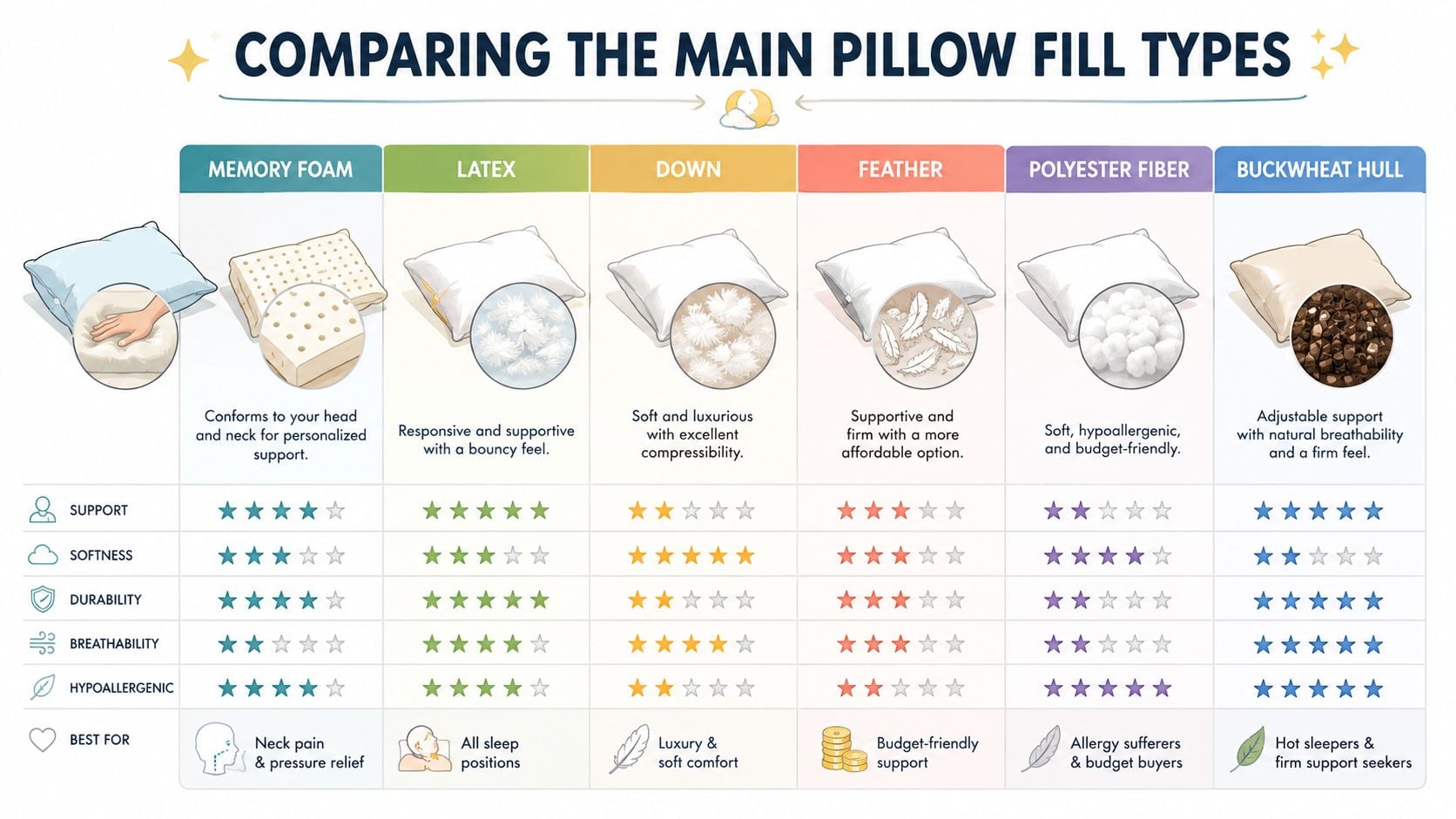
Comparing the Main Pillow Fill Types
Fill type matters because it controls how the pillow feels under pressure, how it recovers, and how long it stays useful. But fill is a tool, not a trophy. The right one depends on what the sleeper wants the pillow to do every single night.
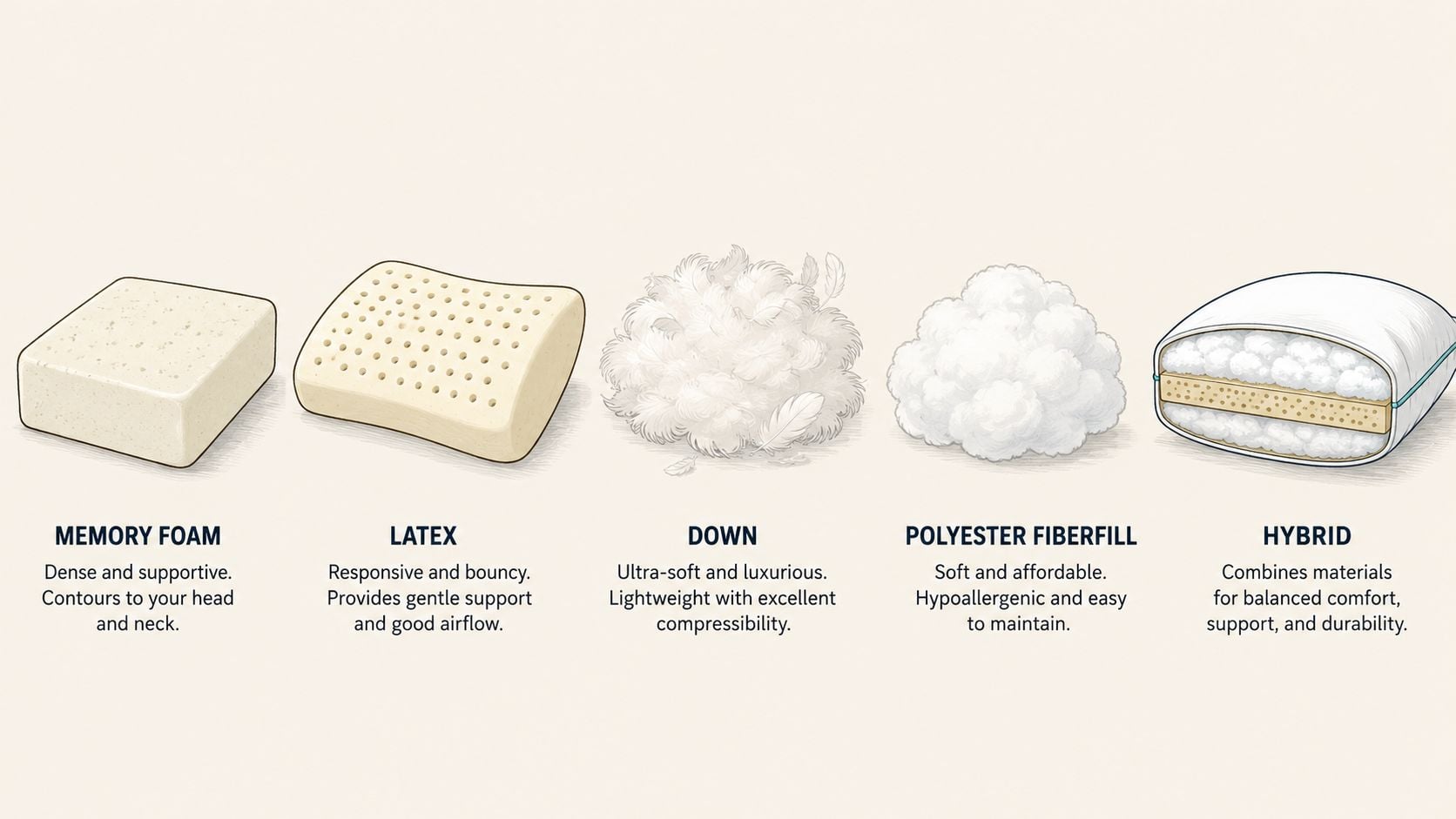
Memory foam
Memory-foam pillows are built to conform under heat and pressure, then return to shape slowly. Technical data describes rebound times of about 5 to 10 seconds and density ranges around 40 to 80 kg/m³, which helps explain why they feel stable rather than bouncy (memory foam technical overview). That slower recovery can help reduce peak pressure at the head and neck.
The downside is simple, they can feel warmer and less lively than other fills. Memory foam suits sleepers who want a stable cervical position and don't mind a more molded feel. For shoppers who want to understand how that material behaves in a sleep setting, Groen's memory foam mattress guide gives useful context for the material's basic character.
Latex
Latex tends to feel springier and less body-hugging than memory foam. It's often a smart pick for sleepers who want support without that slow, sinking feel. Because latex can feel more responsive, it usually works well for people who shift during the night.
Down and down alternatives
Down and down alternatives feel softer and easier to compress. They're good for sleepers who want a plush surface and frequent pillow reshaping. The tradeoff is support consistency, since a soft fill can move around more than a structured foam core.
Polyester fill
Polyester pillows are usually the budget-friendly, lighter-feeling option in the mix. They can work for people who want a simple, familiar pillow, but they often lose shape faster than denser constructions. That makes them a better short-term comfort choice than a long-term support choice.
Hybrid constructions
Hybrids combine more than one material to balance contouring and resilience. That can be a good answer for sleepers who want some plushness without giving up structure. In a showroom, hybrids are often the category that feels closest to a compromise, but a good one, not a bland one.
Bottom line: Treat fills like tools. Memory foam leans supportive, latex leans responsive, down leans soft, polyester leans simple, and hybrid designs try to blend those traits.
That's also where custom order thinking matters. A shopper who wants a made-to-order feel should ask for a setup that balances loft, support, and temperature behavior instead of settling for a one-note pillow. A design-it-your-way approach makes more sense here than pretending one construction solves every sleeper's problem.
Loft, Firmness, and Density Explained
These three words get tossed around like they mean the same thing. They don't. Loft is pillow height, firmness is how much the pillow resists compression, and density is mostly a memory-foam quality marker tied to how much material is packed into the pillow and how well it holds support over time.
Loft
Loft matters because it determines whether the pillow fills the space between the mattress and the neck. A pillow can be soft and still too tall, or firm and still too short. For many side and back sleepers, a medium-high loft of at least 12 cm is a useful shopping benchmark, especially when the mattress is deep or the sleeper has broader shoulders.
Firmness
Firmness controls how the pillow holds the neck. Very soft pillows let the head sink quickly, which can feel cozy but unstable. Medium-firm pillows often give enough support for back sleepers, while firmer designs are usually better for sleepers who need the neck held in a fixed, neutral line.
Density
Density matters most with foam because it affects support stability and rebound. Higher-density foams generally provide more durable support, while lower-density options feel lighter and recover faster. That tradeoff is useful, not confusing, once the buyer knows the goal, softer feel versus steadier hold.
| Sleep Position | Recommended Loft | Recommended Firmness | Why It Works |
|---|---|---|---|
| Side Sleeper | Medium-high, often at least 12 cm | Medium-firm to firm | Fills the shoulder gap and keeps the neck level |
| Back Sleeper | Medium | Medium | Supports the neck curve without pushing the chin forward |
| Stomach Sleeper | Low | Soft | Reduces twisting and cervical strain |
A good showroom test is to lie down and check whether the ear, shoulder, and spine line up naturally. If the neck feels pushed or dropped, the pillow is wrong, even if it feels luxurious for a minute.
Allergies, Temperature, and Neck Pain Considerations
Some pillow roundups treat allergies, heat, and pain like side notes. They are not side notes. They are usually the reason a shopper replaces a pillow in the first place.
Allergies and materials
Allergy-prone sleepers should pay attention to the fill, not just the cover. Natural latex is often a strong choice because it is dense and less inviting to dust mites than loose, fluffy fills. Memory foam can also help here because it does not have the same open, particulate structure that softer fiber fills can.
Down and polyester often need more help from protective covers if allergies matter. That does not make them bad materials. It means the sleeper should be honest about upkeep and cleaning habits before bringing one home.
Temperature and heat retention
Heat is where memory foam can lose people. Foam softens as temperature rises, so a pillow can feel firmer in a cool room and softer in a warm one, and that changes the feel across the night. That is not always a defect, but it is a real buying factor for hot sleepers.
Latex, ventilated foams, and cooling covers can help reduce that issue. The right choice depends on whether the sleeper needs enough contouring to tolerate some warmth, or whether staying cool matters more than a deep cradle.
Neck pain and when adjustable or orthopedic makes more sense
A lot of shoppers overthink the pillow type and underthink the problem. If the main complaint is waking neck stiffness, a pillow that can be adjusted or contoured to hold a stable cervical position may outperform a standard position-specific pillow. That is especially true when the sleeper needs support more than softness.
The clinical brief backs up that pain link. In one study, 42.5% of participants reported no waking symptoms on their own pillow, while poor sleep quality was strongly associated with waking cervical stiffness and scapula pain (clinical pillow research). That does not tell shoppers exactly what to buy, but it does show why pain-aware fitting matters.
If pain and airway issues are part of the sleep picture, it can also help to review an adult tongue tie surgery guide from Pain and Sleep Therapy Center, since sleep discomfort is sometimes tied to broader oral and airway concerns.
Practical shortlist:
Hot sleeper with neck pain, look at latex or a ventilated support pillow.
Side sleeper with stiffness, look at a firmer, contouring design.
Allergy-prone sleeper, choose denser materials and a protective cover.
The result is a cleaner decision tree. Temperature, allergies, and neck pain narrow the field fast, and they usually point to only a couple of serious options.
Sizing, In-Store Testing, and Custom Options
A pillow is one of the few sleep products that should be tested like shoes. It has to fit the body, the mattress, and the way the sleeper turns during the night. That's why the showroom matters more than people think.
Size isn't just a décor choice
Standard, queen, and king pillows each cover different amounts of bed space, but the main issue is shoulder width and sleep style. A larger sleeper or a couple sharing reading pillows may prefer more surface area, while a combination sleeper may need a pillow that stays centered and doesn't drift off the edge of the mattress. The wrong size can make a good fill feel awkward.
A better in-store test is simple. Lie on the pillow in the position used at home, then check whether the head feels centered and the neck feels neutral. Five minutes tells more truth than a full minute of packaging copy.
Groen's custom pillow and blanket sets resource is a useful reminder that sleep comfort often works best as a pairing, not a single purchase. A pillow that matches the bedding setup and sleep position can feel dramatically more settled than one bought in isolation.
What to test in Dyer or Crown Point
The most useful showroom checks are practical, not fancy.
- Lie in the position: Side, back, or stomach, not some idealized version of it.
- Check the line of the body: Ear, shoulder, and spine should sit naturally.
- Move once or twice: Combination sleepers need to know if the pillow stays useful after a shift.
- Feel the heat after a few minutes: Some pillows start fine and then warm up too much.
- Ask how the pillow is built: Adjustable and orthopedic designs deserve a real conversation.
The broader purchase can also be built around special financing available subject to credit approval, white-glove delivery, and custom order options when the sleeper needs a more specific fit. For shoppers who want a clear local starting point, Groen's locations page makes the Dyer and Crown Point visit easy to plan.
Care, Maintenance, and Knowing When to Replace
A pillow does not stay supportive forever. It gets compressed, holds heat, absorbs moisture, and slowly loses the structure that kept your head and neck in line. Good care buys time, but it does not bring a tired pillow back to life.
Use a protector and a washable case to slow down sweat, skin oils, and dust buildup. Down fills usually need gentler cleaning than foam, while foam and latex often do better with spot cleaning and careful drying. Polyester fills benefit from regular fluffing so they do not settle into one flat spot.
The replacement test is how it feels in bed. If the pillow no longer holds your neck up, feels lumpy, or needs constant rearranging, it is finished. For a practical rule of thumb on timing, see our how often to replace your mattress guide, because the same idea applies here, comfort gear wears down and support has a limit.
Replace the pillow when sleep quality drops, not after the pillow becomes visibly ruined.
That approach fits the way Groen's talks about sleep gear. A pillow is part of a wellness setup, and a worn pillow can work against the rest of it. Keep it clean, watch for loss of support, and replace it when your body starts telling you the truth.
Visit Groen and Find Your Best Sleep Pillow
The simplest buying rule is still the right one, match loft to position, firmness to body and pain profile, and fill to temperature, allergies, and longevity. That one framework cuts through most of the noise fast.
For homeowners in Dyer, Crown Point, St. John, Schererville, and Munster, a showroom visit makes the decision much easier. Our family's team can help narrow a shortlist, talk through custom orders and special financing available subject to credit approval, and let each sleeper test a pillow the same way it'll be used at home.
Visit our locations page and bring the questions that matter. Groen's Fine Furniture gives Northwest Indiana shoppers a place to test drive comfort, compare support, and design a sleep setup their way with honest guidance from a multigenerational local team.
Visit Groen's Fine Furniture in Dyer or Crown Point to test the pillows that fit your sleep position, support needs, and comfort goals. Our family can help you compare options, ask about custom orders, and explore special financing plans so you can bring home a pillow that earns its place on the bed.