Blog
Latex Mattress vs Memory Foam: Which Is Right for You

For homeowners in Dyer, Crown Point, and nearby Northwest Indiana communities like St. John, Schererville, and Munster, choosing between a latex mattress vs memory foam usually comes down to one question: what does the household need at night? Some couples want deeper pressure relief. Others want less partner disturbance, a cooler bed, or a mattress that stays supportive for years. Our family has helped NWI shoppers sort through those tradeoffs since 1983, and the right answer is usually less about hype and more about how a bed feels after real use.
| Comparison point | Latex mattress | Memory foam |
|---|---|---|
| Feel | Bouncy, lifted, responsive | Softer, slower, more contouring |
| Motion control | Good | Stronger |
| Cooling | Typically better | Can sleep warmer |
| Pressure relief | Strong | Deep, close-conforming |
| Longevity | Usually longer | Usually shorter |
| Upfront cost | Typically higher | Usually lower |
At Groen's Fine Furniture, our Helpful Mattress Guide keeps the conversation practical. We talk through sleep wellness, honest pricing, white-glove delivery, and the kind of custom-minded service a big-box floor can't match. If a mattress needs to support a family, a couple, or a busy household for years, the decision deserves more than a quick showroom sit.
Mattress Shopping in Northwest Indiana
A lot of local shoppers walk into a showroom thinking they need a simple answer, then realize the question is how the bed fits daily life. A couple from Dyer may be replacing a mattress that sags too soon. A Crown Point family may be dealing with hot sleeping, light sleeping, or both in the same room. A Helpful Mattress Guide keeps the conversation grounded, because sleep affects health as much as any other part of the home.
Our family business has always treated mattress shopping as personal. The right fit for one household in Northwest Indiana will not be the right fit for the next, especially when sleep habits, body types, and bedroom temperatures differ. That is why we tell shoppers to test comfort in person and ask direct questions instead of settling for a one-size-fits-all pitch.
Practical rule: If a mattress leaves one partner tired and the other annoyed, it is the wrong bed, no matter how good the sales tag looks.
That local, hands-on approach is part of the Groen's difference. We serve Dyer, Crown Point, and surrounding areas with a neighborly process built on multigenerational ownership and 5-star service. We also help families think beyond the mattress itself, because a bedroom works better when the whole space supports rest. For shoppers comparing stores, our local mattress guide at top-rated mattress stores near me gives a practical starting point.
The biggest advantage of shopping locally is honesty. You get plain guidance, not pressure. You also get honest pricing, delivery help, and a team that understands families who want comfort that lasts. That matters more than a flashy claim, because a mattress is one of the few purchases you live with every night.
Latex and Memory Foam Material Basics
Latex and memory foam can feel similar during a quick showroom test, but they are built for different sleep needs. Latex comes from rubber tree sap or synthetic materials, while memory foam uses polyurethane foam and other chemicals to create a viscoelastic feel. That material difference shapes how each mattress responds once someone lies down, and it is the reason a bed can feel lively to one sleeper and contouring to another.
What the feel tells you
Latex responds quickly. It feels more lifted, so turning over or changing positions takes less effort. Memory foam reacts more slowly, which creates the familiar sinking sensation many side sleepers like because it hugs pressure points and softens the feel around the body.
That difference is about more than comfort style. It changes how the mattress supports sleep through the night. A quicker surface feels easier to move on, while a slower surface feels more enveloping. Those two sensations lead to very different sleep experiences, even when the mattresses look alike on a floor model.
For shoppers narrowing down options, the material matters before the brand story does. A latex build and a memory foam build can both be good products, but they solve different problems. In our showrooms, that is why the conversation often starts with how the bed feels in real use, then moves to finish, support, and fit for the room. If a household wants more background on one side of that choice, our latex mattress benefits guide gives a clear starting point.
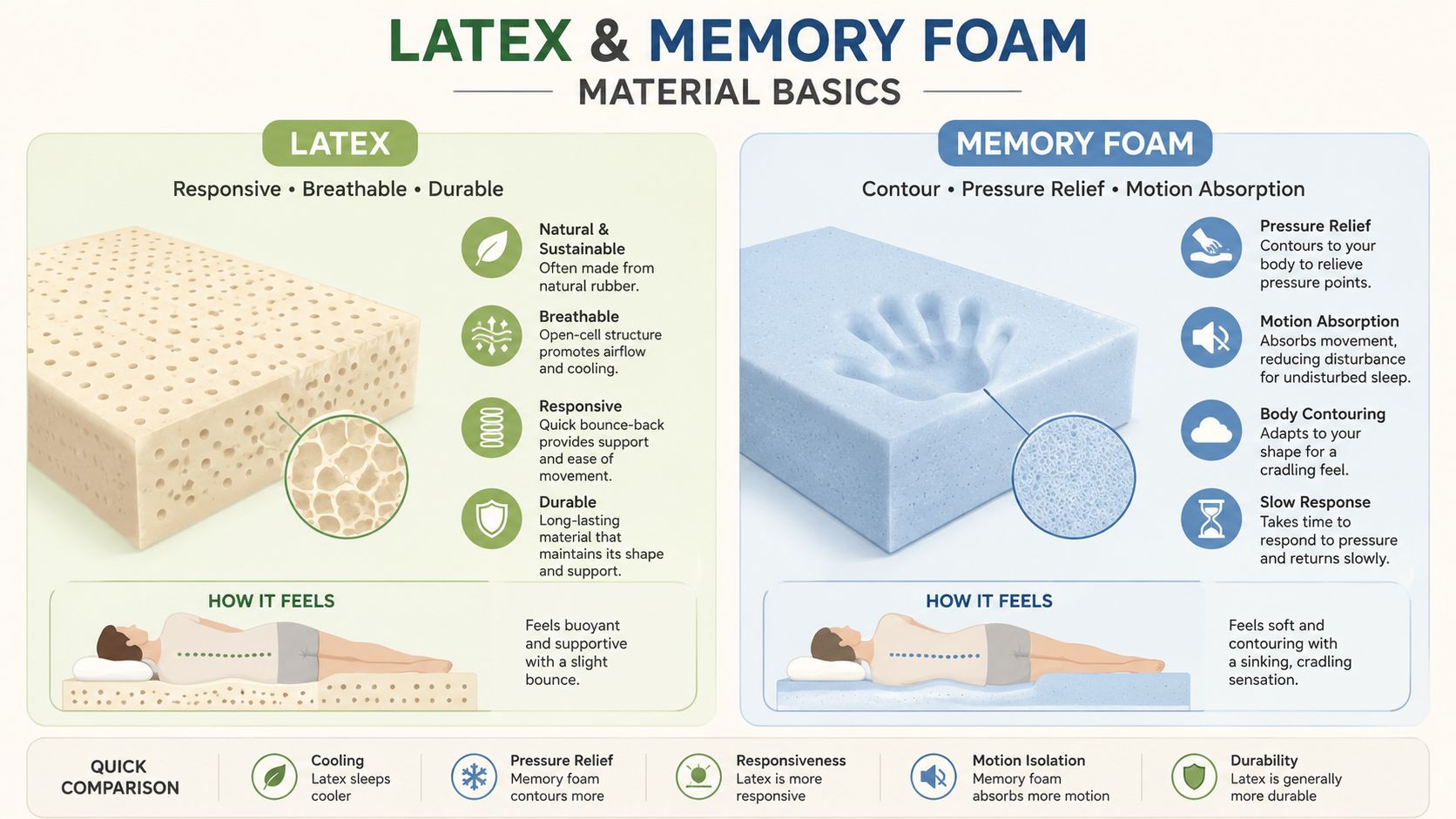
Bottom line: If a shopper wants a mattress that reacts quickly and feels buoyant, latex is usually the better starting point. If the goal is a slower, more conforming cradle, memory foam deserves a closer look.
A good mattress search starts with that material split. Once a household understands how each one behaves, the rest of the decision gets easier, especially for couples who need the same bed to satisfy different sleep preferences. That is where local, in-person guidance matters. It also helps to think about ownership over time, including the right support from a store that can talk through custom ordering and financing options, plus practical upkeep choices like checking SleepHabits bed change frequency so the bed stays a good fit for the home.
Comparing Comfort Temperature and Motion
The cleanest way to compare a latex mattress vs memory foam is to look at how each one performs in real nightly use. NapLab scores latex higher for response, cooling, and pressure relief, while memory foam scores higher for motion transfer. That pattern matches what most couples feel in a bedroom, not just what they read on a spec sheet. NapLab's latex versus memory foam comparison lays out those differences clearly.
| Latex vs Memory Foam Performance Scores | Latex Score | Memory Foam Score |
|---|---|---|
| Response | 10.0 | 8.1 |
| Motion transfer | 7.5 | 9.2 |
| Cooling | 9.2 | 8.2 |
| Pressure relief | 9.4 | 8.4 |
Latex comes through as the more buoyant, cooler option. Memory foam wins where stillness matters most. That's why couples who are easily disturbed by movement often lean toward memory foam, while sleepers who hate a stuck-in-the-bed feeling usually prefer latex.
How those scores feel in a bedroom
The numbers translate to real-world behavior. A latex mattress lets a sleeper turn over without much effort, which helps combination sleepers and anyone who changes positions often. Memory foam absorbs motion better, so a partner's movement is less likely to travel across the bed.
Practical insight: A couple should decide whether they care more about feeling isolated from motion or feeling easy movement across the bed. Those are different goals, and they point to different materials.
Temperature is the other major split. Sleep Foundation notes that memory foam tends to absorb and trap body heat, while latex stays closer to a neutral temperature. For hot sleepers, that alone can be the deciding factor. For mixed households, it can also be the point that changes the whole recommendation. Our hot-sleeper mattress guide is useful for shoppers who already know warmth is a nightly issue.
NapLab also gives latex a stronger score for pressure relief, which is helpful for people who still want contouring without the deep sink of memory foam. The result is simple. Memory foam is the quieter, more cradling choice. Latex is the cooler, springier, more responsive choice.
Durability and Longevity of Each Type
A mattress is a long-term purchase, so durability shouldn't be treated like a side note. Sleep Advisor says latex mattresses can last up to 20 years with proper care, while memory foam can last up to 10 years. Saatva also places average lifespan at 15 years for latex and 10 years for memory foam. Those figures line up with the same overall conclusion, latex lasts longer. Sleep Advisor's latex versus memory foam guidance is one of the clearest sources on that point.
That longevity matters for families who want a bed to hold its support year after year. A mattress that keeps its structure usually keeps its comfort longer, too. For heavier sleepers, or for couples who use the bed every night, the durability gap can become the value difference.
What replacement timing changes
The question is not only how a mattress feels on day one. It's how long it keeps feeling right. A shorter replacement cycle means more frequent shopping, more disruption, and more money spent over time. A longer-lasting mattress can make the original higher price easier to justify because the purchase stretches further.
For shoppers who want another reference point on replacement habits, SleepHabits' guidance on how often to change a bed is a useful reminder that mattresses do have a service life, not just a showroom life.
Useful rule: If a mattress is going to be used every night by two adults, durability should weigh as heavily as softness.
That's why latex usually gets framed as the resilience-first option. It's the material households turn to when they care about support that holds up and a feel that doesn't flatten out too quickly. Memory foam can still be a smart buy, especially for sleepers who prioritize contouring, but it usually won't be the longest-lasting path.
For NWI families, a mattress starts to look less like a short-term comfort purchase and more like a health investment. Strong support, steady comfort, and fewer replacement headaches are worth paying attention to.
Price Ranges and Total Ownership Cost
Price is where memory foam usually feels easier to buy. Sleep Foundation says latex is roughly twice the price of memory foam at purchase, even though latex is also the longer-lasting option. Sleep Foundation also gives average useful lifespan at about 7.5 to 8.5 years for latex and 6 to 7 years for memory foam, while noting that latex remains the more durable material overall. Sleep Foundation's comparison of latex and memory foam is helpful because it connects upfront price to long-term value.
That difference creates a simple ownership tradeoff. Memory foam lowers the entry barrier. Latex lowers the replacement frequency. Families who want the most comfortable purchase today may lean toward memory foam, while families who prefer fewer mattress swaps over time usually see latex as the smarter long-game choice.
Value is not the sticker price alone
A mattress that costs less up front can still cost more if it needs replacing sooner. A mattress that costs more up front can still be the better value if it stays supportive longer. That's the part many shoppers miss when they compare only the showroom tag.
Value check: Ask what the mattress will feel like after years of use, not just what it costs on the first day.
That approach also fits a household budget better when financing is part of the plan. Groen's offers special financing, subject to credit approval, which can make either material easier to fit into a practical buying plan. Our mattress financing options page is a good place to review how that support works before visiting the showroom.
The right takeaway is not that one material is always cheaper. It's that each one spends money differently. Memory foam asks less at checkout. Latex asks for more at the start, then usually gives back more years of use. For families trying to balance sleep quality with buying power, that distinction matters.
Best Sleeper Types and Shared Beds
The hardest mattress decision usually happens in a shared bedroom. One partner sleeps hot, the other wants deeper pressure relief. One wakes up with every movement, the other flips positions all night. That's where the latex mattress vs memory foam debate stops being theoretical and becomes a household planning problem. Sleep Doctor's foam versus latex review is useful here because it highlights the exact tension couples run into, motion control on one side, breathability and easy movement on the other.
Match the mattress to the household, not just the person
Memory foam usually makes more sense for couples who prioritize motion isolation and close contouring. Latex usually makes more sense for sleepers who want a cooler feel, easier repositioning, and a more buoyant surface. Neither choice solves every problem for every pair, which is why mixed-need households often need a smarter setup than a basic all-one-style bed.
That smarter setup can mean a hybrid, a split firmness, or a zoned design. Those formats let one side of the mattress or one comfort layer serve one sleeper better without forcing the other person into a poor compromise. The right answer is often custom enough that the bed should be chosen the way the room is chosen, around real life.
Shared-bed rule: When one person wants stillness and the other wants easier movement, the mattress should be judged by which problem is harder to live with.
This is also where sleep wellness intersects with daily stress. People dealing with jaw clenching, poor sleep, or restless nights often care less about brand language and more about getting a bed that doesn't fight them. For that reason, many families pair mattress shopping with broader rest planning and practical health support, including resources like stress and bruxism treatment options.
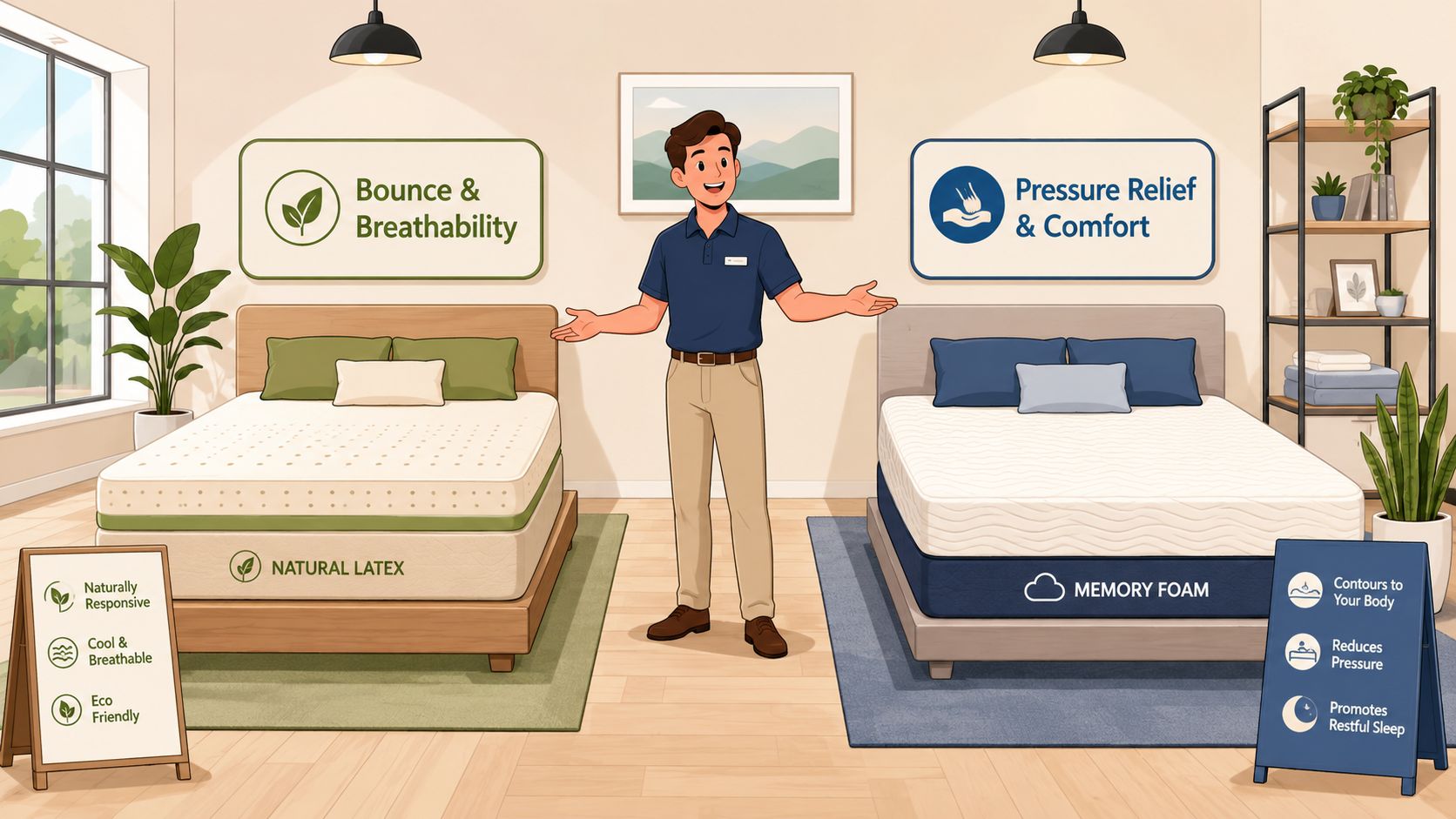
For local shoppers who want that kind of personalized guidance, our couples' mattress guidance speaks directly to shared-bed tradeoffs. The right recommendation is rarely just “buy latex” or “buy memory foam.” It's usually “choose the construction that solves the two biggest sleep problems in the room.”
Groen's Showroom and Buying Recommendations
For NWI families, the best way to settle a latex mattress vs memory foam decision is to test both in person. A showroom visit lets a couple compare pressure relief, bounce, warmth, and movement instead of arguing from internet specs. That matters in Dyer and Crown Point, where many shoppers want a bed that fits the whole household, not just one sleeper's preference.
At Groen's Fine Furniture, our family helps customers sort through comfort choices with a practical, no-pressure approach. We carry sleep options from trusted mattress brands, and we talk through how each one fits the way a real household sleeps. We also help shoppers pair mattress decisions with bedroom plans that make sense long term, including solid wood, American-made, and Amish Furniture pieces for families who want heirloom quality around the bed.
Good reasons to visit the showroom:
- Custom Furniture: Design it your way with made-to-order options that fit the room instead of forcing the room to fit the furniture.
- Special Financing: Subject to credit approval, this can help families get the mattress or bedroom setup they want without waiting.
- White-Glove Delivery: A careful delivery process protects the purchase and makes setup easier at home.
- Interior Design Support: A bedroom should feel coordinated, calm, and comfortable, not pieced together by accident.
The custom-order mindset matters more than many shoppers expect. Some families need a bedroom that supports one sleeper's comfort and another sleeper's warmth, and that kind of fit is often easier to solve when the whole room is planned together. That's where design it your way stops being a slogan and starts being a useful shopping strategy.
If the priority is simple nightly comfort, memory foam still makes sense for sleepers who want close contouring and motion control. If the priority is cooler sleep, easier movement, and longer service life, latex is usually the stronger pick. If the household has conflicting needs, a hybrid or split setup is often the most sensible answer.
Visit Groen's Fine Furniture in Dyer or Crown Point today to test both latex and memory foam in person, and ask about our custom options and special financing plans. Our family can help you compare comfort, value, and long-term support so you can choose a mattress that fits the way your home really sleeps.