How to Choose a Hybrid Mattress for Side Sleepers

About 69% of 3,364 U.S. adults primarily sleep on their side, and more than 75% of side sleepers felt their mattress did not adequately relieve pressure at the shoulder and hip, a 2024 survey write-up from Bryte reports. That same account notes the National Council on Aging, citing sleep researchers, treats a medium-to-medium-firm mattress as generally appropriate for side sleepers because it can cushion the shoulder and hip while supporting the neck and hips.
For homeowners in Dyer and Crown Point, and for families in St. John, Schererville, and Munster who use the same Northwest Indiana showrooms, that split changes the shopping question. It isn't which word on a hangtag sounds pleasant. It's whether one surface can cushion two wide joints and still hold the pelvis up. A hybrid mattress for side sleepers is that two-part fit, matched to body weight instead of a single feel.
Why Side Sleepers Outgrow a One-Feel Mattress
Side sleeping works like a narrow bridge on two posts. The shoulder and the hip are wider than the waist, so they meet the mattress first and carry a concentrated load. The middle of the body barely touches. A very hard surface pokes those posts until a shoulder or hip goes numb. A very soft surface lets the hips drop, the waist hammocks, and the spine leaves a level line.
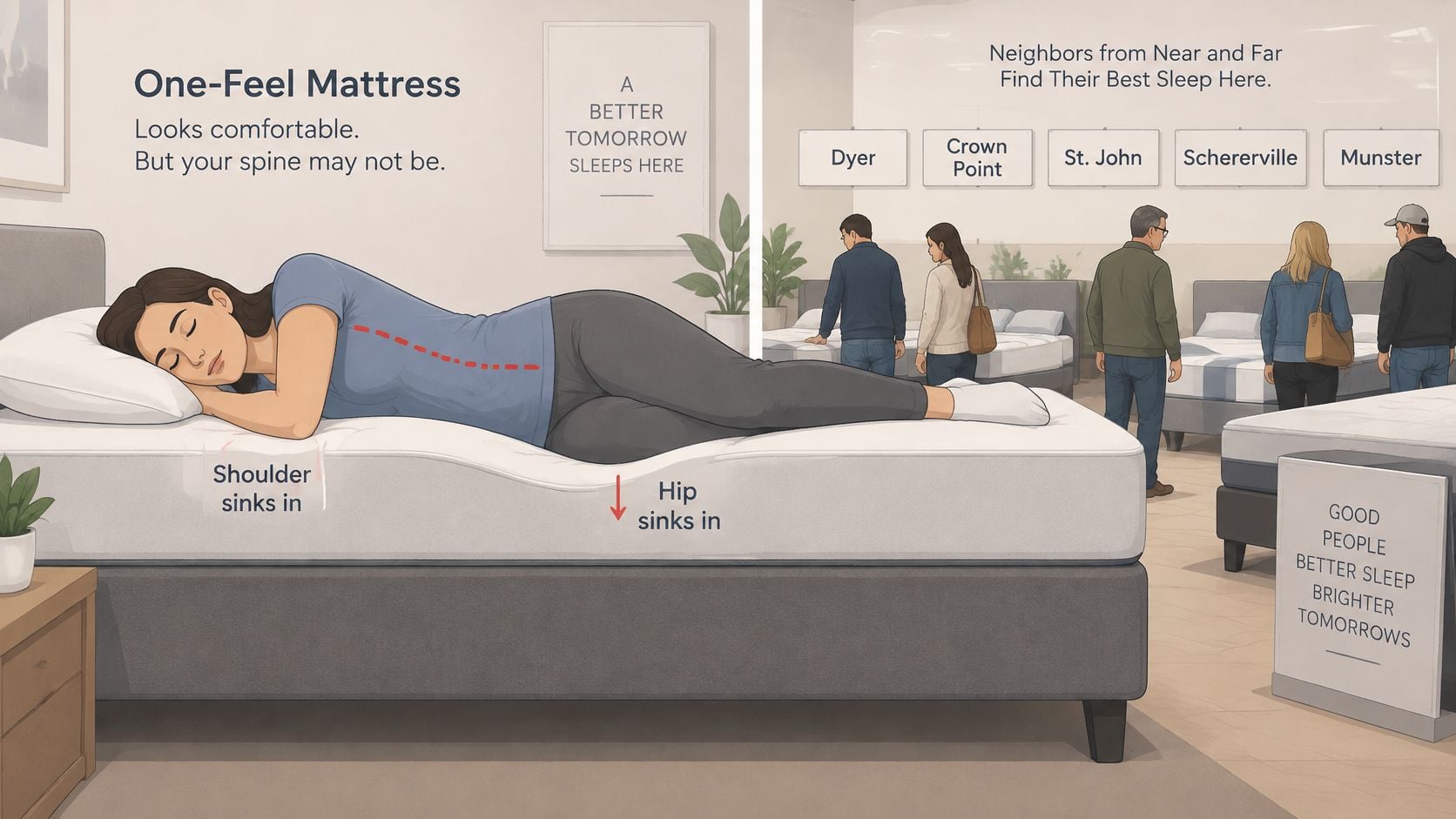
That mismatch is why a one-feel mattress gets outgrown. An extremely soft bed can make turning harder. A very firm bed raises pressure at the same two points. Rest depends on cushion and support happening on the same night, not on picking the plushest pillow-top in the row.
What to feel for instead of a label
Our family-owned floor keeps a Helpful Mattress Guide so a shopper can lie down instead of trusting a printed word. Three checks matter more than the label.
- Shoulder sink: The joint settles modestly into the comfort layers.
- Level spine: From behind, the back stays reasonably straight.
- Quiet hip: Pressure doesn't build during a sustained side lie.
How someone rests changes what those checks mean. SouthShore Fine Linens on sleeping positions walks through how side, back, and stomach postures affect the body, which is why the mattress has to match the posture used most of the night.
The firmness table comes next, then a coil-and-foam checklist, then a side-lying test long enough for pressure to show up. Medium to medium-firm is a range to test, not a universal prescription.
Firmness Starting Points by Body Weight
| Body weight | Start on a 10-point scale | What usually fails | Adjustment |
|---|---|---|---|
| Under 130 lb | 4 to 5 | Shoulder never sinks into the foam | Softer comfort layer |
| 130 to 230 lb | 5 to 6 | Either hip pressure or mild pelvic dip | Stay medium to medium-firm |
| Over 230 lb | about 7 | Hips drop and spine bows | Firmer coil support with still-cushioned joints |
| Any side sleeper, first screen | 4 to 6.5 | Too hard at the shoulder or too plush at the pelvis | Keep only if the spine stays neutral |
| Combination sleeper who also stomach-sleeps | Firmer end of 5 to 6.5 | Low back sags on the stomach | Do not drop to the softest side-sleeper feel |
Testing summarized by the Sleep Foundation found that side sleepers under 130 pounds generally did best with a medium-soft feel around 4 out of 10 or medium around 5 out of 10. Sleepers weighing 130 to 230 pounds commonly preferred medium or medium-firm, about 5 to 6 out of 10. People over 230 pounds often needed a firmer feel around 7 out of 10 so the hips wouldn't sink too far and pull the spine out of line.
AARP places a common side-sleeper starting band at roughly 4 to 6.5 on a 10-point scale. That band only works when the joints stay cushioned and the spine stays neutral. A score inside the band with a numb shoulder, or with a dropped pelvis, is still the wrong bed.
Why weight changes the number
Lighter bodies don't press a firmer mattress enough for the foam to wrap the shoulder. A softer comfort layer is how they reach the contour. Heavier bodies compress farther, so they need more coil resistance under the pelvis. Without that resistance, the hips dip and the waist follows.
A combination sleeper who also rolls onto the stomach should stay inside the broader band and favor the firmer end. Stomach sleeping lets the low back sag on a plush top. Dropping to the softest side-sleeper feel usually trades a shoulder ache for a backache.
Practical rule: Treat the row as a showroom starting point, not a purchase by label. Move one step softer if the shoulder stays numb. Move one step firmer if the waist hammocks.
When the row and the body disagree
The scale number is a start, not a diagnosis. A shorter person with broad shoulders can still need more foam inside the middle weight band. A tall, narrow frame over 230 pounds can feel perched if the comfort layer is thin, even when the coils are firm enough. The last column of the table matters more than the middle one.
Say two people share one bed and sit in different rows. The lighter sleeper's shoulder stays on top of a firmer hybrid, so the joint never gets the wrap. The heavier sleeper's pelvis sinks on the softer hybrid, and the spine bows. Splitting the difference at one medium-firm label often misses both. A zoned coil layout, or enough width for each person to settle into their own zone, is the honest next conversation. The lie-down still decides it. A closer look at how those scores feel is in the guide to mattress firmness for side sleepers.
How Coils and Foam Share the Load
A hybrid isn't a word on a hangtag. It's an innerspring or pocket-coil support core under a comfort stack of memory foam, latex, or both. The two parts do different jobs for a side sleeper, and skipping either one is how a bed feels plush for ten minutes and crooked by morning.
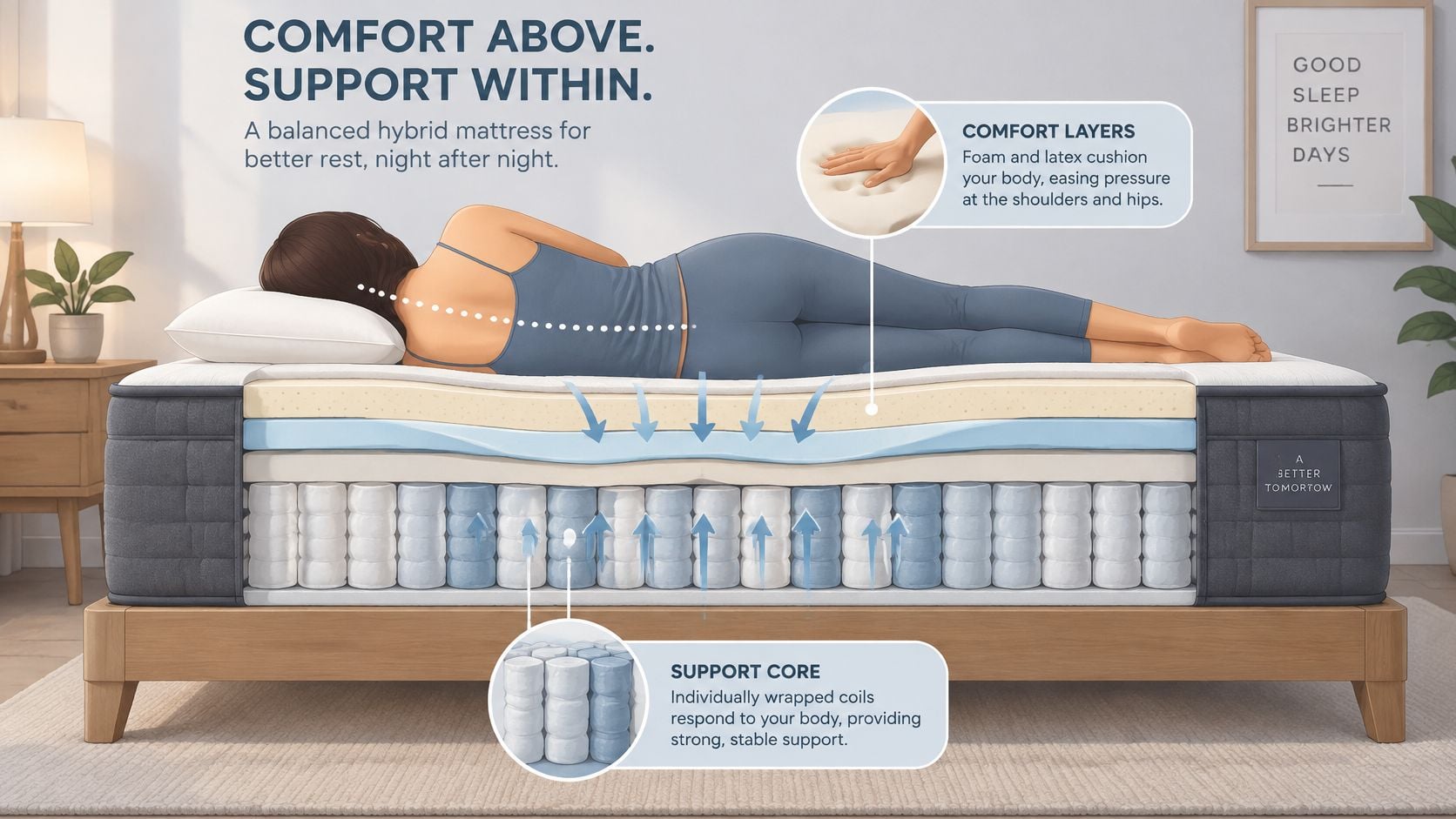
The shoulder and hip are wider than the waist, so they need somewhere to go. Comfort layers let those joints press into the surface. The coil unit holds the pelvis and torso so the middle of the body doesn't fall below the shoulders. The Sleep Foundation describes hybrid construction as surface-level cushioning alongside pocketed coils that permit deeper sinkage at the shoulders and hips, supporting sleep posture without excessive pressure.
Foam as the pillow, coils as the scaffolding
Foam is the pillow. It yields where the body is widest and spreads load off two small contact zones. Coils are the scaffolding. They push back under the pelvis so the waist doesn't become a hammock. If the pillow is missing, the joints rest on a board. If the scaffolding is missing, the whole trunk sinks and alignment goes with it.
Individually wrapped coils also limit motion. Each spring moves in its own fabric pocket, so a turn from one partner travels less than it does on a linked spring grid. That doesn't make a hybrid silent. It makes the difference between a small shift and a wave across the bed.
Three things to name before trusting the word hybrid
Before the feel gets a yes, name three facts on the floor model.
- Coil layout: Pocketed coils, and whether the center or the edge is built differently.
- Comfort material and thickness: Memory foam, latex, or a mix, and whether that layer is thick enough to accept a shoulder.
- The firmness that stack produces: The number from the weight row, felt in the body, not read off a card.
Those three questions lead straight into coil count, wire gauge, foam density, and edge support. A plain definition of the build is on the page about what a hybrid mattress is.
Coil Count Foam Density and Edge Support
The coil unit and the comfort layers don't share one job, so a high coil count alone doesn't make a side-sleeper bed. Thick support coils resist compression and stabilize the core. The foam above them, or a layer of microcoils, does more of the contouring. If either half is thin, the other half can't cover for it.
| Component | Benchmark | What it does for a side sleeper | If it is weak |
|---|---|---|---|
| Pocketed support coils | About 1,000 | Holds the core and limits whole-body sag | Pelvis drops even if the top feels plush |
| Coil gauge | 13 to 15 gauge | Thicker wire at the lower gauge number resists compression | Core feels mushy under the hips |
| Comfort contour | Microcoils or a thick foam top | Lets shoulder and hip sink | Pressure stays on the joints |
| Memory foam density | At least 3 lb per cubic foot | Slows early body impressions | Softens and changes alignment |
| Polyfoam density | At least 1.8 lb per cubic foot | Transition layer avoids a hard bottom-out | Shoulder hits the coils |
| Edge | Reinforced perimeter | Stable sitting and side-of-bed sleep | Roll-off feeling near the edge |
Independent mattress-testing criteria from Wirecutter have used about 1,000 pocketed support coils in the 13 to 15 gauge range as a benchmark for supportive hybrid construction. A lower gauge means thicker wire. The same testing framework looked for memory foam of at least 3 lb/ft³ and conventional polyfoam of at least 1.8 lb/ft³, specs meant to slow early body impressions under repeated loading. Individually wrapped coils also cut motion transfer compared with interconnected springs.
What fails when one layer is missing
Comfort foam often softens before the coil unit wears out. That early give increases pelvic sink and changes alignment, so density matters as much as the first-night feel. A plush top over soft, low-density foam can feel wonderful in the store and hammock the waist a year later.
Transition foam sits between the plush top and the coils so the shoulder doesn't hit a hard stop. Reinforced perimeter coils keep the edge from collapsing when someone sits to tie shoes, or when a side sleeper rests near the side of the bed. Edge feel is easy to miss in the center of a showroom model and obvious at home. More on that check is in the note on mattress edge support.
For couples, one person changes position while the other lies still. Pocketed coils are built to limit how far that movement travels. If the still partner feels every turn, the wrap or the comfort stack isn't doing its job, no matter the coil count.
On any Serta or Beautyrest hybrid, ask for the same three-part stack. Pressure-relieving material on top. A transition layer. Pocketed coils with a reinforced edge.
The Shoulder Hip and Neck Showroom Test
A systematic review summarized in PMC found that medium-firm mattresses generally promote better comfort, sleep quality, and spinal alignment than very soft or very firm surfaces. Excessive firmness can create pressure peaks at the shoulder and pelvis. Excessive softness can let the trunk or hips sink and disturb neutral alignment. The same research, with people lying on their sides, found that higher-weight individuals tended to align more neutrally on firmer mattresses, while lower-weight individuals often aligned better on softer surfaces. Match the weight row, then run the trial. Don't re-pick a score from the label.
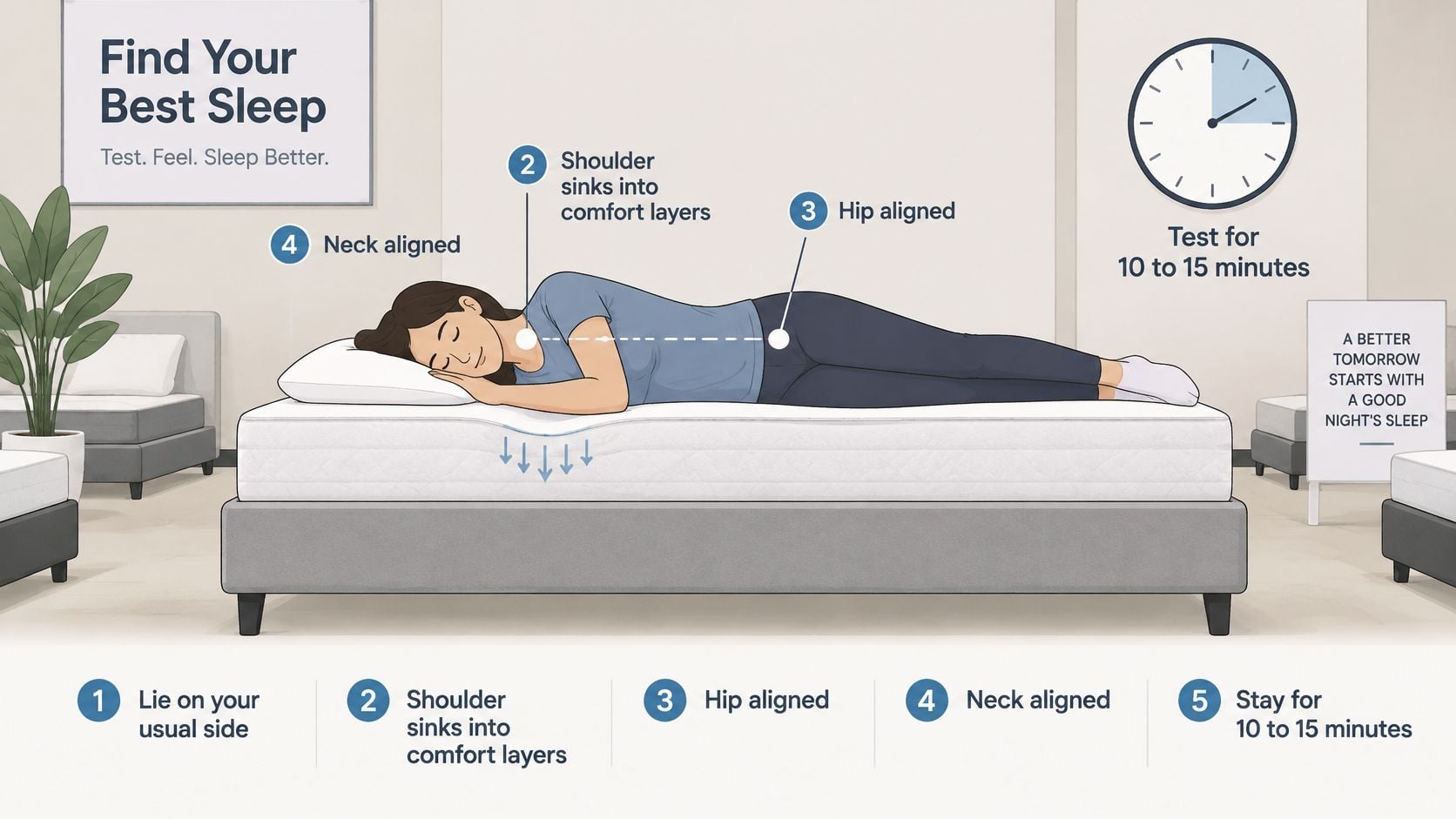
A useful build is a pressure-relieving upper section, typically memory foam, latex, or a combination, over individually wrapped coils. The upper foam conforms under side-sleeping loads. The coil unit limits whole-body sag and steadies the edge.
Six steps on the showroom floor
- Lie on the usual side for at least 10 to 15 minutes. A 30-second bounce only tests bounce.
- Let the shoulder press into the comfort layers. Notice numbness, a hot spot, or the feeling of resting on a board.
- Have someone look from behind, or use a phone photo. The spine should look reasonably straight, and the pelvis should sit level with the torso rather than sunk below it.
- Check that the neck stays level with the spine. A wrong pillow can mimic a bad mattress.
- Roll to the other side and, if it's part of the night, briefly onto the back.
- If two people are shopping, one changes position while the other stays still.
Three outcomes, three decisions
Shoulder numbness means there isn't enough cushion. A hammock at the waist means the coil zone is too soft for that body. A crooked neck with a comfortable hip means change the pillow first. Lighter sleepers often need the softer end of their row, and heavier sleepers the firmer end, but the photo decides, not a guess.
Pain only at the shoulder, only at the hip, or only in the neck is three different buying decisions.
Use a proper foundation for the trial. A bowed base makes any hybrid feel uneven, and the mattress gets blamed for a frame problem. Extra floor habits are gathered in these mattress shopping tips.
Sizing Brands Trial and Honest Buying Power
Feel comes first, then the footprint. A side sleeper needs room to draw the knees up without hanging off the edge. A full is tight for most adults. A queen fits many couples only if both stay near center. A king, or a split setup, helps when partners want different feels or sit in different weight rows. Measure the room and the path from the door before falling in love with the wider size.
Ask the team to match Serta and Beautyrest hybrids on the floor to the weight row and the stack checklist, and to name the comfort-layer material. Pocketed coils under a named foam or latex top are the point. A hybrid label without those details isn't an answer.
Warranty, materials, and the nights at home
Read the warranty for what shoppers skip. Exclusions for body impressions, the foundation the maker requires, what counts as normal softening, and whether the mattress should be rotated. Comfort foam can ease before the coils lose support, and a policy that treats that ease as excluded wear is a different promise than a policy that stands behind it.
Separate a recycled-content claim from two practical questions. Does that foam change pressure relief or lifespan? Can the foam, fabric, glue, and steel coils be repaired or recycled locally? Recycled content isn't the same thing as a mattress the household can take apart later.
The home trial is the long version of the side-lying test. After several nights, check the shoulder, the pelvis, and the neck again, not just whether the bed feels new. The mattress return policy is the place to confirm how that window works before the set is scheduled.
Special financing, subject to credit approval, is buying power that fits a quality sleep set to a budget. No rate and no payment belong in a general guide, because those terms change. White-glove delivery from Dyer or Crown Point means in-room setup, not a curb drop.
If this bedroom is part of a larger home plan, ask about made-to-order options. Design it your way with Canadel dining, or with Amish solid wood built to spec, the same way the mattress should be chosen for the body rather than a default feel. Flexsteel and Bassett cover durability and style in the rooms around that bed. Honest pricing and a clear trial beat a rushed yes.
Test Drive Comfort in Dyer or Crown Point
Bring the firmness row that matches body weight. Plan on at least 10 to 15 minutes on the usual side in the Dyer or Crown Point showroom. Check three things only. The shoulder sinks. The pelvis stays level. The neck stays level with the spine.
Come with a partner if motion and different body sizes are part of the decision. Ask which Serta or Beautyrest hybrid uses pocketed coils, a dense comfort layer, and a reinforced edge. Our family has served Northwest Indiana since 1983, with multigenerational ownership and 5-star service, and the team would rather talk through sleep wellness than push a single feel.
A quality mattress is a health decision for rest, not a spec sheet. Special financing, subject to credit approval, and white-glove delivery are the practical way to take the tested bed home and have it set up in the room where it will be used.
Visit Groen's Fine Furniture in Dyer or Crown Point to lie on a hybrid mattress for side sleepers, match coils and foam to body weight, and ask about special financing plans subject to credit approval. Our family can walk through Serta and Beautyrest hybrids, white-glove delivery, and made-to-order pieces for the rest of the house. Stop by Groen's Fine Furniture and let our family help you create a home you love.