Your Guide to the 15 Inch Wide Cabinet

For homeowners in Dyer, Crown Point, and across Northwest Indiana, the 15 inch wide cabinet usually enters the conversation the same way. There's a narrow gap next to the fridge. A dead strip at the end of a vanity. A laundry room corner that's too small for a full cabinet and too visible to ignore.
A common mistake is to treat that space like filler, not storage. A 15 inch wide cabinet can absolutely earn its keep, but only if it's chosen for the right room, measured correctly, and built with a real purpose. Otherwise, it becomes one more awkward box that holds almost nothing and annoys everyone who uses it.
Our family has helped homeowners around NWI solve this kind of problem for decades. The honest answer is simple. A 15 inch cabinet is worth it when it stores specific things well. It's not a magic answer for every room, and it shouldn't be shoved into a gap just because the size looks convenient.
Table of Contents
- That Awkward Gap A Homeowner's Guide from Dyer to Crown Point
- Measure Twice Order Once A Checklist for the Perfect Fit
- Smart Placement Ideas for Every Room
- What Really Fits and How to Choose Your Style
- Making It Yours Custom Orders and Special Financing
- Installation and Lifelong Care Tips from Our Family
- Create a Home You Love with Groen's
That Awkward Gap A Homeowner's Guide from Dyer to Crown Point
A homeowner in Crown Point sees it every morning. There's a slim space between the refrigerator and the wall. Too narrow for a chair, too visible to ignore, and just wide enough to collect dust, pet hair, and frustration.
A homeowner in Dyer has the bathroom version of the same problem. The vanity ends, the wall begins, and there's an empty strip that wastes space in a room where storage always feels tight. In St. John or Schererville, it might be a laundry room corner where detergent, towels, and cleaning supplies never seem to have a proper home.
That's exactly where a 15 inch wide cabinet makes sense. Not as a decorative patch. As a working piece of the room.
A narrow cabinet should solve a daily problem. If it doesn't hold the items people reach for every week, it's the wrong cabinet.
For homeowners comparing narrow cabinet sizes, this related guide on a 10 inch wide cabinet helps show when going even slimmer makes sense and when it just becomes too narrow to be useful.
The main point is straightforward. A 15 inch wide cabinet is often the sweet spot between “too skinny to matter” and “too bulky for the room.” It gives a home one more hardworking storage zone without swallowing precious floor space.
Measure Twice Order Once A Checklist for the Perfect Fit
Bad measurements ruin good cabinet plans. A cabinet that looks perfect on paper can block a drawer, hit crown molding, or sit awkwardly over a baseboard once it reaches the room.
Start with the finished space
Measure the room as it exists now, not as it looked before paint, trim, or flooring. If the floor was replaced, if tile was added, or if a wall was furred out, those changes matter.
Use this checklist:
- Measure width at more than one point. Walls aren't always straight. Check near the floor, mid-height, and higher up.
- Measure depth from the true front edge. Countertops, trim, and door casings can project farther than expected.
- Measure height with obstacles in mind. For wall units especially, look for soffits, crown molding, vent covers, and light switches.
- Confirm level and plumb. A narrow cabinet exaggerates crooked floors and uneven walls.
Homeowners who want a fuller measuring walkthrough can use this practical guide on how to measure furniture before ordering anything.
Check the parts people forget
Most errors happen when people measure the empty opening and stop there. They forget the room has moving parts.
A 15-inch-wide wall cabinet is commonly paired with 12-inch depth and heights such as 30, 36, or 42 inches, and one common mistake is choosing too much height without checking soffit or crown-molding clearance first, which can force modifications or limit door swing, as shown in this 15-inch-wide wall cabinet product example.
Here's what needs a second look:
- Appliance doors: The refrigerator handle, dishwasher door, and oven door can all steal clearance.
- Counter overhang: Even a small front lip can change how a base cabinet lines up.
- Baseboards and shoe molding: These often require notching, scribing, or a spacer.
- Door swing: A cabinet door that opens into a wall or adjacent trim becomes irritating fast.
- Nearby drawers: Make sure neighboring drawers and pull-outs can still open fully.
Practical rule: The nominal width of the cabinet is only the start. The usable fit depends on trim, hinges, swing space, and what sits beside it.
If the cabinet is going beside an existing run, leave room for the installation to look intentional. A skinny filler strip often saves a project. Forcing a tight cabinet into a tighter opening never does.
Smart Placement Ideas for Every Room
A 15 inch cabinet works best when the room already has a storage pattern and just needs one more disciplined spot. It's not a substitute for a full pantry or a large linen closet. It's the cabinet that catches the overflow and gives it a home.
Kitchen spots that actually work
In a Schererville kitchen, a 15 inch wide cabinet often shines at the edge of a cabinet run. That's a smart place for cutting boards, baking sheets, wraps, food containers, or a narrow pantry setup for oils, spices, and dry goods.
The strongest kitchen uses tend to be:
- Next to the refrigerator: Good for trays, pantry overflow, lunch containers, or snack bins.
- At the end of a cabinet run: Useful for items that don't stack well in wider cabinets.
- Near a prep zone: Good for spices, mixing bowls, and everyday cooking tools.
Homeowners working through layout ideas can also pick up essential small kitchen cabinet tips for homeowners if they need more inspiration for making a compact kitchen feel organized instead of crowded.
Bathroom laundry and hallway wins
In bathrooms and laundry rooms, the 15 inch cabinet often makes even more sense than it does in the kitchen. Narrow rooms don't tolerate bulky storage well. Tall, compact storage usually wins.
A retail example of a 15-inch white floor linen cabinet includes 3 reversible doors and 5 shelves, which shows how a small footprint can still create segmented storage in a bath or laundry setup, as seen in this linen cabinet listing.
That tells homeowners something useful. The width may be narrow, but the cabinet can still divide storage into practical zones. That matters in rooms where toiletries, backup paper goods, towels, and cleaning products all compete for space.
A few room-by-room uses stand out:
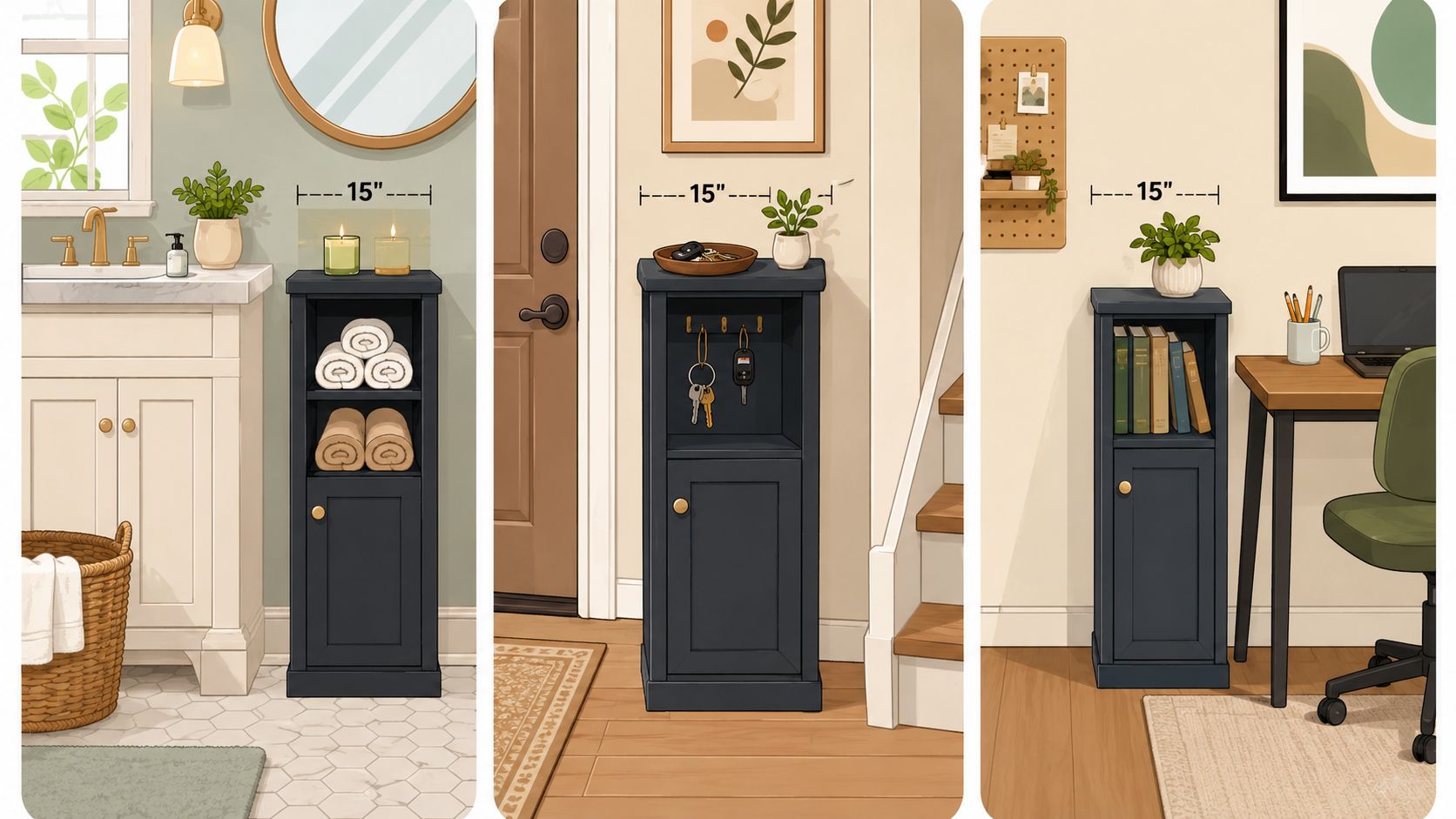
- Bathroom: Rolled towels, extra toiletries, hair tools, and cleaning basics.
- Laundry room: Detergent, stain remover, dryer sheets, paper goods, and folded utility towels.
- Hallway or mudroom: Gloves, pet supplies, seasonal accessories, mail, and grab-and-go household items.
- Home office: Printer paper, cords, files, notebooks, and supplies that usually clutter the desktop.
For more room-specific ideas beyond cabinetry alone, this guide to the best storage solutions for small spaces is a useful next step.
What Really Fits and How to Choose Your Style
A 15 inch cabinet earns its keep when you give it a specific job. If you expect it to swallow bulky, miscellaneous household clutter, you will be disappointed. If you use it for narrow items, stacked supplies, or things that are hard to store in wider cabinets, it becomes one of the hardest-working pieces in the room.

What belongs inside
The best use for a 15 inch wide cabinet is simple. Store one category well instead of storing five categories badly.
| Room | Best uses | Poor uses |
|---|---|---|
| Kitchen | Baking sheets, trays, spices, wraps, reusable containers | Large countertop appliances or oversized mixing bowls |
| Bathroom | Folded towels, toiletries, paper goods, hair tools | Wide baskets and bulky overflow storage |
| Laundry | Detergent, cleaning supplies, folded linens, backup household goods | Hampers, tall equipment, or awkward jumbo containers |
| Office | Files, paper, chargers, notebooks, small electronics | Large binders tossed together or wide decorative pieces |
That is why this size works so well in cabinet plans. It is a standard modular width, so it fits cleanly beside other cabinet sizes instead of looking like an afterthought.
The bigger point is practical. Width on paper means very little until you match it to what your family stores every week. A 15 inch cabinet is worth buying when it solves a recurring problem, such as tray storage in the kitchen, towel overflow in a bath, or paper clutter in a home office. If it only fills a gap, skip it.
The smartest narrow cabinet is not the one that holds the most. It is the one that keeps one problem area under control every day.
If you want help judging build quality before you pick a finish or layout, read these things to look for when buying chests dressers and cabinets.
Choose a style that looks intentional
A standard width does not mean a standard look. Good narrow storage should look like it belongs in the room from day one.
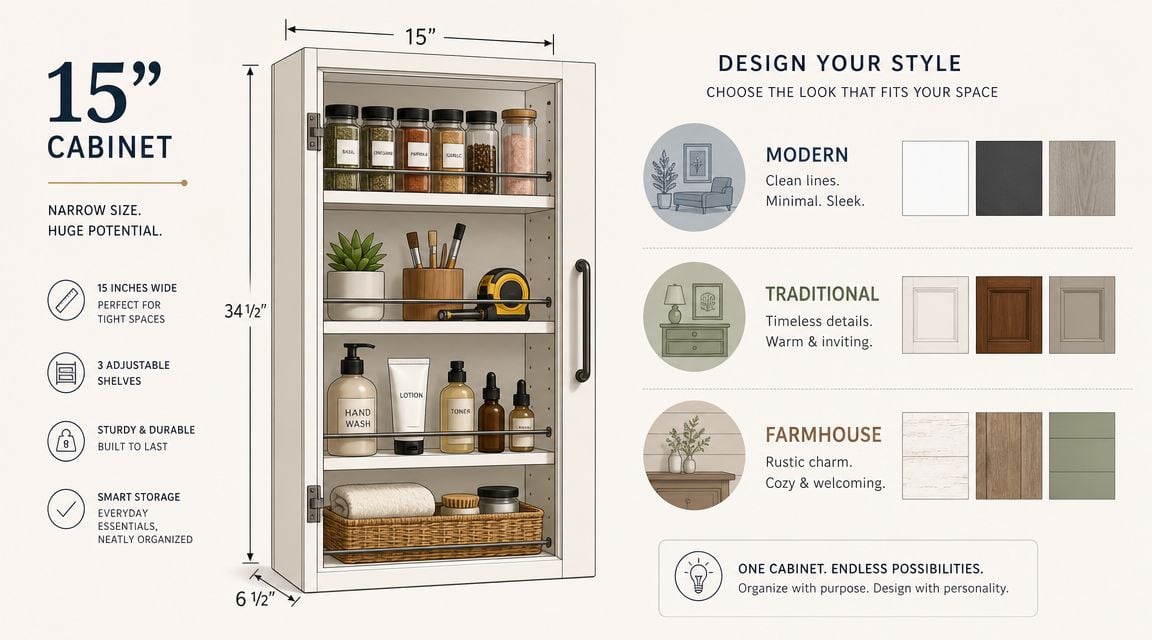
Start with the door style. Shaker fronts are the safest choice if the cabinet needs to live with existing furniture for years. Slab fronts work better in cleaner, more modern spaces. Then look at finish and hardware. A narrow cabinet can disappear into the room with a matching wood tone, or it can add contrast if the space needs a little definition.
Interior layout matters just as much as the exterior. Adjustable shelves are the safe choice for most households. Dividers, drawers, or door-and-shelf combinations are better when the cabinet has a very specific job. A 15 inch cabinet has no room to waste, so the inside should match the items going in it.
Homeowners comparing stock, custom, and specialty cabinets should keep one rule in mind. The size may be standard, but material, shelf layout, hardware, and finish decide whether the cabinet feels like filler or like part of the home.
Solid wood and good joinery matter more on a narrow cabinet than many shoppers expect. These pieces get opened often, loaded unevenly, and placed in tight spots where every flaw shows. Buy the one that feels sturdy, closes cleanly, and suits the room. That is what turns a skinny cabinet from a compromise into useful storage.
Making It Yours Custom Orders and Special Financing
Settling for “close enough” is how awkward spaces stay awkward. A narrow cabinet has to work hard, so details matter more than people think. The finish has to fit the room. The depth has to make sense. The interior has to match what the household stores.
Design it your way
Custom order is often the smarter route for a 15 inch cabinet because the size may be straightforward while the use is not. One family may need shelves for towels. Another may need a door-and-drawer combination for an office nook. A third may want a solid wood piece that matches existing dining or bedroom furniture.
That's where made-to-order options earn their value. Amish solid wood pieces and bespoke programs such as Canadel-style customization give homeowners room to choose the look, wood species, finish, and function instead of forcing a room to adapt to a generic box.
For shoppers who want to understand the process before visiting a showroom, this overview of getting started with custom order lays out what to bring, what decisions matter, and how to avoid ordering something that only “sort of” works.
The smallest cabinet in the room often needs the most thought. It has less room for mistakes and less room to waste.
Buying power matters
Quality storage doesn't need to feel out of reach. A narrow cabinet built well can serve for years, especially when it's made from solid wood and designed around the room instead of patched in as an afterthought.
That's why special financing matters. It gives households buying power and flexibility, subject to credit approval, so they can choose lasting quality instead of making a rushed compromise. That matters in family homes where every inch needs to work and every purchase needs to count.
Installation and Lifelong Care Tips from Our Family
A good cabinet can still look wrong if it's installed carelessly. Narrow pieces make gaps, crooked floors, and bad alignment more obvious. Precision matters.
Installation details that change the result
For a 15-inch-wide base cabinet, a typical configuration is 15 inches wide x 24 inches deep x 34.5 inches high, and installers need to verify the finished opening and allow for filler strips when necessary because the nominal width isn't always the true usable fit, as explained in this standard base cabinet sizing reference.
That leads to a few practical rules:
- Check floor level first. If the floor is off, the door reveal will show it.
- Use filler strips when needed. They create breathing room and make the cabinet look built in.
- Align hardware with neighboring pieces. Even a beautiful cabinet looks random if the pull placement doesn't match.
- Open every nearby door and drawer before final fastening. That simple step catches problems before they become repairs.
Care that keeps it looking right
Solid wood rewards consistent care. It doesn't need fuss, but it does need respect. Wipe spills promptly, avoid harsh cleaners, and keep the finish free from moisture buildup, especially in baths and laundry spaces.
A narrow cabinet also benefits from shelf discipline. Don't overload one shelf while leaving the rest empty. Spread weight evenly, and use simple organizers so items stay accessible rather than jammed together.
Well-built furniture lasts longer when the household treats it like furniture, not like a utility bin. That's especially true with solid wood pieces made to serve for years.
Create a Home You Love with Groen's
A 15 inch wide cabinet is one of those small decisions that can change how a room works every day. It can rescue a kitchen gap, add real bathroom storage, tighten up a laundry room, or turn a forgotten corner into something useful and attractive.
The key is choosing it thoughtfully. If the cabinet has a clear purpose, fits the room properly, and matches the home's style, it's worth it. If it's only there to fill empty space, it usually disappoints.
Homeowners in Dyer, Crown Point, Munster, St. John, and the surrounding NWI communities don't need more filler furniture. They need thoughtful pieces, good measuring, durable materials, and options that can be suited to the home. That's how a small cabinet stops feeling like an afterthought and starts feeling like part of a well-planned room.
A showroom visit is still the smartest next step. Seeing finishes in person, testing door swing, comparing hardware, and feeling the difference in solid wood construction tells people far more than a product photo ever will.
Visit Groen's Fine Furniture in Dyer or Crown Point today to explore custom options and ask about special financing plans. Let their family help create a home you love.