Blog
Latex Mattress Benefits: Health, Comfort & Durability


A lot of Northwest Indiana families reach the same point at about the same time. The mattress that once felt fine now leaves someone waking up stiff, tossing when a partner moves, or sneezing through the night because the bedroom never seems to feel fully fresh. In homes across Dyer, Crown Point, St. John, Schererville, and Munster, that search usually starts with one simple question: what makes a mattress healthier and more comfortable over the long haul?
That's where latex starts to stand out. For households trying to improve sleep quality naturally, mattress materials matter more than many people realize. The support under the back, the way the bed handles moisture, and even how it resists common allergens all shape sleep quality night after night.
For shoppers sorting through too many vague claims, a practical starting point is a local mattress shopping guide for Northwest Indiana. Better sleep usually doesn't come from chasing buzzwords. It comes from understanding what a mattress is made of, how it feels, and whether it fits the people sleeping on it.
Table of Contents
- Your Guide to Better Sleep in Northwest Indiana
- Understanding Latex Natural vs Synthetic
- Key Latex Mattress Benefits for Your Health
- Why a Latex Mattress Is a Smart Investment
- Making Latex Work for Your Budget and Home
- How to Choose the Right Latex Mattress in NWI
Your Guide to Better Sleep in Northwest Indiana
In many local homes, the mattress conversation starts after a few bad weeks, not after one bad night. A parent in Crown Point starts sleeping in the guest room because the main bed feels too soft. A couple in Dyer realizes one person wants cushioning at the shoulders while the other needs steadier back support. Someone in St. John notices morning congestion seems worse in the bedroom than anywhere else in the house.
Those are real-life sleep problems, not showroom problems. They usually need more than a quick firmness label or a five-minute sit on the edge of a bed.
Better sleep often comes from matching the mattress material to the sleeper, not from picking the trendiest model on the floor.
Latex earns attention because it tends to solve several problems at once. It offers responsive support instead of a deep sink, it resists many common bedroom allergens, and it's known for long-term durability. Those latex mattress benefits matter even more for families trying to build a healthier home, especially where adults and kids share busy schedules and need sleep that restores them.
For Northwest Indiana households, the goal isn't just buying a mattress. The goal is creating a bedroom that supports rest, recovery, and daily well-being. That's why understanding latex step by step helps. Once shoppers know what natural latex is, how it differs from synthetic foam, and which construction fits different body types, the decision gets much clearer.
Understanding Latex Natural vs Synthetic
Some of the confusion around latex comes from one simple fact. Not every mattress labeled latex is the same thing. That matters because the feel, durability, and health-related benefits depend heavily on what kind of latex is inside.

What natural latex actually is
Natural latex comes from the sap of rubber trees, specifically Hevea brasiliensis. That sap can be harvested without harming the tree, and the material can be collected for years. For many shoppers, that origin matters because it connects comfort with a more natural material story.
There are also two common ways natural latex foam is processed:
- Dunlop latex tends to feel denser and more grounded. Many sleepers like it in support layers.
- Talalay latex usually feels lighter and more airy. It's often chosen for comfort layers near the top.
Neither is automatically right for everyone. The better choice depends on whether the sleeper wants a more buoyant surface or a firmer, more stable feel.
Why natural and synthetic feel different
A simple way to think about it is this. Natural latex is closer to fresh-squeezed juice. Synthetic latex is more like a powdered mix designed to imitate the original. Both may look similar on the label, but they don't always perform the same way over time.
Synthetic latex is man-made. Blended latex combines natural and synthetic components. Those versions can still have a place in the market, but shoppers should know they may not deliver the same full package of durability, breathability, and low-allergen appeal often associated with high-quality natural latex.
A useful comparison for anyone also weighing foam options is this memory foam mattress overview. Memory foam usually gives a slower, deeper contour. Latex has more lift and pushback.
Practical rule: If someone wants the classic latex feel, the questions should go beyond “Is it latex?” and move to “How much is natural?” and “What layers are being used?”
Another point that often gets overlooked is end-of-life impact. High-quality natural latex mattresses are biodegradable and, depending on conditions, can decompose within roughly six months to four years at end of life, without releasing the same toxic chemicals associated with polyurethane foam decomposition according to LeafScore's latex mattress guide.
That doesn't make every latex mattress identical. It does mean material choice has consequences beyond the first night of sleep.
Key Latex Mattress Benefits for Your Health
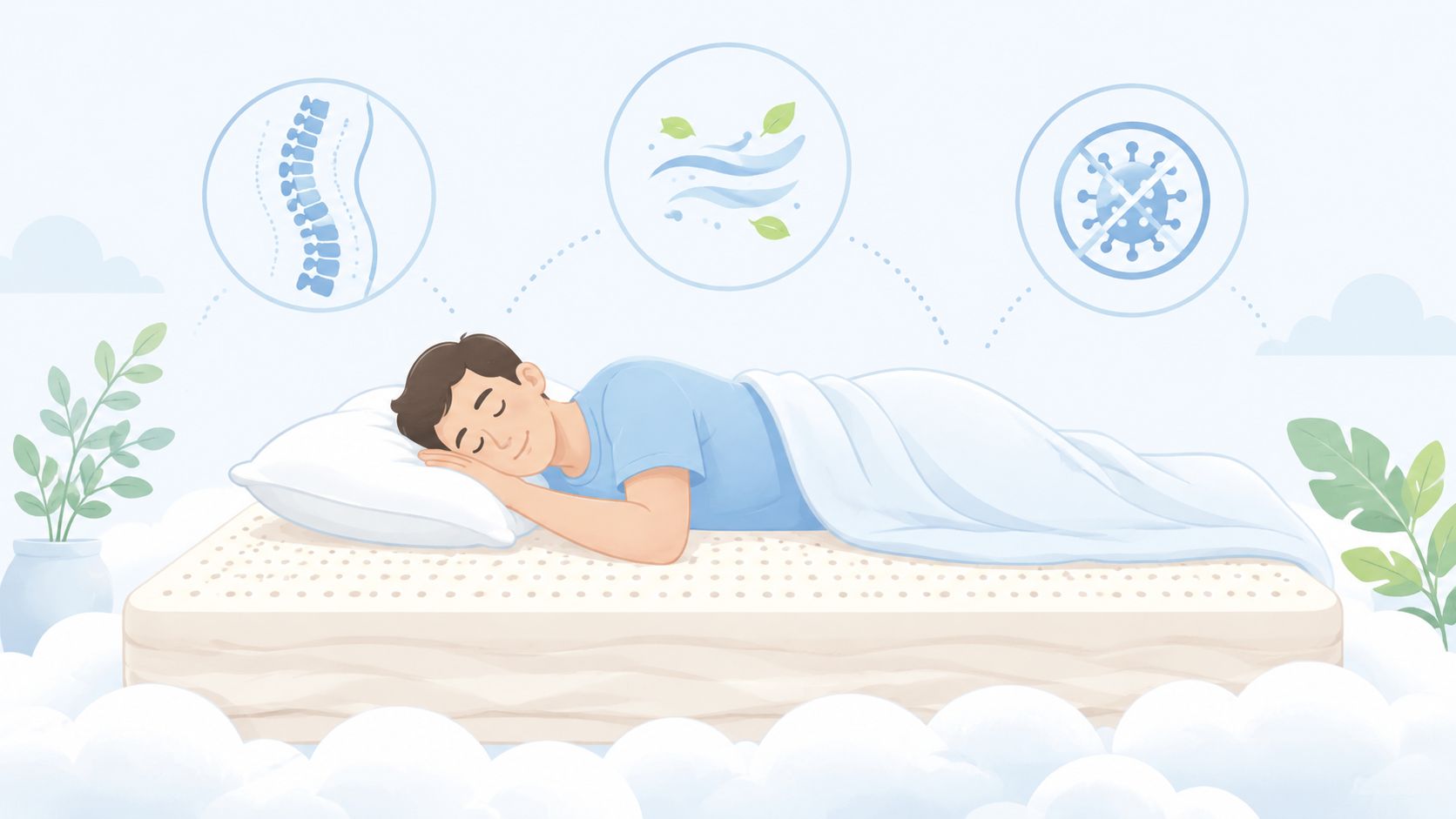
The strongest latex mattress benefits show up where people feel them most. Back support. Pressure relief. Cleaner breathing at night. Less disturbance from motion. These aren't abstract features. They're the difference between sleeping through the night and counting down to morning.
Support that helps the body settle in
Latex has a distinctive feel. It contours, but it doesn't usually trap the sleeper in one position. That's important for side sleepers who need pressure relief at the shoulders and hips, and for back sleepers who need the lumbar area supported without sagging.
Latex mattresses exhibit superior pressure-relieving and spine-alignment properties. Ergonomic evaluations show resilient foams like latex can lower interface pressure peaks by 15–25% relative to standard memory foam, which correlates with lower morning stiffness, as explained in Saatva's latex mattress guide.
That kind of pressure distribution helps explain why so many people describe latex as both cushioned and supportive. It has enough give to ease pressure points, but enough resilience to help keep the body from dipping out of alignment.
For people shopping specifically because of back discomfort, this related look at a mattress that may help with back pain can help frame the decision around body support instead of marketing language.
A cleaner sleep surface for allergy-sensitive homes
Bedrooms collect more than blankets and pillows. They also collect dust, moisture, and allergens that can affect breathing and comfort through the night. In many Northwest Indiana homes, that becomes more noticeable during allergy season or in rooms that don't get ideal air circulation.
Natural latex stands out because it is naturally resistant to dust mites, mold, mildew, and many microbes. Research summarized in the verified data also notes that latex can show 30–60% reductions in allergen load in some testing contexts depending on the cover and construction. For households that deal with asthma or allergy concerns, that makes the mattress itself part of a healthier sleep setup.
Global prevalence figures in the verified data show that roughly 10–15% of adults and 20–30% of children experience allergic respiratory disease. That doesn't mean a mattress treats those conditions. It does mean many families have a real reason to care about what's under their sheets.
A mattress isn't the whole indoor-air story, of course. Families also benefit from paying attention to HVAC upkeep and dust movement in the home. This homeowner's guide to dirty ducts is a useful companion read for anyone trying to reduce bedroom irritants more broadly.
Comfort benefits that couples and warm sleepers notice
Health isn't only about pain and allergies. It's also about whether the bed feels stable, breathable, and easy to sleep on night after night.
Some practical latex mattress benefits show up in smaller moments:
- For combination sleepers: Latex responds quickly when someone changes position, so rolling from side to back feels easier than on slower-responding foams.
- For couples: The material is quiet and absorbent enough to reduce the jarring feel of a partner getting up, even though it remains buoyant.
- For warm sleepers: Latex's open-cell structure supports airflow better than many dense foams, which can help the bed feel less stuffy.
A mattress that supports healthy sleep usually feels uneventful in the best way. Less wrestling for position, less waking up sore, less noticing the bed at all.
Taken together, these benefits explain why latex is often discussed as a sleep-wellness material rather than just another comfort option.
Why a Latex Mattress Is a Smart Investment
A latex mattress usually asks for more upfront. That's true, and most shoppers see it right away. The better question is whether the mattress earns that cost over time.
The value is in how long it holds up
Durability is where latex often separates itself from many conventional options. High-quality natural-latex foams retain more than 90% of their original thickness and support after tests equivalent to 15-20 years of use, whereas premium memory-foam cores can show 5–15% compression set after just 5–7 years, according to Sleepopolis' latex mattress guide.
That matters because mattress disappointment usually doesn't start with a dramatic collapse. It starts with a slight dip where the hips settle too far. Then the support changes. Then sleep changes.
The broader durability picture points in the same direction. Verified market and testing data indicate that natural or high-quality latex units often last 15 years or more under normal use, and many carry 15- to 20-year warranties. Conventional foam or innerspring models are often described with a 7–10-year lifespan in that same body of data.
Why the higher starting price can make sense
When a mattress lasts longer and resists sagging better, the math changes. Over a 15-year horizon, verified data notes that a household may use one latex mattress instead of replacing two or more lower-durability mattresses. That can lower the annualized cost of ownership even if the initial purchase is higher.
A helpful way to frame it is this:
| Mattress question | Lower-durability bed | High-quality latex bed |
|---|---|---|
| How soon does support tend to change? | Often earlier | Often later |
| How often might replacement be needed? | More frequently | Less frequently |
| How does it feel financially? | Lower at checkout | Stronger long-term value |
That long-view mindset matters for health too. A mattress that keeps its shape is more likely to keep delivering the support profile the sleeper chose in the first place. For families thinking in terms of wellness and value together, this guide on why a high-quality mattress matters for long-term health adds useful context.
Paying less once can cost more if the mattress stops supporting the body well years earlier than expected.
There's also a larger market signal behind this category. A 2025 industry report in the verified data estimates the global latex mattress market at about USD 12.9 billion, with a projection to reach about USD 25.6 billion by 2035, reflecting roughly 7.1% compound annual growth. That projection suggests many buyers are moving toward longer-lasting sleep products, not just lower initial prices.
Making Latex Work for Your Budget and Home
A premium mattress only helps if it fits real household decisions. For many families in Northwest Indiana, that means balancing long-term value with monthly budget realities, delivery logistics, and the practical question of how a heavy mattress gets from the showroom into the bedroom.

Buying power for a long-term purchase
Affordable luxury becomes more than a slogan. A latex mattress may be a lasting choice, but that doesn't mean a household wants the full cost to land all at once. Special Financing available, subject to credit approval, can make the purchase feel more manageable and give families buying power when they're ready to improve sleep instead of putting it off.
For shoppers comparing payment approaches, this page on mattress financing options lays out the basics in a straightforward way.
Some households use financing to move up in material quality rather than in extras. That can be a smart trade. Better support, cleaner materials, and stronger durability usually affect everyday life more than cosmetic upgrades.
Practical help once the mattress arrives
Latex mattresses are substantial. That density is part of why they often feel so supportive, but it also means setup can be more demanding than people expect. Maneuvering a heavy mattress through stairs, tight hallways, or narrow corners isn't a small detail.
A practical buying plan often includes:
- Room readiness: Make sure the bed frame or foundation matches the mattress type and provides proper support.
- Delivery planning: Clear pathways, measure turns, and think through upper-floor placement before delivery day.
- Old mattress removal: Decide in advance whether the existing mattress needs to be moved out at the same time.
The right mattress should feel like an upgrade, not a weekend lifting project.
White-Glove Delivery helps remove that friction for households in Dyer, Crown Point, St. John, Schererville, Munster, and the surrounding Northwest Indiana area. Instead of treating delivery like an afterthought, a better purchase experience treats setup as part of sleep wellness too. When the mattress is placed correctly and the room is ready, the first night is simpler.
That same thinking shows up across other parts of the home. People often want furniture and sleep products suited to how they live, whether that means custom dining from Canadel, Amish solid wood made to order, or mattress guidance shaped around real comfort needs. Design it your way isn't just for the dining room. It applies to sleep as well.
How to Choose the Right Latex Mattress in NWI
A good latex mattress match starts the same way a good pair of shoes does. The label matters less than how it fits your body, how you move, and how long you need it to stay comfortable. A simple soft, medium, or firm label does not tell the whole story.
Northwest Indiana families often miss one part of the decision. They shop by feel for five minutes, even though latex performs differently depending on body type, sleep position, and layer build. That is why two people can both say, "I need support," and still need very different mattresses.
Start with sleep position and body type
Sleep position gives you the first clue. Body weight and body shape help finish the picture.
A side sleeper usually needs more cushioning at the shoulders and hips so those areas can settle in without creating pressure. A back sleeper often needs a more balanced surface that supports the lower back while keeping the hips from sinking too far. A stomach sleeper usually does better on a firmer build that keeps the midsection from dropping and pulling the spine out of line.
Weight changes the feel too. A lighter sleeper may experience a firm latex bed as hard and unyielding because they do not sink in enough to reach the comfort layers. A heavier sleeper may need a denser support core so the mattress keeps its shape and stays supportive through the night.
Many generic mattress guides often fall short. They stop at comfort words. A better approach matches the latex type and layer setup to the person sleeping on it.
Think in layers, not just firmness labels
Latex mattresses work in parts. The upper layers handle cushioning and pressure relief. The deeper layers handle alignment and pushback. That layered design is why one medium mattress can feel completely different from another.
For example, a person with shoulder pressure may do well with a plusher comfort layer over a steadier base. Someone with recurring lower back discomfort may prefer a more medium-firm build that keeps the spine level instead of allowing too much dip through the center.
A useful showroom conversation often includes questions like these:
- Does the top layer relieve pressure, or does it keep the body resting more on the surface?
- Is the support core appropriate for the sleeper's weight range?
- Will the mattress still feel comfortable during position changes at night?
- If two people share the bed, do both sleepers need the same level of support?
Firmness helps narrow the choices. Layer construction determines whether the mattress actually fits the sleeper.
For many households in NWI, that detail matters more than the marketing label. Parents with back fatigue, athletes recovering after practice, and older adults who want easier movement in bed may all prefer latex, but they will not always prefer the same latex build.
What to test in the showroom
Testing latex takes a little patience. A quick sit on the edge or a 30-second lie-down rarely tells you enough.
Stay in your usual sleep position for several minutes. Pressure points often show up slowly, especially around the shoulders, hips, and lower back. Then roll from one side to the other and notice how easily the mattress responds. Latex should feel springy and supportive, not slow or stuck.
Pay close attention to your midsection. If your hips sink too low, your back may complain later. If the surface feels too flat and rigid, your shoulders and hips may take too much force.
If you sleep with a partner, test together. One person may want more cushioning while the other needs stronger support. That is common, and it is one reason in-person guidance helps.
At Groen's Fine Furniture, shoppers can compare latex options with guidance centered on fit, support, and long-term comfort. That hands-on process gives Northwest Indiana families a clearer way to match mattress construction to real sleep needs, rather than choosing by label alone.