Best Mattress for Stomach Sleepers to Test

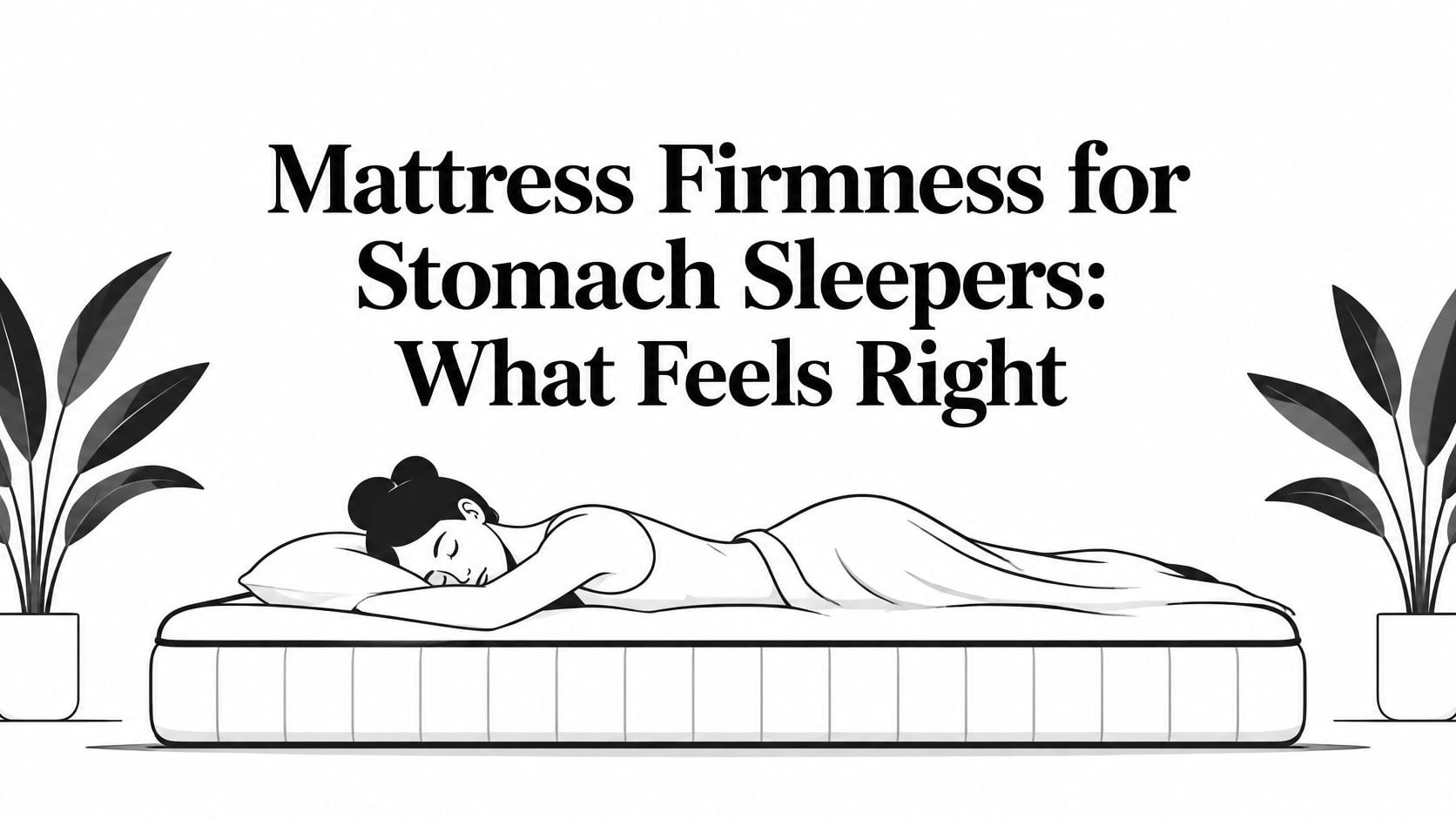
The best mattress for stomach sleepers is usually medium to firm, roughly 5 to 8 on a 1 to 10 firmness scale, not the hardest bed in the showroom. That band protects against the two problems prone sleepers fight at the same time: a pelvis that sags and a rib cage that gets punished.
The most repeated advice on this topic points at the firmest surface available and stops there. That advice is half right at best. Firmness is only useful when it keeps the hips and rib cage on the same level line, and past a certain point a harder bed stops helping the spine and starts bruising the ribs, the chest, and the hip bones.
For homeowners in Dyer, Crown Point, and the towns around them, that distinction saves a return. The sections below walk through the firmness bands by body weight, what each mattress build does under the midsection, named Beautyrest and Harmony Lux feels to request, and a showroom test that settles the question in about ten minutes.
Firmness That Fits a Stomach Sleeper
Stomach sleepers in Dyer, Crown Point, Schererville, St. John, and Munster tend to walk in with the same question: which bed comes first, before any brand name. The answer is a band, not a model. Most stomach sleepers land between 5 and 8 on a 1 to 10 firmness scale, which reads as Medium to Firm on a showroom floor, not the hardest slab in the building.
The Sleep Foundation's guidance for stomach sleepers sets a floor of at least 5 on that scale, with many sleepers preferring roughly 5 to 8. The reason is weight distribution. Face down, the abdomen and pelvis are often the heaviest part of the body, and a surface that's too soft lets that mass sink, which increases the curve in the lower back and can create strain. The same page notes that sleepers above 230 pounds typically need more firmness than those below 130 pounds, because greater weight increases sinkage.
The weight rows, one at a time
| Sleeper | Firmness (1-10) | Label to try | Why this row |
|---|---|---|---|
| Under about 130 lb | 5-6 | Medium | Cushion ribs and chest while the core still resists waist sink |
| About 130-230 lb | 6-7 | Medium to Firm | Default band for most stomach sleepers |
| Over about 230 lb | 7-8 | Firm | Heavier midsection needs more pushback so hips do not drop |
| Also sleeps on the side | 4-7, one step below the weight row | Medium | One step softer than the weight row, then test both positions |
| Very soft or extra-hard extremes | Below 4 or 9-10 | Ultra Plush or Extra Firm | Usually too much sink or too much rib pressure for prone sleep |
Read the table as a starting line, not a finish line. A lighter sleeper who starts at 5 to 6 keeps enough give under the ribs and chest that the surface doesn't feel like a floor, while the core underneath still holds the waist up. Someone at 130 to 230 pounds usually presses far enough into a soft comfort layer that the midsection dips, so 6 to 7 keeps him or her sitting on top of the bed rather than in it.
Combination sleepers are the row many shoppers skip. If the night regularly ends on a side, drop one step from the weight row and check both positions before deciding. A bed that's perfect prone and punishing on the shoulder gets abandoned by 3 a.m.
Labels are a shortlist, not a verdict
Comfort levels on our floor are Extra Firm, Ultra Plush, Plush, Medium, and Firm. For prone sleeping, Firm and Medium are the usual lane. Plush can work for a light sleeper who passes the alignment test, and Ultra Plush is seldom the match, because a deep cradle under the belly is exactly what pulls the lower back into an arch.
The hangtag shortens the list. It doesn't answer the question. A bed marked Firm from one maker and Firm from another can differ by a full point of real support, and a pillow top can make a Firm core feel like a Medium. Treat the label as the two or three beds to lie on first.
That logic extends past the bedroom. Families who also care for a bedbound relative can compare pressure-relief priorities in this guide to mattress support for bedridden seniors, and the same principle holds: the surface has to hold the body without letting the heaviest section drop.
How Hip Sink Changes the Lower Back
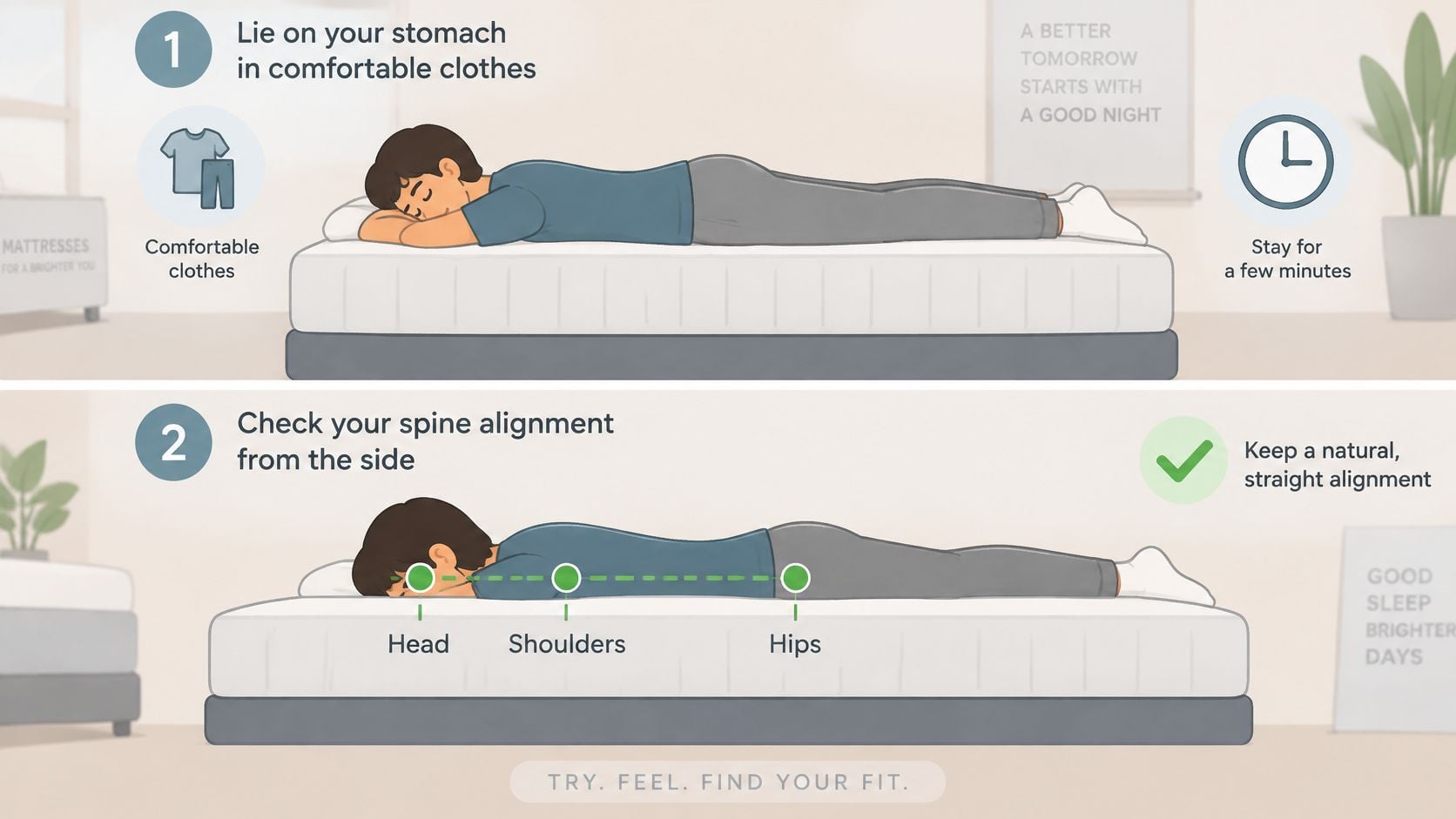
Picture a seesaw with the rib cage on one end and the pelvis on the other. Lying on the stomach puts the heaviest load in the middle, right at the belt line. If the belly and hips sink below the level of the ribs, the lower back bends into extra extension, and that's the tightness many people feel in the first ten minutes after getting up.
Push the other way, to a surface so hard that only ribs and hip bones make contact, and the sleeper spends the night on two pressure points, shifting constantly because the body can't settle. Neither extreme is support. Support is the middle.
The rule that matters: the right surface keeps the pelvis from sagging while still cushioning the ribs.
What the mattress trial evidence actually shows
A randomized clinical trial published in 2003 tested the assumption that harder equals more supportive. The multicenter, double-blind trial included 313 adults who had low-back pain for more than three months and reported pain while lying in bed or getting up. Participants were assigned either a firm mattress with a standardized firmness score of 2.3 or a medium-firm mattress scored 5.6.
After 90 days, the medium-firm group did better on all three measures. The odds ratio for improved pain in bed was 2.36 (95% confidence interval 1.13 to 4.93), for pain on rising it was 1.93, and for disability it was 2.10 (95% confidence interval 1.24 to 3.56). The full trial is indexed in PubMed's record of the mattress firmness study.
Read that result carefully. It doesn't say to buy the softest bed on the floor. It says the hardest bed isn't automatically the most supportive, which is the assumption most stomach-sleeper advice still rests on.
What a balanced feel is like under the hips
The build that works has two jobs split between two layers. A dense core, whether coils, latex, or high-density foam, holds the pelvis up near the level of the rib cage. A thin, resilient comfort layer takes the edge off the chest and hip bones without letting the body carve a deep cradle.
Shoppers who want to see how alignment is taught from the clinical side can browse BEDHEAD University alignment training, which frames neutral posture in the same terms: joints stacked, curves preserved, no segment forced into a long stretch.
This is a sleep-wellness question before it's a spec question. The Helpful Mattress Guide exists for exactly this reason. Rest and a neutral spine matter more than a list of layers, and a bed that reads well on paper but leaves the lower back tight every morning has failed the only test that counts. Anyone weighing how a bed interacts with an existing back problem will find more in this guide to the best mattress for back pain.
Body weight, pelvic shape, and how often the night changes position still decide which row from the first table applies. Those three variables move a sleeper a full point in either direction.
Mattress Builds That Hold the Midsection
Constructions differ far more under the hips than the names on the tags suggest. The useful comparison isn't foam versus coils. It's how much pushback each build delivers where the pelvis presses hardest, and how much soft material sits between the body and that pushback.
An innerspring with a sturdy coil unit pushes back under the pelvis and usually sleeps cooler, since air moves between the springs. A thick, soft top can erase that advantage in a hurry. A hybrid keeps the coil core and adds a thinner foam comfort layer, which is often the easiest balance for stomach sleepers who want some cushion without the hammock effect.
All-foam memory beds contour closely. A thick, soft memory-foam stack lets the abdomen drop, so a dense resilient core with a thin comfort layer is the safer arrangement. Gel memory foam can feel cooler in the hand, and that's all it means. Gel isn't support.
| Build | Hip sink | Surface feel | Stomach-sleeper use |
|---|---|---|---|
| Innerspring | Low when coils are robust | Responsive, often cooler | Strong default if the top is not thick and soft |
| Hybrid | Low to moderate | Coils plus a thinner comfort layer | Best balance of pushback and rib cushion for many |
| Memory foam | High if soft and thick | Slow contour, closer hug | Only when the core is dense and the comfort layer is thin |
| Gel memory foam | Depends on the foam under the gel | Cooler hand-feel, still foam | Choose for temperature, not as proof of support |
| Euro top | Moderate | Quilted, slightly rounded top | Fine when the core stays firm and the top is not deep |
| Pillow top | Often high | Plush, taller sleep surface | Use caution; skip deep plush tops if hips drop in minutes |
Why the pillow top is the caution, not the coil
A pillow top adds height and a plusher first impression. A deep one, the kind that feels like a separate soft mattress sewn on top, is the build most likely to let the pelvis dip. The core underneath can be firm and the sleeper will still sink, because the soft layer is doing the work at the hip.
That's why Plush Pillow Top and Ultra Plush deserve a second look rather than a fast yes. Test them the same way as everything else, and if the hips drop within a few minutes, the label doesn't matter.
Filter the floor before you lie down
The website sort makes this faster than walking the whole showroom. Mattresses can be filtered by type at Gel, Memory Foam, Innerspring, and Memory Foam Pillow Top, and the fuller range of types includes Euro Top, Gel Memory Foam, Hybrid, Innerspring, Memory Foam, and Pillow Top. Start with innerspring and hybrid, then add one foam option to compare.
One rule closes this out. Pick the row that resists sink, then buy only as much comfort layer as still lets the sleeper roll over without a struggle. Cushion that traps the body is a liability, not a luxury. Anyone still torn between the two main structures will get more from this breakdown of hybrid versus innerspring construction.
Beautyrest and Harmony Lux Builds to Compare
The current Beautyrest and Harmony Lux lines give shoppers named feels to request instead of a vague request for "something firm." Treat each model as a test of the rules already set, not as a ranked winner.

Firm builds for heavier frames
The Beautyrest Black L-Class Extra Firm has two layers of firm and extra firm comfort foams, which places it squarely with heavier stomach sleepers who still sink on a medium bed. For a lighter frame, that same bed will read as hard, and the ribs will say so within five minutes.
An extra firm build is the right answer for a narrow group. It solves sink. It creates pressure. The sleeper who needs it knows quickly, because on a medium bed the hips still drop and the morning lower back stays tight.
The plush pillow top to approach slowly
The 16-inch Beautyrest Black C-Class Plush Pillow Top carries a top layer of GelTouch Foam plus layers of Medium Comfort and Gel Memory Foams. The height and the pillow-top construction are the parts to watch, since a plush top can let hips drop even when the model name sounds comfortable.
Lie on it prone for a full stretch, not a quick sit-and-leave. If the midsection settles lower than the ribs, the cushioning is working against the sleeper no matter how good the first thirty seconds feel. A medium innerspring feel and a medium pillow top are not the same test, and shoppers who confuse the two often buy the wrong one.
Harmony Lux, and the two or three feels to request
Harmony Lux Carbon comes in Extra Firm, Medium Pillow Top, and Plush. Harmony Lux Diamond comes in Medium and Ultra Plush Pillow Top. For prone sleeping, start on the Extra Firm Carbon and the Medium versions, then move to Ultra Plush Pillow Top only if a firmer test already passed and a little surface give is the missing piece.
That leaves most stomach sleepers with two or three named feels to ask for, matched back to their weight row. Serta and Beautyrest are the two sleep lines to compare for this purpose, using firmness and type filters rather than hunting for a single hero bed. A side-by-side view of how the lines differ is in this mattress brands comparison.
No model wins for every body. The value of naming them is that the conversation starts at the right end of the floor.
How to Test Alignment in the Showroom
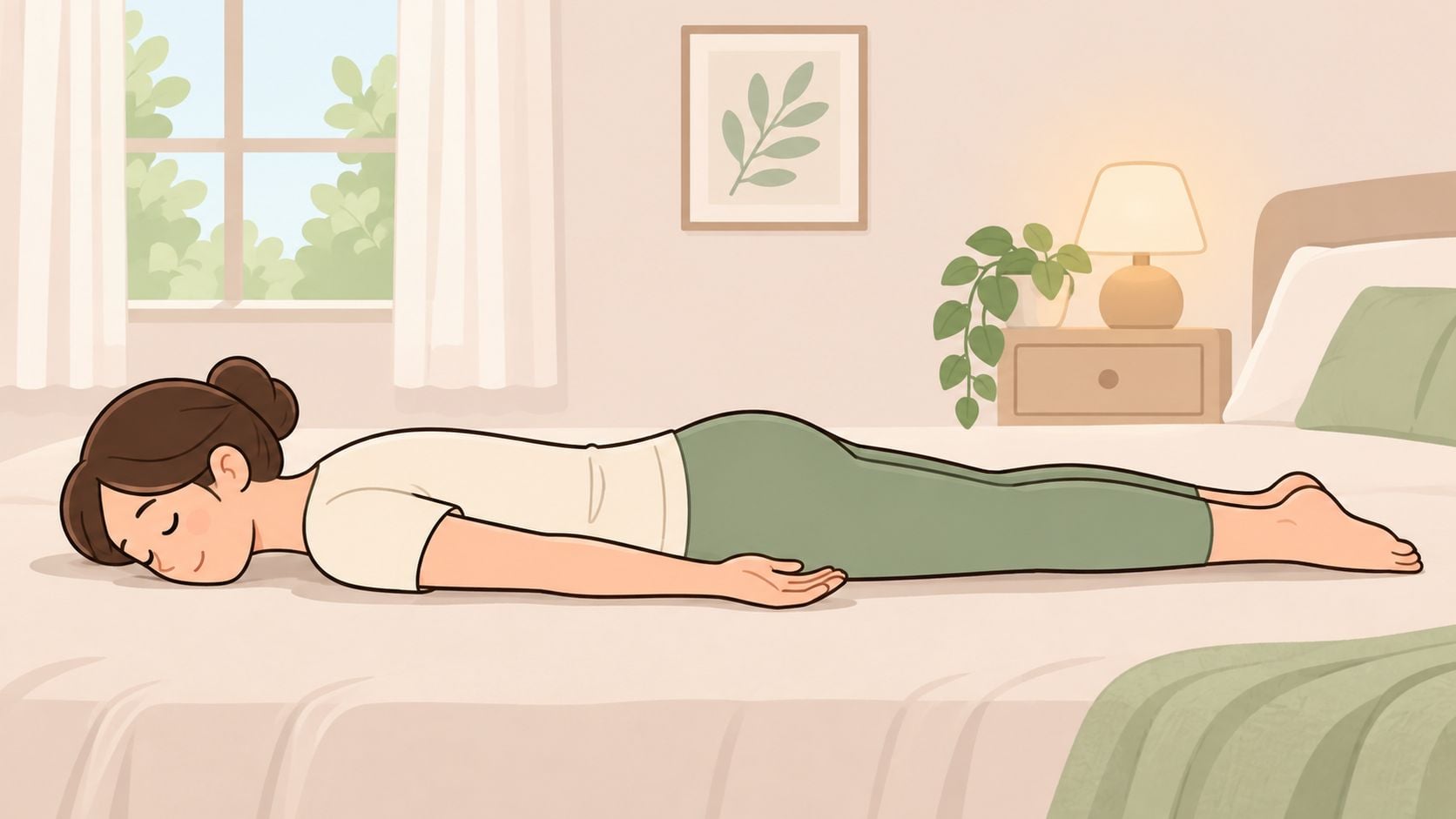
Fifteen seconds on the edge of a bed tells a shopper nothing. The test that predicts how a mattress performs at home takes a full ten minutes and follows the same six steps on every bed under consideration.
A 60-participant motion-analysis study published in BMJ Open Respiratory Research on posture and mattress firmness found that higher-body-weight participants achieved more neutral spinal alignment on firmer mattresses, while lower-weight participants aligned better on softer models. The same study reported that shorter participants tended to align better on softer mattresses, and that medium firmness was more favorable for taller participants. Because the researchers saw meaningful differences among body-shape subgroups, they recommended prone alignment checks conducted on the complete foundation intended for use.
The six-step trial
- Settle in properly. Wear comfortable clothes, take off shoes, and lie fully on the stomach for five to ten minutes. Notice whether you're already bracing.
- Check the side profile. Have someone look, or use a phone camera at hip height. The pelvis should stay level with the rib cage, without a valley under the waist.
- Read the pressure points. Pay attention to ribs, chest, and hip bones. Sharp pressure means moving one step softer, not jumping to plush.
- Roll over. Turn to the side and then the back if the night is mixed. A bed that only works in one position will not hold up across eight hours.
- Test the foundation. Try the mattress on the base or foundation that will go home. A weak base changes the sink and voids the test.
- Recall mornings. Think about the last two weeks of low-back tightness on rising and ask whether this surface would change it.
Steps two and three are the ones people skip, and they're the ones that matter. A shopper who only notices "comfortable" has measured the quilted cover, not the support.
Two sleepers, two tests
Partners should each run the prone check separately, even if only one of them sleeps face down. A bed firm enough for a 240-pound stomach sleeper will feel like a board to a 125-pound side sleeper sharing it, and split sizes exist for exactly that reason.
Practical rule: if the hips drop within the first few minutes, stop. Firmness labels can't rescue a surface that already failed the alignment check.
The team can set that side-by-side comparison up in the Dyer or Crown Point showroom, with the same foundation and the same ten-minute window for each sleeper. More preparation before the visit, including what to bring and what to measure, is in this guide to mattress shopping tips.
The goal is a pass or fail on each bed, not a new theory about firmness.
Pillows and Nights You Change Position
Neck trouble and mattress trouble get blamed for each other constantly. Separate them before spending money. Many people who call themselves stomach sleepers also turn onto a side during the night, and one pillow can't serve both positions.
Prone, the head needs almost nothing under it. A low loft or no pillow keeps the neck from cranking upward. Roll to the side and the same sleeper needs a medium loft to fill the space between ear and shoulder. A single "stomach-sleeper pillow" recommendation can't cover that range.
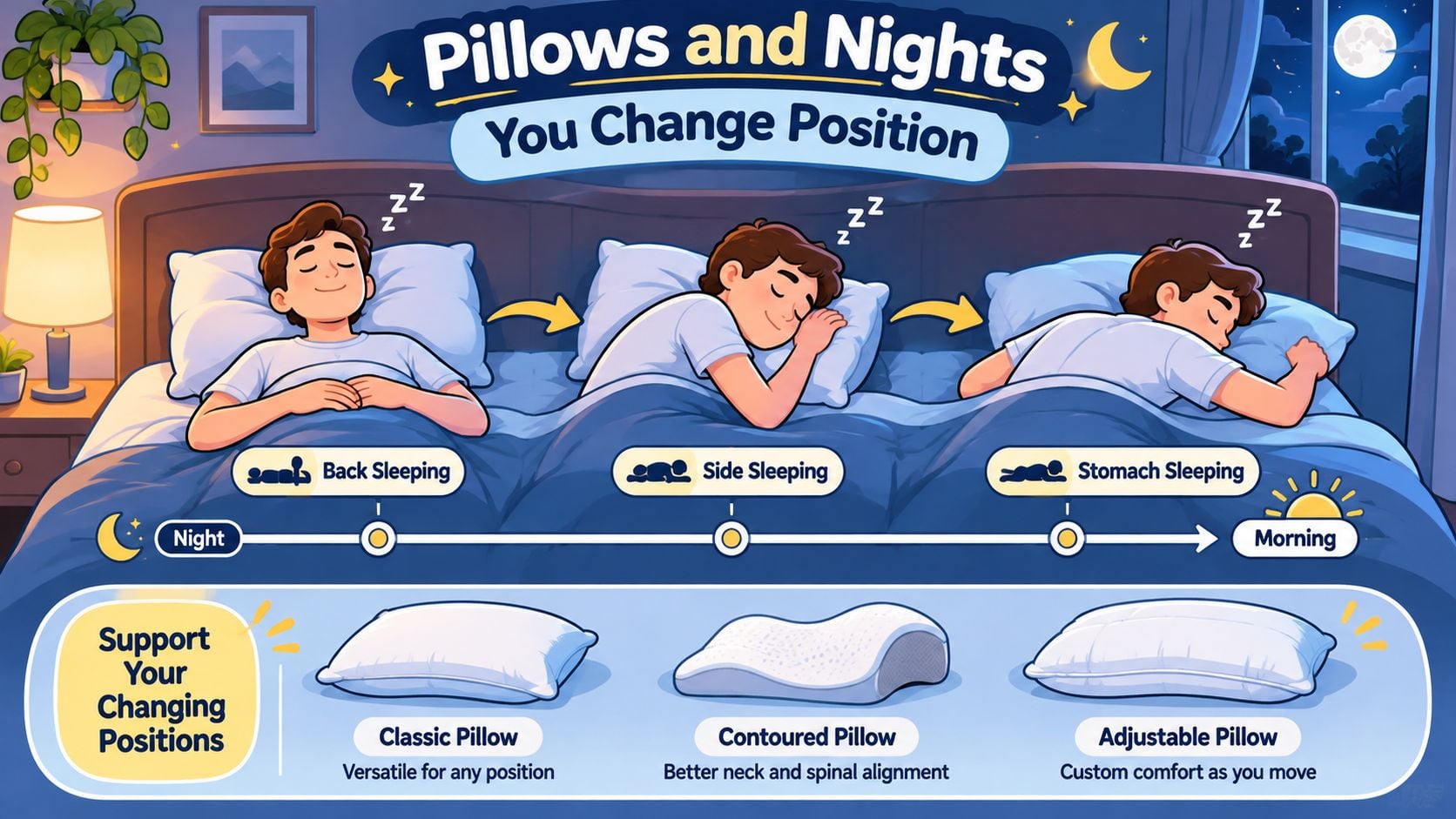
A tall pillow top raises the whole body and changes the loft the neck needs. Recheck the pillow after the mattress passes the hip test, not before.
When the fix is fewer hours prone
A 2025 systematic review indexed in PubMed's review of sleep position and low-back pain linked prone sleeping with low-back-pain risk and pointed toward supine or supported side-lying positions for better spinal health. That's worth saying plainly: the strongest fix is sometimes fewer hours on the stomach, not a more specialized bed.
A morning decision rule keeps this simple.
- Neck pain first thing: change the pillow loft before you shop for a mattress.
- Lumbar ache on rising: revisit firmness and how much of the night is spent face down.
- Both: handle the pillow, then retest the bed, in that order.
What sleep tracking can and can't tell you
Personalization is where the category is heading. A 2026 National Sleep Foundation report paired survey responses with more than 190 million nights of in-home smart-bed data, and separate summary reporting found that 8 percent of respondents wore a sleep tracker while 6 percent had purchased a smart mattress. Those figures describe interest in the technology. They don't prove any mattress is medically better for a stomach sleeper.
Skip the sleep-score marketing. The honest signals are morning symptoms, how often the position changes, and a real trial period on the bed. Pillow selection deserves its own pass once the mattress is settled, and this guide to the best sleep pillows covers loft by position.
Choose Your Mattress in Dyer or Crown Point
The whole decision fits in one pass. Choose the medium-to-firm band that matches the weight row, favor a hybrid or a supportive innerspring over a deep plush pillow top, and buy only the Beautyrest or Harmony Lux feel that kept the pelvis level during the prone test. If neck pain was the main complaint, set pillow loft before replacing the bed at all.
Nobody has to settle for one feel across a whole mattress. Sizes run from Twin and Twin XL through Full, Queen, King, and California King, including split Queen, split King, and split California King when partners need different support. A split configuration is the practical way to design a sleep setup around two different bodies rather than compromising both.
Our family has served Northwest Indiana since 1983, with multigenerational ownership and five-star service from showrooms in Dyer and Crown Point for neighbors in St. John, Schererville, and Munster as well. Special financing, subject to credit approval, provides buying power that fits a budget without a quoted rate, and white-glove delivery takes the mattress from the floor to the bedroom.
Customers can call or text the furniture and mattress experts while narrowing a shortlist, which beats arriving with fifteen tabs open. Visit Groen's Fine Furniture in Dyer or Crown Point today to explore our custom options and ask about our special financing plans. Let our family help you create a home you love.
A medium-to-firm mattress, a thin pillow, and a ten-minute prone test settle most of this question before a single night is spent. Groen's Fine Furniture stocks Beautyrest, Serta, and Harmony Lux builds across the firmness range, including the split sizes that let two different sleepers share one bed, and the team will lay the same foundation under each candidate so the comparison is honest. Stop by Groen's Fine Furniture in Dyer or Crown Point, lie on three beds in your own sleeping position, and let the hips decide.