Executive Desk Wood Guide for Home Offices

The spare room finally has a purpose. In Dyer and Crown Point, that usually means a door that swings inward, a window on one wall, a closet that needs to open, and a chair that needs room to roll back. A photo of a dark wood executive desk gets saved to a phone, and the tape measure comes out a week later than it should.
Wood is the right instinct for that room. It's warm on camera, it ages instead of wearing out, and it feels like furniture rather than equipment. What gets skipped is fit, because a handsome top can still be the wrong workstation when the room can't take the footprint, the apron steals legroom, or the lumber was never given room to move.
For households across St. John, Schererville, and Munster, the home office also works two shifts. It's a credible backdrop for a nine o'clock call and a comfortable place to type for six hours after that. Executive desk wood choices reward the buyer who checks clearance, seated fit, and moisture before grain and stain. Those checks go in a particular order, and the first one happens on the floor with a roll of tape.
Room Size and Clearance for a Wood Executive Desk
A desk can fit against a wall and still crowd the room once chairs, drawers, and doors are in use. Start with the full working area, not just the desktop. The OSHA computer workstation purchasing guide gives an executive-office planning range of 105 to 130 inches by 96 to 123 inches when three to four people meet around a desk, or about 70 to 111 square feet of surrounding office area. For one worker with a credenza or filing cabinet alongside, its range is 60 to 72 inches by 60 to 84 inches.
These are planning figures, not building requirements. Use them to picture how the desk, people, and storage share the floor, then check the actual room and furniture dimensions.
| Situation | Planning size | What it covers | Check before you buy |
|---|---|---|---|
| Meeting around the desk, 3 to 4 people | 105–130 in by 96–123 in | About 70–111 sq ft of office area | Guest chairs and a clear path |
| One worker plus credenza or files | 60–72 in by 60–84 in | Primary desk and side storage | Door swing and window light |
| Knee and foot room | 17.6 inches of knee depth, 24 inches of foot depth, and 20.8 inches of knee-clearance width | Chair and leg clearance under the apron | Thick aprons that steal knee room |
What each row asks of your room
The meeting row is easy to overlook. A desk may fit within the stated width, yet guest chairs need room to pull back. Mark out the chairs' positions and the path around them, then check whether anyone would bump into a bookcase or block the doorway.
For a single worker, include the credenza, printer, or filing cabinet in the floor plan. A desk facing a wall opposite the door may keep the entry path open, but first check whether it blocks window light or leaves drawers unable to open fully. The workspace planning guide for scaling startups explains how square footage per person is calculated, a useful way to consider a home office shared by two people.
Legroom deserves its own measurement. The OSHA guide recommends 17.6 inches of knee depth, 24 inches of foot depth, and 20.8 inches of knee-clearance width. It also advises keeping a monitor at least 20 inches from the eyes, using a matte desktop finish to reduce glare, and choosing a rounded or sloping front edge where forearms rest. A decorative apron can take up room beneath the top, so measure the clear opening under the desk, not only its outside width.
Tape it first. Mark the desk footprint with painter's tape, then allow 30 to 36 inches behind it for chair roll-back. Open every nearby door and drawer to see whether they meet the desk or chair.
A tape measure helps, but a floor outline makes clearances easier to judge at a glance. The step-by-step guide to measuring furniture covers what to measure and record before choosing a piece. Include the desktop, the space under its apron, and the room needed to sit and move comfortably. A wood executive desk serves as a working surface first, so room to use it matters as much as its appearance.
Desk Styles for Spare Rooms and Shared Offices
There's a layout for every room shape, and the differences are practical rather than decorative. Two desks can wear the same stain and behave nothing alike under a keyboard, so it helps to see the underlying build before picking a silhouette.
The double-pedestal executive desk
Two pedestals hold files on both sides and leave the kneehole open in the middle. Widths commonly land between 60 and 72 inches with 30 to 36 inches of depth, which suits a dedicated room and reads as a real office on a call. In a Crown Point house where a former dining room became the office, this is the piece that anchors the space, provided the meeting row in the planning table fits.
The writing table in a smaller spare room
A lighter apron and one shallow drawer bank make a writing table the answer for a tight spare room that still wants a wood presence on camera. Storage moves to a bookcase or a low credenza behind the chair, which often looks calmer anyway. Clearance checks come first here, since a slim top that blocks the closet door is no improvement on a laptop at the kitchen island.
The partner desk for two people
Two people face each other across a single top. It works when spouses share an office, or when an owner takes calls from one side and keeps paper on the other. This layout needs the larger planning zone and a mid-tone finish both users can live with for years, so a very dark stain is usually the wrong call.
The L-shape and the desk-plus-return
An L-shaped top, or a main desk with a return, keeps the monitor on one leg and paperwork on the other. That's the practical answer when one surface can't be both typing height and a meeting table, and it sidesteps corner glare without a fight.
Pair any of these with a low credenza or bookcase behind the chair instead of stacking the desktop with paper. Shared and commercial rooms get specified in similar combinations, and the Pacific Mobile Structures furniture catalog shows how desks, tables, and seating are grouped for a room that has to serve several people. Made-to-order solid wood, including Amish desks built to a chosen length, species, and finish, is how a sloped ceiling or an odd alcove gets a piece that fits instead of a standard that almost fits. Locking drawers, one cable grommet rather than a row of them, and a wood modesty panel earn their keep on daily calls.
Match one style to one reader. A pedestal desk for a true office, a writing table for a tight room, a return for mixed paper and screen work.
Solid Hardwood or Veneer Under the Finish
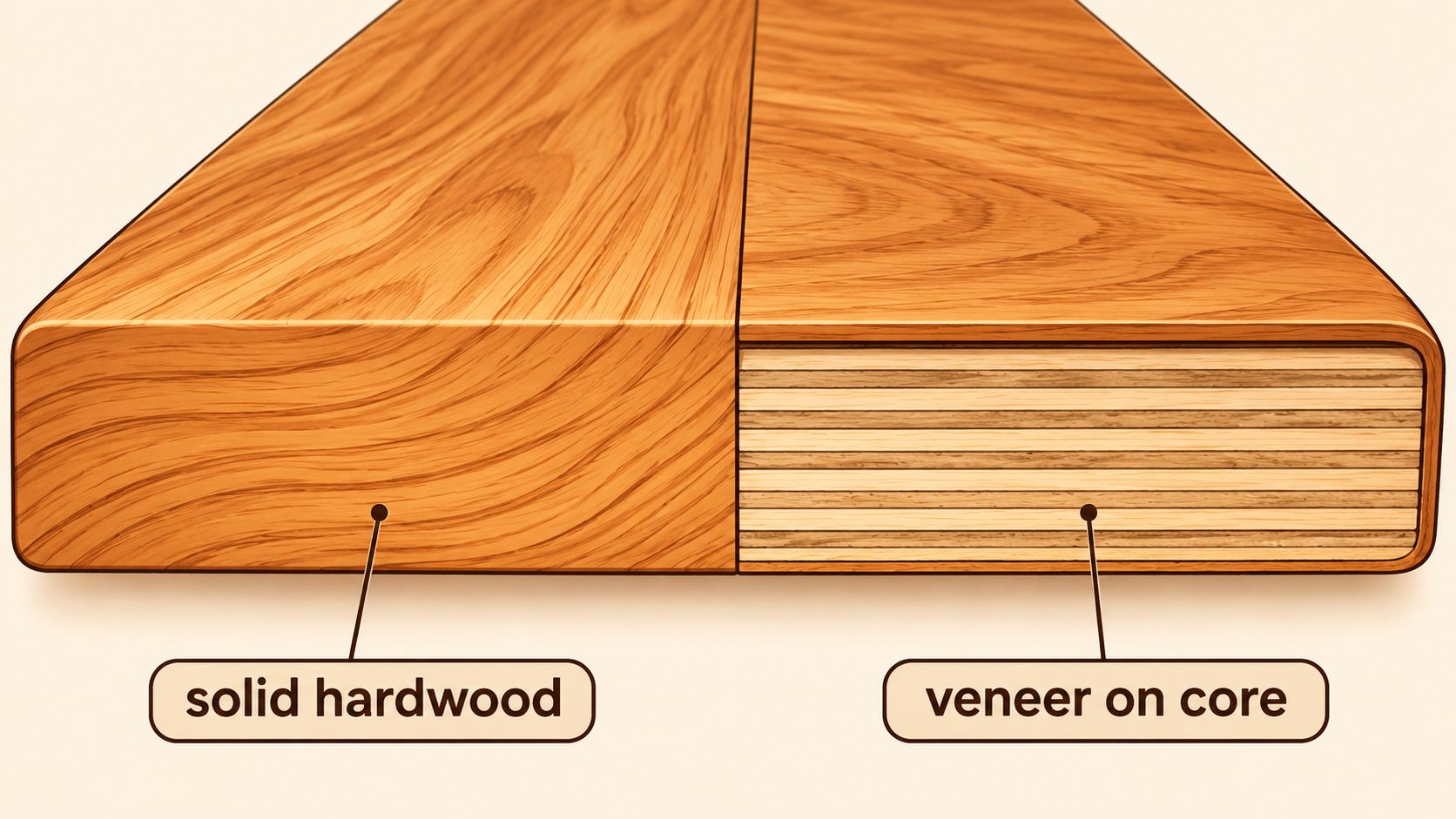
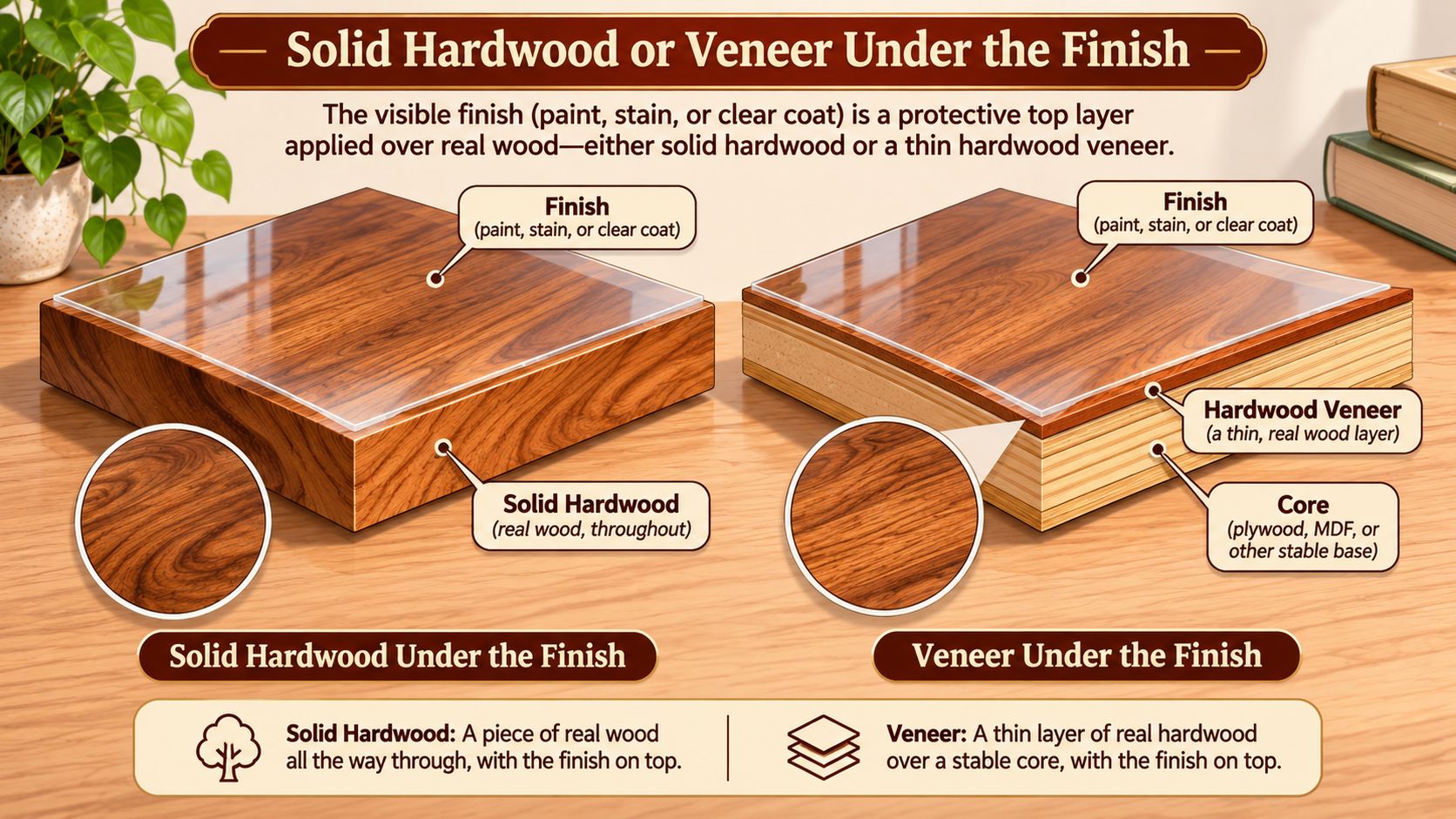
A desktop can look like solid wood while having a different construction underneath. A solid top is lumber through its full thickness. Veneer is a thin slice of real wood bonded to a plywood or particleboard core. Both can be well made, so check the edges and underside to see what supports the working surface.
What the market says about solid stock
U.S. furniture industries consumed 6.2 million cubic meters of sawn hardwood lumber in 1999, 3.3 million cubic meters in 2013, and about 1.2 million cubic meters in 2019. That is roughly an 80.6 percent decline from 1999 to 2019, based on the figures in the U.S. Forest Service market review. The review also reports that more than 70 percent of nonupholstered furniture consumed in the United States is imported. Solid hardwood is a substantial material choice in a market where imported furniture makes up a large share.
What solid buys, and what it costs
Solid stock can be sanded and refinished, giving a desk more options for repair as its surface wears. The trade-off is that a solid top must be built to accommodate wood movement. Seasonal changes in humidity can make wood expand or contract, so the construction needs room for that movement rather than rigidly holding a wide top in place.
When assessing a desk, ask which parts are solid where the weight lands: the legs, aprons, and top. A wood skin over a hollow core is built differently from veneer over a stable panel. Check an unfinished edge or drawer side for clues about the underlying material, and ask what can be repaired or refinished.
The sustainability wrinkle
Solid wood is not automatically the lower-impact choice. A life-cycle assessment of 25 furniture pieces published in Scientific Reports found that pre-production accounted for 42.25 percent to 99.98 percent of total life-cycle impact, averaging 76 percent. The assessment identified wooden-board production and electricity as hotspots for desks. The material label alone cannot settle the comparison: durability, repair, and how long a desk stays in use also matter.
For more detail on panel construction, this guide to engineered wood furniture explains how cores are made and where they suit daily use. Then inspect the desk itself. Ask what can be refinished, what can be replaced, and which parts are solid wood.
Wood Species and What They Change in Daily Use
Wood is still the default desktop material, accounting for 42.1 percent of a global executive desk market valued at $4.8 billion in 2025, according to MarketIntelo's executive desk market report. Within that group, the species decides what the top looks like after five years of mugs, rings, and laptop corners rather than under showroom lighting.
| Wood or build | Look and hardness | How it ages | Best when |
|---|---|---|---|
| White or red oak | Open grain, hard, takes stain clearly | Stays relatively stable in color | Family office with daily wear |
| Hard maple | Tight pale grain, very hard | Stays light; stain can blotch | Light rooms and heavy laptop use |
| Black walnut | Rich brown, softer than oak | Color is deep from the start; dents show sooner | Formal look with a desk pad |
| Cherry | Fine grain, medium hardness | Deepens from light to reddish brown | Patient traditional rooms |
| Mahogany-type hardwood | Fine traditional grain | Holds a formal dark tone | Classic executive styling |
| Veneer over a stable core | Even face, lighter weight | Face is thin, so deep sanding is limited | Wide tops where flatness matters |
Picking a row from the way the desk gets used
White and red oak carry open grain and high hardness, and they take stain clearly, which is why a family desk in a house with teenagers usually lands there. A dent in oak reads as texture rather than damage.
Hard maple is tighter and paler, very resistant to dents, and a good match for a light room with a laptop on it most of the day. Maple can blotch if the stain is rushed, so ask whether the maker seals the wood before coloring it.
Black walnut looks like the classic executive top on day one and shows impressions sooner because it's softer than oak. Pair it with a desk pad and accept that a walnut top records its history.
Cherry starts lighter and deepens toward reddish brown as light reaches it, a patient finish rather than an instant dark stain. It suits a traditional room where the desk will stay put for twenty years.
Mahogany-type hardwoods read formal, with fine grain and a deep tone. Ask where the stock comes from and whether it's certified or traceable, because the species name alone says nothing about the source.
Veneer over a stable core belongs in the same scan when the goal is a wide, flat top with a consistent face. It's lighter to move and steadies a long span, at the cost of limited sanding later.
A simple default. Oak or maple for a desk that meets coffee mugs and laptop corners. Walnut or cherry when the room is formal and the top stays covered.
Grain should answer to the rest of the house. A cherry bedroom suite or a chestnut hall bench nearby will fight a cool gray office top unless the contrast is the point. Matching a species to a room's light and existing furniture is covered in more depth in choosing the right hardwood for longevity and style. A made-to-order piece lets a buyer name the species and finish instead of accepting the sample on the floor, which matters most when the desk sits beside furniture the family already owns.
Moisture Movement and a Finish That Lasts
A desk can fit the room and still develop a raised edge or a split if its top is fastened without room to move. Solid wood exchanges moisture with indoor air, swelling as humidity rises and shrinking as it falls. Indoor humidity can differ considerably between winter and summer, so a desk needs construction that accommodates those changes.
For furniture, cabinetry, and millwork, the U.S. Forest Products Laboratory recommends a final moisture content of approximately 6% to 8%, according to its guidance on wood and moisture. Below the fiber-saturation point, wood loses bound water from its cell walls and shrinks; in more humid air, it swells again. The change is greatest across the grain, not along the board's length.
The same guidance on wood and moisture gives typical radial shrinkage of about 2% to 6% and tangential shrinkage of about 7% to 12% from green to oven-dry, while longitudinal shrinkage is usually only 0.1% to 0.2%. Those figures describe a broad moisture change, not what a desk does in an ordinary room. They help explain why a wide top needs space to expand across its grain, even though its length changes very little.
Construction that lets a top move
A wide solid-wood top needs fasteners that hold it to the base while allowing cross-grain movement. Elongated fastener holes and figure-eight fasteners are two ways to do this. If a rigid base locks the top in place, stress can show later as a split apron, cracked joint, raised edge, or gap between boards. Ask whether the lumber was kiln-dried, checked for moisture after machining, and allowed to adjust to the room before assembly.
A finish slows moisture exchange. It does not stop movement, so the joinery still has to allow for it.
A continuous finish on exposed surfaces, including the underside, edges, and cutouts, slows moisture gain and loss. The Forest Service wood handbook explains that this can reduce uneven moisture changes that contribute to cupping and checking. For a working desk, look for a clear coating with documented resistance to abrasion, water spotting, and ordinary cleaners. Use a mat or coaster beneath hot or wet items.
For drawer fronts and modesty panels, ask how the boards are cut and finished, rather than assuming the cut alone will prevent visible movement. If an older desk needs repainting, shellac sealer before repainting woodwork explains how a sealer can help keep tannins from bleeding through a new coat. For ongoing care, guidance on cleaning and caring for wood furniture covers cleaners, humidity, and habits that help preserve a film finish. Before buying, ask whether a scratch can be blended locally or requires refinishing the entire top.
A Fit Test for Real Workdays
A desk can look authoritative and still hurt by two in the afternoon. Traditional executive styling often arrives with a fixed top height, a thick apron, a sharp square front edge, and pedestals that stop a chair from rolling in close. None of those traits show up in a product photo.
The same problems repeat across home offices. A peer-reviewed evaluation of 41 workstations found frequent issues including laptop-only use, nonadjustable chairs without armrests, monitors set too low, and hard desk surfaces, published in the home-office workstation study. Its recommendations are plain: monitor at eye height, keyboard positioned so the forearms stay roughly parallel to the floor, and a soft or rounded front edge where arms rest.

Five checks before the desk comes home
- Sit first, in your own chair. Note elbow height with the shoulders relaxed, not lifted toward the keyboard.
- Match the top to the elbows. The desktop should meet them so the forearms stay about parallel to the floor. If it sits too high, everything downstream compensates badly.
- Roll in and check the arms. Armrests should clear the apron and both pedestals, and the chair should tuck in far enough that the screen isn't at arm's length.
- Put the monitor at eye height. A riser or an adjustable arm solves a top that's right for typing and low for the screen.
- Rest your forearms on the front edge for a full minute. Reject a sharp square edge. Wrist and shoulder discomfort shows up before it registers as a decision.
Occasional letter-writing and six-hour computer days are different jobs for one surface. When the handsome main top can't do both, a keyboard tray, monitor arm, or small task return costs less than replacing the desk. A sit-stand accessory helps some people, though it only earns its place if the wood top and its clearance still work when the user is seated, which is most of the day in many home offices. The guide to the office desk height standard explains where a fixed top typically lands and how much adjustment is worth asking for.
A desk that photographs well and hurts by two in the afternoon isn't a value at any price.
Visit the Showroom and Design It Your Way
A desk can look right and still be wrong for the room or the workday. Before choosing one, check that its footprint leaves a clear path around the chair, its wood suits the way you'll use the surface, and its construction allows the top to move with changes in moisture. Then consider how it feels when you sit at it. A good-looking desk that blocks a door or makes computer work uncomfortable is not a good fit.
Groen's Fine Furniture has served Northwest Indiana since 1983, with showrooms in Dyer and Crown Point. Sales associates can help you find the right item, and custom orders offer room to match furniture to your style. Most of the furniture sold can be customized, though options depend on the collection.
- Custom orders. Groen's welcomes custom orders, and associates can help you explore suitable choices. Canadel's dining program offers thousands of combinations, as shown in Canadel's catalog. Its customization FAQ explains that customization does not mean every item can be made fully bespoke.
- Special financing. Financing is subject to credit approval and can help spread the cost of a suitable purchase over time.
- Local experience. The staff has decades of combined sales experience. Groen's is family-owned, and its five-star reviews reflect its customer-first approach.
A showroom visit gives you a chance to examine the details that are hard to judge in a photo: the grain, the finish, the edge, and how the desk feels as a working surface. Bring your room measurements and consider how the desk will fit your routine. Groen's also offers a premium delivery service.
Home Office products include desks, office chairs, office storage, and bookcases. Explore custom options and ask about financing at Groen's Fine Furniture in Dyer or Crown Point.