Entertainment Room Furniture: A Complete How-To Guide

A family in Dyer finally has the basement they've wanted for years. The television is mounted, the game consoles are ready, and everyone has a different opinion about where the sectional should go. The room looks almost finished, but the first movie night reveals blocked walkways, awkward viewing angles, nowhere to put controllers, and seating that isn't comfortable for longer than a few minutes.
That situation is common in Northwest Indiana. Good entertainment room furniture should support movie nights, gaming, reading, visiting, and everyday relaxation. It shouldn't turn a family room into a fixed theater that works for one activity and nothing else. Groen's Fine Furniture has served NWI families since 1983, helping homeowners in Dyer, Crown Point, St. John, Schererville, and Munster create comfortable rooms with lasting, personal character.
Planning Your Ideal Entertainment Space
The Dyer family started with a familiar idea: place the largest television on the longest wall, add a large sectional, and fill the remaining space with tables. That plan sounded simple until they marked the basement's traffic path and realized that a reclined seat would interfere with the doorway. Their children also needed room for gaming, while one parent wanted a quiet reading corner.
The better solution was to plan the room around activities instead of equipment. A flexible arrangement can include a sectional for group viewing, a movable ottoman for games, an occasional chair for reading, and storage that keeps controllers and blankets within reach without making the television the only visual focus. Families looking for broader ideas about adaptable rooms can browse Aureli Construction family spaces for additional inspiration.
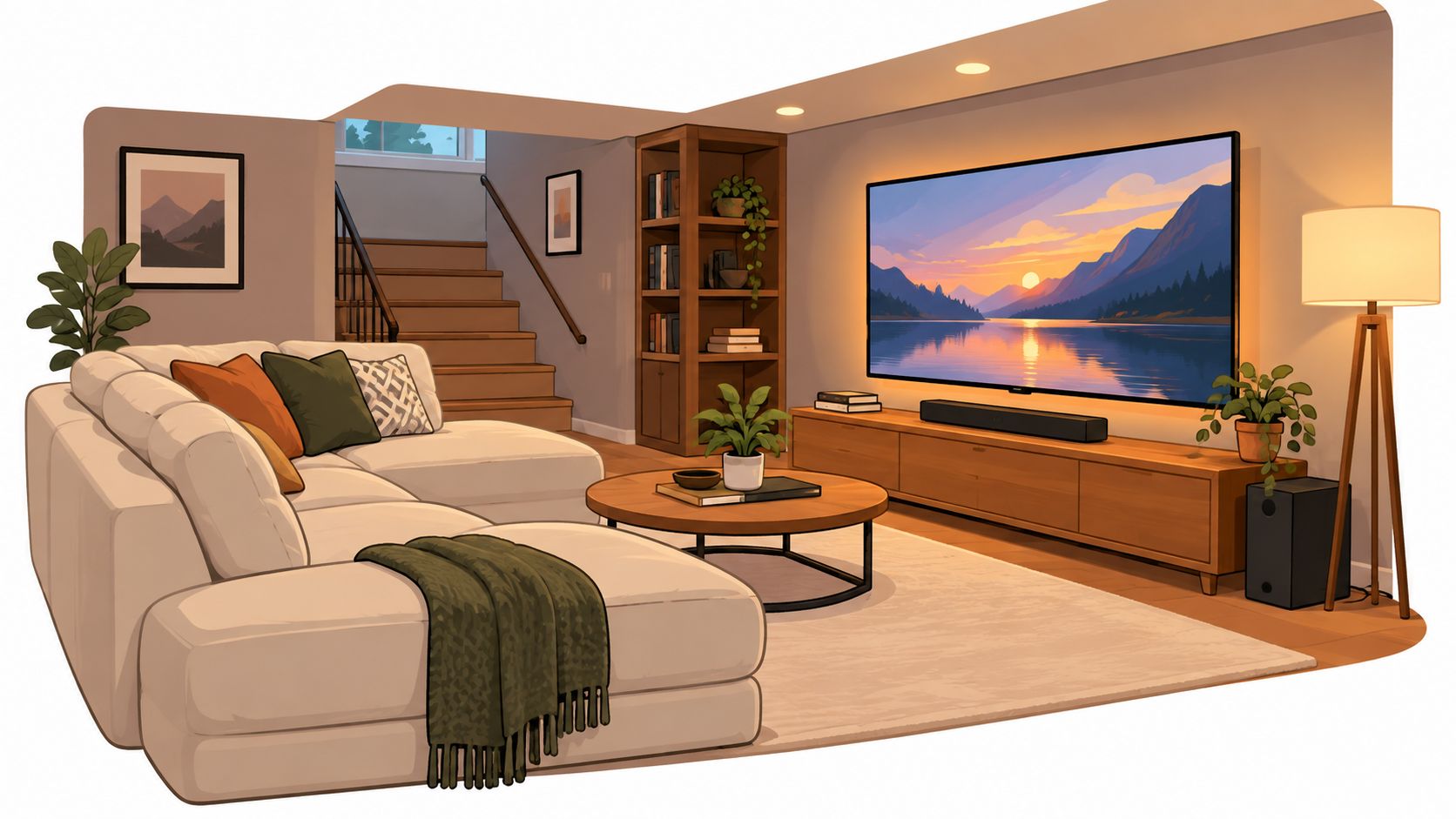
Televisions remain the anchor of most entertainment spaces. Nielsen estimated 125 million U.S. television households for the 2023–24 season, representing just under 97% of U.S. households (Nielsen). That scale explains why furniture has moved beyond the single television cabinet. Coordinated systems now combine media consoles, shelving, recliners, sofas, sectionals, and occasional tables.
Start with the room, not the showroom
Measure the room's walls, doorways, windows, outlets, vents, and walking routes before choosing a piece. Mark the television wall and identify where people naturally enter, leave, and gather. A beautiful console won't solve a layout that forces everyone to walk in front of the screen.
Then list the room's real uses. A great room in Crown Point may need open seating for guests, while a bonus room in Schererville may need flexible pieces that can shift between gaming and family gatherings. A basement retreat in St. John might benefit from storage-heavy furniture and softer upholstery.
Practical rule: If the room needs to serve more than one purpose, choose movable or modular pieces before specialized theater seating.
Planning for change matters, too. Electronics evolve, children grow, and families rearrange rooms. A sofa-and-chair arrangement or modular sectional can adapt more easily than a permanent row of theater seats. The strongest layout feels immersive during a movie but remains welcoming when the screen is off.
Measuring for Comfort and Sightlines
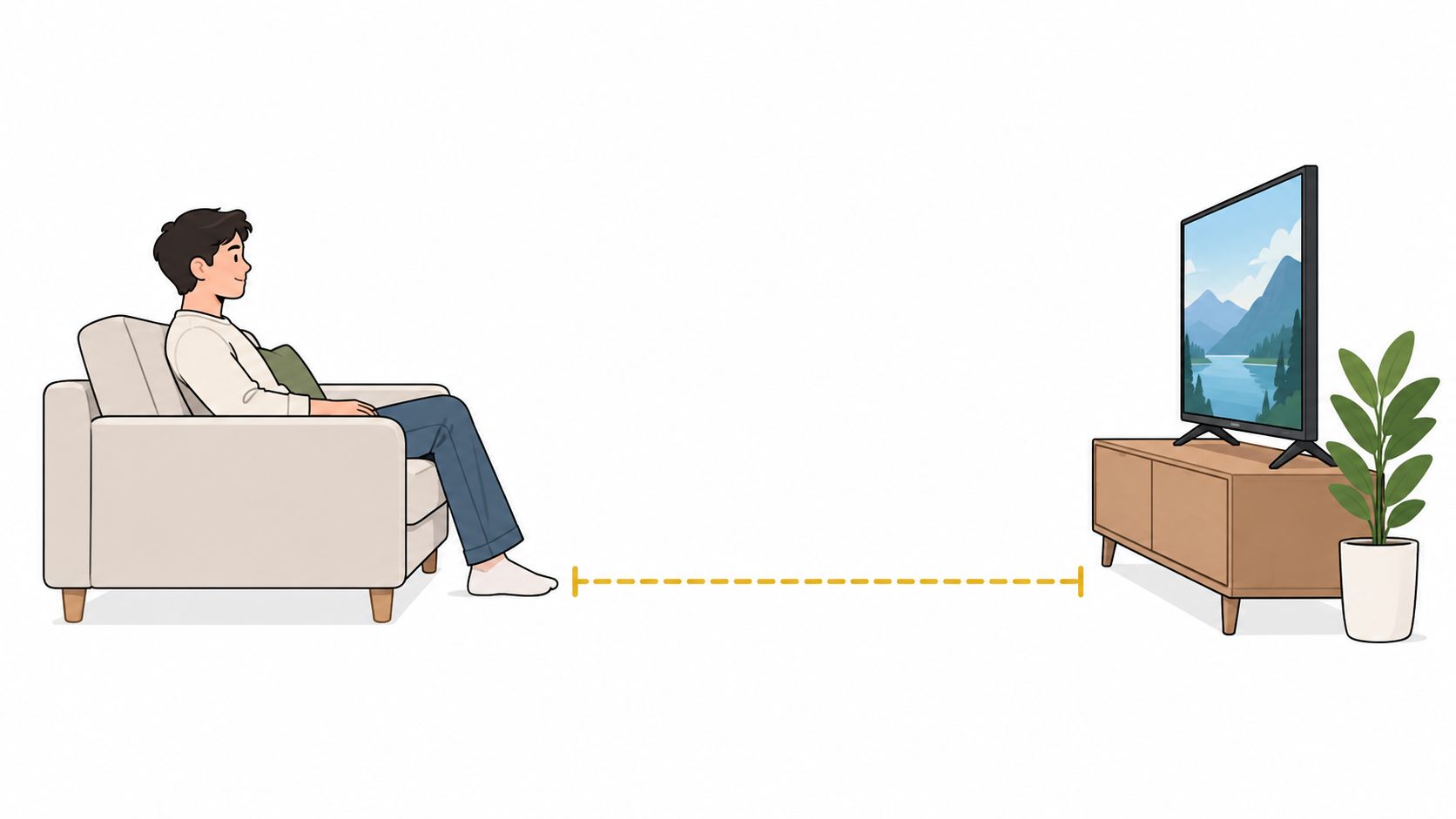
Furniture dimensions alone don't determine viewing comfort. The critical measurement is the distance from the seated eye position to the screen plane, not from the back of the sofa. A deep sectional, a recliner, and an upright chair place the viewer's eyes in different locations, so each seat needs to be considered before the layout is finalized.
SMPTE ST 2080-3:2017 specifies a nominal viewing distance of 3 to 3.2 picture heights from the display center for HDTV image evaluation (SMPTE standard). For a 16:9 screen, picture height equals diagonal size multiplied by approximately 0.49. A 65-inch display therefore has a picture height of about 31.9 inches, producing a reference viewing distance of roughly 7.97 to 8.50 feet.
Use a repeatable measurement
- Measure the screen. Record the television's diagonal size and calculate picture height by multiplying it by approximately 0.49 for a 16:9 display.
- Calculate the reference range. Multiply picture height by 3 and then by 3.2. Convert the resulting distances into feet.
- Mark the seated eye point. Place a temporary chair or use the actual sofa depth. Measure from where the viewer's eyes rest, especially if the seat reclines.
- Check every primary seat. Confirm that corner seats, chairs, and recliners have clear sightlines without forcing viewers to twist their necks.
- Test before ordering. Use painter's tape on the floor to mark the screen, front edge of the furniture, and walking paths.
A sectional can create excellent family seating, but its corners often sit at an angle to the screen. A sofa paired with chairs may provide more consistent sightlines and easier movement. Recliners offer excellent personal comfort, yet their extended footrests require careful clearance.
Homeowners who want a more detailed placement process can use this guide to calculate the best placement for your sofa and television. The key is simple: design the television, seating, and circulation as one system rather than selecting each item independently.
Choosing the Right Seating for Your Family
Seating determines whether an entertainment room feels generous or cramped. A large sectional creates a natural gathering point for movie nights and visiting, while a sofa-and-chair arrangement usually gives a room better flexibility. Modular seating sits between the two, offering a configuration that can change as the family's needs change.
A household that hosts extended family may prefer a broad sectional with a durable performance fabric. A couple using a compact living room in Munster may get more value from a sofa and two occasional chairs, preserving open floor space for movement. A dedicated gaming area may benefit from individual recliners, provided the room still has a clear path and a comfortable place for guests who aren't gaming.
Compare the main options
| Seating choice | Best fit | Main advantage | Watch carefully |
|---|---|---|---|
| Sectional | Family rooms and open basements | Creates shared seating and defines the room | Corner sightlines, depth, and traffic flow |
| Sofa and chairs | Flexible living spaces | Makes conversation and rearrangement easier | Chairs may need to move for screen viewing |
| Modular sofa | Rooms likely to evolve | Sections can be reconfigured | Pieces must remain visually and physically cohesive |
| Recliners | Personal comfort and long viewing sessions | Supports relaxed posture and individual control | Recline clearance and cable placement |
| Mixed arrangement | Families with varied habits | Combines lounging, reading, gaming, and guests | Scale must be balanced across every piece |
Quality construction matters more than a dramatic showroom appearance. Flexsteel is a practical choice for shoppers prioritizing durability, while performance fabrics help busy households manage spills, pets, and frequent use. Solid wood frames and quality upholstery also support a longer service life, particularly when cushions or covers can be cleaned, replaced, or refreshed.
The most specialized seat isn't automatically the best family seat. The best choice is the one that supports the room's most common activities without blocking the less frequent ones.
Comfort should be tested in the posture the household uses. Someone who watches television upright may need different support from someone who reclines, reads, or naps. Before ordering, families should sit fully back, extend a recliner if applicable, check arm height, and consider whether the seat remains comfortable when used for conversation.
Groen's team also provides practical guidance through five things to look for in a new sofa or chair. That kind of evaluation keeps a purchase focused on support, scale, fabric, and daily use instead of appearance alone.
Selecting Media Consoles and Storage Solutions
A media console has four jobs: support the screen, organize equipment, manage cables, and anchor the room visually. A console that's too narrow can look overwhelmed by the television, while one that's too shallow may not safely support the display or accommodate components. The right piece should also leave ventilation around electronics and provide storage for controllers, remotes, games, blankets, and books.
Start by measuring the television base, not just the screen. Choose a stand wider and deeper than the base, place the display toward the rear of the top surface, and confirm that doors and drawers won't interfere with cables or ventilation. A custom entertainment center can add shelving and closed storage where a standard console would leave unused gaps.
Cable management deserves attention before delivery. Homeowners can review these residential cable management tips for ideas about routing, separation, and access. A useful furniture design includes channels or openings that let cables reach outlets without hanging across walkways.
Make safety part of the design
The U.S. Consumer Product Safety Commission investigated at least 363 furniture, television, and appliance tip-over fatalities from 2000 through 2011. Approximately 82% of reported victims were younger than eight, televisions were on furniture in 64% of incidents, and only 9% of televisions were anchored (CPSC investigation).
Anchoring should be specified during the furniture order, especially for custom or Amish-built entertainment centers. The installation sequence should include:
- Select a stable base: Use a stand wider and deeper than the television base.
- Position the display carefully: Keep it toward the rear of the top surface.
- Secure the television: Use manufacturer anchor points when available.
- Anchor the console: Attach it to a wall stud or approved structural point.
- Control the cables: Route them so children can't pull on them.
- Test the installation: Apply moderate forward force and correct any movement.
Drywall-only fasteners, weight-based stability, and television-only anchoring aren't enough. Children may climb shelves or pull cables, so open storage should be placed thoughtfully and heavier items should stay low.
For rooms with a difficult corner, a properly sized corner media console can use space efficiently without forcing the screen into an awkward angle. The best storage solution keeps technology accessible while making the room feel like a comfortable living space rather than an equipment station.
Enhancing Atmosphere with Lighting and Acoustics
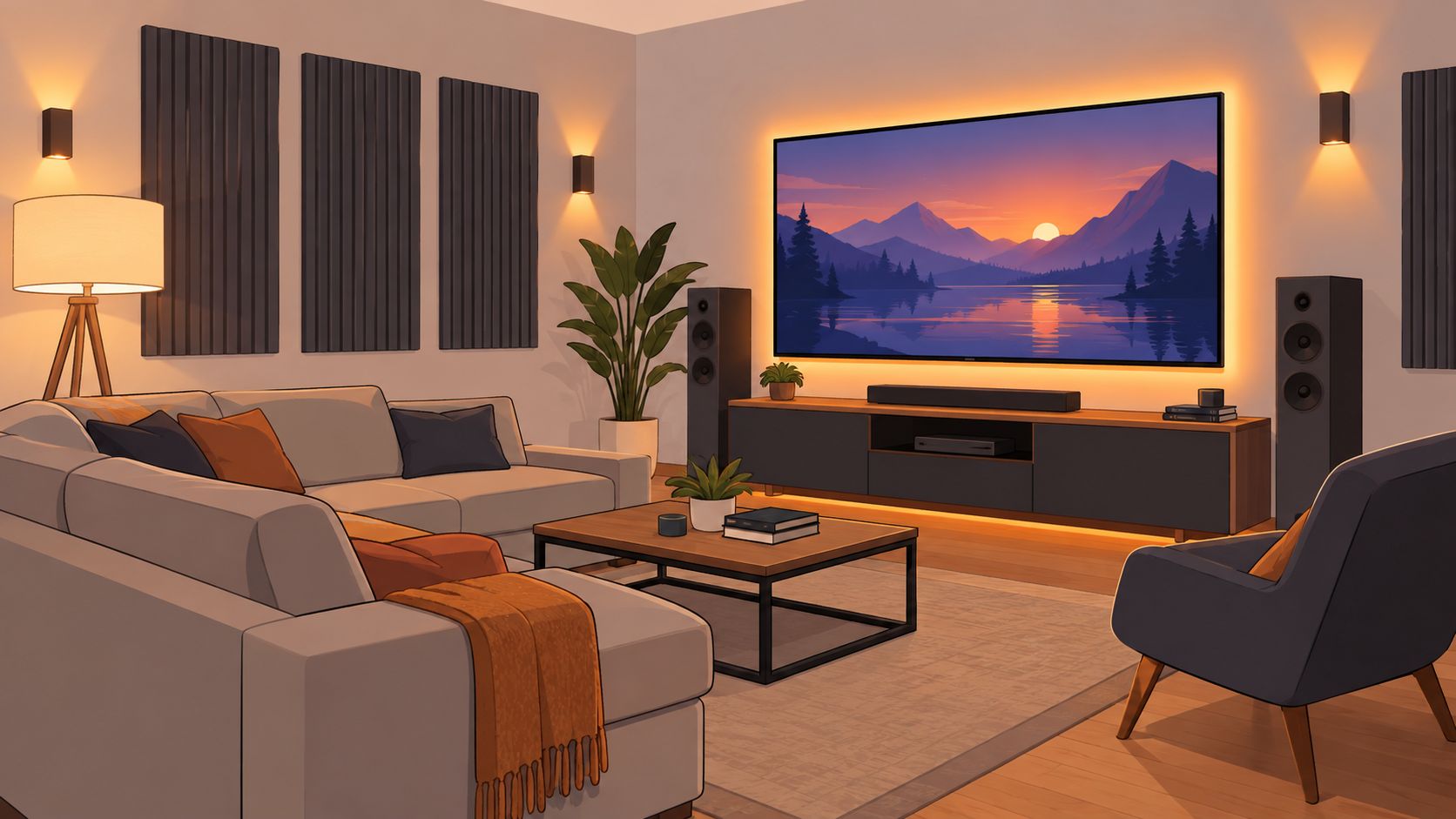
A room can have excellent furniture and still feel uncomfortable if the lighting creates glare or the sound bounces harshly from bare surfaces. The strongest entertainment spaces use layered lighting, soft furnishings, and deliberate placement to support both screen viewing and ordinary family life.
Ambient lighting should provide general visibility without shining directly onto the screen. Floor lamps and table lamps can illuminate seating areas, while dimmable fixtures let the household shift from homework or conversation to a quieter movie setting. Accent lighting behind shelving or beneath a media unit can highlight furniture without becoming a competing focal point.
Let soft materials do practical work
Rugs, curtains, upholstered seating, and fabric shades absorb reflections that hard floors and bare walls send back into the room. These materials can make dialogue easier to follow and help the space feel warmer, without requiring a commercial theater treatment.
Wall panels can also become a design feature. Homeowners considering decorative illumination can explore Dublin painters on 3D wall lighting for ideas about combining texture and light. The important point isn't to copy a theater look. It's to use lighting and surfaces that make the room comfortable when the television is on and attractive when it isn't.
A practical arrangement might use a warm lamp beside a reading chair, low accent light around shelving, and filtered daylight at the windows. The television should remain free from direct reflections, while the seating area should be bright enough for conversation and safe movement.
The furniture's finish also affects atmosphere. Natural wood brings visual warmth, performance upholstery softens large seating pieces, and coordinated occasional tables keep drinks and remotes within reach. More ideas for improving brightness and comfort are available in this guide to putting a living room in the best light.
Investing in Quality and Custom Options
A room built for everyday family life deserves furniture that can handle everyday family life. The cheapest-looking solution often becomes the most frustrating when cushions flatten, hardware fails, finishes date quickly, or a changing television setup leaves the piece unusable. Longevity starts with construction, but it also depends on repairability, adaptable sizing, and a finish the household will continue to enjoy.
Amish Furniture offers solid-wood craftsmanship and made-to-order possibilities for homeowners who want a piece sized to a specific wall or coordinated with existing furniture. Flexsteel supports shoppers focused on durable seating, while Bassett offers style flexibility for rooms that need a more custom visual direction. These choices are not interchangeable, and the right one depends on whether the priority is construction, configuration, upholstery, or finish.
Customization solves real room problems
Canadel's UDesign system allows buyers to select a dining table's color, shape, size, and finish, with multiple dimensions, different shapes, more than two colors or finishes, and selections from other Canadel collections documented in its catalog (Canadel catalog). The same design mindset applies to an entertainment room. A coordinated dining and living area can share finishes without forcing every piece into a fixed showroom configuration.
Custom order services are especially valuable when a room has an unusual wall, a tight corner, a specific storage need, or a strong preference for solid wood. A homeowner doesn't have to settle for a piece that is almost right. The better approach is to define the room's measurements and daily demands, then select a bespoke, made-to-order configuration that fits.
Groen's Fine Furniture offers custom furniture guidance that helps families compare these choices through custom furniture made simple. Special Financing, subject to credit approval, can also provide additional buying power for shoppers who want quality furniture while fitting the purchase into a household budget. Terms and availability can change, so families should ask the showroom team for current details.
Quality doesn't mean overspending blindly. It means choosing solid construction, serviceable components, durable upholstery, useful storage, and a configuration that can remain relevant through changing electronics and family routines.
Visit Groen's to Bring Your Vision to Life
A family in Crown Point may arrive with a room sketch and leave with a clearer plan after testing several seating depths. A homeowner from Dyer may discover that the preferred recliner needs more clearance than expected, or that a sofa-and-chair arrangement creates better sightlines than a large sectional. Those discoveries are difficult to make from a screen.
A showroom visit gives shoppers the chance to sit upright, recline fully, compare fabrics, inspect wood finishes, and judge scale beside other pieces. It also creates room for practical questions about cable access, storage, delivery paths, anchoring provisions, and future rearrangement. White-Glove Delivery can help carry the project from selection to installation, while Interior Design guidance can connect the entertainment room with the rest of the home.
Groen's Fine Furniture serves Northwest Indiana from showrooms in Dyer and Crown Point. The family-owned business has built its local legacy since 1983 through multigenerational ownership, five-star service, custom order options, American-Made and solid-wood furniture, and personal guidance. Nearby families in St. John, Schererville, and Munster can bring room measurements, television details, fabric preferences, and photographs to make the conversation more productive.
Mattress shoppers can also use Groen's Helpful Mattress Guide when an entertainment room update becomes part of a larger home-comfort project. The CDC recommends a bedroom that is dark, quiet, cool, and comfortable, with a temperature of about 65–68°F for many people, and advises using a comfortable mattress and pillow (CDC sleep guidance). The same guidance identifies creaking, lumps, a depression where someone sleeps, or waking with stiffness as signs a mattress may need replacement.
The best entertainment room isn't the one filled with the most specialized pieces. It's the one that supports real family habits, feels comfortable every day, and can adapt when those habits change.
For flexible entertainment room furniture, custom Amish solid wood, Flexsteel and Bassett seating, and personal help with layout, fabric, storage, and delivery, visit Groen's Fine Furniture in Dyer or Crown Point. Bring the room measurements and television details, test drive the comfort, and ask the team about Custom Furniture options and Special Financing subject to credit approval.