How to Find a Sectional Sofa Sleeper for Small Spaces


For homeowners in Dyer, Crown Point, St. John, Schererville, Munster, and throughout Northwest Indiana, the living room often has to work harder than its square footage suggests. It may be the family gathering spot, a movie room, a home office, and the place where overnight guests sleep. A sectional sofa sleeper for small spaces can solve that overlap, but only when the piece fits the room in both sofa mode and bed mode.
The mistake is choosing by wall length alone. A comfortable sleeper must preserve everyday circulation, support healthy rest, and suit the household's real routines. The right planning process makes it possible to gain useful sleeping space without turning a welcoming living room into an obstacle course.
Why Compact Sectional Sleepers Matter in Smaller Homes
A homeowner in Crown Point may need a guest bed for visiting family but have no spare bedroom to dedicate to it. A family in an older Dyer home may want generous seating without blocking the path to the kitchen. In both situations, the important question isn't whether a sectional sleeper looks compact in a photograph. The question is whether it can handle daily sitting, occasional sleeping, and normal household movement without asking the room to give up too much.
Housing age and type help explain why these decisions vary from one NWI home to another. A U.S. Census analysis of housing by year built found that single-family homes built in the 1960s or earlier have a median current size of 1,500 square feet, compared with 2,200 square feet for homes built from 2005 to 2009. That difference is 700 square feet, or approximately 46.7%, so a living room in an older home may face very different furniture constraints from one in a newer detached house. Multifamily homes are more compact still, with units built in the 1960s or earlier showing a median size of 800 square feet, compared with 1,100 square feet for multifamily homes built from 2005 to 2009, according to the same analysis.
One footprint, several responsibilities
A compact sectional sleeper can replace the need for a separate sofa and guest bed, leaving more floor area available for circulation, play, or a desk. That benefit comes with trade-offs. A chaise may provide a comfortable place to stretch out but reduce the room's usable path. A pull-out bed may offer a more familiar sleeping surface but require substantial open floor area. Storage inside the sectional can help keep bedding nearby, but it can also affect the frame and configuration.
Small-space living is also part of a wider housing pattern. The United Nations World Urbanization Prospects reports that cities are now home to 45% of the world's population, totaling approximately 3.7 billion people within a global population of 8.2 billion. Earlier UN reporting estimated that 54% of the global population lived in urban areas and projected that the share could reach 66% by 2050, with urban populations potentially increasing by 2.5 billion people. Those figures use different methodologies, so they shouldn't be treated as one continuous series, but they do show why multipurpose furniture matters in many households.
Practical rule: A small room doesn't require small expectations. It requires a sectional that performs well in every position the household actually uses.
Before shopping, readers can review Groen's sectionals buying guide and consider broader small-room organization ideas in these storage tips for small children's bedrooms. The useful takeaway is simple: reduce competing furniture, protect movement, and select pieces that earn their floor space.
Measuring Your Room and Planning the Layout
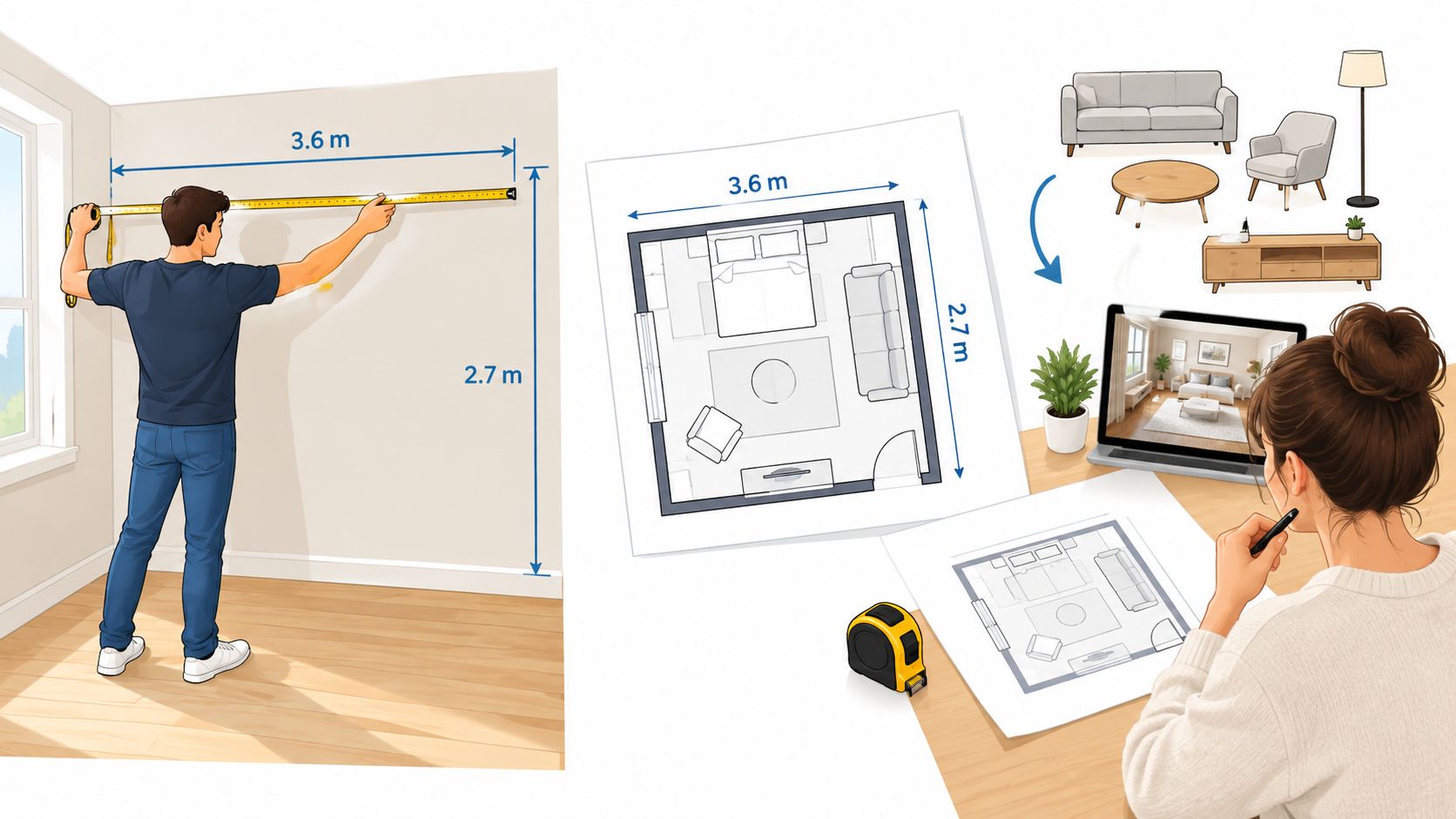
A sectional sleeper should be measured twice, once as a closed sofa and again as a fully opened bed. Many disappointing purchases begin with a wall measurement that looks safe until the mattress extends across a doorway, covers a vent, or leaves no practical route to the kitchen.
A scale floor plan, even a simple one made with paper or painter's tape, gives a more reliable answer.
Build the measurement worksheet
Record the following before visiting a showroom or placing an order:
- Room dimensions: Measure usable length and width, not just the broadest points.
- Ceiling height: This helps evaluate visual scale and delivery access.
- Doorways and halls: Record widths and note tight turns, stairwells, and low overhangs.
- Fixed features: Mark windows, vents, outlets, radiators, built-ins, and door swings.
- Existing furniture: Include coffee tables, desks, televisions, dining areas, and storage pieces that must remain.
- Sectional orientation: Note whether the chaise sits on the left or right when facing the sofa, and whether that orientation works with traffic.
The sectional measuring guide from Groen's can help organize these details before a showroom visit. A phone photo of the room, paired with a hand-drawn plan, can also help a furniture specialist understand what the measurements mean in practice.
Tape the open bed footprint
Mark the closed sectional first. Then extend the tape to show the complete sleeping surface, including the area required to walk around it and make the bed. Typical sectional pull-outs can require approximately 92 to 120 inches of open length and 88 to 104 inches of open depth, according to this sleeper-sofa clearance guide. A separate sofa-dimension guide notes that some sleepers need 80 to 95 inches or more from the rear wall to the end of the bed when opened, so the product's specifications must take priority over general assumptions.
Preserve approximately 30 to 36 inches for the primary circulation route, 18 to 24 inches for a tighter secondary route, and 14 to 18 inches between the closed sofa and coffee table. These are professional planning guidelines, not universal building-code requirements. The living-room furniture layout guidance provides useful context, but local conditions and product specifications still need to be verified.
The pass-or-fail test is straightforward. Every required route from the entry to the kitchen, bathroom, or exit should remain usable when the bed is open, and the bed shouldn't require another major piece of furniture to move.
Choosing the Right Configuration and Mattress Type
The best configuration depends on what the sectional needs to do most often. A household that hosts guests occasionally may prioritize an inviting sofa, easy conversion, and a mattress that feels supportive for a short stay. A household using the sleeper frequently needs to place more weight on sleep wellness, mattress support, conversion effort, and the ability to keep bedding organized.
A compact piece can conserve floor space yet still fail if the seat is too deep for upright sitting, the cushions feel overly firm, or the mattress leaves a guest waking sore. Those details matter more than a product label that only says “small.”
Match the layout to the room's traffic
A conventional L-shaped sectional can maximize seating along two walls, but the chaise may interrupt a route when the room has a central doorway. A reversible chaise offers more flexibility when the room may change or when the traffic pattern has not settled. Its advantage disappears if the chosen side places the chaise directly across the main path.
An armless sleeper can create a lighter visual profile and reduce the amount of structure near a passage. It may also provide less support for someone who prefers defined arms or a traditional lounge posture. A sectional with integrated storage can keep sheets and pillows close at hand, but the storage compartment should be easy to access without disturbing the room.
The conversion mechanism deserves a hands-on test. The person who will open the bed should be able to do so smoothly, without dragging the unit into a wall or shifting a heavy coffee table. If cushions need to be removed, the room needs a designated place to stack them.
Separate occasional guests from regular sleepers
Occasional guest use allows more flexibility, but it doesn't eliminate the need for a supportive sleep surface. A visitor may tolerate a compromise for a short stay, while frequent sleeping places greater importance on pressure relief, stable support, and a mattress that promotes restorative rest.
Groen's Helpful Mattress Guide offers a useful starting point for evaluating sleep needs. In a showroom, visitors should sit with feet supported, test the back angle, lie on the sleeper mattress, and notice whether the surface supports the body evenly. Serta and Beautyrest provide familiar mattress expertise for shoppers who want to discuss sleep comfort alongside living-room furniture.
Sleep wellness matters: The right question isn't only whether the bed fits the room. It's whether the household can convert it easily and whether guests can rest comfortably on it.
Seat depth, cushion firmness, mattress construction, and chaise orientation should be judged together. A shallower seat may work better for upright conversations and laptop use, while a deeper seat may suit relaxed lounging. A firmer mattress may offer stable support but feel less forgiving to some sleepers. No specification sheet can replace a posture and comfort test in person.
Custom Orders, Financing, and Delivery Planning
Standard dimensions rarely respect an older house, a condo hallway, or a living room with an inconvenient doorway. Made-to-order furniture gives shoppers more control over upholstery, modules, orientation, and dimensions, so the sectional can fit the room's circulation instead of forcing the household around a fixed design. Measure the route from the delivery entrance to the final position, then consider how much floor the sleeper occupies when opened. A sofa that fits on paper can still block a kitchen approach, doorway, vent, or daily walking path.
Customization solves functional problems here: choosing the configuration, cover, and scale that address the room's actual constraints. A furniture-market survey found that 81% of respondents said color customization was offered and 76% identified covering-material customization. Modular options and dimensions ranked close behind in the same furniture-market research report. Those findings support a practical small-space approach. Select materials and proportions according to traffic, household routines, and the space required for conversion.
Design for the room and the household
A custom order can address an awkward wall, a narrow approach to the kitchen, or the need for a performance fabric in a busy family room. Start with the way people move through the room each day. Mark the sectional's closed footprint, the sleeper's open projection, and the clearance needed to walk around it. This operational footprint often determines whether the bed will be used regularly or avoided because setup interrupts the household.
Groen's showroom team can help connect those measurements with fabric, seating, and configuration choices. Bring a room sketch, doorway measurements, and photos of tight turns. The frame, upholstery, seat support, sleeper mechanism, and service plan should match the household's expectations and the work the furniture must handle.
Special Financing is available subject to credit approval, which can provide additional buying power when a quality sectional, mattress, or coordinated room needs to fit a household budget. Financing terms can change, so review the current offer and conditions before deciding. Compare the full purchase and the service included, rather than choosing only by the initial monthly figure.
Prepare for white-glove delivery
Delivery planning should begin before the order is placed. A sectional sleeper may fit the living room yet fail at the front door, on a stair turn, or at the entrance to a basement family room. This couch delivery service guide offers useful reminders about access, handling, and placement.
The delivery conversation should cover:
- Access measurements: Confirm the entry door, hallway, stairwell, elevator, and tight turns.
- Removable components: Ask whether legs, backs, arms, or modular sections can be removed for access.
- Placement: Identify the final orientation and keep vents, outlets, windows, and door swings clear.
- Conversion test: Open the sleeper after placement to verify that the bed operates as planned.
- Floor protection: Clarify how flooring, corners, and thresholds will be protected during installation.
The custom-order starting guide can help shoppers prepare questions before selecting materials or dimensions. Groen's local showroom guidance and White-Glove Delivery keep the plan connected from room measurements through installation. Good delivery planning protects the furniture, preserves daily circulation, and makes the sleeper easier to use when guests arrive.
Styling, Maintenance, and Next Steps
A small living room stays comfortable when every decorative choice respects the sleeper's operating path. A low-profile coffee table can be easier to move or remove than a heavy table with a broad base. A rug sized for the primary seating area can define the room without extending into the bed's opening zone, and open floor near the sleeper keeps conversion from becoming a daily chore.
Visual restraint also improves function. Keep baskets, ottomans, lamps, and accent tables out of the bed projection. If bedding is stored inside the sectional, use a dedicated set of sheets and pillows so conversion doesn't require searching through closets or moving several accessories.
Maintenance protects both comfort and appearance:
- Follow upholstery instructions: Blot spills promptly and use the cleaning method recommended for the fabric.
- Check the mechanism: Watch for unusual resistance, loose hardware, or changes in alignment.
- Rotate the mattress when permitted: Follow the manufacturer's guidance to support more even wear.
- Test the bed periodically: A sleeper used only for guests should still be opened occasionally so the household knows how it operates.
Groen's Fine Furniture serves Dyer, Crown Point, and surrounding NWI communities with multigenerational ownership, five-star service, Interior Design guidance, and White-Glove Delivery. Further ideas for preserving style in a compact room appear in this guide to furnishing a small space without losing style.
Visit Groen's Fine Furniture in Dyer or Crown Point to test-drive sectional sleeper configurations, compare mattress comfort from Serta and Beautyrest, and review made-to-order upholstery and layout options. The showroom team can help homeowners from St. John, Schererville, Munster, and across Northwest Indiana plan delivery access and ask about Special Financing, subject to credit approval.