Extendable Dining Set Guide for Northwest Indiana Homes


A weekday dinner in a Dyer kitchen can feel very different from a holiday gathering in Crown Point. On an ordinary evening, a large dining table may crowd the walkway between the kitchen and living room. When family arrives, that same room suddenly needs to welcome extra chairs, serving dishes, and conversation. For homeowners across Northwest Indiana, an extendable dining set solves that mismatch by giving the household a comfortable everyday footprint and additional capacity when the occasion calls for it.
The right choice isn't just the table with the most seats or the most attractive finish. Room clearance, leaf storage, wood movement, mechanism access, chair comfort, and future repairability all affect whether the table remains useful for years. A careful selection process helps families in Dyer, Crown Point, St. John, Schererville, and Munster create a gathering place that fits real daily life.
Why an Extendable Dining Set Earns Its Place at Home
A homeowner measuring a dining room often faces a practical choice: accept a table that crowds the room every day, or choose one that feels too small when guests arrive. An extendable dining set changes that calculation. Its closed footprint supports ordinary routines, while its fully extended footprint provides additional seating when the household needs it.
The important measurement is not only the table in its compact form. Mark the table's full length with painter's tape, then add space for chairs to slide out and for people to walk around them. This simple test shows whether the expanded arrangement protects circulation or turns the dining area into a bottleneck. A table earns its place when both footprints work in the same room.
That flexibility helps a dining set serve changing routines without requiring a second table or a temporary surface in storage. A household may use the compact arrangement for meals, homework, or conversation, then open it for visiting relatives, game nights, or a larger shared meal. One well-built piece can support several patterns of life.
Flexibility with long-term value
The value of an extendable table is tied to more than its purchase price. Examine how firmly the top closes, whether the leaves align without force, and whether the runners move evenly. Hardware that is accessible for adjustment or repair can matter more over time than a low initial cost. A table that opens smoothly after repeated use is easier to keep in service.
Historical furniture shows that flexible seating has been a practical need for centuries. An English draw-top table from as early as the 16th century could use three leaves to double in length when more seating was required. Early tables made from oak, elm, walnut, or cherry also demonstrate how construction and material choices shaped long-term use. Britannica's furniture history
Practical rule: Size the table for the room's fully extended footprint, then choose the mechanism and construction that can support repeated opening, closing, and daily use.
That rule applies across NWI homes, from narrow eat-in kitchens to formal dining rooms. The strongest choice preserves circulation when closed, accommodates real gatherings when open, and remains dependable as the household's needs change.
How an Extendable Dining Set Actually Works
An extendable dining set is a table, commonly paired with chairs or a bench, that changes length or width through a built-in system. The table separates, creates an opening, and uses one or more leaves or panels to bridge that opening. Some leaves remain inside the table, while others are removed and stored in a closet, sideboard, or another protected location.
A useful visual analogy is a hardcover book. The closed cover represents the everyday tabletop. When the table opens, the two main sections move apart like covers flexing away from the spine, revealing room for the hidden “pages” that complete the surface. The analogy isn't exact, but it makes the central idea easy to picture: the additional surface is designed to appear when needed and disappear when the table returns to its compact form.
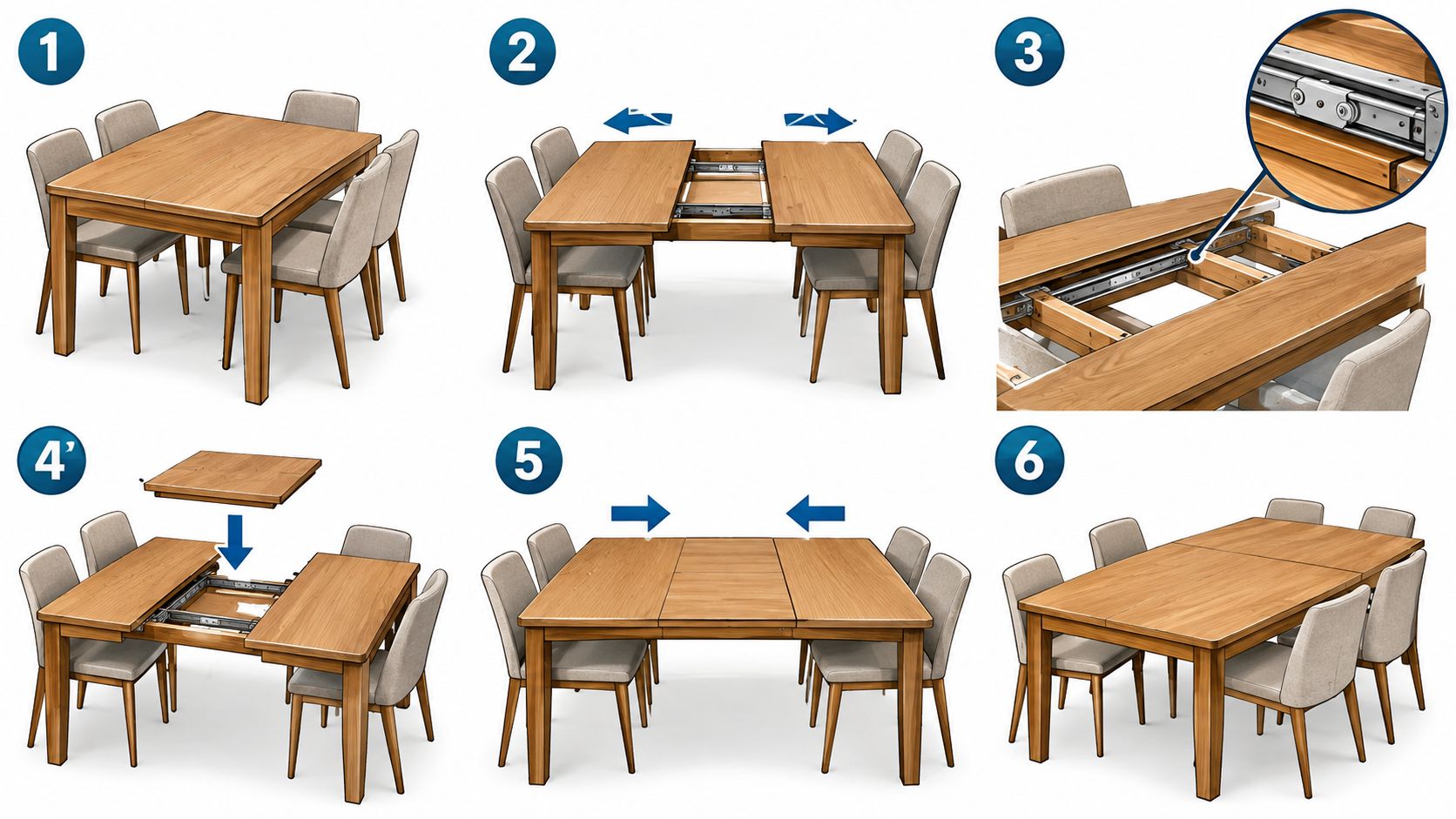
The basic opening sequence
- Clear the tabletop. Serving pieces, décor, and placemats can interfere with the opening motion.
- Release the locks. Many tables use catches or locking hardware beneath the top.
- Separate the sections. Runners guide the two halves apart in a controlled line.
- Position the leaf. A center leaf may lift into place, or a removable panel may be inserted into the opening.
- Close the seams. The tabletop sections move together until the leaf sits flush.
- Relock the structure. The finished surface should feel stable, without an obvious height difference between sections.
A self-storing leaf remains beneath the tabletop or inside the table body. A separate leaf must be carried to the table and stored elsewhere. Self-storage is convenient for a room with limited closets, while a removable leaf can allow a larger expansion if the homeowner has a suitable storage location.
The underlying principle is simple, but the quality of the runners, locks, joinery, and leaf fit determines whether the process feels smooth years later. The mechanism should open without force, align without repeated adjustments, and close securely after the leaf is removed.
Common Extension Mechanisms Compared
Different extension systems suit different households. A homeowner who opens a table only during an annual gathering has different priorities from a family that changes the configuration every weekend. The most convenient system isn't always the one that provides the greatest expansion.
A butterfly leaf folds at its center and stores inside the table. When the tabletop sections slide apart, the folded leaf unfolds and fills the gap. This built-in storage makes it attractive for smaller dining rooms and busy kitchens, because the homeowner doesn't need to carry a loose panel from another room.
A center-leaf system uses one or more removable leaves placed between the two tabletop sections. It can provide a substantial expansion, but the loose leaves need a dry, protected storage location. The homeowner should consider whether a sideboard, closet, or other furniture piece can support them without leaning or exposure to unsuitable conditions.
Some tables use end extensions that slide outward to reveal a concealed leaf. This approach can preserve a more continuous center surface and may appeal to design-focused buyers who prefer the extension lines to sit toward the ends. Drop-leaf and gate-leg designs take a different route, folding portions of the tabletop down for compact everyday use and raising them when additional surface area is required.
| Mechanism | How It Expands | Leaf Storage | Best For |
|---|---|---|---|
| Butterfly leaf | The tabletop sections separate and the hinged leaf unfolds into the opening | Inside the table | Small spaces and frequent hosts |
| Center leaf | The table slides apart and a removable panel is inserted | Inside the table or separately | Buyers seeking flexible expansion |
| End extension | Ends slide outward to expose or receive a hidden panel | Inside the table or at the ends | Design-focused rooms |
| Drop-leaf or gate-leg | Hinged sections lift or swing into position | Folded against or within the table structure | Compact kitchens and dining nooks |
| Separate slide-and-drop-in leaf | Sections move apart and a loose leaf drops into place | Closet, sideboard, or other protected storage | Larger expansion needs |
A self-storing system generally reduces daily handling. Separate leaves can offer more flexibility, especially when a homeowner chooses a single large leaf or multiple leaves, but storage and handling become part of ownership. More components also mean more opportunities to inspect alignment, support, and locking points.
The dining tables with leaves stored in the table collection provides a useful reference for seeing how integrated storage affects everyday convenience. Mechanism choice should follow actual habits, not just the number of seats shown on a showroom label.
Materials, Finishes, and Custom Craftsmanship
At the showroom, a closed table can look perfect under bright lights. The better test comes when the table is opened, wiped after dinner, and used through changing indoor humidity. The tabletop, runners, leaf supports, fasteners, and finish must function as one system.
Solid hardwoods such as oak, maple, walnut, and cherry bring different grain patterns, colors, and levels of visual character. Denser wood can suit mechanism housings and areas that receive frequent contact. Grain direction also affects how naturally an added leaf relates to the main top. The seam will remain part of the design, but careful grain selection makes the extended surface look deliberate rather than pieced together.
Wood responds to moisture. It absorbs humidity and releases moisture in dry conditions. A 24-inch-wide solid-wood panel can move by more than 1/8 inch between dry winter and humid summer conditions, with greater movement possible when indoor humidity changes substantially. This explanation of wood movement helps explain why floating panels, elongated fastener holes, and movement-tolerant joinery matter. These details give the wood room to shift without forcing the tabletop or extension hardware out of alignment.
What the finish contributes
A topcoat protects the surface from ordinary household use, while also shaping the wood's feel, sheen, and color. Catalyzed conversion varnish, oil-and-wax blends, and polyurethane create different combinations of surface texture and resistance. Ask how the finish will feel beneath a hand, how it will respond to regular cleaning, and whether small marks can be repaired without refinishing the entire top.
Upholstered chairs or benches add another material decision. Performance fabric can provide a softer seat while remaining practical for a dining room used every day. Its color and texture should relate to the wood finish, rather than compete with the table's grain.
High-quality veneer over a stable engineered core can offer consistent grain and useful dimensional stability. It deserves evaluation on its construction, not dismissal because it is not solid wood. Check how the veneer is applied, how the edges are finished, and whether the structure gives the extension hardware firm support.
| Material | Durability | Finish Options | Customization Potential |
|---|---|---|---|
| Solid hardwood | Strong heirloom potential when properly joined and maintained | Hand-rubbed, varnish, oil, wax, and polyurethane-style finishes | High, including species, stain, edge, and grain alignment |
| Quality veneer | Consistent surface and useful stability | Broad range of sheens and colors | Moderate to high, depending on the collection |
| Engineered core | Supports dimensional consistency beneath a finished surface | Coordinated painted or wood-look finishes | Varies by construction |
| Performance fabric | Adds comfort and practical seating support | Multiple colors, textures, and stain-resistant options | High for chair and bench upholstery |
Custom ordering lets a homeowner connect appearance with the table's working parts. Groen's Fine Furniture offers custom order paths with choices for wood species, stain, edge profile, chair upholstery, finish sheen, and leaf grain alignment. The same decisions can also clarify long-term value. A well-fitted leaf, properly supported extension, and finish suited to daily use may matter more over time than a lower initial price.
A dining room table finishes guide can help compare surface character before choosing a finish. The goal is a table that reads as one considered piece when extended, with craftsmanship that continues to make sense after years of opening, closing, cleaning, and hosting.
Sizing and Room Layout That Actually Works
You may measure a closed table, see comfortable space around it, and still discover a problem on dinner night. Once the leaves are fitted and chairs are occupied, the table's fully extended footprint becomes the dimension that governs the room. Size the set for that largest working shape, just as you would check a door's full swing rather than measuring only the door when it is closed.
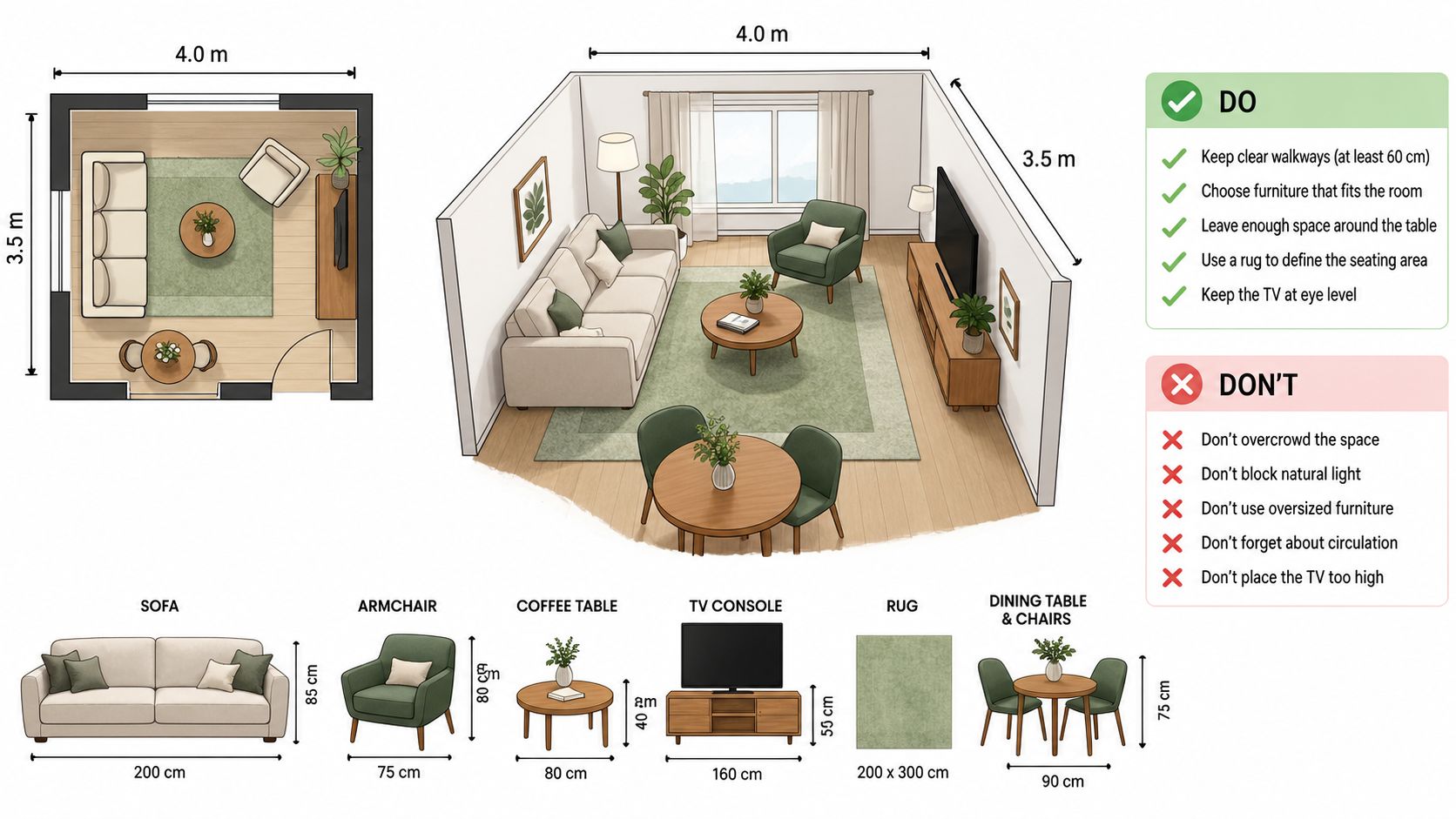
Begin with the room's clear dimensions. Measure wall to wall, then subtract permanent features such as a sideboard, counter, cabinet, radiator, or kitchen island. Allow at least 36 inches for pulling out chairs and moving around the table. Where people must pass behind seated guests, plan 42 to 48 inches. Reserve about 24 inches of table edge per diner, and use standard planning guidance for a tabletop height of roughly 29 to 30 inches with about 10 to 12 inches between the compressed seat and the underside of the table or apron. These allowances are outlined in this dining table space and clearance guide.
A practical floor test
- Measure the closed table. Record its actual length and width, rather than relying only on the stated seat count.
- Add every leaf. Work from the table's complete opened dimensions.
- Add chair depth. Include armrests, back shape, and any rear taper.
- Map the outline. Mark the fully extended table and chair positions with painter's tape.
- Walk the routes. Test access to the kitchen, doorway, hallway, and nearby furniture.
- Check serving access. Confirm that someone can reach the table without squeezing behind occupied chairs.
The tape outline is a useful reality check. A table can fit on paper while its extended corner blocks a pantry door, interrupts the route to the kitchen, or leaves no practical place to set down a serving dish. In an open-plan room, the kitchen island clearance and seating guide provides further context for judging the relationship between island seating, dining chairs, and walking space.
Comfort at the tabletop
A 20- to 24-inch extension may add seating for roughly two people, but the result depends on chair width, table shape, leaf width, end seating, and leg placement. A length label alone cannot confirm comfortable capacity, as explained in this practical buying guide.
For a room-specific check, use this dining table size guide to organize closed and extended dimensions, chair measurements, and circulation zones before ordering. This method also helps assess long-term value: a mechanism that opens smoothly, supports the extended surface properly, and fits the room in both positions can serve changing gatherings for years, regardless of its initial price.
Extendable Versus Fixed Dining Sets
A fixed table suits a dining room where the guest count rarely changes. Its top has a continuous surface, and its base does not need runners, locks, hinges, or leaf storage. Fewer moving parts can mean simpler daily use and maintenance. In a formal room with a stable routine, that straightforward construction may offer better value than unused flexibility.
An extendable dining set makes a different trade. Seams, hardware, and added construction allow one table to serve ordinary meals and larger gatherings. The practical test is the table's fully extended footprint. Mark the open length on the floor, place chairs around it, and check whether people can sit, stand, and pass without squeezing through the room. A compact closed size has little value if the open version cannot function comfortably.
| Factor | Fixed Table | Extendable Set |
|---|---|---|
| Everyday footprint | Permanently determined | Compact when closed |
| Hosting capacity | Limited to its fixed size | Grows when leaves are installed |
| Surface appearance | Continuous grain | May show seams or grain transitions |
| Hardware | Minimal moving hardware | Runners, locks, hinges, or supports |
| Storage | No extension-leaf storage | Integrated or separate leaf storage |
| Long-term value | Strong when needs remain stable | Strong when household needs change |
| Maintenance | Generally simpler | Requires mechanism inspection and care |
A fixed table may cost less at purchase, but the price tag is only one part of ownership. If a household grows or begins hosting more often, an undersized table may be replaced sooner. A well-built extendable table can remain useful as routines change. The reverse is also true: inaccessible hardware, unstable joints, or parts that cannot be replaced can turn a complex design into an expensive frustration.
Comfort depends on more than the table's length. Chair width, table shape, leaf size, end seating, and leg placement determine whether the added positions work in practice, as explained in this practical buying guide. Test both closed and open positions rather than judging capacity from a label alone.
Durability also includes repairability. Ask whether runners, locks, and other high-wear components are accessible, adjustable, and replaceable. Research on product longevity and repair decisions supports treating repair access as part of long-term value, not as an afterthought: This research on product longevity and repair decisions.
A homeowner who hosts occasionally may prefer one leaf and simple operation. Frequent entertainers may accept separate storage or a larger support system for added flexibility. Choose according to how often the table changes and whether its fully extended footprint works in the room.
Choosing the Right Configuration for Your Home
A useful decision starts with three questions: how much room exists when the table is open, how often the leaves will be used, and where the leaves will live between gatherings. Material and styling choices come after those practical answers.
A compact condo dining nook that occasionally hosts six may benefit from a round or oval configuration with a self-storing butterfly leaf. The internal storage avoids adding a loose panel to a limited closet, while a pedestal can reduce interference at the seating positions. A lighter finish, a modest edge profile, and armless upholstered chairs can preserve visual openness.
A growing family kitchen needing daily flexibility for four and weekend seating for ten may need a rectangular table with a sturdy center-leaf or telescoping system. The homeowner should tape the full footprint beside the island and confirm that the extended chairs don't block the main kitchen route. A solid maple, oak, or cherry top can provide a durable foundation, while a performance-fabric bench can add flexible seating along one side.
A formal dining room built for frequent entertaining can support a larger rectangular or oval design with one or more removable leaves. Separate storage may be acceptable when a sideboard or dedicated closet is available. A richer walnut or cherry finish, a shaped edge, and carefully matched chair upholstery can reinforce the room's formal character without sacrificing practical expansion.

The finish checklist
- Wood and construction: Compare solid wood, quality veneer, and engineered-core options according to the desired ownership horizon.
- Extension style: Choose internal storage for convenience or separate leaves when greater expansion justifies protected storage.
- Seating: Test chair width, arm clearance, upholstery, and legroom instead of relying only on the listed seat count.
- Appearance: Select the edge profile, stain, sheen, and grain direction so the extended surface feels cohesive.
- Room character: A homeowner drawn to restrained lines may find ideas in modern Japanese style dining, especially where visual calm and efficient proportions matter.
- Budget planning: Special Financing, subject to credit approval, can provide buying power for a custom-built, American-Made set without promising a specific rate or payment.
For additional planning support, this guide to picking the right dining room table can help connect dimensions, seating, shape, and personal style. A custom order becomes more useful when the homeowner arrives with the taped floor plan, chair measurements, preferred wood species, and a clear description of everyday and hosting needs.
Visiting Our Showrooms to Bring It All Together
A showroom consultation should feel like a planning conversation. Homeowners can bring room measurements, photos of the dining area, a sketch of door and island locations, and examples of finishes they already enjoy. Those details help a furniture specialist evaluate the table's closed and extended footprints instead of recommending a configuration based on appearance alone.
The most important tests happen in person. A shopper can open and close the mechanism to feel whether the runners glide smoothly, check how the locks engage, compare grain and finish samples, and sit in several chairs to judge posture and proportion. A tabletop that looks right from across the room may feel too high, too narrow, or too crowded once a person sits down.
Groen's multigenerational ownership has served Northwest Indiana since 1983, with showrooms in Dyer and Crown Point and service extending across NWI, including St. John, Schererville, and Munster. The showroom locations give homeowners a place to compare Canadel custom dining, Amish solid wood craftsmanship, chair upholstery, finishes, and extension systems with personal guidance.
The team can also discuss White-Glove Delivery, custom furniture options, and Special Financing subject to credit approval. That hands-on process supports a more durable decision, because the homeowner can test the table before committing to the configuration that will serve family meals and NWI gatherings for years.
Visit Groen's Fine Furniture in Dyer or Crown Point to explore custom extendable dining sets, Canadel dining, and Amish solid wood options sized for the home's fully extended footprint. The family-owned team can help compare mechanisms, finishes, seating comfort, White-Glove Delivery, and Special Financing subject to credit approval, so each household can create a dining space it will enjoy for years.