Blog
Home Decor Accent Pillows: Design & Care Guide


You have the sofa, coffee table, and rug in place, yet the room still feels unfinished. For homeowners in Dyer, Crown Point, and throughout Northwest Indiana, the right home decor accent pillows can add the softness, texture, and personality that turn a furnished room into a welcoming one. The key is to treat pillows as part of the room's architecture, not as last-minute color patches.
A well-made pillow also has a lifecycle. Its insert determines shape, its cover affects comfort and care, and a thoughtful replacement strategy can refresh a room without replacing major furniture. The most satisfying results come from matching each choice to the sofa, the room's purpose, and the way the household lives.
Why Your Living Space Needs a Finishing Touch
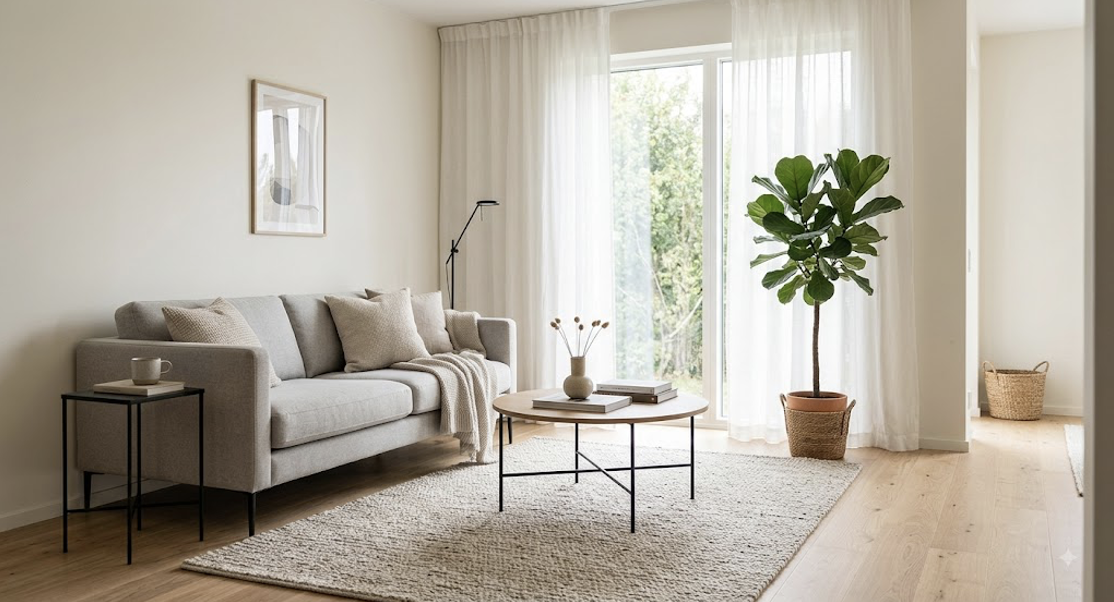
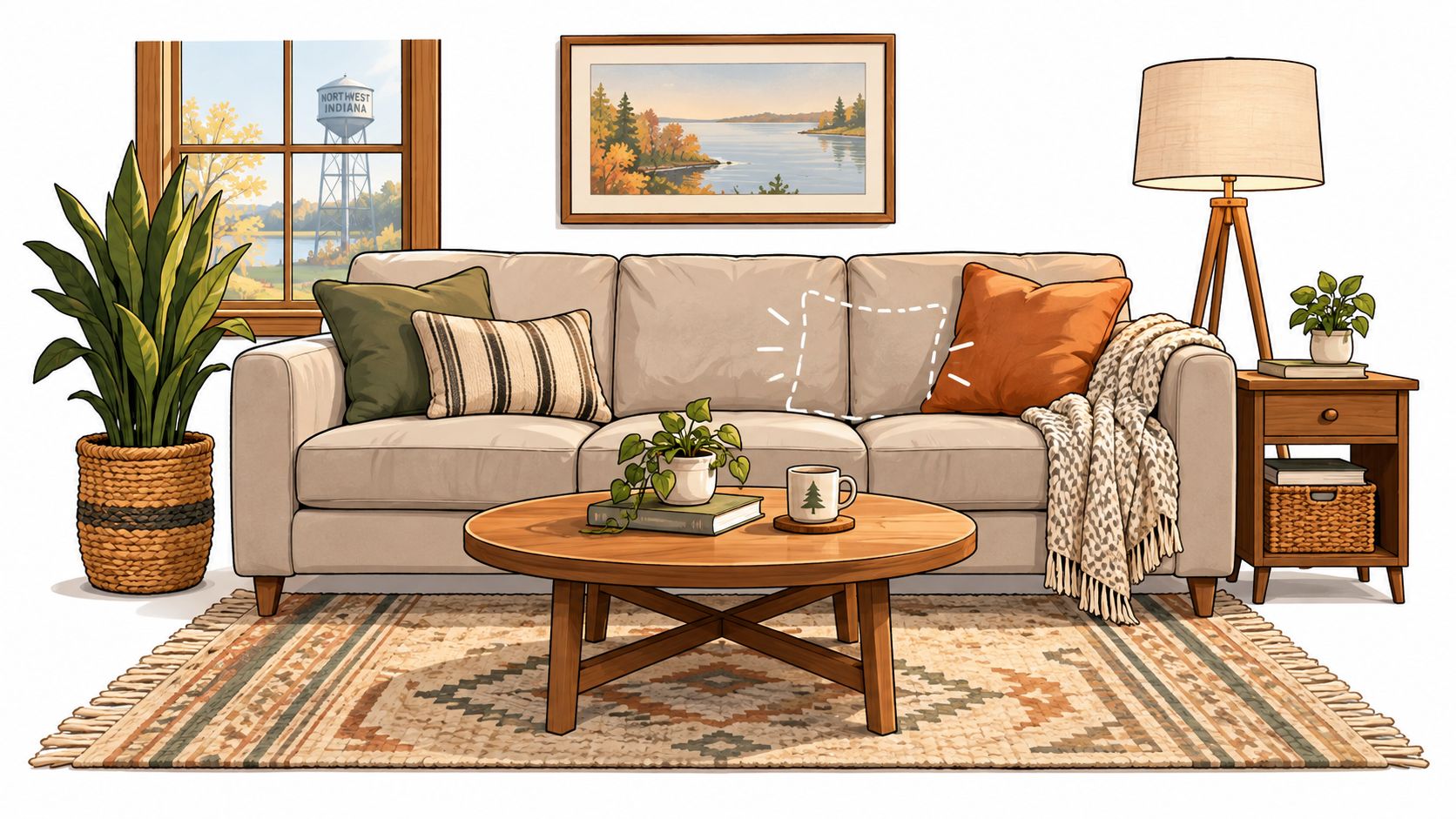
A neutral sofa can be comfortable and well-proportioned while still looking a little anonymous. Add a pair of textured pillows, a patterned lumbar, and a smaller accent in a color pulled from the rug, and the same seating arrangement gains depth. The furniture hasn't changed. The room has a clearer point of view.
That transformation matters in homes across NWI, where living rooms often need to serve several roles, from quiet evenings to family gatherings. Pillows soften firm upholstery, support the lower back, and give guests an easy visual cue that the seating is meant to be used. They can also help connect a sofa to nearby artwork, window treatments, rugs, or wood finishes. For broader guidance on balancing wall pieces with furnishings, Aroma Warehouse landscape art tips offer useful perspective on scale and placement.
More than a color accessory
Interior styling becomes stronger when pillows perform several jobs at once. A substantial square can anchor the arrangement, a smaller shape can create a front layer, and a contrasting weave can keep a monochromatic room from feeling flat. Traditional rooms may benefit from precise piping and classic motifs, while modern spaces often suit cleaner edges, restrained patterns, and sculptural texture.
The category itself has grown far beyond occasional embellishment. The global decorative pillow market was valued at $10.56 billion in 2025 and is projected to reach $17.56 billion by 2034, at a projected compound annual growth rate of 5.8%, according to DataIntelo's decorative pillow market overview. Residential use represented 72.5% of demand, while Asia Pacific accounted for 38.2% of revenue, showing that accent pillows belong to a substantial, home-focused category rather than a niche decorating habit.
The history is just as revealing. Pillows were used sparingly as accents in the 1920s until later in that decade, as described in a design-history discussion referencing House Beautiful, while decorative pillows now represent about 22% of the broader pillows market, according to Business Research Insights. Their role has shifted from occasional ornament to an accessible way to adjust comfort and character.
Understanding Sizes, Inserts, and Fill Materials
A cover only shows part of the pillow. The insert determines whether that cover looks crisp and lifted or loose and wrinkled, so shoppers should evaluate size, fill, and fabric together rather than buying by appearance alone.
The most widely used sizing rule is simple: choose an insert about 2 inches larger than the finished cover on each side, such as a 20-by-20 insert for an 18-by-18 cover, according to Pillow Inserts 101. Smaller covers and many lumbar shapes often need an insert about 1 inch larger, while oversized covers measuring 24 by 24 and above may suit an insert about 3 inches larger.
Practical rule: Measure the finished cover, not the empty packaging label, before choosing the insert.
Size changes the visual weight
An 18-by-18 pillow usually works well as a front layer on a sofa or as a compact chair accent. A 20-by-20 pillow has more presence and can anchor a deeper seat. Larger euro-style shapes create a broad backdrop, especially on a bed or generously scaled sectional, but they can overwhelm a narrow chair.
A full look also depends on construction. For a 22-by-22 pillow with 5-inch loft, one technical method estimates 1,815 cubic inches of fill volume using a 0.75 compression factor, converting that volume to about 26 ounces at 0.0143 ounces per cubic inch, as detailed in Handmadelytics' pillow construction guide. The same guidance warns that underfilling can collapse corners and create wrinkles, while overfilling raises seam stress.
Fill changes the experience
Feather-down inserts provide a relaxed, sink-in feel and can be reshaped by hand. Polyester fiberfill generally creates firmer support and a more stable outline, which may suit a lumbar pillow or a chair that needs structure. Decorative inserts may also use feather, down alternative, or polyester constructions, and many listings pair polyester fill with a cotton or poly-cotton shell, as shown in this polyester accent insert example.
For a technical comparison, medium decorative inserts are commonly described around 0.50 ounces per cubic inch, while firmer supportive options can reach roughly 1.50 ounces per cubic inch. Premium hollow conjugated fiber guidance describes 7D x 64 mm siliconized fiber, fill weights of 500 to 600 grams for standard pillows and 600 to 750 grams for firmer king-size builds, with a stated ±5% fill-weight tolerance and ±0.5D fiber-denier verification, according to VN Polyfiber's manufacturing guide. Shoppers interested in specialty forms can also review luxury pillow kits with Minky forms.
For room-specific guidance, the perfect pillow guide can help connect insert choice with seating depth and use.
Mastering Color and Pattern Mixing Techniques
Color mixing works best when it has a visible structure. A neutral sofa gives more freedom, but bold pillows still need a relationship to something already in the room, such as a rug, painting, wood tone, or window treatment.
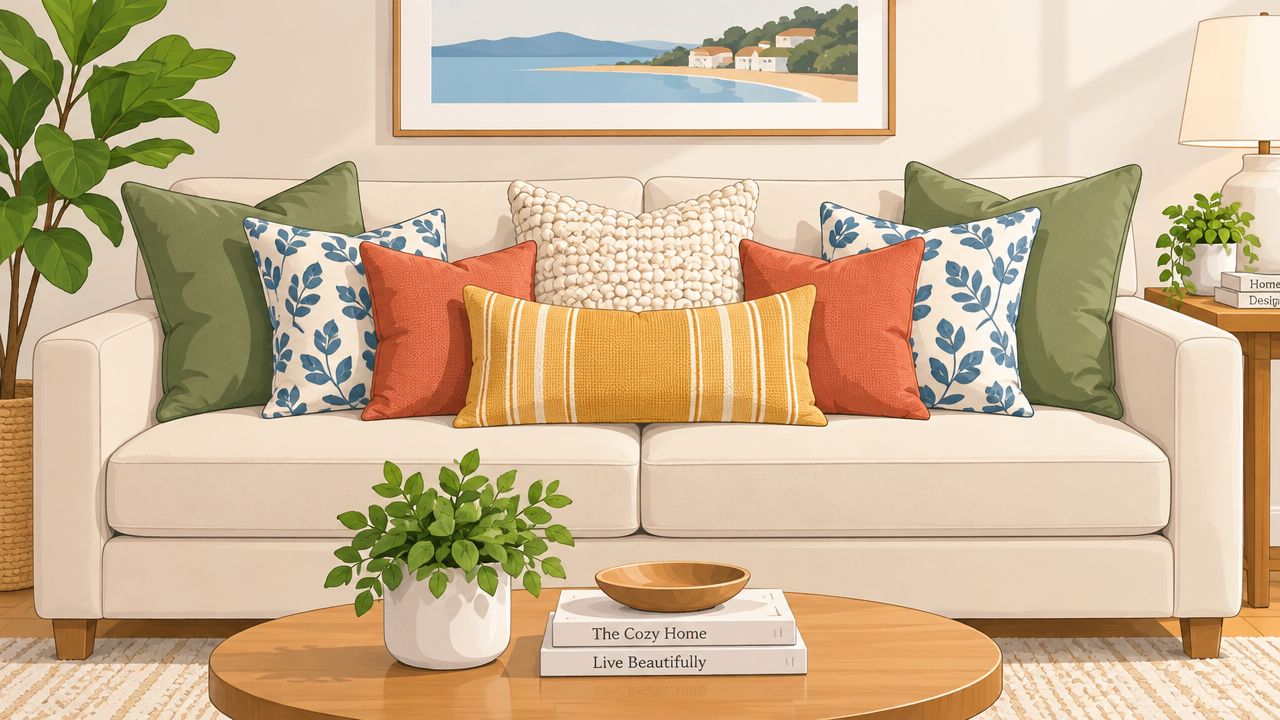
Start with the largest visual anchor. That might be a solid pillow in a grounded shade, a broad stripe, or a restrained geometric. Add a second pattern with a different scale, then finish with a smaller motif or quiet texture. The patterns shouldn't compete for identical attention.
A workable mixing sequence
-
Choose a connecting palette. Pull two or three related colors from an existing rug, artwork, or nearby accessory. Repeating a color across different materials makes the arrangement feel intentional.
-
Vary the pattern scale. Pair a larger botanical or geometric with a narrower stripe or small repeat. Similar-sized patterns tend to blur together, while different scales create hierarchy.
-
Change the hand-feel. Smooth velvet, nubby linen, woven bouclé, and chenille reflect light and hold the eye differently. Interior guidance commonly recommends at least three different sizes and contrasting tactile finishes to prevent a flat arrangement, as described by Printdoors' decorative pillow sizing guidance.
-
Repeat one element, not everything. A shared blue, a recurring warm neutral, or a repeated line can tie the group together. Matching every pattern and texture makes the display look packaged rather than collected.
Design check: Step back from the sofa and look at the group as a whole. If every pillow demands attention, remove one competing pattern before adding another.
Three sizes usually create a more natural visual rhythm than a row of identical squares. A large back pillow can support the arrangement, a medium shape can carry the principal pattern, and a smaller lumbar or textured accent can provide a stopping point. For more pattern-pairing guidance, the pattern mixing and balance guide offers a useful framework.
Strategic Placement and Seasonal Updates
Placement should follow how the room is used. In a living room, the deepest pillows generally sit toward the back of the sofa, with smaller pieces layered toward the front. That arrangement creates depth while leaving room for a person to sit comfortably. A chair usually needs less volume, and a lumbar pillow can provide support without swallowing the seat.
Bedrooms call for a different proportion. Larger decorative pillows can stand against the headboard, while smaller shapes bridge the space between the bedding and the headboard. The final layer should support the room's scale, not create a barrier that has to be removed every night.
Refresh the cover, preserve the insert
A durable insert can remain useful while covers change with the room. Filled decorative pillows function as ready-to-use pieces, but unfilled covers make a practical styling layer for repeat refreshes, easier storage, and seasonal changes. Market coverage also identifies interchangeable-cover ecosystems and subscription seasonal cover services as emerging models, according to Deep Market Insights' decorative pillow report.
Spring may call for lighter linen or cotton textures, while autumn favors deeper tones and warmer tactile finishes. The advantage isn't constant buying. It's keeping a dependable base of well-sized inserts and changing the visible layer when the household wants a different mood.
Plant placement can reinforce the same seasonal shift. A homeowner considering low-maintenance greenery can browse desert plants for the home as a complementary styling resource, especially in rooms where natural texture is part of the palette.
For sofas, sectionals, and chairs with different depths, the living room arrangement guide can help determine how many layers the furniture can comfortably support.
The Advantage of Custom and Local Shopping
Online browsing makes it easy to collect ideas, but upholstery and textiles are physical decisions. A fabric's weave, softness, sheen, and resilience can look different in person, especially beside a particular sofa or wood finish. A local showroom gives homeowners the chance to test those relationships before committing.
That hands-on process matters when the pillow is part of a larger room update. Flexsteel is associated with durability, Bassett offers style flexibility, and custom programs can help coordinate upholstery, accent fabrics, and surrounding case goods. Made-to-order options let a room fit the household instead of forcing the household to work around whatever happens to be in stock.
Customization without compromise
Groen's Fine Furniture serves Northwest Indiana from showrooms in Dyer and Crown Point, with a family-owned history dating to 1983. Its custom furniture services include Canadel custom dining, where tables and chairs can be specified through combinations of sizes, shapes, and finishes, along with Amish solid wood furniture built around craftsmanship and exact specifications.
The same principle applies to accent styling. A pillow can coordinate with a custom dining finish, echo a performance fabric on a sectional, or introduce softness beside solid wood. Customers can compare real swatches under showroom lighting and feel the difference between a smooth cover and a more substantial woven surface.

Showroom advice: Bring a photo of the room, a rug sample, or a paint card. Context makes fabric decisions more accurate than memory.
Local service also extends beyond the purchase. White-Glove Delivery, interior design guidance, American-made options, and multigenerational ownership give shoppers a more personal path from selection to installation. Groen's serves nearby communities including St. John, Schererville, and Munster, and offers Special Financing subject to credit approval for customers who want more buying power while fitting quality furniture into a considered budget. Details can be explored through custom furniture made simple.
Care, Maintenance, and Long-Term Comfort
A pillow lasts longer when its cover and insert receive different kinds of care. The first step is always the manufacturer's label. It identifies whether the cover can be removed and washed, and it prevents a well-intentioned cleaning routine from damaging delicate fibers or finishes.
Cotton and many synthetic fabrics can often tolerate a gentle or delicate machine cycle when the label permits it. Velvet, silk, and specialty woven fabrics may require spot cleaning, hand washing, or professional dry cleaning, as summarized in this throw pillow care guide.
A simple maintenance routine
- Check before washing: Remove the cover only if the construction and care label allow it. Close zippers before cleaning to protect the teeth and fabric edges.
- Treat marks early: Blot rather than scrub. Aggressive rubbing can spread a stain or alter the nap of velvet and other textured fabrics.
- Dry with care: Avoid high heat unless the label specifically permits it. Incomplete drying can leave odors and moisture inside the cover.
- Restore the insert: Air the insert periodically and reshape it after use. Gentle hand fluffing helps redistribute fill and keeps corners from looking collapsed.
- Store by season: Keep replacement covers clean and fully dry in a breathable container. Avoid compressing delicate textiles under heavy items.
Fill material affects maintenance as much as feel. Feather-based inserts may need regular plumping to maintain an even silhouette, while fiberfill often holds a more stable shape but can still flatten under repeated pressure. The right care routine preserves both the look and the comfort that justified the original selection.
For broader upholstery and textile maintenance, Groen's offers a furniture cleaner resource. Homeowners in Dyer, Crown Point, and surrounding NWI communities can also visit a showroom to compare fabrics, discuss custom options, and ask about White-Glove Delivery and Special Financing.
Groen's Fine Furniture helps Northwest Indiana households coordinate home decor accent pillows with custom furniture, solid wood Amish craftsmanship, Canadel dining, and comfortable upholstery from trusted brands. Visit Groen's Fine Furniture in Dyer or Crown Point to test-drive the comfort, feel real fabric swatches, explore made-to-order choices, and ask about special financing plans subject to credit approval.