Sectional Sofa Extra Deep: A Complete Buying Guide


For homeowners in Dyer, Crown Point, and throughout Northwest Indiana, an extra-deep sectional can turn a stiff living room into the place everyone wants to use. The catch is simple: a sectional sofa extra deep isn't defined by a fashionable label. It's defined by seat depth, total footprint, posture, and the walking space left around it.
A standard sofa may look generous in a showroom but feel cramped during a Friday movie night. An extra-deep design offers room to stretch, curl up, nap, or share the cushion with children and pets. It can also overwhelm a room, leave shorter family members unsupported, or block the route between a kitchen and living area if nobody measures first.
The right decision comes down to four questions: What are the true dimensions? Who benefits from the depth? How should the room be measured? What should a buyer ask for at a local showroom? Those answers matter far more than a product tag that says “deep.”
When a Regular Sofa Just Isn't Enough
A Dyer family settles in for Friday movie night. The standard sofa has a 21-inch seat depth, enough for upright conversation but not generous enough for a relaxed evening. One adult sits forward with knees bent, another has pushed two pillows behind the lower back, and a child has claimed the chaise sideways because there isn't room to sit comfortably facing the television.
The half-eaten pizza on the ottoman keeps getting nudged by feet. The dog climbs into the middle seat, forcing everyone closer together. Someone eventually moves to the floor, not because the movie is bad, but because the sofa has run out of usable lounging space.
That scene isn't a failure of the family. It's a mismatch between formal sitting furniture and real household behavior. Standard seat depth generally falls within the conventional range, while deeper seating creates a larger surface for relaxed positions and shared use. A shopper comparing sectionals should understand the practical distinctions covered in this sectional buying guide before choosing a shape or fabric.

The change is functional, not merely oversized
An extra-deep sectional changes the way people use the room. Instead of keeping both feet planted and the torso upright, occupants can sit cross-legged, tuck their feet beneath them, lean back, or stretch across a chaise. That daybed-like quality is exactly why some families choose this category for media rooms, open living spaces, and everyday family gathering.
The trade-off is that deeper furniture takes planning. A large cushion doesn't help if the back of the sectional blocks a doorway or the front edge leaves no comfortable route to the coffee table. In Northwest Indiana homes, where open kitchen and living areas often share one circulation path, the floor plan deserves as much attention as the upholstery.
By the time a buyer reaches the showroom, the useful questions are clear: Is the seat extra deep? Will every regular user reach the floor or need a bolster? Can the room preserve its traffic lanes? Which configuration and custom options solve the household's actual habits?
What Makes a Sectional Sofa Extra Deep
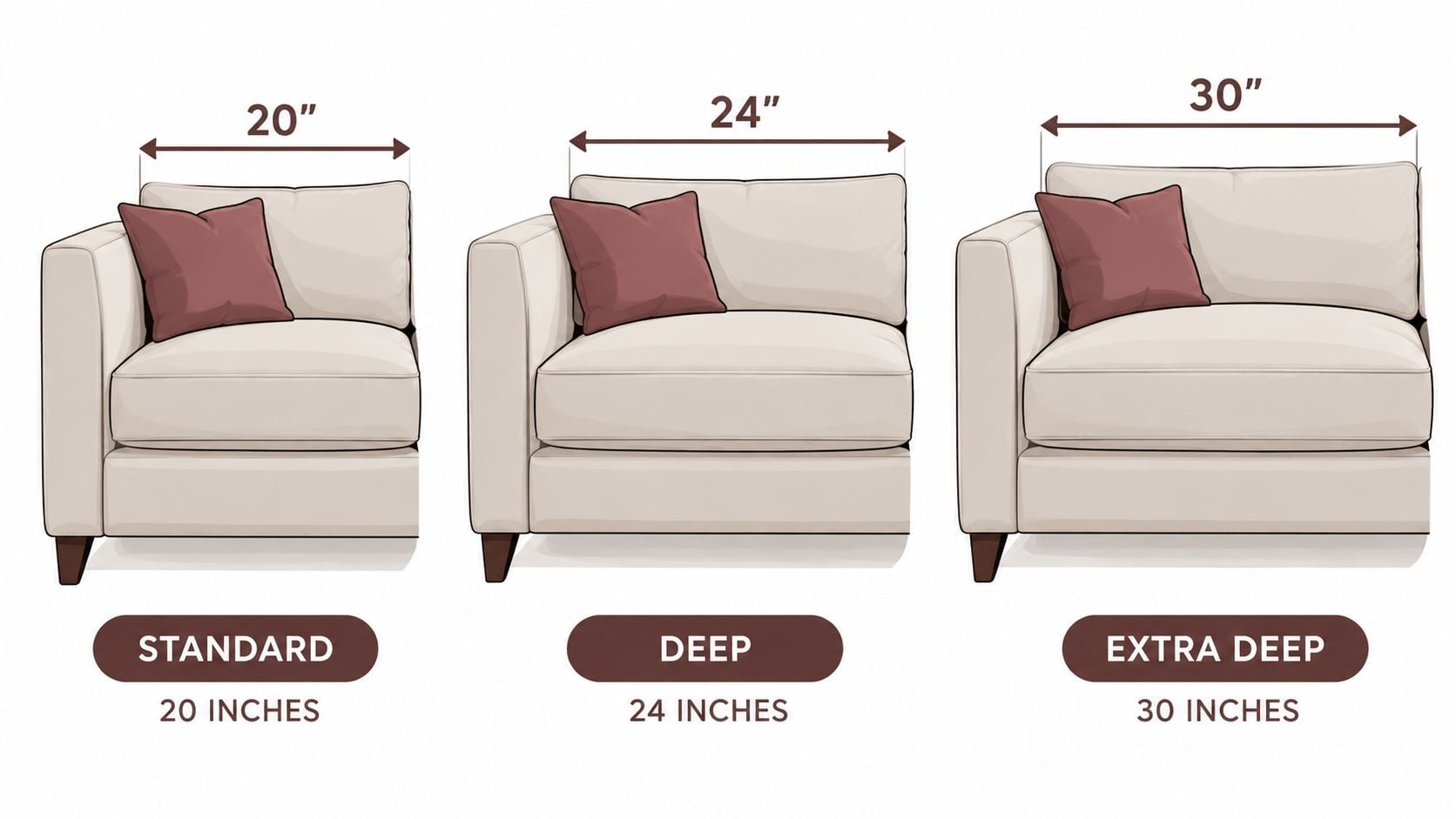
A shopper should measure the seat, not judge the sofa by its width or by the number of cushions. Retail sizing guidance commonly places standard seat depth at 21 to 24 inches, deep seating at 28 to 35 inches, and extra-deep seating at 35 inches or more in a sectional sizing guide. Other industry guidance places standard seating around 20 to 24 inches, deep seating around 31 to 39 inches, and extra-deep seating around 40 to 48 inches, especially for lounging and taller users, as described in this deep-seating construction guide.
Those ranges aren't contradictory so much as inconsistent across manufacturers. The practical showroom rule is to ask for the actual seat depth, then compare it with the overall depth.
Seat depth and overall depth are different
Seat depth runs from the front edge of the sitting surface to the point where the back cushion begins. Overall depth runs from the rear of the frame to the frontmost edge, including the back structure, cushions, arms, and any reclining mechanisms.
A product can have a deep seat without appearing enormous from the side, or it can have a large overall footprint while losing usable depth to thick arms and substantial back cushions. One documented extra-deep modular example reaches 45 inches of overall depth, with a 38-inch seat depth and chaise pieces reaching 54 inches of seat depth. Another product listing identifies a 38-inch seat depth and 45-inch overall depth for several modules, while a separate extra-deep configuration reaches 47 inches overall depth across multiple sofa pieces in the manufacturer dimension examples.
Why depth changes posture
As the sitter moves farther back, the pelvis shifts rearward and the knees open into a more reclined position. That's comfortable for stretching and movies, but it makes upright conversation or laptop use harder without movable lumbar pillows.
Practical rule: A buyer who wants both formal sitting and sprawling comfort should prioritize loose or movable back cushions. They let the same frame support a more upright position during conversation and a deeper lounge position later.
A useful showroom test is to sit fully back, check whether the lower back feels supported, and notice whether the feet reach the floor naturally. The label matters less than the body's response.
Who Really Benefits From Extra Depth
Extra depth works best for households that treat the sectional as a lounge platform, not as a place to sit upright. Tall adults, people who sit cross-legged, and families who pile onto one cushion during movie nights usually appreciate the added surface immediately.
The deeper seat also suits users who prefer a relaxed angle through the hips and knees. Industry guidance identifies the deepest seating ranges as especially appropriate for lounging, napping, and taller users around 6'0" and above. A movable lumbar pillow can make the design more versatile, particularly when one household includes both tall and shorter occupants.
The strongest matches
- Tall adults: Longer legs need more support beneath the thighs, and a shallow seat can feel restrictive.
- Cross-legged loungers: Extra surface lets the sitter change position without perching on the edge.
- Families and pet owners: A broad cushion gives children and animals room to share the seating area.
- Media-room households: A relaxed posture fits long viewing sessions better than formal, upright furniture.
- Users seeking a reclined position: The open knee angle can feel more natural than a rigid sitting posture.
Who should think twice
Shorter users may find an extra-deep cushion too long. If the feet don't reach the floor, the sitter may slide forward, lose lumbar support, or need a footrest every time. A small room can also suffer because depth consumes floor area faster than many buyers expect.
Work-from-home users should be cautious if the sectional will double as a desk chair. The same reclined geometry that feels excellent for a film can encourage slouching during laptop work. Formal entertaining spaces may also look less structured when the sectional has a very low, lounge-focused profile.
| User or Room Type | Best Seat Depth Range | Key Consideration |
|---|---|---|
| Tall adult | 31 to 39 inches | Test thigh support and lumbar position |
| Cross-legged lounger | 35 inches and above | Prioritize usable cushion surface |
| Mixed-height family | Deep with movable cushions | Use pillows to adjust support |
| Shorter adult | Standard to moderate deep | Confirm feet reach the floor |
| Laptop user | Standard or moderate deep | Upright support matters |
| Large media room | Extra deep | Preserve routes around the footprint |
The simplest self-check is this: Will the sectional mainly support upright conversation, or will the household stretch, curl up, nap, and share it? If lounging is the dominant use, extra depth deserves serious consideration. If the answer is mixed, a flexible back-cushion design is the safer choice.
Measuring Your Room Before You Fall in Love
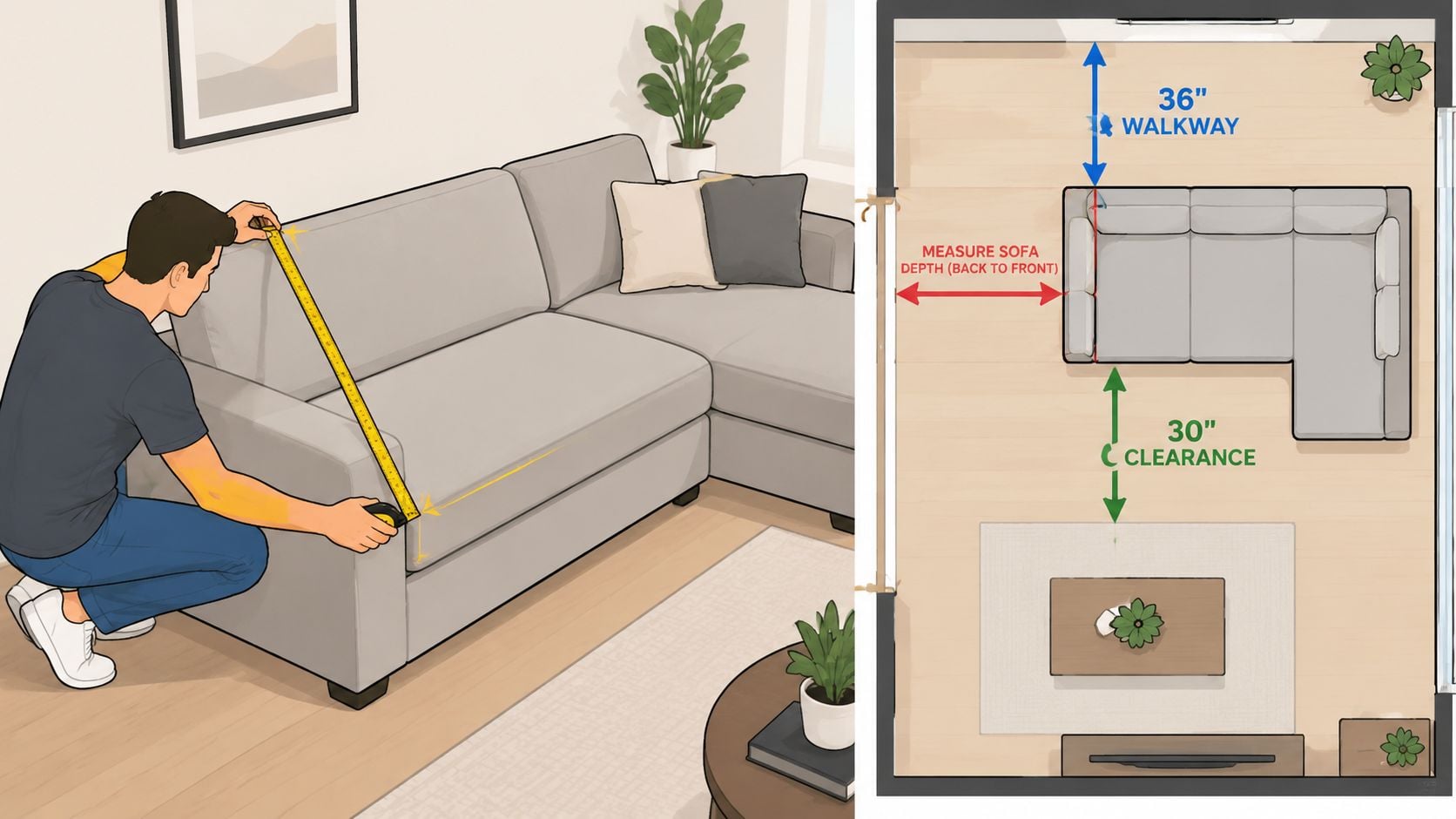
A tape measure should come out before a fabric sample. Start with overall depth, measured from the farthest point at the back to the front edge, then record seat depth separately. A planning guide places extra-deep overall depth at 35 inches and above, while oversized deep sectionals commonly reach 35 to 42 inches and may need 30 to 36 inches of walkway clearance, as explained in this deep sectional sizing resource.
Don't measure only the wall. Measure the route the sectional must travel through the home.
A reliable room check
- Record the room envelope. Measure each wall, alcove, doorway, window, and opening. Note where doors swing, especially doors leading into the living room.
- Mark fixed obstacles. Include vents, radiators, outlets, trim, stair openings, and television connections. A sectional that fits the wall may still cover a return vent or make an outlet unreachable.
- Map circulation. Use painter's tape on the floor to outline the proposed back and front edges. Walk the route while carrying a laundry basket or opening nearby doors. That simple test exposes tight paths quickly.
- Check delivery access. Measure the entry door, hallway turns, stair landings, elevator openings if applicable, and the room entrance. Modular pieces can simplify handling, but every module still needs a viable route.
- Bring visual evidence. A rough sketch, room photographs, and doorway measurements give a design specialist something useful to work from. Anyone planning a move should also review this practical guide to heavy furniture moving before delivery day.
The room sketch doesn't need architectural precision. A clear floor plan with furniture, doors, and walking paths is enough to eliminate configurations that look appealing but can't function.
The sectional measurement guide can help organize those dimensions before a showroom visit. The strongest buyers arrive with facts rather than guesses, which makes it easier to shortlist an L-shape, chaise, or modular arrangement that respects the home's structure.
A deep sectional should fit the path through the room, not merely the wall where it will sit.
Choosing Configuration, Fabric, and Comfort Level
Configuration controls how the sectional occupies the room. An L-shape usually suits an open living area because it defines a seating zone without closing every side. A U-shape or curved arrangement creates a generous social hub but demands a larger, more open room. A chaise sectional can deliver a lounge position while using one wall more efficiently.
| Configuration | Typical Footprint (W x D) | Best Fabric Match | Cushion Feel |
|---|---|---|---|
| L-shape | Room-dependent, with one extended return | Performance weave or leather | Supportive to relaxed |
| U-shape | Broad footprint on three sides | Durable performance fabric | Plush, family-oriented |
| Curved | Expansive central footprint | Chenille or textured weave | Soft, conversational |
| Chaise | Long return with a compact opposite side | Performance weave or leather | Firm seat with lounge end |
The table intentionally avoids pretending that one footprint fits every house. Modular components, arm thickness, back height, and chaise orientation change the final dimensions. A left-facing chaise means the chaise sits on the viewer's left when facing the sectional, while a right-facing chaise places it on the opposite side. That distinction can determine whether a walkway stays open.
Match upholstery to daily contact
Performance weaves are the practical choice for children, dogs, and cats because they're designed for frequent use and easier spot care. Leather offers a durable, wipe-clean surface and develops a distinct character over time. Plush chenille provides a softer hand and a richer, more tactile appearance, but it still needs a care routine suited to the specific fabric.
Texture affects the visual weight of a large sectional. Buyers comparing upholstery can browse a fabric art collection for ideas about how weave, color, and pattern influence the surrounding room, then review the manufacturer's care instructions before ordering.
Test the cushion before choosing the color
A firm supportive foam cushion makes standing and upright conversation easier. A down-wrapped or softer cushion creates a sink-in feel that works beautifully for reading and movie nights, but it requires more regular shaping. Neither is universally superior.
At Groen's Fine Furniture, shoppers can compare Flexsteel reclining sectionals and Bassett custom upholstery in person, focusing on seat depth, cushion response, arm height, and finish rather than choosing from a photograph. The brand selection also includes materials and styles suited to different rooms, from performance fabrics to leather.
The upholstery fabric selection guide is useful before a visit, especially for households deciding between stain-conscious performance fabric, leather, and softer chenille.
Styling and Layout Tips That Make Extra Depth Work
An extra-deep sectional changes the scale of every nearby piece. A small rug can make the sofa look stranded, while a tiny coffee table can disappear in front of the seat. The room needs visual anchors that acknowledge the sectional's larger footprint.
Anchor the front edge
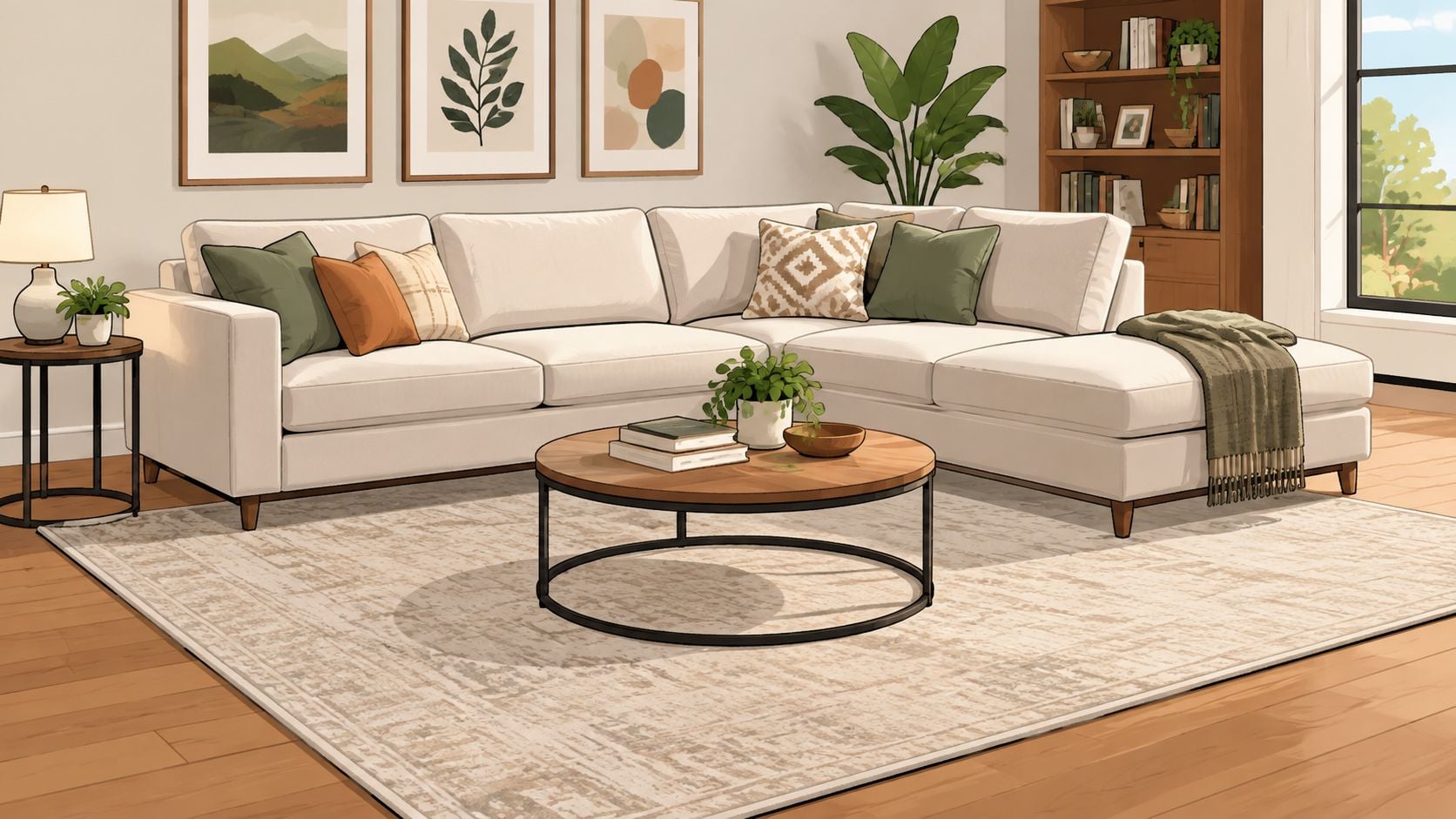
An 8×10 or 9×12 rug can give a substantial sectional enough visual foundation, with the front legs resting on the rug rather than floating beside it. The rug should connect the sectional to the coffee table and nearby chairs, creating one deliberate seating zone instead of several disconnected objects.
Leave 16 to 18 inches between the seat edge and coffee table so occupants can move their legs without striking the table, while still keeping drinks and remotes within reach. A round table often softens the hard geometry of an L-shape and reduces sharp corners in a busy family room.
Preserve the routes people actually use
Keep a 30 to 36-inch traffic lane around exposed ends and along the routes between the entry, kitchen, stairs, and seating. Those clearances matter more than forcing the sectional flush against a wall. In a tight room, floating the piece slightly away from the wall can preserve flow, especially when a slim console sits behind it.
A floor lamp placed behind the deeper arm balances the sectional's visual weight and directs light toward the reading or lounge position. Larger 20 to 24-inch square pillows provide meaningful back support, while smaller pillows can vanish against a deep cushion.
For rooms with unusual doors or competing focal points, the sectional layout ideas offer a useful starting point. The final arrangement should still be tested with tape on the floor, because a layout that looks balanced on paper may pinch the walking route in real life.
Care, Custom Ordering, and Financing at Groen's
Extra-deep upholstery sees concentrated use in the center seats, chaise, and favorite lounging corners. Performance weaves should be vacuumed regularly, with a soft upholstery attachment that removes crumbs and pet hair without pulling at the fabric. Spills should be blotted, not rubbed, because rubbing can push the liquid deeper and roughen the surface.
Reversible cushions should be rotated 90 degrees when the design allows it. That simple change spreads body impressions across more than one sitting position. Fixed cushions need gentle vacuuming around seams and periodic reshaping instead.
Build quality and daily maintenance
Kiln-dried hardwood frames from Flexsteel and Bassett are listed with a lifetime warranty when cared for properly, so buyers should read the actual warranty terms and follow the manufacturer's maintenance directions. Upholstery warranty coverage and exclusions can differ by fabric, cushion construction, and use.
Custom ordering solves the common problem of a sectional that has the right look but the wrong proportions. Groen's custom-order path lets a household discuss seat depth, arm height, leg finish, and fabric, with thousands of swatches available across the Dyer and Crown Point showrooms. Most custom builds carry a 6 to 10 week lead time, as described in the custom-order overview.
| Brand | Fabric Families | Lead Time | Warranty | Financing |
|---|---|---|---|---|
| Flexsteel | Performance weaves, leather, textured upholstery | Most custom builds, 6 to 10 weeks | Lifetime frame warranty when properly cared for | Special Financing subject to credit approval |
| Bassett | Custom upholstery, performance fabrics, leather | Most custom builds, 6 to 10 weeks | Lifetime frame warranty when properly cared for | Special Financing subject to credit approval |
| Amish Furniture | Solid wood craftsmanship, selected upholstery options | Varies by order | Review order-specific terms | Special Financing subject to credit approval |
Special Financing through Synchrony and GreenSky can provide additional buying power, with promotional no-interest windows available for qualifying buyers. Furniture financing is generally tied to credit approval, so shoppers should review the specific promotional terms before accepting an offer.
White-Glove Delivery completes the process with room-of-choice placement and packaging removal. That service matters for a deep sectional because careful placement protects walls, floors, door trim, and the room plan created before ordering.
Common Questions and How to Take the Next Step
Can an extra-deep sectional fit through a standard 36-inch doorway? Often, yes, especially when the design arrives in separate modular pieces. The delivery team still needs the complete route, including turns, stairways, and interior door openings.
Are performance fabrics better for pets and children than boucle? Performance weaves are generally the more practical choice for active households because they're easier to maintain and less likely to show everyday mishaps. Boucle offers distinctive texture, but its loops require careful consideration around claws, snagging, and cleaning.
What happens if one arm arrives damaged? The recipient should photograph the damage before moving or discarding packaging, then contact the retailer promptly with the order details. A documented delivery issue gives the service team the information needed to review the next step.
Can a left-facing chaise become right-facing later? Usually not without a configuration designed for reassembly. Buyers should confirm whether the selected modules can be rearranged before ordering, rather than assuming the chaise can switch sides.
A free design consultation can begin with room dimensions, doorway widths, and a photograph of the living space. A specialist can sketch configurations on the floor, compare seat depths, and discuss fabric, cushion feel, custom ordering, American-Made options, White-Glove Delivery, and Special Financing subject to credit approval. No deposit is required to start the conversation.
For households in Dyer, Crown Point, St. John, Schererville, Munster, and surrounding NWI communities, the best next step is a comfort test with the actual measurements in hand. The right sectional should feel generous without making the room work harder.
Groen's Fine Furniture offers custom sectional guidance, quality upholstery from brands including Flexsteel and Bassett, and personal service through multigenerational ownership in Northwest Indiana. Visit Groen's Fine Furniture in Dyer or Crown Point to test-drive extra-deep comfort, review custom options, and ask about Special Financing plans.