Power Rocker Recliner Guide: Features, Fit and Buying Tips


For homeowners in Dyer and Crown Point who share one living room seat across a busy week, the chair has to do more than look right in a photo. A parent wants a quiet rock after dinner. A grandparent wants a way out of a deep seat that doesn't take a shove. Someone else wants the footrest up for a movie. A power rocker recliner is built for that mix, and our family at Groen's Fine Furniture has helped Northwest Indiana households choose these chairs since 1983.
The useful way to shop is to test the chair as two systems: the powered recline and the rocking base. The recline decides how the body rests. The base decides how the chair moves while upright. Each can be tried on its own in the showroom, so a flaw in one doesn't get blamed on the other and neither gets judged by fabric, finish, or financing.
What a Power Rocker Recliner Is and How Its Two Systems Work
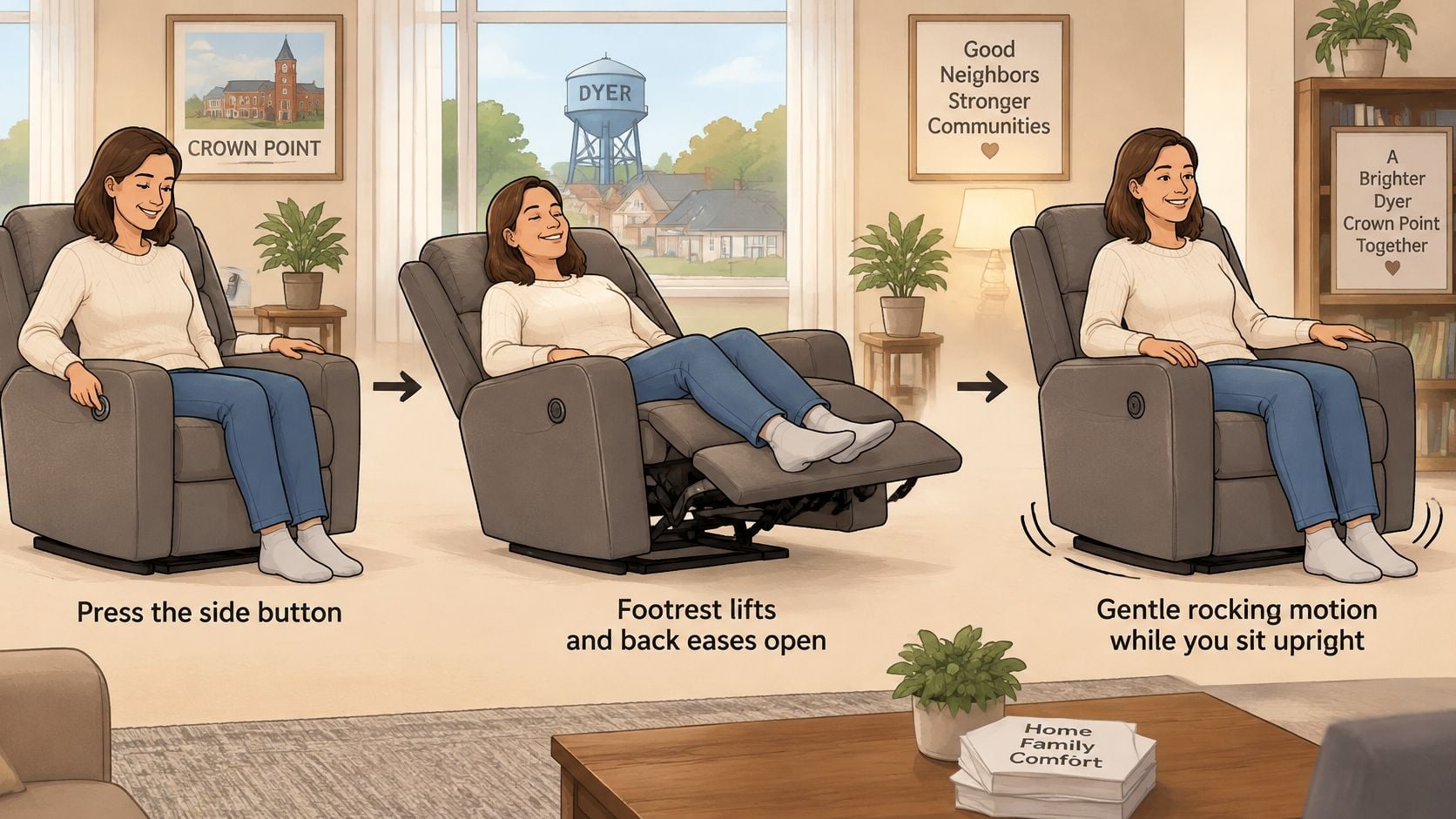
Say a homeowner in Crown Point settles in after work and presses one button. The footrest rises on its own, the back eases open, and the chair stops where they want it. Later they sit upright and the same chair rocks gently, the way a rocking chair does. That is a power rocker recliner: a recliner with an electric motor that moves the backrest and footrest, set on a rocker base so the whole chair can glide forward and back.
Inside the chair, a small motor sits low in the frame, wired to a hand switch and driving the linkage under the seat and backrest. Beneath all of that, curved rocker cams under the base carry the chair's weight and let it travel forward and backward. The two parts do separate jobs, and each can fail or feel off on its own. A jerky stop mid-recline points to the motor or linkage. A thump, or a base that walks across the floor, points to the rocker cams. Judging them apart keeps a showroom visit honest.
Three signs mark the category:
- Motorized control: A hand switch or console, not a side lever, starts and stops the motion.
- Footrest linkage: The ottoman extends on its own linkage rather than sitting there as a loose cushion.
- Rocker cams: The base uses curved cams so the chair can move smoothly forward and backward while it's upright.
Rocking moves the whole chair on its base. Reclining changes the seat and back angles and extends the footrest. One chair does both, but never at the same moment: the rocking motion happens while the chair sits upright. A simple test confirms the fit. In the showroom, sit upright and rock for a minute, listening for squeaks or a scrape on the floor. Then press the button and recline fully, checking that the motion stays smooth and quiet. That is the pairing in action: the rock you want after dinner, plus the powered recline that brings the footrest up for a movie.
How Power Rocker Recliners Differ From Manual and Standard Power Models
| Feature | Manual recliner | Standard power recliner | Power rocker recliner |
|---|---|---|---|
| Recline control | Hand lever or pull handle | Electric motor with push-button or hand switch | Electric motor with push-button or hand switch |
| Rocking motion | Rare; some models offer a basic rock | Typically none | Rocks forward and back on a rocker base when upright |
| Power outlet needed | No | Yes | Yes |
| Floor space needed | Recline space only | Recline space only | Recline space plus rocking clearance |
| Ease for limited hand strength | Lower | High | High |
| Electrical parts to service | None | Motor, switch, wiring | Motor, switch, wiring, rocker linkage |
| Best suited to | Simple setups and low-power rooms | Reclining without rocking | Family rooms wanting rock and one-touch recline |
A manual recliner moves because someone pulls a lever or handle. The recline is only as smooth as that person's arm and the linkage behind it. It needs no outlet, which makes it a fit for a room where a cord would cross a walkway. Fewer electrical parts also means fewer things to service later. Our team still asks families to work the lever themselves, because a motion that feels fine for one person can be a strain for another. A side-by-side look at power recliners and manual recliners helps when the household is split on that point.
A standard power recliner adds a motor and a push-button or hand switch. Positions repeat from one evening to the next, and limited hand strength is much less of a barrier. The trade-off is real: every use needs power, and the motor, switch, and wiring become parts that may need service years from now.
A power rocker recliner keeps that motor and adds a rocking base. Some manual chairs offer a basic rock, but a power model's base is usually built for smoother, more stable motion under a seated load. It also asks more of the room. Plan for an outlet within reach and for floor space beyond the recline path, because the base has to move.
Practical rule: Choose manual for a simple, low-power setup, standard power when recline matters and rocking doesn't, and a power rocker when the family room needs both.
Motor, Lift and Rocking Features Worth Comparing
One motor or two
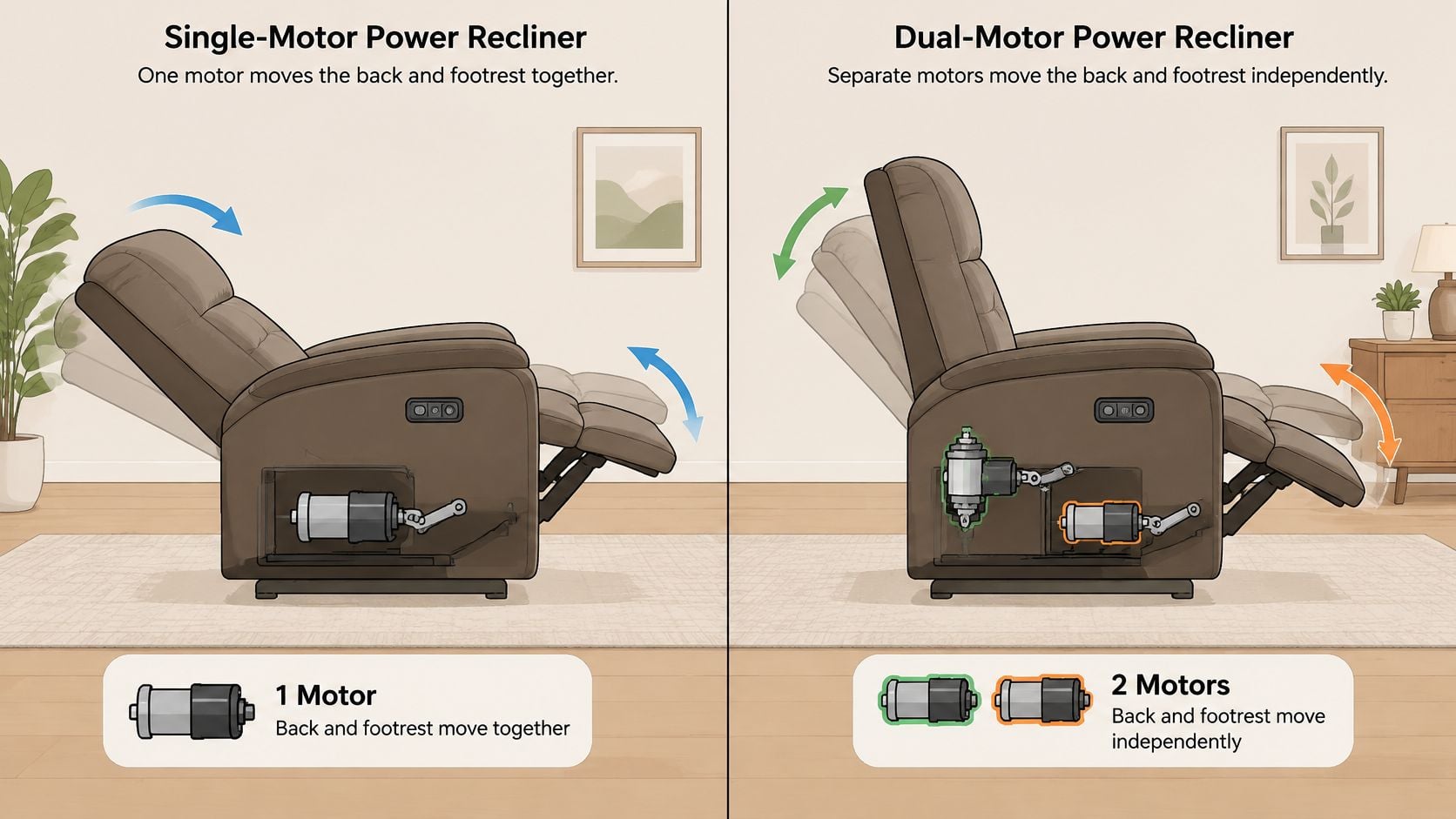
A single-motor design uses one drive to move the back and footrest together. It's typically simpler and lighter, and it suits someone who always wants those parts to travel as a pair. A dual-motor design gives the back and the footrest their own drives, so each can move on its own.
That independence matters in a shared chair. One person may want the back open and the feet only slightly raised. Another may want the opposite. Ask which layout is on the exact model, then run both motions before anyone talks about fabric.
Power lift is a third job
Power lift tilts the whole chair forward to help a seated person stand, which is useful for older adults and for anyone with knee or hip limits. The lift hardware is its own mechanism, separate from the recline drive and the rocking base, so a chair can still rock and recline when lift is part of the build. A power rocker already carries two systems; lift adds a third job on top of them. Confirm it's offered on that model, not just on a similar one in the line. The showroom team can walk through power lift recliners when standing up is the main hurdle.
What the rock should feel like
Rock the chair through its full range while it's upright. It should stay smooth and steady, without speeding up at the ends or knocking the floor. Check whether the rock locks, and whether the base has a stop so the chair doesn't shift once the back starts to open. Rocking comes from the base, so run this test before anyone touches the recline button. A rock that feels good empty can feel loose once someone is seated.
Recline angle changes how the body is supported. Ergonomic seating guidance finds that opening the backrest past upright eases the load on spinal discs. Ask whether the seat pan moves with the back, then recline in stages to check. A mechanism with more pivot points and stoppable positions can hold that support through the motion, while a basic single-pivot design fits fewer body types.
The best stops are the ones where the pelvis stays stable, the back stays supported, and the thighs and calves aren't left hanging. Sit, recline in stages, then rock slowly, and notice whether the chair feels controlled at each step instead of only at full open.
Upholstery, Durability and Sizing for Your Room
Upholstery hides the parts that decide whether a power rocker recliner still feels solid years from now. Start with the frame and the linkage. A U.S. General Services Administration upholstered-furniture test cycles a recliner from fully closed to the TV position, then to full recline, and back to closed. It applies a 200-pound load, 150 pounds on the seat and 50 pounds at the center of the backrest, and runs at least 25,000 cycles before the force goes up or the test continues to failure. Ask whether a model's maker can point to similar cycle testing. "Built to last" isn't a number.
Performance fabrics and tight-weave leathers handle wear and stains better than loose, open weaves. Ask for the fabric's abrasion rating and its cleaning code, then match that code to how the household cleans. For a plain explanation of what sits under the cover, understanding furniture construction and cushion quality from Lewis and Sheron Textiles is a useful read before the showroom conversation turns to color.
Flexsteel is known for durable upholstered construction, and Bassett offers style choices that can match a room's color and texture. Either way, the cloth has to survive the motion, not only the first week.
A seat that fits a tall user can feel too deep for a shorter one, so the spec sheet matters more than the photo. Use a tape on the floor at home, then repeat the checks in the showroom. Our furniture measuring guide covers doors and walkways if the path from the truck to the corner is tight.
| Measurement | How to check it | Why it matters |
|---|---|---|
| Clearance behind the chair | Measure from the wall to the front of the chair with the back fully reclined | Prevents the back pressing the wall and keeps the power cord from being pinched |
| Rocking clearance on each side | Mark the chair's footprint and check the rock path with the chair rocking | Stops the base from knocking furniture or walls |
| Seat width and depth | Sit fully back with knees bent and check hip and thigh support | Confirms the chair fits the body rather than the room |
| Overall footprint (width, depth, height) | Compare the manufacturer's spec sheet with the room layout | Confirms the chair clears doors, walkways and side tables |
| Footrest extension length | Recline fully and check how far the footrest reaches | Confirms heels or calves are supported, not left hanging |
| Upholstery abrasion rating | Ask for the fabric's rating or cleaning code | Predicts how the fabric handles daily wear and cleaning |
Power, Safety and Upkeep for Your Recliner
Electrical checks before the chair comes home
The powered half of this chair works like any other household appliance. It has a plug, a power supply, and a motor, and each of those parts deserves a check before the chair earns a permanent spot in the room.
Start with the basics: confirm the input voltage, the plug type, and whether the chair uses a plug-in power supply block or a hard-wired connection. IEC 60335-1 is a widely used baseline for household appliances, and UL's overview of that standard covers electrical construction, testing, markings, and instructions. Ask whether the complete electrical assembly has been evaluated for the market where it will be used, including the adapter, the switch, and the wiring that runs behind the frame. Certification is a concrete screen for the electrical side. Comfort stays a separate question for the showroom.
The U.S. Consumer Product Safety Commission identifies UL 962 as covering household-furnishing hazards that involve reclining mechanisms, footrest stability, and related furniture risks. It also cites ANSI/BIFMA X5.4-2020 provisions on leg-rest durability, leg-rest strength, recliner pinch points, and stability. The same CPSC materials describe entrapment hazards around movable foot supports and the opening between the footrest and the seat, including incidents involving children.
Where it sits, and who is nearby
Place the chair at an outlet it can reach without an extension cord. Route the cord away from moving linkages, and check wall clearance with the back fully open. A cord pinched between the frame and the wall can damage insulation over time.
When the CPSC recalled certain power-reclining furniture, the agency cited five dealer reports of chairs that could tip forward as occupants stood while the chair stayed reclined, and no injuries had been reported at the time of that notice. Return the chair fully upright before anyone stands. Recalls involving electronic recliners have also described USB charging modules that could overheat and spark. Stop use and request service if a port feels warm or shows scorch marks.
A wall-hugger design shortens the clearance behind the back. It doesn't remove tipping risk, cord risk, or the need to keep hands clear.
Keep hands, fingers, pets, and children out of the footrest opening while the chair is moving. Treat the gap between the seat and the ottoman as a pinch point, and keep it clear of blankets, toys, and anything else small enough to slip inside.
A simple upkeep rhythm
This chair carries two systems, so upkeep has to cover both: the powered recline drive and the rocking base underneath it. Motors also need rest between runs. Recliner operating manuals commonly set a duty cycle, which works like a rest interval between sets at the gym: a short run window, then a longer cool-down before the next cycle. The motor itself usually runs on low-voltage DC power from a plug-in supply. Follow the chair's own manual, and release the control rather than holding it through long stretches.
| Task | Frequency | What to look for |
|---|---|---|
| Vacuum footrest opening and linkage | Monthly | Debris that can jam moving parts |
| Inspect cord and plug | Monthly | Cuts, heat marks, or a loose-fitting plug |
| Stop-on-release test | Every 3 months | Chair halts as soon as the control is released |
| Manual-release check | Every 3 months | Release works without power |
| USB charging port check | Every 3 months | Warmth, discoloration, or scorch marks on the module |
Run the stop-on-release and manual-release checks in the showroom before you buy. A chair that fails either one on the sales floor will not improve at home.
If the chair stops working later, check the outlet, then the switch, then the cord. After that, call our team or the manufacturer, and leave the housing closed.
Fabric care belongs in that same rhythm. The guide on couch care with Rubber Ducky Rug Cleaning walks through protective treatment in plain steps, and our furniture cleaner guidance covers day-to-day products that won't harm performance fabric. White-Glove Delivery can place the chair, walk through the controls, and demonstrate the manual-release procedure so a power outage never leaves someone stuck partway back.
Value, Custom Orders and Special Financing
Ask one repair question before you compare prices: how long are motor and switch parts stocked, and will a technician come to the home? A lower sticker can cost more over the years if the powered base has to be hauled away for every small failure. Treat the chair like a household appliance with a moving base: the purchase only stays a good value when the service path is clear. Ask for that path in writing, including who diagnoses the problem, who orders the part, and what the family does while the chair waits.
Custom order service is how a chair gets designed around the room instead of the other way around. Choose the fabric, the configuration, and the finish on a made-to-order piece. The same design it your way approach runs through bespoke lines such as Canadel dining and Amish solid wood, for pieces built to stay in the house for generations.
Special Financing is available, subject to credit approval, as a way to fit a lasting chair to the household budget. Rates change, so ask the team to walk through current options and review furniture financing options before the showroom visit. A useful answer sounds specific: the chair can be delivered, demonstrated, and serviced without turning a repair into a second purchase decision.
Choosing Your Power Rocker Recliner in Dyer or Crown Point
Most buyers can narrow the field with three questions:
- Rock or recline only? If nobody in the house misses a rocking motion, a standard power recliner may be the simpler chair.
- Does the room allow it? The spot needs clearance for the rock and the full recline, plus an outlet the cord can reach without crossing a path.
- Will parts and warranty match the years ahead? A motor that's easy to service is worth more than an extra feature nobody will use.
Bring those answers to the showroom and treat the visit like a test drive for a car the family plans to keep. Run each chair through its two systems one at a time: rock it while upright, recline it partway and rock again, then open it fully and listen for strain in the motor. A power rocker recliner is two mechanisms in one frame, and either one can fit poorly, so our multigenerational team measures the room and repeats those steps on every model a family considers.
A shared chair deserves a shared test. The tallest and lightest regular sitters should each try the same floor model, since a chair that cradles one person can sit differently under another. If no stock model fits the bodies and the corner, custom orders adjust the fabric, size, and configuration, and American-made solid wood or performance fabrics can carry the look into the rest of the room.
Before the delivery crew leaves, ask them to run the chair through a full rock and recline in its permanent spot while everyone watches. A wobble or a motor noise is far easier to address that day than after the truck pulls away.
Visit Groen's Fine Furniture in Dyer or Crown Point to explore custom options and ask about special financing plans. Let our family help you create a home you love.
Groen's Fine Furniture helps NWI families compare rocking bases, powered recline, and lift options in person, then place the chair with white-glove delivery. Bring room measurements to Dyer or Crown Point and test the motion the household will use. Visit Groen's Fine Furniture to set a time with our team and ask about custom orders and special financing.