Recliner vs Sofa: Choosing the Right Fit for Your Home

A family in Dyer or Crown Point can spend an afternoon measuring an empty living room and still feel stuck between a generous sofa and a plush recliner. The better question isn't which piece looks more inviting in a showroom. It's which seating supports the people who use the room, fits the traffic pattern, holds up to daily life, and respects the household budget.
For homeowners across Northwest Indiana, including St. John, Schererville, Munster, and the surrounding NWI communities, the answer may be a sofa, a recliner, or a combination of both. The following comparison turns published ergonomics, furniture-testing guidance, room planning, and practical showroom judgment into a clear buying path. Additional living-room planning guidance is available in this living room furniture selection guide.
Why the Recliner vs Sofa Question Is Really About Your Household
A sofa usually becomes the room's shared address. Children stretch across it, guests sit together, and family members gather for conversation or movie nights. A recliner gives one person something different, a seat shaped around individual support, adjustable positioning, and personal downtime.
That distinction matters in a Crown Point home where one adult reads every evening, or in a Dyer household where several people need to sit together after dinner. A fixed sofa may be the right anchor, but it won't automatically give every body the same support. A recliner may suit the person with stiff knees or a sore back, but several recliners can make conversation and circulation awkward.
Start with the people, not the catalog
A practical furniture decision begins with four questions:
- Who sits there most often? A household that hosts regularly needs shared seating. A person who watches television, reads, or naps alone may benefit more from adjustable support.
- How does each person sit? Upright sitting, legs raised, leaning back, and curling into a corner place different demands on seat depth and cushion firmness.
- Who needs to stand independently? Older adults and anyone with knee, hip, or back limitations should test seat height, armrest position, and the effort required to rise.
- What must the room still do? A living room may need to support conversation, play, entertaining, television, and quiet rest in the same footprint.
Published U.S. academic survey evidence found measurable geographic variation in recliner ownership, with ownership highest in one defined region and lowest in another. It also found that households in another region owned the greatest number of recliners per household, while ownership increased across the household categories analyzed, supporting a market-by-market and household-by-household approach rather than a single national assumption (academic recliner ownership survey).
Practical rule: If one person needs customized support and everyone else needs shared seating, a sofa-plus-recliner arrangement usually solves more problems than choosing one format for the entire room.
By the end of the decision, the recommendation should be straightforward. Choose a sofa when the room's primary job is gathering. Choose a recliner when one person's comfort and mobility drive the purchase. Choose both when the household has mixed needs, which is common in multigenerational NWI homes.
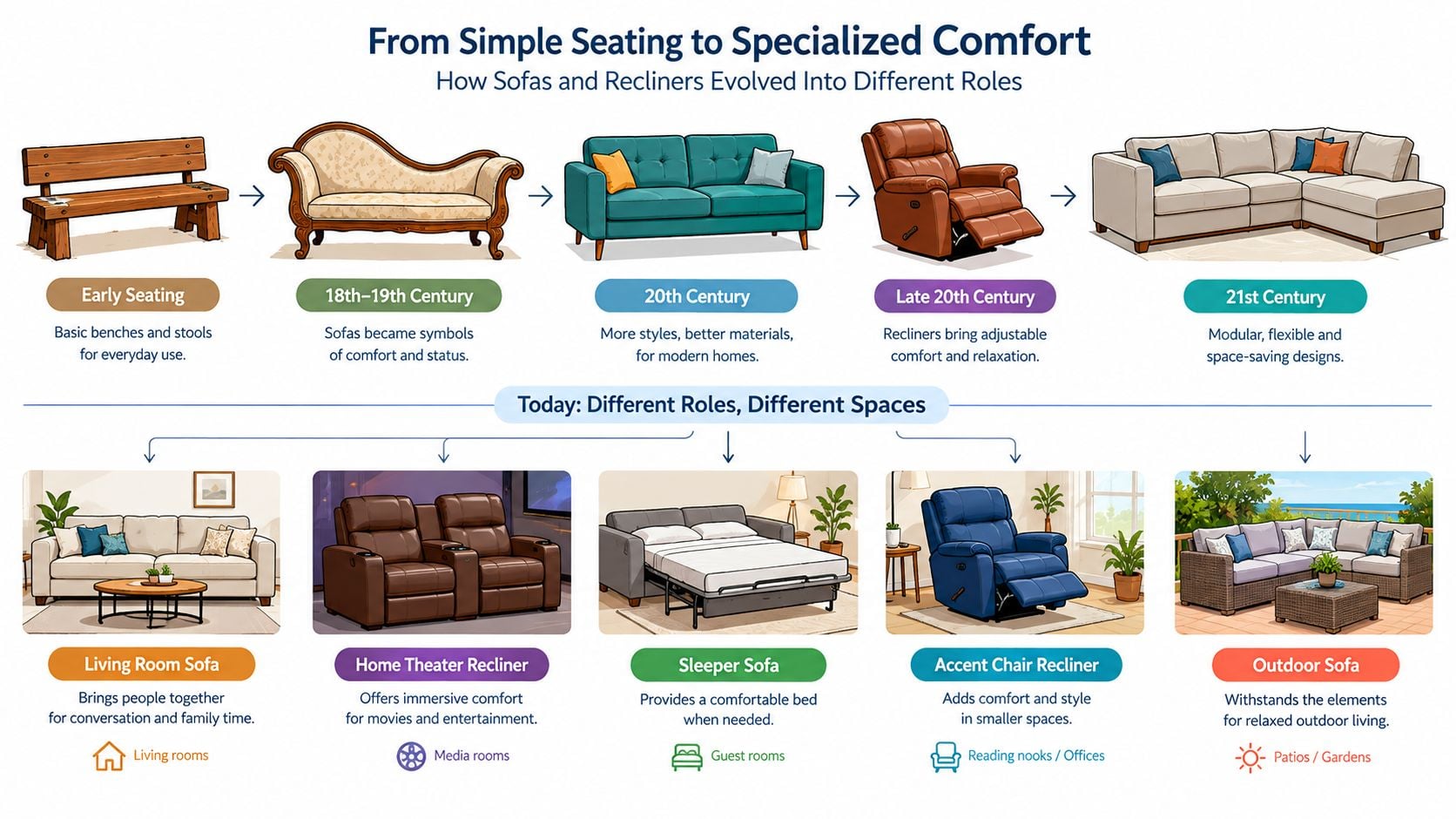
How Sofas and Recliners Evolved Into Different Roles
A sofa and a recliner split into different roles because they came from different design problems. Early cushioned, raised seating appears in ancient civilizations, while the sofa took shape later as a more recognizable upholstered form for shared use. By the late 1600s and 1700s, sofas were becoming established in Europe as furniture meant to seat more than one person at a time.
The word sofa came into English from the Arabic ṣuffa, a cushioned bench. As upholstery improved, makers added padded backs, arms, springs, horsehair, and cotton batting. Industrial production then pushed those features into more middle-class homes, which helped define the sofa as a household piece built for gathering, conversation, and everyday shared use rather than one person's exact body fit.
Shared seating versus adjustable support
That history still matters on a sales floor now.
A sofa is a multi-person platform. Its job is to hold a room together, seat several people comfortably, and give you a fixed footprint that works against a wall or out in an open plan. That fixed structure is exactly why sofas still dominate rooms built for company, conversation, and households that need one piece to serve several people.
The recliner came later and solved a different problem. It shifted seating away from shared posture and toward individualized comfort. Once a chair could tilt the back and support the legs, the furniture stopped being only about where people sat in the room and started being about how one body was supported over time. That is why recliners belong in the same conversation as sofas, but not in the same category of use.
Mechanisms changed the tradeoff. A recliner gives one person control over back angle and leg support, but it also asks for clearance, moving parts, and a little more care over the years. A sofa gives up that adjustability and pays you back in easier placement, cleaner traffic flow, and broader seating capacity.
Manufacturers now treat recliner sofas as their own category, not just a sofa with an added feature. One market estimate valued the category at about $6.95 billion in 2025 and projected $11.73 billion by 2033, with a projected compound annual growth rate of 6.76%.
Why most flexible rooms use both
In real homes, these pieces work best when you stop treating them as rivals. A sofa handles the room-fit job. A recliner handles the body-fit job.
That is why the strongest layout in many family rooms is one well-scaled sofa plus one properly placed recliner. The sofa keeps the room social. The recliner gives one household member a seat that supports reading, television, recovery, or long sitting without forcing everybody else into the same setup.
Comfort and Ergonomics Side by Side
A properly fitted recliner can outperform a fixed sofa for extended solo sitting, but the word fitted does the heavy lifting. A recliner only helps when the user's pelvis, lower back, legs, head, and arms remain supported throughout the motion.
Cornell ergonomics guidance identifies supported reclining between approximately 110° and 130° as the range associated with lower lumbar-disc pressure, reduced back-muscle activity, and improved comfort. Supported reclined sitting can reduce intradiscal pressure by about 50% compared with more upright unsupported postures, according to the Cornell ergonomics guidance.
That doesn't mean the deepest position is automatically healthiest. A 2025 study of older adults found the best comfort and pressure distribution near a 105° backrest angle, with seat height equal to or 25 mm below the user's popliteal height. A 135° angle increased perceived slipping and reduced postural security, as reported in the same ergonomics evidence base.
What to test in a sofa
A sofa has no moving back or footrest, so the shopper must evaluate the fixed relationship between seat, back, arms, and cushions. The right sofa lets the user keep the lower back supported without sliding forward or leaving the feet unsupported.
Check these points before choosing:
- Seat height: The feet should rest securely on the floor, and standing shouldn't require a hard forward rock.
- Seat depth: Excess depth can leave shorter users leaning against pillows. Too little depth can restrict taller users.
- Cushion compression: Softness should allow comfort without allowing the pelvis to sink into a slouched position.
- Armrest position: Arms should rest naturally rather than forcing the shoulders upward.
- Shared fit: Several occupants should be able to sit supported, even if their body proportions differ.
What to test in a recliner
A recliner deserves a complete motion test, not a quick sit in the upright position. Open the footrest, move through the intermediate positions, and hold the reclined posture long enough to notice whether the lower back stays supported.
The footrest should support the lower legs without pushing the pelvis forward. The back should remain in contact with the body, and the headrest should meet the head rather than forcing the neck forward. Buyers helping an older adult or someone with mobility limitations may also benefit from this practical guide to comparing lift recliners for mobility.
Body-fit test: A seat that feels soft for two minutes may feel unstable after an hour. The useful question is whether the user can sit, recline, and stand without fighting the furniture.
For households weighing a power recliner, lift recliner, or fixed sofa, the ultimate recliner buying guide offers another way to organize the test. The verdict is clear: a recliner wins for supported individual lounging, while a sofa wins when several people need a stable shared seat.
Space, Footprint, and Room Layout Considerations
You feel the room decision fastest when the chair is open, the ottoman is out, and somebody still needs to get past with a basket of laundry. That is why recliner versus sofa is a room-fit question, not a style question. The better piece is the one that fits the body and still lets the household move naturally.
A recliner often looks manageable in its upright position, then claims much more space once the footrest is up and the back is angled. A sofa asks for a broader fixed footprint, but its shape is easier to plan around because it does not keep changing positions. In a multigenerational home, that difference matters. One person may need the support and easier stand-up posture of a recliner, while everyone else still needs a clear path to the hallway, coffee table, or favorite seat.
Measure the usable footprint
Measure every option in the positions your family will use:
- Closed dimensions: Record the width and depth when the piece is upright.
- Fully extended dimensions: Measure the farthest point reached by the footrest and back.
- Clear circulation: Measure the route left between the open seat, walls, tables, doorways, and other furniture.
| Seating Type | Typical Width |
|---|---|
| Compact single recliner | 30–36 inches |
| Oversized single recliner | 44–55 inches |
| Three-seat reclining sofa | 78–100 inches |
Those numbers help you narrow the field. They are not a substitute for the actual spec sheet. Always get the exact measurements for the model you are considering, then check the delivery path too. A piece can fit the room and still fail at the front door or hallway turn. This step-by-step guide on how to measure furniture helps you catch that before delivery day.
Choose the layout before the upholstery
Start with the traffic pattern. In many smaller Northwest Indiana living rooms, condos, and downsized homes, a compact sofa paired with one recliner works better than filling the room with multiple reclining seats. You keep a social anchor for everyday conversation and still give one family member the seat that fits their body best. That combination also leaves more flexibility if the household changes, whether that means overnight guests, a parent moving in, or kids needing more floor space.
Mechanism choice affects placement. A wall-hugger can help in a tighter room because it reduces the rear clearance you need. A modular sofa can be easier to rework later. Custom order decisions belong here too, not at the end. Arm shape, overall width, and seat count all affect whether a piece earns its floor space.
Use a simple floor test before you buy. Tape out the full outline of the sofa or recliner, including the open position, then walk through the room carrying something bulky. That quick test shows you more than a sketch on paper.
Room-planning rule: The piece with the smaller closed footprint is not automatically the better fit. Buy the one that leaves enough usable room for how your household actually lives.
If delivery or rearranging is part of the job, this guide can help you protect your home during a move. Count the seats you need, measure the open footprint, and protect the walking paths first. Upholstery color can wait.
Durability, Mechanisms, and Upholstery That Last
A sofa and a recliner shouldn't be judged by the same durability checklist. A sofa is primarily a structural seating platform. A recliner is a structural platform plus a hand-operated or power-operated mechanism, with additional wear, stability, pinch, and control points.
European furniture standards separate general seating strength and durability testing from dedicated testing for hand- and power-operated reclining mechanisms. The mechanism test method is based on use by an adult weighing up to 110 kg, but that method doesn't establish every structural-strength requirement. Domestic-seating requirements also address stability, strength, durability, finger entrapment, shear, and compression hazards (European reclining-mechanism standard).
U.S. General Services Administration requirements similarly treat sofas and recliners as upholstered seating subject to recognized performance methods, with additional testing for the reclining function. In plain language, a recliner should come with more questions than a fixed sofa.
Ask construction questions that match the piece
For a sofa, inspect the frame, suspension, seam quality, cushion recovery, and stability. Sit at several positions, press along the front rail, and check whether the cushions recover rather than staying compressed.
For a recliner, add these questions:
- Mechanism testing: Has the reclining function been tested for endurance?
- Control warranty: What coverage applies to the motor, switch, transformer, or lever?
- Clearance: What operating space must remain around the mechanism?
- Stability: Does the open position feel secure, or does the user feel pulled forward?
- Serviceability: Can the mechanism be accessed and repaired if needed?
Flexsteel is a useful brand category to examine for shoppers prioritizing durability, but the same inspection still applies. A recognizable name doesn't replace checking the frame, suspension, upholstery, and mechanism coverage.
Read abrasion numbers carefully
ACT upholstery guidance identifies 15,000 Wyzenbeek double rubs or 20,000 Martindale cycles as benchmarks for some general upholstery applications. For high-traffic or public applications, it identifies 30,000 double rubs or 40,000 Martindale cycles. The guidance also warns that results above 100,000 double rubs may not add meaningful value and that abrasion resistance doesn't necessarily predict service life (ACT upholstery abrasion guidelines).
A performance fabric can still fail to meet a household's needs if the frame is weak, the cushion loses shape, or the fabric is poorly suited to cleaning habits. For stitching and upholstery construction, practical upholstery sewing advice from B-Sew Inn provides useful background on how thread and needle choices affect finished work.
A deeper guide to upholstery materials can help shoppers compare fabric, leather, and performance options. The buying principle is direct: choose the construction for the job, then choose upholstery that matches children, pets, traffic, and cleaning expectations.
Which Household Benefits Most From Each Choice
The strongest recommendation changes with the household. A living room used by one person for recovery needs a different seat from a room used for weekend hosting. Northwest Indiana families can usually identify the right direction by matching the furniture to three recognizable patterns.
A young family in Schererville or Munster
A young family furnishing a first home usually needs a sofa-led layout. The sofa gives children room to sit together, lets adults supervise play, and supports guests without asking everyone to claim a separate mechanism.
A single recliner can still earn a place if one adult uses it every day for reading or television. It should sit where the open footrest won't cut across the main route. Performance upholstery deserves attention because family seating has to tolerate active use, but durability should be evaluated through the full construction rather than one abrasion number.
A multigenerational household in St. John or Crown Point
A multigenerational home often benefits most from a sofa-plus-recliner combination. The sofa preserves shared family seating, while a carefully fitted recliner gives an older adult or mobility-limited user an adjustable position and a more supportive way to rise.
Research on older adults found that sofas commonly have low seats, soft cushions, and low or missing armrests, features that can make standing more difficult. The same research identified the trunk-to-thigh angle as the most influential joint angle during sit-to-stand movement and found that adjustable seat tilt or rising assistance can reduce postural barriers and fall risk (research on seating and sit-to-stand movement).
That doesn't make every recliner safe or every sofa unsuitable. The user still needs to test seat height, armrest position, cushion compression, and the effort required to stand. A lift feature may help some users, but the correct choice remains a body-fit decision.
An entertainer in Dyer
An entertainer who hosts game days, movie nights, or larger family gatherings should start with a sofa-led arrangement. A sofa keeps people facing one another and provides more flexible seating for guests who aren't using a recline function.
One recliner can add a dedicated comfort position without turning the room into a row of isolated seats. If the room is large enough, a sofa, recliner, and occasional chair can create distinct conversation and viewing zones. If the room is tight, a well-scaled sofa may be the smarter choice.
Household test: If the furniture must serve several generations, don't ask whether a recliner or sofa is universally more comfortable. Ask which seat lets each person sit securely, relax fully, and stand without unnecessary effort.
The same logic applies to aging-in-place planning. The right arrangement may look less uniform, but it will serve more bodies and more daily routines. Each household should identify whether it resembles a first-home family, a multigenerational home, or a frequent-hosting room before choosing a matching set.
Custom Orders, Financing, and the Groen Difference
A living room doesn't have to be built around whatever happens to fit the showroom floor. Custom order furniture lets a household work from its room dimensions, body needs, upholstery preferences, and visual style. That matters when a standard sofa is too deep, a recliner is too wide, or a shared room needs one coordinated piece and one individually supportive seat.
Groen's Fine Furniture offers custom furniture options alongside brands and categories with distinct strengths. Flexsteel suits shoppers focused on durability, Bassett supports style-led rooms, and Amish Furniture brings solid wood craftsmanship for buyers seeking heirloom construction. Custom order services can help families design it their way, whether the goal is a made-to-order sofa, a custom sectional, or a living room that coordinates with custom dining.
Special Financing, subject to credit approval, can provide additional buying power when a household needs to fit a quality purchase into its budget. The useful approach isn't to chase the lowest initial figure. It is to choose the seating that supports the household and then carefully review available financing terms.

Local guidance makes the test practical
Groen's family-owned showrooms in Dyer and Crown Point have served Northwest Indiana since 1983, with multigenerational ownership and five-star service built around personal guidance. The team can help compare stationary sofas, reclining sofas, power and manual recliners, upholstery choices, and room proportions without treating every household as interchangeable.
The same visit can include interior design guidance, White-Glove Delivery planning, and support for the rest of the home. For mattress shoppers, the Helpful Mattress Guide keeps the conversation centered on health, rest, and sleep wellness, with Serta and Beautyrest among the mattress brands available. Canadel custom dining and solid wood Amish furniture also support a home where living-room seating needs to coordinate with lasting pieces elsewhere.
More detail on the ordering process is available through custom furniture made simple. The next step should be physical, not theoretical. A shopper should sit upright, recline fully, stand, measure the route, and let the household test the options together.
Visit Groen's Fine Furniture in Dyer or Crown Point to test-drive sofas and recliners, explore custom-order options from Flexsteel, Bassett, and Amish Furniture, and ask about Special Financing, subject to credit approval. Let the family-owned team help create a comfortable, lasting room with honest guidance and White-Glove Delivery.