Best Wall Hugger Recliners: A Practical Buying Guide


A recliner can look perfect in a showroom and still be wrong for a Dyer living room. The back may clear the wall, yet the footrest can block the walkway, the seat can crowd a coffee table, or the power cord can cross the path to the sofa. For homeowners in Dyer, Crown Point, and communities across Northwest Indiana, the best wall hugger recliners are the ones that fit the entire room, not merely the space behind the chair.
Groen's Fine Furniture is a family-owned NWI furniture retailer serving local households since 1983. The team helps homeowners in St. John, Schererville, Munster, and surrounding communities compare comfort, construction, upholstery, and installation details without treating every recliner as interchangeable. The practical approach is simple: measure first, test the full motion, then choose the chair that supports daily life.
Why a Wall Hugger Recliner Might Be Your Best Move
A family in a Dyer living room may start with a familiar problem. The sofa fits against one wall, the television sits opposite it, and the only sensible place for a recliner is beside the sofa. A conventional chair needs room behind its back to open, so it pushes into the walkway or forces the entire seating arrangement forward. The wall-hugger design can preserve that circulation space by moving its seat forward as it reclines.
That makes a wall hugger a room-planning solution, not just a more compact chair. It can suit an apartment, a family room with several traffic routes, or an open-plan space where every inch behind the seating matters. It can also work well in a room where a homeowner wants a recliner near a wall without sacrificing access to a side table, lamp, or media console.
Practical rule: A chair that clears the wall but blocks the walkway hasn't solved the room problem.
The design isn't right for every household. A very deep model can still dominate a small room once the footrest rises. A low seat may be uncomfortable for someone who needs strong support when standing. A power model may require careful cord placement, and a chair with generous padding may need more usable floor space than its upright dimensions suggest.
What local homeowners should decide first
The strongest candidates usually share three qualities:
- The room has limited rear clearance: The chair must sit close to a wall, sofa, or fixed architectural feature.
- The household uses the chair daily: Frequent use makes seat fit, controls, stability, and service support more important than appearance alone.
- The buyer can reserve front space: The mechanism saves room behind the recliner, but the seat and leg rest still travel toward the room.
Groen's broader living room assortment gives shoppers a way to compare wall-hugger seating with sofas, sectionals, tables, and living room accents in the same planning conversation. A homeowner considering Flexsteel for durability, Bassett for style, or a custom upholstery choice shouldn't judge the recliner in isolation. The chair has to work with the room's scale, colors, circulation, and intended use.
For ideas on arranging a compact seating area, homeowners can also review furniture choices for small living rooms. By the time a shopper visits a showroom, the useful goal is clear: bring room measurements, know the likely traffic path, and be ready to evaluate the entire recline motion.
How Wall Hugger Recliners Work
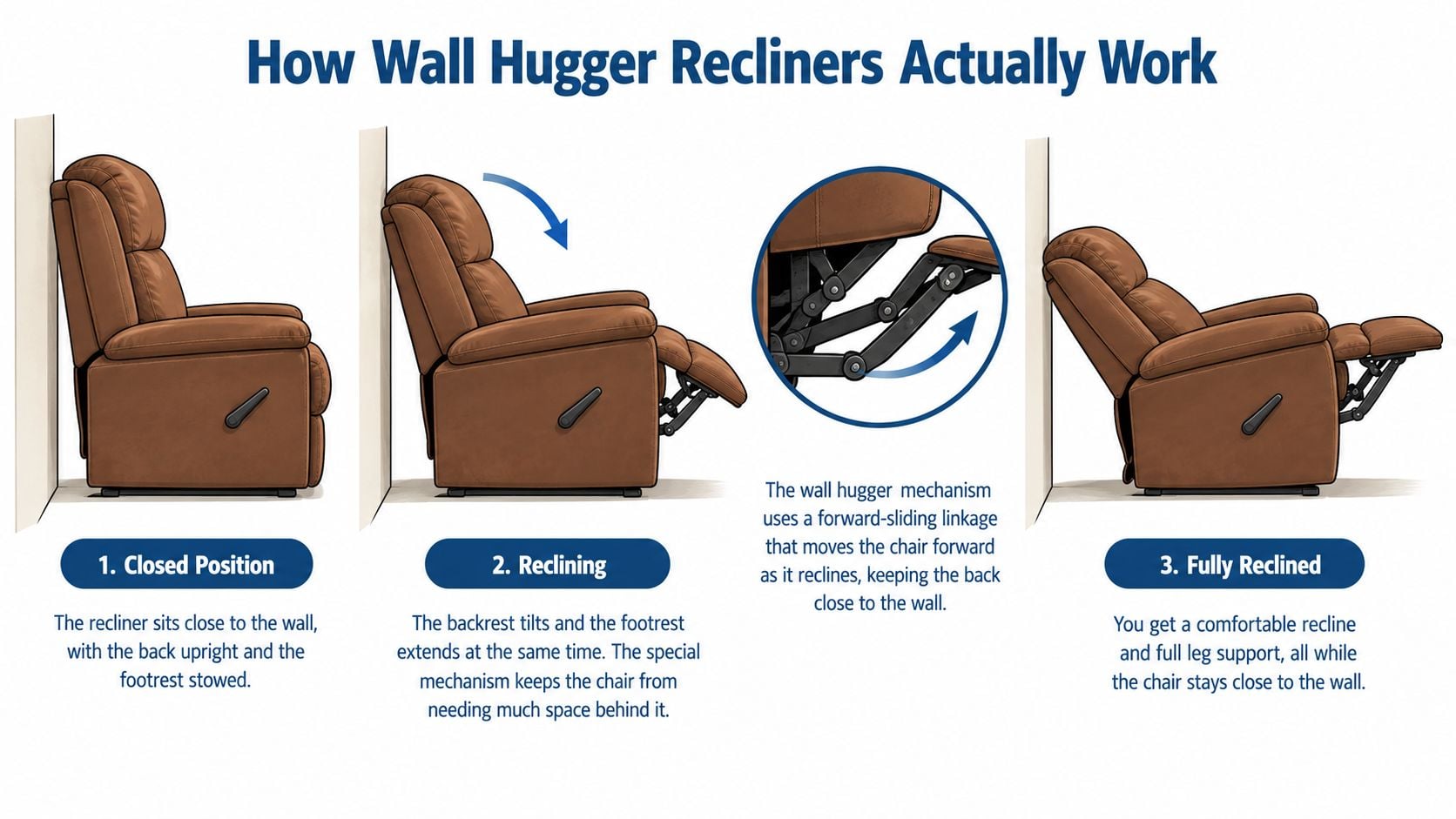
A wall-hugger recliner uses a forward-sliding seat mechanism. In a conventional recliner, the backrest rotates into the space behind the chair. A wall-hugger design uses internal rails, linkages, or a trolley-style mechanism to move the seat forward as the backrest inclines and the footrest rises. That motion saves rear clearance, but it shifts the chair's operating space toward the room.
The engineering principle appears in a 2008 U.S. patent for a “zero gravity wall hugger recliner.” Its documented trolley mechanism moves the seat and backrest forward, allowing the chair to sit only a few inches from a wall during the transition from upright to reclined. A related European patent application describes the same basic movement, with the seat advancing as the backrest tilts so the back avoids the wall. See the 2008 wall-hugger recliner patent for the documented mechanism.
The motion in plain language
Activating the recline function starts three linked movements:
- The seat advances toward the room. This creates space for the backrest to angle without striking the wall.
- The backrest inclines. It moves into a reclined position while staying within the chair's rear operating envelope.
- The footrest deploys. The leg rest rises into the area in front of the chair, making front clearance just as important as the wall gap.
Published planning guidance commonly places wall-hugger rear clearance around 3 to 6 inches, while conventional recliners often need approximately 12 to 18 inches. Treat those figures as planning ranges, not guarantees. Backrest height, cushion thickness, frame design, flooring, and installation instructions can change the required gap. The general distinction between forward travel and rearward rotation is also shown in wall-hugger and conventional recliner designs.
Modern reclining furniture traces back to an American wooden porch chair created in 1928 by cousins Edward M. Knabusch and Edwin J. Shoemaker. The design developed into upholstered indoor seating by 1929 to 1931, establishing the familiar combination of a reclining back and integrated leg rest. Later motion-furniture designs added functions such as powered adjustment, lifting assistance, adjustable headrests, and wall-hugger movement.
Test the full motion in a showroom, not just the upright position. Watch the rear gap, front travel, footrest clearance, and contact points as the chair opens and closes.
Treat “zero wall” as a marketing label until the manufacturer provides the required clearance for the exact model. The useful specification is the measured gap with the chair fully upright and installed according to its instructions.
Measure Your Room Before You Measure the Chair
A chair can fit neatly against the wall and still make the room unusable. Before you visit a showroom, use a tape measure and painter's tape to test the entire operating footprint, including the path people use around it.
Follow the full footprint
Measure from the wall to the front zone with the chair closed. Mark the intended width on the floor, then extend that outline forward to show where the seat and footrest will travel. Some compact wall-hugger models still need roughly 60 to 68 inches of front-to-back room when fully extended, so the walkway in front may limit your choice before the wall gap does.
Confirm the exact manufacturer's rear-clearance requirement with the back fully reclined. Published estimates range from about 1 to 6 inches for many wall-hugger designs to more than 12 inches for conventional recliners. Treat those figures as planning ranges. The actual requirement depends on the model, its mechanism, and the installation instructions.
Check the parts showroom photographs usually hide:
- Baseboards and trim: A deep baseboard can reduce the usable gap behind the chair.
- Outlets and cords: Keep receptacles and power cords clear of the mechanism's travel path.
- Side clearance: Leave space for controls, arm movement, and access to moving joints.
- Front obstacles: Measure coffee tables, ottomans, lamps, heating registers, and the main walking route.
- Doors and adjacent furniture: Check the door swing and the route between the chair and nearby seating.
Mark both the closed footprint and the fully extended front zone with painter's tape. Walk through the outline while carrying a basket, turning toward the sofa, and passing toward the doorway. If the taped layout feels cramped, the chair will feel cramped. Use this guide to measuring furniture for a broader measuring routine before you place an order.
Wall Hugger vs Conventional Recliner Clearance
| Dimension | Wall Hugger | Conventional |
|---|---|---|
| Rear clearance planning range | About 3 to 6 inches in many examples | Approximately 12 to 18 inches in many examples |
| Main movement | Seat travels forward as the back reclines | Backrest rotates or tips rearward |
| Primary room risk | Front travel blocks circulation | Rear clearance pushes the chair into the room |
Use the table for initial planning, not as a substitute for the product manual. In the showroom, ask staff to demonstrate the exact model from upright to fully reclined. Watch the rear gap, front travel, cord position, and contact points, then compare that movement with your taped layout at home.
Room-readiness checklist
- Wall-to-front-zone depth measured with the chair closed.
- Manufacturer's rear clearance confirmed.
- Fully extended front travel marked with painter's tape.
- Baseboards, outlets, trim, and registers checked.
- Side access for controls and safe passage confirmed.
- Door swings and delivery routes reviewed.
- Flooring considered, especially if the chair slides across hardwood or vinyl.
Features Worth Comparing Across the Best Wall Hugger Recliners
A good wall-hugger comparison starts with fit and ends with daily comfort. Features matter only when they improve the way the household uses the chair.
Manual recline suits shoppers who prefer a straightforward mechanism and don't need powered positioning. A power recliner makes sense when a user wants controlled movement, adjustable stopping points, or easier operation without pulling a lever. Power can be especially useful for someone with limited hand strength, but the control must remain reachable from the upright position and the household needs a plan for operation during a power interruption.
Compare the comfort architecture
A showroom sit should reveal more than whether the cushion feels soft. The seat depth must support the user without forcing the knees too high, the back should maintain contact without creating a gap, and the headrest should meet the head when the chair is reclined. Adjustable lumbar support can help a household with different users, but it should be tested in several positions rather than accepted as a label.
Groen's living room selection includes wallsaver and power-reclining options, and shoppers can use the power reclining seating guide to understand the broader category before comparing individual chairs.
Upholstery also changes the ownership experience:
- Performance fabric: A practical choice for active households that want a softer hand and easier everyday care.
- Leather: A structured, durable-feeling option with a distinct surface character and simple visual lines.
- Custom upholstery: Useful when the chair must coordinate with an existing sofa, sectional, or room palette.
Frame construction deserves direct questions. Kiln-dried hardwood, engineered wood, and steel each serve different structural roles, and the buyer should ask what the manufacturer uses in the frame, base, and reclining mechanism. A chair that feels solid during one brief sit still needs a clear warranty covering the frame, mechanism, motor, and upholstery terms.
Match the chair to the household
A small-apartment buyer should rank compact width, front travel, and control placement first. A family-room buyer may prioritize performance fabric, sturdy arms, and a finish that coordinates with multiple seats. A media-room household may value headrest adjustment, lumbar positioning, and a smooth power stop. A multigenerational household should give equal weight to seat height, transfer support, stability, and control accessibility.
Customization can keep the buyer from settling for a stock color or generic configuration. Groen's Custom Furniture services support a “Design it your way” approach, while Canadel custom dining and Amish solid wood furniture show how made-to-order choices can shape a broader home. For the recliner, the important questions are whether the available fabric, leather, finish, and configuration choices suit the room and whether the final dimensions remain compatible with the measured footprint.
How to Judge Durability and Safety Beyond the Showroom Sit
Five minutes in a showroom can reveal pressure points, but it can't prove long-term mechanism durability. A more useful evaluation asks how the chair was tested, what load the test used, and whether the test covered the complete operating range.
The U.S. General Services Administration's recliner method moves a chair from closed to TV position, then to full recline and back under a 200-pound test load. The method specifies 25,000 cycles or failure, whichever occurs first. Those figures come from the GSA upholstered furniture test method, and they provide a meaningful question for a retailer or manufacturer.
Separate strength from durability
A high static weight rating doesn't automatically prove that a mechanism will remain reliable through repeated movement. Static strength, mechanism durability, stability, and electrical safety are separate test domains. International EN 1728 testing distributes reclining-seat cycles between upright and adverse reclined positions, recognizing that force and stress change as the chair's geometry changes.
Ask the sales team:
- User rating: What tested user-weight rating applies to the complete chair?
- Cycle count: How many cycles did the tested unit complete?
- Test scope: Did testing cover the complete chair or only the mechanism?
- Warranty coverage: Which frame, motor, control, and mechanism components receive protection?
- Load conditions: Did the test reflect the intended user and realistic movement?
A household should match the tested rating to the heaviest intended user and allow margin for dynamic loads, such as dropping into the seat, pushing hard on the arms, or resting heavily on the footrest. Powered models also need safe cord routing, protection from pinch points, reachable controls, and a practical response to a power interruption.
Check stability and moving joints
EN 1022:2023 addresses domestic seating stability, including reclining seats and loungers. Stability should be checked with the chair empty and occupied, including entry and exit at the most reclined position. EN 12520:2024 addresses finger entrapment, shear, compression, sharp edges, and hazardous openings in domestic seating, making those concerns especially relevant for households with children or older adults.
Flooring deserves attention too. Forward movement can scuff hardwood or vinyl over time, so a flooring-compatible base, protective glides, or a suitable rug may be appropriate. During delivery or a future move, homeowners can also consult this practical furniture protection guide from Gentle Giant Removals & Relocations before the chair is lifted or repositioned.
For broader expectations about construction and service life, homeowners can review how long furniture should last. The central judgment remains practical: a durable chair should feel stable, operate smoothly, protect users from accessible hazards, and come with warranty terms that match its moving parts.
Test Drive Your Shortlist at a Local Showroom
A proper showroom test should resemble the chair's real job at home. The shopper should sit upright first, place both feet on the floor, and check whether the arms provide useful support for standing without excessive effort. Then the shopper should recline fully, observe the head and lumbar position, and return to upright without crossing the extended footrest.
The chair should remain stable during entry, exit, and the most reclined position. Controls should be reachable without twisting, cords should have a safe route, and the extended footrest shouldn't create a dangerous interruption in the main walkway. The front clearance deserves as much attention as the wall gap, especially in a small living room, apartment, or RV.
Bring the room plan into the test
A phone photo of the room, the taped floor outline, and the key measurements give the showroom team useful context. Groen's Fine Furniture offers wall-hugger and wallsaver seating options, including power configurations with features such as lumbar support, headrests, heat, massage, and charging options. Those features should be judged against the room and the user, not added just because a control panel makes the chair look more advanced.
The same visit can address upholstery, configuration, and delivery. Custom order services allow shoppers to explore fabric, finish, and setup choices, while Special Financing is available subject to credit approval to provide additional buying power and help fit a quality purchase into the household budget. White-Glove Delivery can also reduce the difficulty of moving a heavy recliner through a doorway and into its final position.
Groen's multigenerational ownership and five-star service support homeowners throughout NWI, including Dyer, Crown Point, St. John, Schererville, and Munster. Shoppers can find local showroom information through Northwest Indiana furniture stores and arrive ready to test the exact motion rather than relying on a product label.
The strongest final choice is the chair that clears the wall, preserves the walkway, supports a safe transfer, and feels comfortable in every position. A showroom visit turns those requirements into something a homeowner can verify before delivery.
Visit Groen's Fine Furniture in Dyer or Crown Point to test wall-hugger recliners, compare custom upholstery and power features, and ask about Special Financing subject to credit approval. Let the Groen family help create a comfortable living room with honest guidance, custom options, and White-Glove Delivery.