Oversized Chair with Ottoman: Sizing, Style, and Fit Guide

For homeowners in Dyer, Crown Point, and throughout Northwest Indiana, an oversized chair with ottoman can become the seat everyone claims. On a cold NWI evening, a reader settles into a broad cushion, places both feet on the ottoman, reaches for the remote, and finally stops shifting around. The appeal is immediate, but the purchase deserves more thought than choosing the widest chair in the showroom.
The chair and ottoman work as one comfort system. Seat height, cushion support, ottoman position, upholstery, and the room's circulation all affect whether the pairing feels restful or awkward. This guide helps homeowners evaluate those details, measure the combined footprint, compare construction choices, and decide whether a ready-made or made-to-order configuration makes more sense.
Why an Oversized Chair with Ottoman Belongs in Your Living Room
A standard accent chair can provide an attractive place to sit, but it often leaves the legs unsupported. A recliner solves that problem differently, with a built-in mechanism and a fixed reclining path that can make the piece feel more visually substantial. An oversized chair with ottoman offers a middle ground. The sitter gets room to change position, stretch out, read, nap, or watch television without committing the entire chair to one mechanical position.
The important point is that the chair and ottoman shouldn't be judged separately. A chair may fit a wall beautifully, yet the ottoman can interrupt a walkway when pulled close enough for comfortable leg support. In showroom conversations, many shoppers become surprised. They came to measure the chair, but the room has to accommodate the complete arrangement in daily use.

Comfort that changes how a room gets used
A broad lounge chair can support more than a quick seat. It can give a parent space to read with a child, offer a quiet corner for a book, or create a dedicated place to rest without taking over the entire room like a large sectional might. Soft lighting, a throw, and other simple choices can also make the space more inviting. Homeowners looking for practical atmosphere ideas can find useful comfort tips from Jackpot Candles.
The styling should still serve the household. Families may prefer durable performance fabric, while a formal sitting room might call for leather or a refined woven textile. The right choice makes the chair feel intentional rather than oversized for its own sake.
Begin with the room, not the catalog
Before selecting a color or silhouette, homeowners should measure the chair's resting position, the ottoman's usable position, and the walking route around both. Groen's living room essentials can help shoppers think about the chair as part of a complete seating plan rather than an isolated purchase.
A successful pairing should deliver three things:
- Leg support: The ottoman lets the sitter rest both feet without forcing the knees too high.
- Flexible use: The chair supports reading, conversation, television, and quiet downtime.
- Clear circulation: Family members can move through the room without constantly bumping the ottoman.
The Ottoman Tradition and How Oversized Chairs Evolved
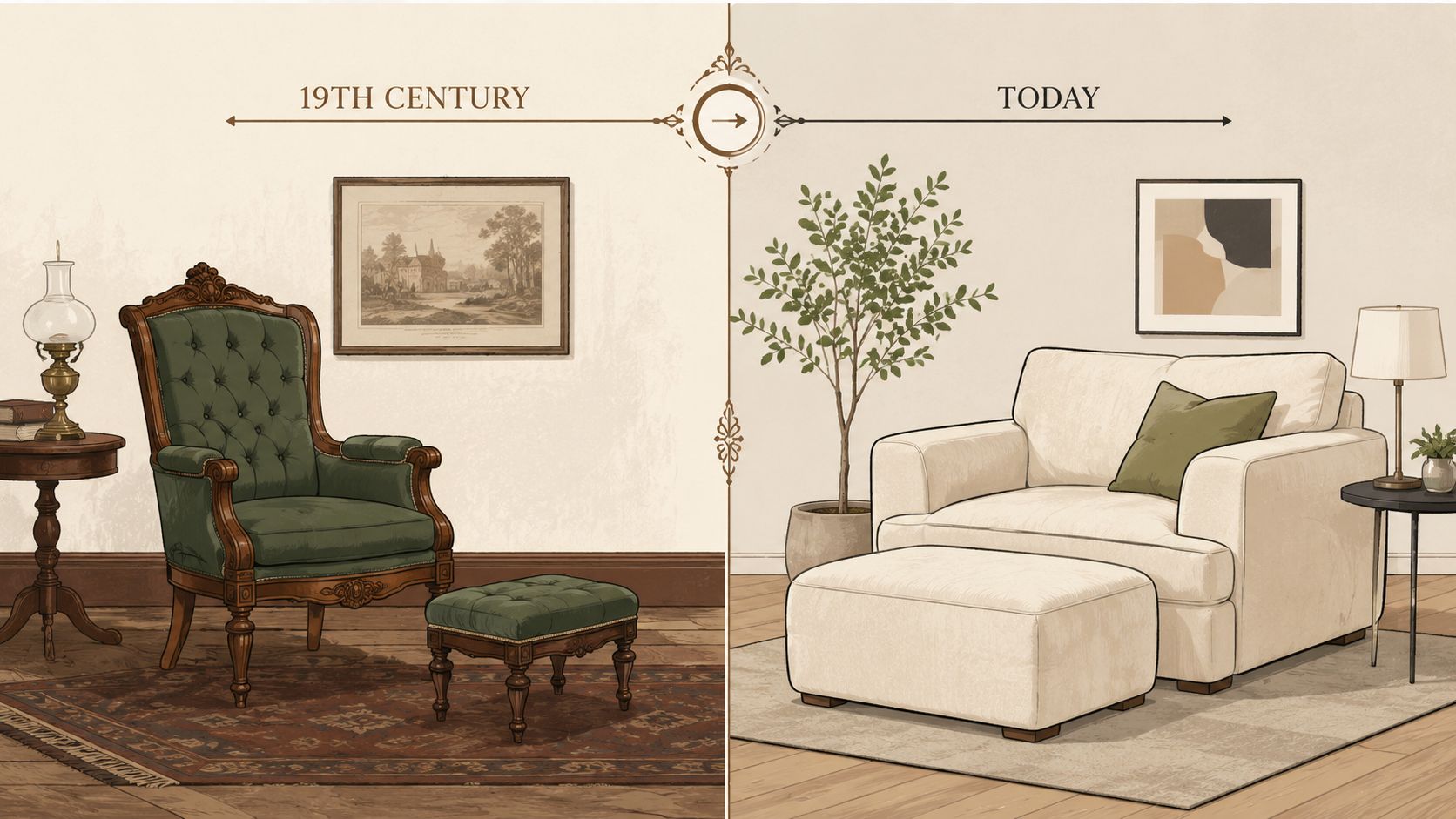
The ottoman has a long comfort-centered history. Its lineage can be traced to furnishing practices in the Ottoman Empire, where it began as a low wooden platform piled with cushions and later developed into sectional seating that wrapped around three walls of a room. The piece entered Europe in the late 18th century, and its name comes directly from the Ottoman Empire, which controlled large parts of eastern Europe and the Mediterranean world at its height in the 16th and 17th centuries. This history is documented in the history of the ottoman as furniture).
That background explains why the form feels natural today. The ottoman wasn't originally conceived as a decorative afterthought. It belonged to a broader tradition of low, communal, relaxed seating. Modern upholstered furniture changed the materials, proportions, and construction, but the underlying purpose stayed familiar: create a place where the body can settle.
From lounge furniture to the modern pair
Over time, matching chairs and footrests became a recognizable comfort arrangement. Later lounge furniture widened the visual language, using deeper seats, generous arms, and more enveloping backs. The contemporary oversized chair continues that progression, but its size alone isn't what makes it successful.
A genuine chair-and-ottoman unit should coordinate in proportion. The ottoman needs enough surface to support the feet, while the chair needs a seat that lets the sitter use the backrest without leaving the legs unsupported. A very large chair with a small decorative footstool may look balanced in a photograph but perform poorly during a long reading session.
A proven form still needs careful evaluation
The historical lineage makes the pairing more than a passing style choice, but it doesn't excuse poor fit. Shoppers still need to examine seat height, depth, cushion behavior, frame construction, and room access. The question isn't merely whether the chair looks big. It's whether the proportions create a relaxed sitting position for the people who will use it.
Practical rule: A large chair becomes a comfort solution only when its ottoman, cushion, and surrounding space work together.
Getting the Sizing Right for Comfort and Footprint
Sizing begins with the sitter, then expands to the room. A practical baseline places the chair seat height in the 17 to 19 inch range and the ottoman around 15 to 18 inches, so the ottoman sits slightly below the compressed seat and keeps the knees gently flexed. The same guidance places a well-sized ottoman at roughly 60% to 80% of the chair's width. These relationships are explained in the oversized chair with ottoman sizing example.
A published setup measured a chair at 41.4 inches wide by 35 inches deep by 33 inches high, paired with an ottoman measuring 35 inches wide by 22.4 inches deep by 19 inches high. Together, the arrangement created an overall footprint of 57.4 inches when placed as a unit, according to the same source. The example shows why the ottoman can't be treated as a small accessory.
Use the body as the measuring guide
A seat that's too deep can leave a shorter sitter slouched against the back cushion. A seat that's too shallow may leave a taller sitter without enough thigh support. The ottoman should keep the feet supported without lifting the knees above the hips or allowing the calves to hang beyond the edge.
| Measurement | Typical Range | Recommended for Average User | Recommended for Taller User |
|---|---|---|---|
| Chair seat height | 17 to 19 inches | Mid-range height with feet grounded | Upper end if it supports easy standing |
| Ottoman height | 15 to 18 inches | Slightly below compressed seat height | Upper end when paired with a taller seat |
| Ottoman proportion | 60% to 80% of chair width | Broad enough for both feet | Wider surface for fuller leg support |
| Combined footprint | Depends on chair and ottoman placement | Measure in the room | Allow extra depth for leg extension |
These ranges should be treated as a starting point, not a substitute for sitting. The broader domestic seating guidance associated with ANSI/HFES 100 recommends an adjustable seat height of 15 to 22 inches, at least 4.5 inches of travel, a seat width of at least 17.7 inches, and a recline-capable backrest within roughly 90° to 120° relative to horizontal. Independent ergonomic guidance places typical seat depth around 380 to 460 mm, or 15 to 18.1 inches, and seat height around 405 to 460 mm, or 15.9 to 18.1 inches, as outlined in this ANSI/HFES seating checklist.
For a taller user, an oversized seat may feel welcoming, but excessive depth can still encourage slouching. A test sit should check whether the lower back meets the cushion and whether the feet remain comfortably supported when the back is used properly. Homeowners can compare broad seating options through Groen's extra-wide chair selection, then verify the complete chair-and-ottoman footprint at home.
Fill, Frame, and Fabric Choices That Change the Feel
Two oversized chairs can have similar exterior dimensions and feel completely different. Cushion fill controls how the sitter lands and rises, the frame influences stability, and upholstery changes the way the chair handles touch, light, and daily wear. Shoppers should evaluate those elements as a combination instead of selecting fabric first and hoping the comfort follows.
A down-wrapped foam cushion usually gives a softer, more relaxed sink-in sensation. High-resilience foam offers quicker pushback and tends to feel more structured. A pocketed coil cushion core can provide a springier response beneath the upholstery. None is automatically correct. The best option depends on whether the household prefers enveloping softness, upright support, or a blend of both.
Match the cushion to the frame
A firm frame paired with a softer fill can create a balanced chair. The structure keeps the sitter supported while the cushion supplies comfort at the contact points. A softer frame generally benefits from a more supportive cushion, because excessive softness in both parts can make standing harder and encourage the sitter to collapse into the back.
Frame materials also change the long-term impression:
- Kiln-dried hardwood: A strong foundation for a frequently used chair, particularly when the joints are reinforced.
- Engineered hardwood: A consistent option that can support dependable construction when properly assembled.
- Softwood: Can suit lighter-use furniture, but the complete joinery matters more than the label alone.
- Corner-blocked joinery: Adds reinforcement where the frame experiences repeated movement.
- Eight-way hand-tied springs: May contribute to an even, resilient sitting experience when integrated with quality materials.
Upholstery should reflect the household
Top-grain and full-grain leather offer distinct tactile character and can be practical for households that prefer an easy-to-wipe surface. Performance weaves are useful when daily traffic and spills are concerns. Velvet provides a plush visual and hand feel, linen brings a lighter texture, and microfiber offers a soft surface with a different maintenance profile.
A useful showroom test includes three configurations: one softer, one more supportive, and one upholstered in the material closest to the household's needs. Homeowners can also review Groen's upholstery material guide before comparing swatches in person. The final decision should account for posture, pets, children, sunlight, cleaning habits, and how often the chair will serve as the room's primary seat.
Custom and Amish-Built Options Worth Considering
A stock chair can be comfortable and still be slightly wrong. The seat may be too deep for one family member, the ottoman may sit too high, or the available fabric may not suit pets, sunlight, or the room's existing palette. Those small compromises become more noticeable when the chair is used every day.
Custom order furniture gives the buyer a way to solve the fit instead of working around it. A made-to-order configuration can address seat width, seat depth, arm height, ottoman size, leg finish, nailhead trim, and contrast welt. Fabric or leather selection can also be matched to the household's practical demands and decorative direction.
Why solid wood craftsmanship matters
Amish furniture is associated with solid wood craftsmanship, careful joinery, and an emphasis on pieces designed for long service. A homeowner evaluating an Amish-built chair or complementary furniture can review the construction details, finish, and upholstery choices together through Groen's Amish furniture in Indiana.
The same made-to-order thinking applies across a room. Canadel's custom dining program, for example, supports personalized choices for dining tables and chairs, while Amish solid wood furniture offers another route for buyers who want specifications selected around the home. Those options reflect a broader principle: furniture should fit the household, not force the household to accept an almost-right configuration.
Custom doesn't have to mean excessive
A mid-range frame with carefully selected upgrades can outperform a more expensive stock piece that misses the sitter's proportions. The strongest value often comes from spending first on the parts that affect daily use, such as seat depth, cushion support, ottoman alignment, and durable upholstery.
A showroom advisor should be able to explain which selections change comfort, which affect appearance, and which primarily affect maintenance. That conversation helps families choose bespoke, made-to-order furniture with clear priorities rather than adding features without a purpose.
Measuring Your Room So the Set Actually Fits
The room is the third party in the decision. A chair can fit on paper while the chair-and-ottoman arrangement crowds the coffee table, blocks a vent, or leaves someone squeezing sideways through the walkway.
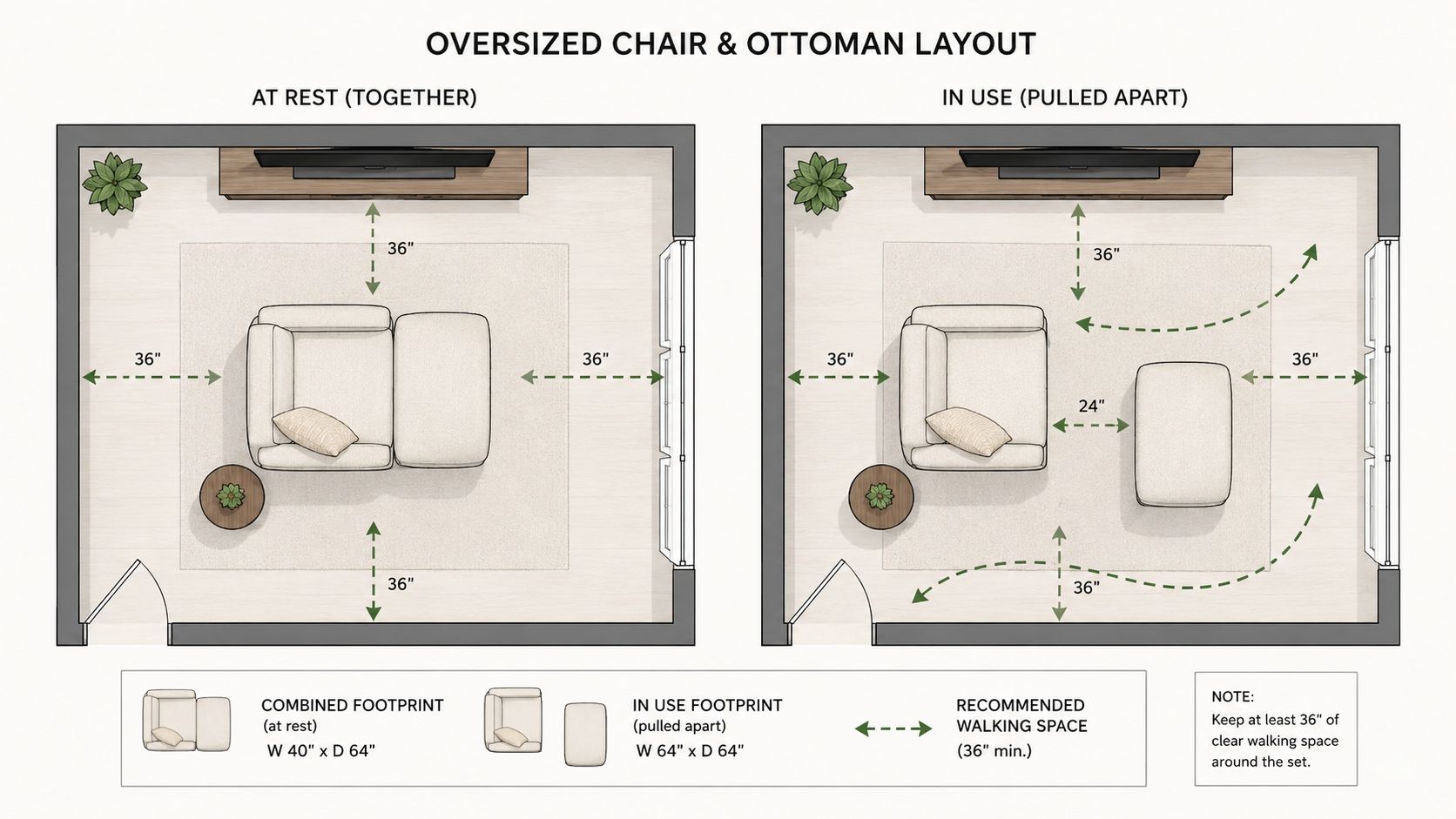
Start by measuring the chair in its normal position, then measure the ottoman pulled close enough for full leg support. Record the combined length at rest and in use. If the chair reclines or has a moving back, measure the full depth in the most extended position, not only the depth shown on the showroom floor.
Protect the walking routes
A comfortable room needs more than a furniture outline. Walk the route from the main doorway to the seating area, from the seating area to other rooms, and around the ottoman when someone is using it.
Use these checks during planning:
- Behind the chair: Reserve a clear path of roughly 30 to 36 inches where people regularly pass.
- Around the ottoman: Aim for similar breathing room around the ottoman when it's pulled forward for lounging.
- At the sides: Allow at least 24 inches where a person needs to move beside the chair.
- At the front: Reclining versions may require 24 to 36 inches in front and 12 to 18 inches behind, according to the practical layout guidance in this oversized seating guide.
Those measurements are planning references, not guarantees. Existing furniture, door swings, floor outlets, radiators, supply vents, and low window sills can change the usable area. A chair should never cover a heat source or block an air register just because the dimensions technically fit.
Measure the delivery path
The display footprint isn't the same as the shipping challenge. Measure the doorway, hallway, stair turn, and the diagonal clearance available for the chair's longest shipping dimension. Older NWI homes can have tight staircases or narrow transitions that deserve attention before an order is placed.
Consider a 42-by-40-inch chair with a 30-by-24-inch ottoman in a 12-by-14-foot room. The pair can breathe if the chair occupies a corner or open edge and the ottoman stays aligned with the chair, but the arrangement can feel crowded if a sofa, coffee table, and main walkway already claim the center. Homeowners can use Groen's furniture measuring guide to document both the room and the delivery route before visiting a showroom.
Matching Versus Contrast Ottoman Styles
The ottoman is often the most expressive part of the pairing because it can either disappear into the chair or create a deliberate visual counterpoint. A matching ottoman makes the two pieces read as one grounded form. A contrasting ottoman separates the shapes and gives the room a more collected, personal appearance.
In a formal living room with bold wall color or varied nearby furniture, matching upholstery can calm the composition. The chair and ottoman share the same texture, color family, and visual weight, so the large scale feels intentional rather than scattered. A matching ottoman should generally share the chair's depth so the leg support feels as coordinated as the appearance.
When contrast works better
Contrast styling suits a family room where the chair already has a clear role and the ottoman can add warmth or texture. A leather ottoman beside a fabric chair introduces material variation without requiring every piece in the room to match. A bright woven ottoman can also enliven a neutral chair while keeping the larger item visually restrained.
A contrast ottoman can be slightly smaller, allowing the chair to remain the dominant shape. That choice works especially well when the room contains other large furniture or when the ottoman is frequently moved aside for conversation. The surface still needs to support the feet comfortably, so visual contrast shouldn't become an excuse for poor proportion.
| Factor | Matching Ottoman | Contrast Ottoman |
|---|---|---|
| Visual effect | Reads as one complete lounge unit | Adds texture, color, or material variation |
| Proportion | Usually shares the chair's depth | Can be slightly smaller for lighter visual weight |
| Best setting | Formal rooms or rooms with varied surrounding furniture | Family rooms and relaxed, layered interiors |
| Material approach | Coordinated leather, fabric, or weave | Mixed leather, performance fabric, or woven texture |
| Traffic considerations | Consistent appearance across the pair | Choose the ottoman material for the use it receives |
Traffic should guide the upholstery choice. Performance fabric or durable leather may make sense where feet, snacks, and frequent movement are expected. A more delicate textile can work in a quieter room with controlled use.
The ottoman also affects circulation when it moves away from the chair. A layout may need a 60 to 72 inch minimum walkway when the ottoman is pulled away for stretching out. That distance should be checked against the room's actual furniture arrangement, not measured in isolation.
Showroom, Delivery, and Financing Next Steps
The first showroom visit should focus on sitting, not buying. A homeowner can learn more from a deliberate test than from a quick glance at a product card, especially when the chair will serve as a primary reading, television, or resting seat.
A practical sit-test includes:
- Try at least three oversized chair models so the differences in seat depth, back angle, and cushion response become obvious.
- Test the ottoman with shoes on and off. Footwear changes the way the legs rest and can reveal whether the surface is too short.
- Check neck and lumbar support after two minutes, then again after four minutes. A chair that feels pleasant immediately may not support the body well after the sitter settles.
- Change positions naturally. Reading upright, leaning back, and stretching the legs can expose awkward arm height or a poorly aligned ottoman.
- Notice the stand-up motion. The sitter shouldn't need to push hard against the arms or slide forward excessively.
Bring room photographs, written measurements, doorway and hallway dimensions, and a sample of an existing fabric or wood tone. These details help an advisor discuss color, proportion, delivery access, and compatibility with the rest of the home. They also make custom ordering more precise.
Plan delivery before the order
Delivery timing depends on availability and construction. In-stock special orders may take 4 to 6 weeks, while custom and Amish-built pieces may take 10 to 16 weeks, according to the purchasing guidance for this article. Homeowners with a move-in date, renovation deadline, or seasonal entertaining plan should discuss timing before selecting a finish or fabric.
White-Glove Delivery can be useful for unwieldy frames, tight staircases, and older NWI homes with challenging access. The service conversation should include the complete route, not just the front door. A delivery team needs to know about stairs, turns, railings, narrow hallways, and any doorway that requires a special approach.
Use financing as a planning tool
Special Financing can provide additional buying power, subject to credit approval, when a family wants to select the right construction instead of choosing solely by immediate cash outlay. Available plans can include 12-month same-as-cash, 36- and 48-month reduced APR options, and layaway for seasonal purchases, with credit decisions handled in-store. Terms can change, so the showroom should provide the current details before an application or purchase.
Groen's Fine Furniture serves homeowners across Dyer, Crown Point, St. John, Schererville, Munster, and surrounding Northwest Indiana communities. The family-owned business has served the region since 1983, with multigenerational ownership, five-star service, custom furniture guidance, and brands such as Flexsteel for durability, Bassett for style, Canadel for custom dining, Amish Furniture for craftsmanship, and Serta and Beautyrest for sleep products. Homeowners comparing mattresses for a separate room can also use the store's Helpful Mattress Guide to keep health and rest central to that decision.
A showroom sit-test is the clearest next step. It turns measurements, cushion preferences, upholstery questions, custom options, delivery planning, and financing into one practical conversation.
Visit Groen's Fine Furniture in Dyer or Crown Point to test-drive an oversized chair with ottoman, compare upholstery and cushion options, and discuss custom or Amish-built configurations. Ask the family-owned team about White-Glove Delivery and Special Financing, subject to credit approval, so the final pairing fits both the room and the household.