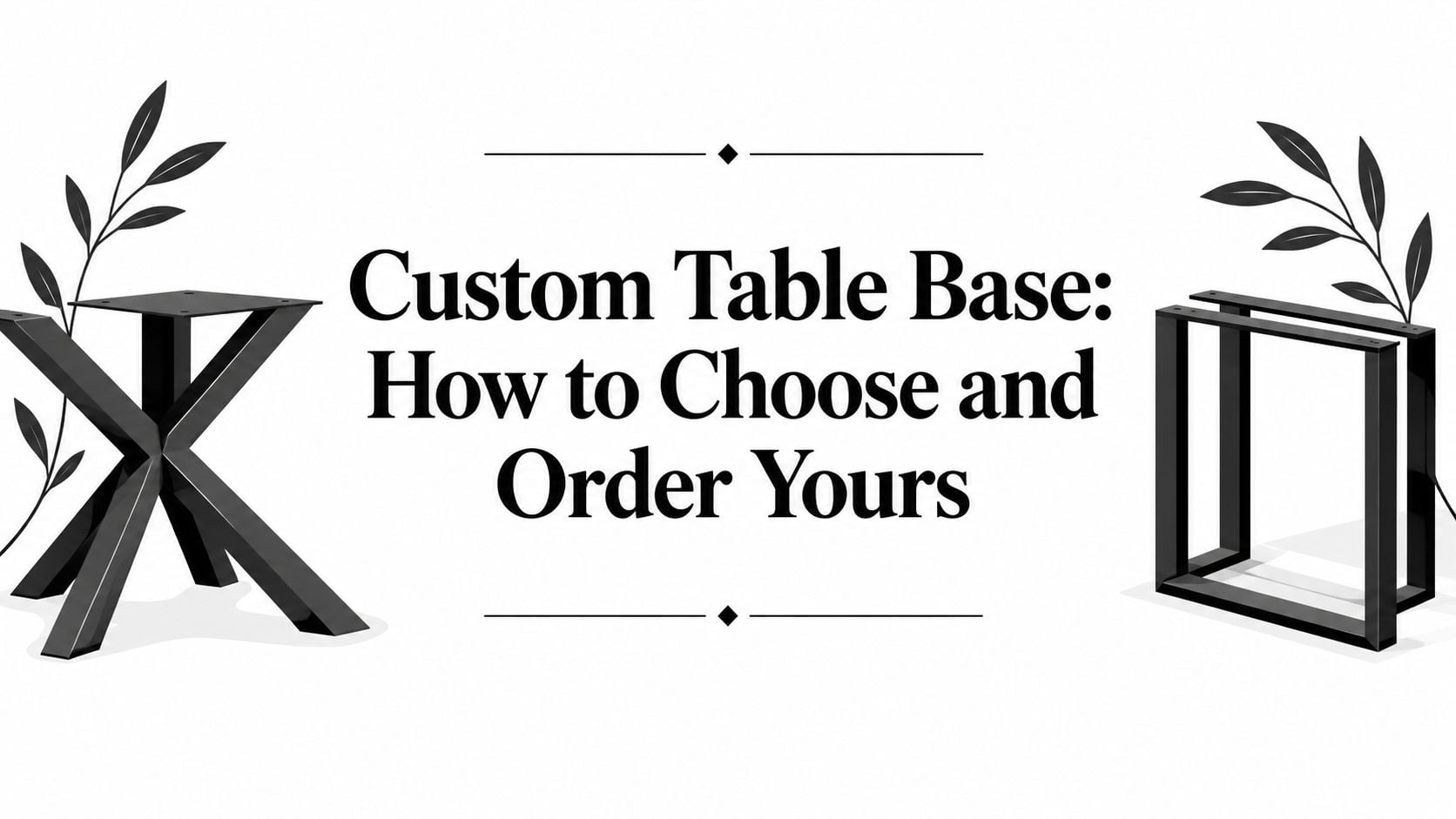
Custom Table Base: How to Choose and Order Yours

A family in Dyer finds a beautiful solid-wood tabletop, brings it home, and then discovers the supplied base crowds the chairs. The top looks right, but knees hit the supports, the table rocks on an uneven floor, and the room feels tighter than it did in the showroom. Homeowners in Crown Point, St. John, Schererville, and Munster run into this problem because the tabletop usually gets chosen first.
That order deserves to be reversed. A custom table base determines how people sit, where chairs slide, how the table carries its load, and whether the finished piece feels comfortable every day. The right base can turn a tabletop into a lasting gathering place. The wrong one can make an expensive table frustrating.
Why the Base Should Lead Your Table Decision
The base sets the table's working geometry. It affects height, knee clearance, seating flexibility, visual weight, and stability before anyone considers stain color or edge detail. A wide top on a narrow pedestal may look elegant but tip more easily under an off-center load. A long top on a trestle may feel sturdy but interfere with chairs at the ends. A four-leg design may solve that problem while creating new conflicts with knees and chair legs.
Furniture manufacturing already treats these decisions as technical work. The U.S. Bureau of Labor Statistics overview of furniture manufacturing classifies the sector under NAICS 337 and identifies cutting, bending, molding, laminating, and assembly as core processes involving materials such as wood, metal, glass, plastics, and rattan. A made-to-order base therefore involves more than decoration. It brings together material selection, structural form, machining, finishing, joinery, and tabletop compatibility.
Practical rule: Choose the support pattern before committing to the tabletop dimensions.
A useful first visit starts with the room, not a catalog photograph. The household should record the available floor area, the number of regular seats, the location of doors and walkways, and whether anyone needs extra knee or wheelchair clearance. A banquette may call for a pedestal. A long farmhouse-style top may need a trestle. A compact breakfast nook may work better with four legs.
Homeowners can also review Groen's dining-table selection guidance before visiting, then bring a simple room sketch. A separate Value Tools Co comparison can help readers think about how material and support construction affect a work surface, though a household dining table requires its own stability and comfort decisions.
The Four Base Styles Worth Knowing
The base decides how a table lives in the room. It controls knee space, chair placement, stability, and how easily people can slide in, shift over, or gather around the ends. Start there, then choose the top that fits the support.

Single pedestal
A single pedestal keeps support centered and clears the outer edge. That makes it a smart pick for round and oval tops, smaller breakfast areas, and rooms where a bench or banquette changes how people get seated. You do not have corner legs interrupting traffic, and guests can scoot around more freely.
Watch the footprint. A pedestal that looks clean from across the room can still feel tippy if the base is too narrow for the top above it. Proportion matters more here than with any other base family.
Double pedestal
Double pedestals belong under longer rectangular tops. They spread the load across two support points, give the table visual weight, and usually keep the middle of each long side open for comfortable seating. For many family dining rooms, this style strikes a good balance between presence and legroom.
It also keeps the underside cleaner than a full trestle assembly, which some homeowners prefer when they want a substantial table without as much visible structure below.
Trestle
A trestle uses upright supports tied together by a long beam or related structure. It works especially well with long, solid-wood tops and fits farmhouse, transitional, and other classic American looks. If you are considering one, this trestle table design guide gives helpful context before you settle on proportions.
Test chair locations carefully. A trestle can leave the center open, then put a post or stretcher right where an end chair or side chair wants to land.
Four-leg and mixed-material designs
Four-leg bases are familiar for a reason. They fit smaller dining nooks well, define each seat clearly, and often make sense when you want a straightforward layout without a central support.
Mixed-material bases change the feel fast. Steel can visually anchor a thick stone, glass, or live-edge top. Wood softens the room and connects more naturally with Amish and traditional furniture.
The right base family leaves proper clearance for the room, the chairs, and the people using them.
Measure the Room and the People, Not Just the Top
A tabletop measurement is only the starting point. The household needs a written base specification that accounts for the room, chair movement, body position, and load behavior.
Build the room sketch first
Use a tape measure and mark the table's proposed footprint on the floor with painter's tape. Then pull out each chair as it would be used, including the extra space needed for someone to sit down, stand up, or pass behind the chair. Mark doors, heating vents, cabinetry, and walkways that could make a visually appealing table impractical.
Next, measure the base area rather than assuming the support will fit inside the top's outline. A pedestal may occupy less perimeter space but need a wide footprint. A trestle may leave the center open while placing supports exactly where a chair wants to go. For stone or other heavy surfaces, readers may also find these practical granite measuring tips useful when documenting the top.
Write down the human measurements
A 2025 ergonomic study measured 121 students and evaluated existing study-table postures using REBA and RULA. The existing arrangement produced a REBA score of 9 and a RULA score of 8, classifications indicating high to very high ergonomic risk. The researchers designed an adjustable table measuring 60 to 72 centimeters in height, 62 centimeters in width, and 124 centimeters in length, using the 5th-to-95th-percentile body-size range in the sample. The study on adjustable table ergonomics supports a straightforward lesson: leg placement and knee clearance matter as much as top size.
For a home order, the written sheet should include:
- Top dimensions: Record length, width, thickness, shape, and overhang.
- Seating plan: Note the usual number of diners, end seats, benches, and occasional extra guests.
- Clearance needs: Identify anyone who needs more knee room, open access, or easier chair movement.
- Base footprint: Mark the outermost support points and the locations that could block chairs.
- Load details: Mention stone, glass, thick solid wood, extension leaves, or office equipment.
The furniture measuring guide from Groen's can help organize the room measurements before a custom consultation. A helper should hold the tape while another person sits, pulls out a chair, and checks whether the support feels intrusive.
Wood Movement, Hardware, and Finish Choices
Solid wood responds to changes in moisture. That movement needs to shape the attachment plan, especially when a custom base meets a broad solid-wood top. A rigid screw connection across the full width can restrain the top and contribute to splits, joint failure, or cupping.
Let the top move correctly
Start by identifying the grain direction and the dimension that expands across the grain. Select a fixed reference point, commonly the center of an apron or cleat, then orient elongated holes or clips perpendicular to the grain. The hardware should hold the top securely while allowing controlled movement.
Suitable approaches can include:
- Z-clips: These provide a concealed connection with room for seasonal movement.
- Figure-eight fasteners: These pivot as the top shifts.
- Wooden buttons: These support a traditional solid-wood construction method.
- Washer-head screws: These can slide when installed through properly oriented slots.
One technical guide estimates movement of roughly 1/8 inch per 12 inches of width between dry-winter and humid-summer conditions in moderate climates, with up to 3/16 inch per 12 inches in more extreme climates. For a 48-inch-wide tabletop, that means planning for approximately 1/2 to 3/4 inch of potential movement. The wood movement guide gives the technical basis for documenting this before production.
The consultation should record the wood species, moisture environment, grain orientation, hardware type, and slot direction.
Treat finish as part of ownership
Finish affects how the table lives in a busy home. A stain can emphasize grain and pair naturally with Amish solid wood. Paint can define the base and make a large table feel lighter. A two-tone combination can separate the top from the support structure without making the piece look disconnected.
Repairability matters too. Families should ask whether small damage can be touched up locally, whether the hardware remains accessible, and whether the finish can be renewed without replacing the whole table. Buyers considering dark metal details may also review ideas for specifying black iron door hardware to coordinate pulls, lighting, and other room accents.
Groen's dining room table finish information can help shoppers arrive with a finish family in mind. The best custom order isn't the one with the most options. It's the one whose materials, attachment method, and finish suit the household's actual maintenance habits.
Custom Order Options Through Groen's Showrooms
A stock table usually asks the buyer to accept a predetermined relationship between top and base. A made-to-order program lets the household decide how the table needs to function before the final appearance is locked in.
Canadel's custom dining program offers more than 30,000 possible combinations, including wood species, tabletop shape, more than 50 finish colors, table base style, and seat upholstery, as documented by J.C. Perreault's Canadel program information. A separate showroom and online design program covers eight collections, including Gourmet, Champlain, and Loft, with choices that can include size, shape, height, leaf or extension configuration, species, stain or paint color, two-tone combinations, hardware, base style, and matching chairs, benches, or stools. Those details are described in Canadel customization information.
Amish solid-wood custom furniture takes a different path. It emphasizes craftsmanship, material character, and a piece built to a specified size, profile, finish, and support arrangement. That route suits a household seeking heirloom value, American-Made character, and a base that feels integrated with the top rather than added afterward.
Canadel vs Amish Custom Base at a Glance
| Decision | Canadel custom dining | Amish solid wood custom |
|---|---|---|
| Best fit | Coordinated dining sets with broad design flexibility | Heirloom-oriented solid-wood furniture built to specification |
| Base choice | Select from available base styles within the chosen program | Develop the support arrangement around the top and room |
| Top decisions | Size, shape, height, leaf or extension configuration | Size, shape, thickness, wood character, and proportions |
| Finish direction | Wood species, stain, paint, two-tone combinations, and finish colors | Species-specific stain, paint, and finish treatment |
| Seating | Matching chairs, benches, stools, and upholstery | Seating coordinated around the custom table |
| Strength of the path | Made-to-order coordination across a dining collection | Craftsmanship, solid wood, and long-term personalization |
Before the appointment, the buyer should decide the intended seating count, preferred finish family, room style, and whether the table must accommodate leaves, a bench, or counter-height use. Groen's custom-order starting guide can help organize those decisions.
Groen's Fine Furniture offers custom dining guidance through its Dyer and Crown Point showrooms, including Canadel dining and Amish solid-wood options. The wider showroom experience also includes Flexsteel for durability, Bassett for style, and White-Glove Delivery planning for the finished room.
Lead Time, Pricing, and How the Order Actually Works
Custom ordering becomes easier when the buyer knows the sequence. The showroom conversation should end with a written specification and quote, not a vague promise that the details will be sorted out later.
The order path
The usual process looks like this:
- Consultation: The household brings measurements, room photos, chair information, and the desired base style.
- Written quote: The quote reflects dimensions, material, finish, hardware, seating, and delivery requirements.
- Approval and deposit: Production begins after the buyer approves the specifications and provides the required deposit.
- Production queue: The maker schedules the piece according to its materials, construction, and finishing requirements.
- Delivery planning: The team reviews entrances, staircases, elevators, finished basements, and floor protection.
- White-Glove Delivery: The table arrives with placement and setup coordinated for the home.
Lead time varies because no two custom orders have the same top, base, finish, or construction details. Larger dimensions, heavier materials, specialized finishes, extension mechanisms, and unusual access conditions can affect both price and scheduling. A finish change may be possible before production reaches a certain point, but it should be raised immediately rather than assumed.
Stability deserves a written conversation, particularly for a large slab, thick glass, stone top, or table used by children and older adults. The U.S. Consumer Product Safety Commission tip-over report estimated about 2,900 emergency-department-treated furniture tip-over injuries annually in 2019–2021, with tables accounting for roughly 40% of furniture-related tip-over incidents. Ask how the fabricator evaluates the footprint, center of gravity, attachment hardware, uneven-floor adjustment, overhang, and resistance to sideways force. “Heavy-duty” isn't a stability test.
Special Financing is available subject to credit approval. It can provide buying power and help a household fit a made-to-order table into its budget, but the exact terms should be reviewed with the showroom before approval. Honest pricing means understanding what the buyer is paying for, including structure, finish, hardware, delivery, and the labor required to make the table fit the room.
Your Next Step Toward a Base That Actually Fits
A good custom table base conversation starts with a few decisions already in hand. The household should choose a likely base family, sketch the room, mark chair pull-out zones, note the people who will use the table, and list any unusual top material or extension requirement.
The stability discussion should be direct. A fabricator should be able to explain how the base supports the top, how the attachment permits movement when solid wood is involved, and how the finished table handles an off-center load. Static weight alone isn't enough. A table should also resist the everyday forces created when someone leans on an edge, pulls up from a chair, or a child climbs where children shouldn't.
Long-term flexibility deserves equal attention. Buyers should ask whether the base can be separated from the top without damage, whether feet or leveling hardware can be replaced, whether fasteners remain accessible, and whether the support can accommodate a different tabletop later. Research examining repair, reuse, recycling, refurbishment, and sharing behaviors surveyed 4,216 consumers across Germany, Italy, India, and South Africa in March and April 2024, as recorded in this circular-economy furniture research. The practical takeaway is simple: durability includes the ability to repair, reuse, and remodel.
A showroom visit should feel like a working design appointment, not a guessing exercise. Bring the room sketch, tape-measure notes, preferred chair, finish samples if available, and a short list of must-haves. In Northwest Indiana, Groen's multigenerational ownership, five-star service, and local presence in Dyer and Crown Point give families a place to discuss custom furniture, interior design coordination, White-Glove Delivery, and Special Financing in one conversation.
Visit Groen's Fine Furniture in Dyer or Crown Point this week, ask to compare the Canadel custom dining and Amish solid-wood paths, and bring the measurements that will guide the base-first decision. The right table should feel comfortable at the first meal and remain useful through years of family life.
Visit Groen's Fine Furniture in Dyer or Crown Point to explore custom table bases, Canadel dining, Amish solid wood, and coordinated seating for a table built around the room. Ask the family team about White-Glove Delivery and Special Financing, subject to credit approval, so the finished table fits both the home and the household's budget.