Office Desk Height Standard: A Guide for Your Home

A home office often starts with good intentions. A spare bedroom gets a desk, a chair gets pulled in, a laptop lands on top, and work begins. A few weeks later, shoulders feel tight, wrists feel cranky, and the back starts asking for better furniture.
That pattern is familiar in homes across Dyer, Crown Point, St. John, Schererville, and Munster. Since 1983, this family business has watched the same problem show up again and again. The desk looks fine, but the fit is wrong. The body pays for it.
Your Guide to Home Office Comfort in Northwest Indiana
For many people in Northwest Indiana, the home office has become one of the hardest-working spaces in the house. It handles morning emails, school paperwork, household planning, and long afternoons at a keyboard. When that space isn't set up well, discomfort creeps in fast.
A common example is the homeowner who bought a desk because it matched the room. The style worked. The finish looked right. But after a few days, the shoulders kept lifting toward the ears while typing, and the neck never seemed to relax. The problem wasn't motivation or posture alone. It was the desk height.

A home office should support the person using it, not force constant adjustment. Good comfort starts with the work surface meeting the body where it naturally rests. That idea sounds simple, yet it's one of the most overlooked parts of furnishing a room.
Why desk height gets missed
People usually notice the chair first. They might add a cushion, shift the monitor, or scoot closer to the screen. Those changes can help, but they don't solve the root issue if the desktop itself sits too high or too low.
A desk can be beautiful and still be wrong for the person using it every day.
Anyone trying to improve your WFH posture usually gets better results when the desk, chair, and keyboard all work together. That same whole-room thinking matters when planning a more comfortable workspace at home, and creating an inspiring home office often starts with a desk that fits the body before it fits the décor.
What comfort should feel like
A well-fitted desk usually feels quiet in the body. The forearms rest naturally. The shoulders stay down. The wrists don't have to bend upward just to reach the keyboard.
That kind of comfort isn't reserved for a fancy corporate office. It can happen in a guest room, a den, or a corner workspace off the kitchen. The key is understanding the office desk height standard, then using it as a starting point instead of a final answer.
The Standard Office Desk Height Explained
The phrase office desk height standard sounds more universal than it really is. Upon hearing it, one might assume there's one correct height for everyone. There isn't. There is only a standard that fits some bodies better than others.
The best-known standard is 28 to 30 inches, or 71 to 76 cm, and that range was engineered around seated elbow height for users between 5'8" and 5'10". At that fit, forearms can rest parallel to the floor with about a 90 to 100 degree elbow angle, which helps reduce shoulder elevation and cervical strain, according to this desk height guide.
What that standard was meant to do
That measurement wasn't picked at random. It was meant to place the work surface near the user's natural seated elbow height. When that happens, the hands can reach the keyboard without the shoulders shrugging upward or the wrists extending too far.
Consider a car seat that only slides into one position. One driver gets in and feels perfectly supported. The next driver has to stretch for the pedals or crowd the steering wheel. The seat isn't bad. It's just fixed.
Why the standard doesn't fit everyone
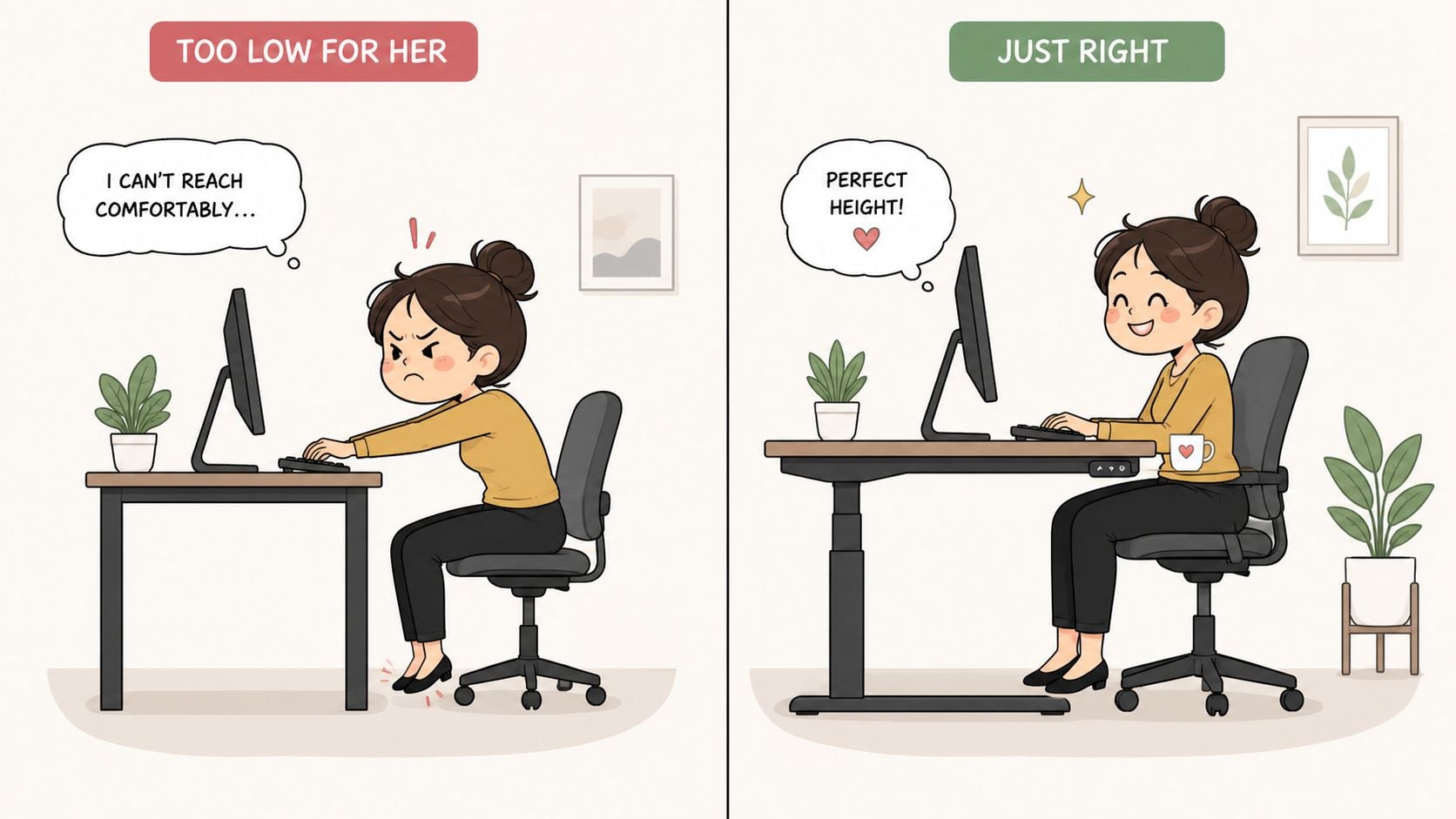
The trouble starts when a fixed desk gets treated as if it should work for every person in every room. A shorter user may end up lifting the shoulders to meet the desktop. A taller user may fold forward and work with the wrists or upper back in a strained position.
That is why the standard should be treated as a reference point, not a rule carved in stone.
Practical rule: A standard desk is a starting measurement for shopping, not proof that the desk will feel right at home.
A similar idea shows up in other furniture categories too. Dining tables follow common dimensions, but the right fit still depends on the people who use them most. That same measurement mindset helps when reviewing common table proportions in this dining height guide.
Where people get confused
Many shoppers assume discomfort means the chair is poor quality or that they only need better posture habits. Sometimes that's true. Often, the desk is the hidden issue.
Three points usually clear up the confusion:
- Standard doesn't mean universal. It means commonly produced.
- Comfort isn't based on overall height alone. Arm position while seated matters more than is generally understood.
- A handsome desk can still be ergonomically off. Style and fit are different decisions.
Once that clicks, desk shopping becomes much easier. The question stops being "Is this a standard desk?" and becomes "Is this the right height for the person who'll use it every day?"
How to Find Your Personal Ergonomic Desk Height
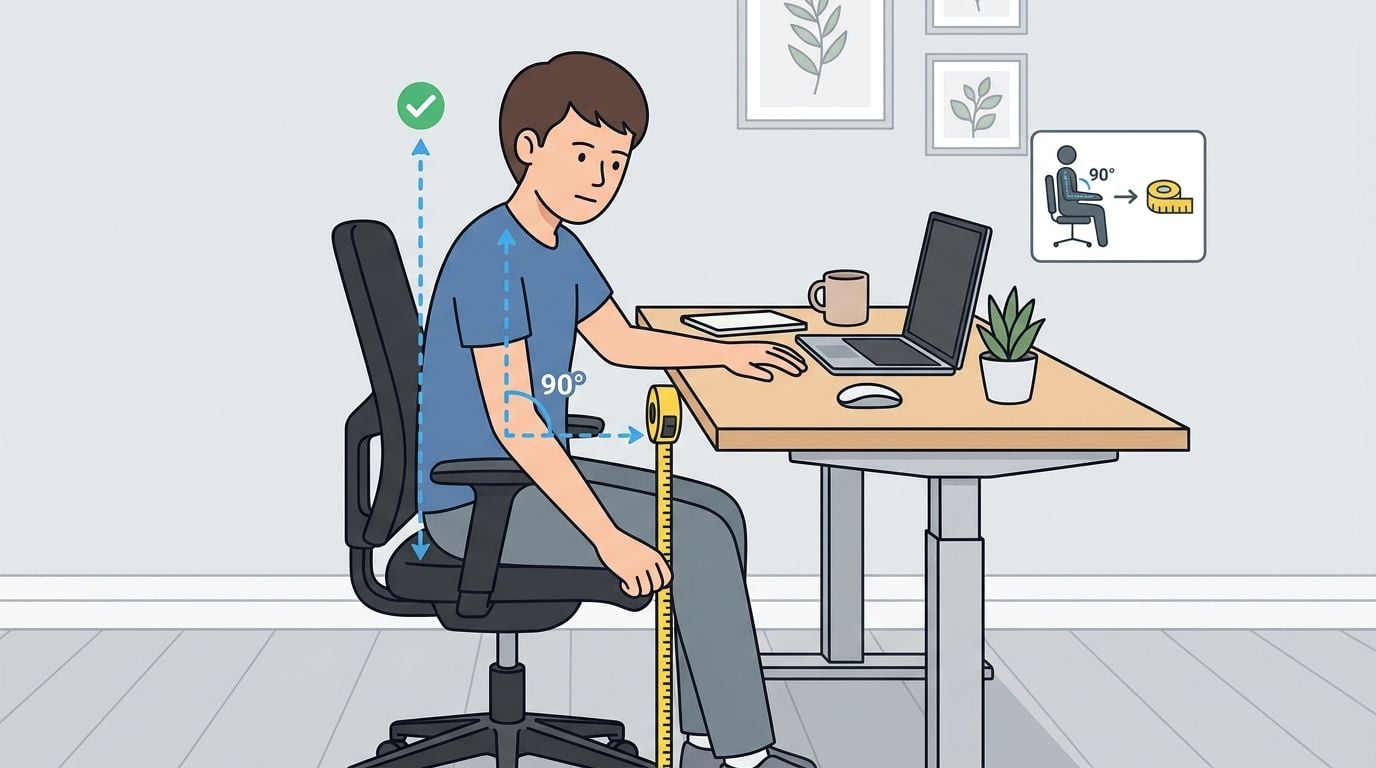
Finding a good desk height at home doesn't require special equipment. It just takes a chair, a tape measure, and a few quiet minutes. The goal is to match the desk to the body in a natural working position, not in a stiff, posed one.
Start with the chair, not the desk
This is the step many people skip. The chair sets the body's base position. If the seat is too high or too low, every desk measurement taken afterward will be off.
Use this order:
- Sit all the way back in the chair. Let the back rest support the spine naturally.
- Place the feet flat on the floor. The legs should feel supported, not dangling.
- Relax the shoulders. They shouldn't be pulled up or forced back.
- Bend the elbows comfortably. The forearms should hover roughly parallel to the floor.
Once that position feels easy, measure from the floor to the underside of the elbow. That number gives a strong starting point for the keyboard surface or top of desk surface, depending on setup.
Use the formula as a starting range
For people who want a quick estimate before measuring furniture in person, a desk height formula can help. A calculator-based approach gives a minimum and maximum desk height using total body height in inches. The minimum is (0.4739 × height) ? 6.678 and the maximum is (0.5538 × height) ? 9.4270, according to this desk height calculator reference.
That same source notes that OSHA leg clearance under the desk should generally be 20 to 28 inches (50 to 72 cm), so knees and legs have room without boxes, drawers, or stored items crowding the space.
If the desktop height looks right but the knees keep hitting the underside, the setup still isn't right.
Account for what sits on top of the desk
A desk surface isn't the whole story. The keyboard changes the working height. A thick keyboard can raise the hands enough to affect wrist position, so a setup that looks correct on paper may still feel high in practice.
That is why measuring the room and the furniture carefully matters. A detailed measuring routine helps avoid surprises, especially when checking surface height, apron depth, drawer clearance, and chair fit. A simple prep guide on how to measure furniture can make showroom visits much more productive.
A simple at-home check
If there is uncertainty, this quick test helps:
- Type for five minutes. Notice whether the shoulders creep upward.
- Pause and check the wrists. If they bend upward, the desk may be too high.
- Slide the chair back slightly. If the body leans forward to compensate, the desk may be too low or the monitor may be poorly placed.
- Look underneath. Make sure legs have room to move freely.
The right height often feels almost unremarkable. The body stops negotiating with the furniture, and work becomes easier to sustain.
Recommended Desk Heights for Every Body
A height chart helps turn abstract ergonomic advice into something practical. It won't replace a personal measurement, but it gives a dependable starting point for shopping and comparison.
One important anchor point is this: the standard fixed office desk height in the United States is 28 to 30 inches (71 to 76 cm) and is designed for people around 5'8" to 5'10". That same guidance notes that a person 5'4" often needs about 26" to 27" (66 to 68.5 cm), while a person 6'0" often needs about 30" to 31" (76 to 78.5 cm) to avoid shoulder strain, based on this office desk height guide.
Recommended Ergonomic Desk Height by User Height
| User Height (ft/in) | User Height (cm) | Ideal Sitting Desk Height (in/cm) | Ideal Standing Desk Height (in/cm) |
|---|---|---|---|
| 5'4" | 163 cm | 26" to 27" / 66 to 68.5 cm | Personal measurement recommended |
| 5'8" to 5'10" | 173 to 178 cm | 28" to 30" / 71 to 76 cm | Personal measurement recommended |
| 6'0" | 183 cm | 30" to 31" / 76 to 78.5 cm | Personal measurement recommended |
How to use this chart wisely
This table works best as a shopping filter. It helps rule out desks that are clearly too tall or too short before anyone falls in love with the finish, hardware, or storage layout.
It also helps when planning accessories and room layout. Someone exploring home office desk setup ideas can use these ranges to narrow the search before comparing style, storage, and placement.
The best desk height on paper is still a starting point. The best desk height in real life is the one that lets the body relax.
A quick note on standing height
Standing desk height is more personal than many shoppers expect. Arm length, shoulder position, and keyboard setup all matter. For that reason, personal measurement is the safer recommendation unless the desk offers easy adjustability or custom sizing.
That may feel less convenient than a universal chart, but it's far more honest. The goal isn't to force everyone into one range. The goal is to help each person find the range that supports daily comfort.
Design It Your Way Custom Desk Solutions
Fixed-size desks work well for some people. They leave others compromising every day. That gap becomes obvious for shorter users, taller users, and anyone with proportions that don't line up neatly with a standard showroom height.
A broader ergonomic view shows why custom sizing matters. The standard desk range of 28 to 30 inches is optimized for users between 5'8" and 5'10", while shorter users under 5'5" and taller users over 6'0" may need desks as low as 22.8 inches or as high as 32+ inches to maintain a 90° elbow angle, according to this ergonomic comfort reference.
When standard sizing stops working
Consider a homeowner who is petite and keeps finding that every desk feels high, even after adjusting the chair. Raising the chair may help the arms reach the surface, but then the feet may lose firm contact with the floor. Another homeowner may be tall enough that a standard desk leaves the upper back rounded all afternoon.
Neither person needs to "get used to it." They need furniture that fits.
That is where custom furniture becomes more than a style upgrade. It becomes a comfort solution.
What a custom desk solves
A made-to-order desk lets the buyer choose more than color and shape. It can solve the exact fit issue that mass-produced dimensions often ignore.
Custom planning can address:
- Exact height needs. The desktop can be built to suit the user's working posture instead of a generic average.
- Leg clearance concerns. Drawer depth, apron design, and support placement can leave better room underneath.
- Room-specific proportions. A desk can be scaled for a small nook, shared office, or larger dedicated workspace.
- Material priorities. Solid wood offers lasting structure and a more substantial feel than many lighter alternatives.
For homeowners who value craftsmanship, Amish Furniture and other American-Made options make a strong case. They bring durability, repairability, and a sense that the piece belongs in the home for the long run, not just until the next redesign.
Bespoke comfort can still fit the budget
Custom doesn't have to mean unreachable. It often means choosing the measurements, storage, and finish that matter most, then skipping compromises that lead to discomfort later.
For many families, Special Financing also creates more buying power. That can make a bespoke desk feel less like a stretch and more like a sensible investment in daily comfort. People interested in the process often feel more confident after reading about custom furniture made simple.
A desk used every workday isn't a small purchase in practical terms. It shapes posture, focus, and how the room functions. Design it your way is not a luxury phrase in that context. It's the path to a desk that finally fits.
Find Your Perfect Fit at Groens Fine Furniture
The right desk height isn't just a number on a spec sheet. It's the feeling of sitting down and not having to brace, shrug, reach, or adjust every few minutes. That kind of comfort is personal.
Many guides treat desk height as a fixed measurement and leave out important details. Keyboard thickness and chair seat height can change the actual working position, and a thick keyboard may require lowering the desk surface by 0.5 to 1 inch below elbow height to reduce wrist strain, as noted in this ergonomic desk height article. Those small details often explain why a desk that "should" work still feels off.
What to bring into the showroom
A little preparation makes the visit easier and more productive.
- Bring your measurements. Floor-to-elbow height, chair seat height, and available room dimensions are the most helpful.
- Bring a photo of the room. That helps with scale, finish, and layout decisions.
- Bring questions about daily use. Writing, computer work, paperwork, and shared use all affect the ideal desk choice.
Why local guidance still matters
Online dimensions can only go so far. In person, shoppers can test surface height, check knee room, compare drawer layouts, and see how a desk feels with real seating.
For families across Northwest Indiana, that kind of hands-on help matters. A multigenerational local business can offer a more personal conversation than a warehouse-style transaction. It can also make room for better solutions, from Custom Furniture and Solid Wood options to White-Glove Delivery and Interior Design support. Shoppers looking for style can explore names like Bassett, and those who value long-term durability often recognize Flexsteel for its reputation.
Visit Groen's Fine Furniture in Dyer or Crown Point today to explore custom options and ask about special financing plans. Let this multigenerational family business, proudly serving Northwest Indiana with 5-star service since 1983, help create a home office with lasting comfort, honest value, and the kind of personal fit that standard desk sizing often misses.