Custom Sofa Designs: How to Plan and Order Yours

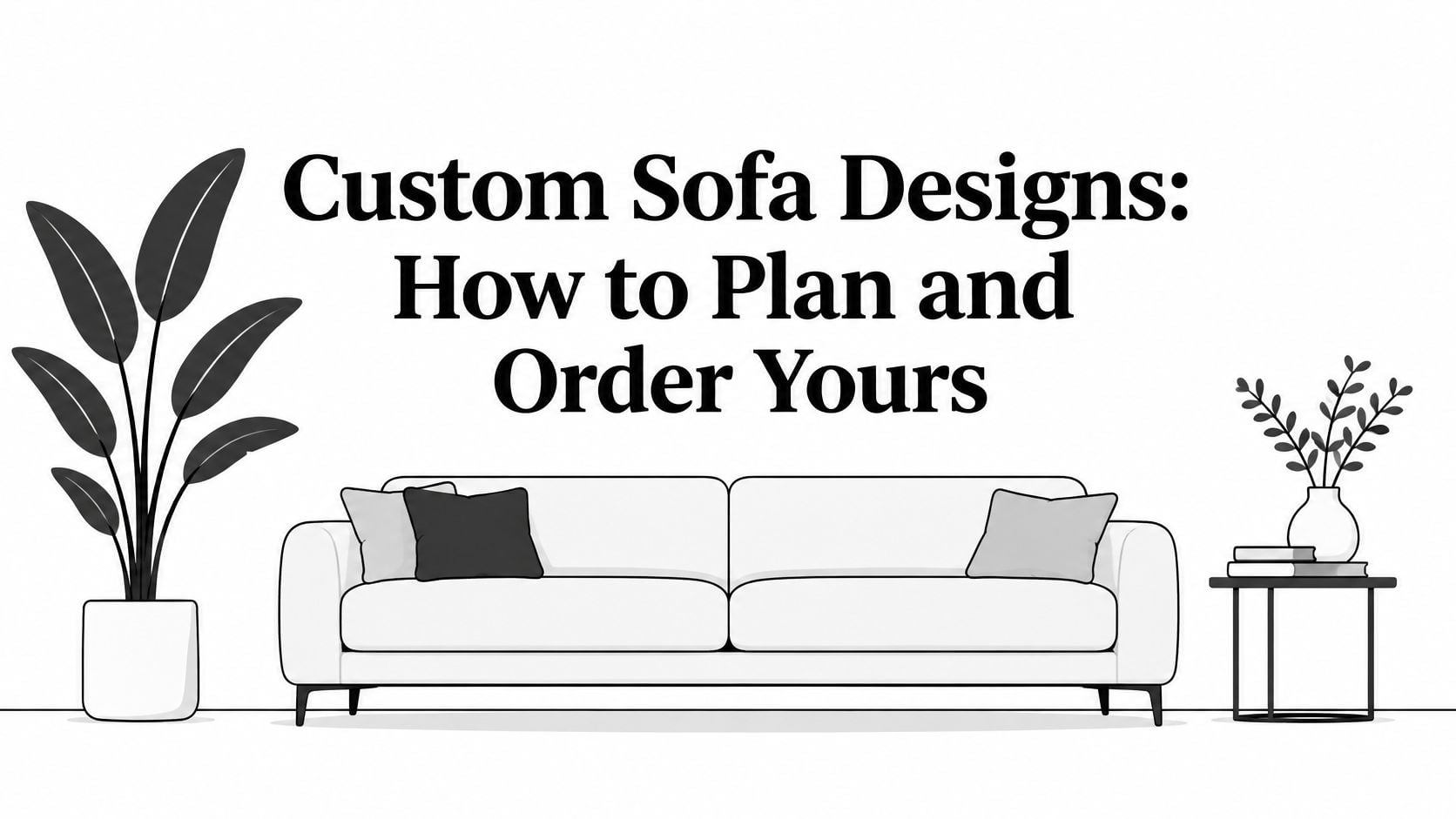
For homeowners in Dyer and Crown Point, the sofa search often starts with a familiar frustration: the current couch blocks the walking path, the cushions swallow anyone who sits down, or the whole family can't settle comfortably together. A beautiful showroom sofa won't solve those problems unless its dimensions, support and delivery requirements suit the home.
The strongest custom sofa designs start with painter's tape, a measuring tape and an honest conversation about daily use. Across Northwest Indiana, from St. John and Schererville to Munster, families can use that practical approach to choose furniture that feels personal without sacrificing lasting comfort.
Sofa Dimensions to Lock In Before You Order
A sofa that looks balanced in a showroom can overwhelm a Dyer townhouse living room. In a Crown Point family room, the more important problem might be a seat that's too low for a parent who rises slowly. Outside dimensions determine room fit; seating dimensions determine personal fit. Record both.
The following reference ranges are starting points for comparing models, not specifications that every manufacturer offers.
| Dimension | Typical Range | Who It Suits Best | Check Before Ordering |
|---|---|---|---|
| Seat height | 17-19 in | Older adults and anyone who rises often | Below 18 in can be harder to stand up from |
| Seat depth, accessible | 20-22 in | Shorter users and upright sitting | Stays within the 24 in aging-in-place ceiling |
| Seat depth, lounge | 23-26 in | Taller adults who recline | Needs supportive cushions for sit-to-stand |
| Arm height | 22-26 in from floor | Users who push up from an arm | Also measure rise above the seat cushion |
| Back height | 30-36 in from floor | Reading and relaxed sitting | Test actual shoulder and head support |
| Overall depth | Set by frame depth plus cushion projection | Standard living rooms | Confirm finished depth in writing |
| Two-seat width | 60-72 in | Apartments and snug rooms | Preserve walking access at both ends |
| Three-seat width | Set by usable seats plus both arms | Family rooms as the main seating anchor | Measure the delivery route before ordering |
For accessible seating, the PDH Academy aging-in-place guide recommends seat heights of roughly 17-19 inches, seat depths no greater than 24 inches, and notes that seats below 18 inches can be difficult for older adults to rise from.
Choose posture before silhouette
Shorter users may need the lower end of the height range to keep their feet supported, but older users shouldn't automatically choose a lower seat. The useful combination is feet resting comfortably, a supportive cushion and a manageable standing movement. Ask whether the arms are designed to bear weight during that movement.
Deep seating suits taller adults who recline or tuck their legs underneath them. It's less suitable for someone who must slide forward before standing. The softest, deepest, lowest sofa isn't necessarily the most comfortable.
For comparing length labels, The Sofa Cover Crafter sizing guide provides useful context on three-seat sofa measurements. The sofa size guide can also help organize room-fit questions before a showroom visit.
Specification rule: Record arm height from the floor and arm rise above the cushion separately. They aren't interchangeable measurements.
Copy this specification line, replacing each blank with a single target measurement and the manufacturer's accepted tolerance: Overall width ___ ± ___; overall depth ___ ± ___; seat height ___ ± ___; seat depth ___ ± ___; arm height ___ ± ___; back height ___ ± ___.
How to Measure Your Room and Mock Up the Fit
Visual estimates leave too much unresolved for a made-to-order purchase. A floor outline exposes the space occupied by the sofa, but a useful mock-up also tests cushion projection, arm position and the route through the house. Use painter's tape, a rigid measuring tape, cardboard and an existing stable chair or bench.
Build the room and access plan
Record the usable footprint. Sketch wall lengths, windows, doors, outlets and vents, then mark the intended walking path; a practical planning target is 30-36 inches of clear passage, with more space wherever household mobility requires it.
Measure the delivery route. Include doorway openings, hallways, stair turns, elevator interiors and tight corners, then ask the delivery team to check diagonal clearance for the longest module because straight-line width alone doesn't establish access.
Define the seating posture. Choose upright conversation, relaxed lounging or mixed use before settling on depth, since a room-sized sofa can still be wrong for the people sitting on it.
Tape the full footprint. Mark overall width and depth, including projecting arms and cushions, so household members can walk around the actual outline rather than an optimistic rectangle.
Mock up the vertical dimensions. Use cardboard to indicate back height and stable seating with cushions to approximate seat height, then test for at least ten minutes and try standing without hands only if that's safe; cardboard itself must never support body weight.
Check the working room. Test television sightlines, sectional orientation, outlet access and vent clearance because a comfortable seat isn't useful if it blocks everyday functions.
Write the module plan. List every hand, return, console, leg and cushion, and obtain finished-dimension tolerances, cushion-fill details and frame construction in writing so the manufacturer receives an unambiguous configuration.
For difficult entrances, House Moving Melbourne's explanation of moving a sofa through tight doorways helps frame the access conversation. The delivery team should still approve the actual route and proposed furniture.
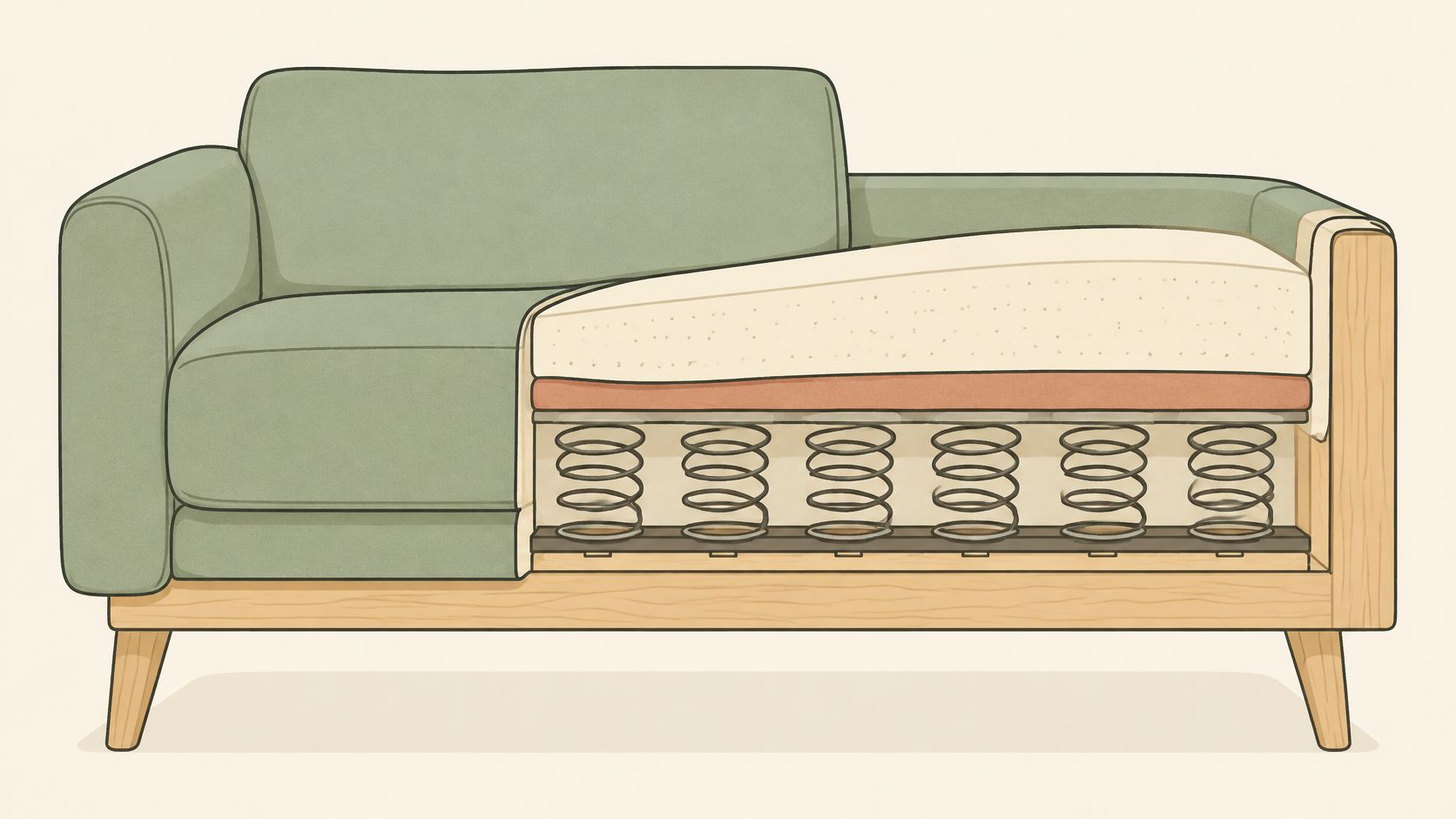
The internal structure also matters when asking whether legs, backs or modules can be removed for access.
Catch the expensive mistakes early
The Association for Contract Textiles abrasion disclaimer explains the limits of laboratory wear testing. That distinction reinforces a useful purchasing habit: validate each requirement directly rather than accepting a reassuring label as proof of overall suitability.
Use the living room furniture arrangement guide to assess placement before approving the outline. Watch especially for these failures:
- Appearance-only selection. A pleasing silhouette doesn't establish usable seating or comfortable posture.
- Missed diagonal clearance. A module may clear the entrance but fail at the next turn.
- Excess sectional depth. A generous lounge area can consume the room's circulation space.
Frame, Suspension and Cushion Choices That Shape Comfort
| Option | What It Means | Best For | Trade-off |
|---|---|---|---|
| Kiln-dried hardwood frame | Frame built from dried hardwood members | Daily family use and long ownership | Heavier and typically higher cost |
| Engineered or plywood frame | Board-based frame with stable joinery | Value-focused builds, including lighter-use rooms | Confirm material quality, joinery and warranty |
| Solid wood Amish frame | Hand-built frame made to approved dimensions | Heirloom pieces intended for long ownership | Made-to-order scheduling and customization limits |
| Sinuous spring suspension | S-shaped spring wire across the base | Firm, even support at moderate cost | Ask about wire gauge, spacing and attachment |
| Eight-way hand-tied suspension | Hand-tied coil network beneath the seat | Even support in a traditional construction | Higher labor cost and production requirements |
| Foam cushion core | Solid polyurethane foam | Consistent shape and upright seating | Lower-density foam can lose support sooner |
| Down-wrapped cushion | Foam core wrapped in down or feathers | Plush, sink-in comfort | Regular fluffing and greater compression |
| Blended cushion | Foam core with fiber or down topper | Support with surface softness | Confirm the exact blend in writing |
Comfort comes from the combination, not a single premium component. A substantial frame won't correct an unsuitable seat pitch, and a plush cushion can feel very different over firm springs than over a more yielding base. Construction quality matters more than a material name alone.
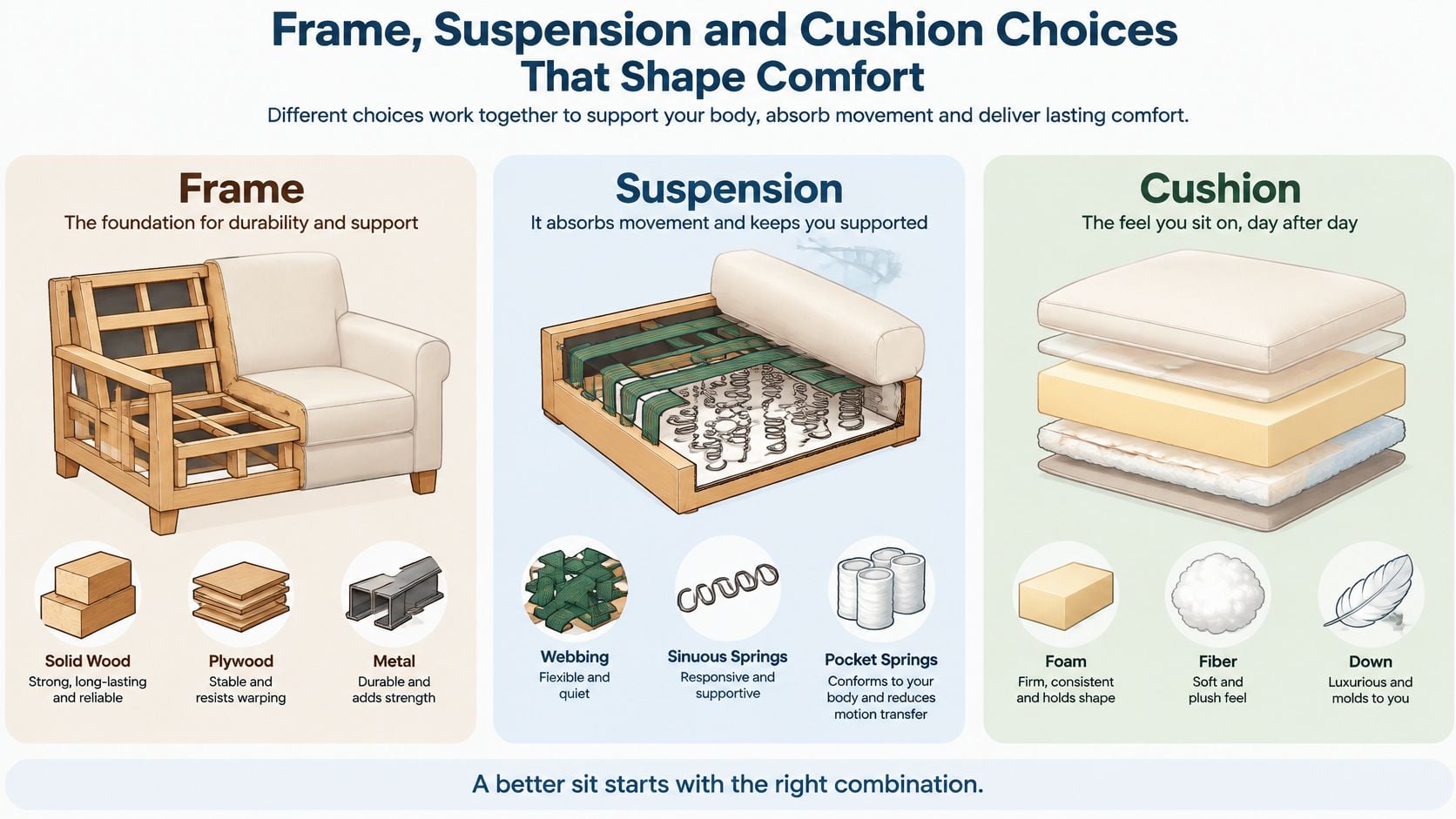
Match the construction to the household
A daily family room with children benefits from supportive suspension, a foam or blended core and removable covers. Removable doesn't mean washable, so obtain care instructions before treating that feature as a cleaning solution.
A formal room used mainly for guests can accommodate a softer or down-wrapped cushion if the household accepts regular reshaping. A multigenerational home should prioritize a supportive core, a suitable seat height and sturdy arms over dramatic sink-in softness.
Flexsteel is associated with durability, while Bassett offers style-focused upholstery choices. Amish Furniture brings Solid Wood craftsmanship to bespoke pieces, but an exact-specification upholstered frame should be confirmed with the showroom rather than assumed available across every collection. The solid wood frame sofa guide provides a starting point for those construction questions.
Specify style and serviceability together
Choose track, rolled or English arms; tight-back or loose-back cushions; and tapered or block legs. Arm profiles change usable seat width and support height. For sectionals, a chaise, corner wedge or armless module changes the footprint and belongs on the approved drawing.
A sofa that can accept replacement cushions and covers gives the household more options than one that must be replaced when a single component wears out.
Ask about serviceable frames, replacement covers, reupholstery access and whether modular sections can be rearranged. Record cushion core density, fill composition and suspension type on the order. For American-Made preferences, confirm the origin of the specific model rather than relying on a collection's general identity.
Fabric Ratings and Finish Decisions for Real Households
Start with the household, not the swatch wall. Will the sofa handle daily lounging, children, pets and frequent spot cleaning, or occasional visits in a quieter room? Those answers establish the performance questions before color narrows the choices.
The benchmarks below come from Association for Contract Textiles abrasion guidance, which identifies 15,000 Wyzenbeek double rubs or 20,000 Martindale cycles for low-traffic/private applications and 30,000 Wyzenbeek double rubs or 40,000 Martindale cycles for high-traffic/public applications.
| Household Use | Wyzenbeek Double Rubs | Martindale Cycles | Fits |
|---|---|---|---|
| Low-traffic or private room | 15,000 | 20,000 | Formal living room and occasional seating |
| High-traffic or family room | 30,000 | 40,000 | Daily family-room use, including households with children or pets |
For a busy family room, specify at least the higher benchmark when available. That's a purchasing target, not proof that a fabric is pet-proof or guaranteed to outlast another fabric.
Read beyond the abrasion count
Wyzenbeek and Martindale are different tests. Their machines, rubbing motions, abrasives and endpoints differ, so their numbers can't be compared as equivalent scores.
- Flat rubbing isn't complete wear testing. Abrasion results don't reproduce edge wear, cushion compression, spills, sunlight or pet claws.
- Strong fabric can still perform poorly at a seam. Ask about seam slippage, pilling and colorfastness rather than choosing by the largest count.
- Performance labels need specifics. Confirm cleanability and warranty exclusions, particularly for staining, pets and fading.
Cleaning codes help establish what can safely touch the upholstery: W permits water-based cleaning products, S calls for solvent-based products, WS permits either category, and X generally means vacuuming or light brushing only. Top Cleaners' guide to W, S, WS and X explained offers useful context before professional cleaning. Always follow the upholstery manufacturer's instructions and test approved products inconspicuously.
Finish the selection at home
Keep a physical swatch under the home's lighting for at least a day as a practical approval check. Look at it beside the flooring and existing chairs, and notice whether texture or directional pile changes its appearance.
Specify leg finish, nailhead placement, welt trim and pattern orientation. A large repeat may look appealing on a swatch but land awkwardly across separate cushions unless placement is discussed.
The upholstery fabric selection guide can help organize those decisions. Before approval, require the test method, specimen result, cleaning code and fiber composition on the order record.
Communicating Your Design Preferences to Our Team
In a 2024 Furniture Today and Strategic Insights survey of 1,016 adults who had bought upholstered furniture during the previous year or planned to buy it in the following year, 72% of sofa, loveseat and sleeper shoppers said they would consider a custom order, while only 25% of purchasers in that category ended up custom-ordering. Clear answers about dimensions, fabrics, comfort, pricing, lead times and delivery help make the decision less uncertain.
Bring evidence of everyday life
A useful consultation starts with materials that explain the room and its users:
- Room photographs. Include views taken at different times of day so the team can assess light, existing finishes and visual connections to nearby rooms.
- Room and access measurements. Bring the annotated sketch and delivery-route details, not just the wall where the sofa will sit.
- Household uses. Note lounging, guests, homework and pets, including who uses the sofa most often.
- Seating positions. Identify the preferred positions, such as upright reading, feet-up lounging and lying down, and rank them when they conflict.
- Cushion language. Describe the desired feel as firm, medium or plush, then identify a tested showroom cushion that matches it.
- Fabric references. Bring preferred swatches and photographs showing the lighting they'll live under.
Style doesn't require specialist vocabulary. A reference piece, a color family and a texture communicate more than a broad label such as contemporary. For example, an oak coffee table, warm neutral upholstery and a tightly woven texture establish a workable direction.
Before approval: Ask the consultant to read back a written design summary, including the main comfort priority and the compromise the household accepted.
The custom-order starting guide helps prepare those decisions. Interior Design guidance is most useful when it resolves a specific question, such as balancing an existing chair with a new sofa, rather than adding choices without a clear purpose.
Timeline, Pricing, Financing and Order Confirmation
A custom sofa order is easier to manage when the written estimate covers both production and delivery. Confirm the schedule, costs, financing terms and room access before approving production.
| Stage | What Happens | Typical Timing | Your Decision |
|---|---|---|---|
| Consultation and measuring | Room assessed, mock-up planned, posture defined | Initial visit through completion of home checks | Target dimensions and seating posture |
| Fabric and finish selection | Swatches reviewed at home and test records requested | Initial selection plus home review | Fabric, pattern repeat and cleaning code |
| Order confirmation | Module list, tolerances and fill details approved | Before production starts | Final configuration and financing terms |
| Production | Manufacturer builds the approved order | Sofa lead time set at order confirmation | Approve the schedule and update process |
| Delivery and setup | Furniture brought to the room with agreed placement | Scheduled after the build and shipping arrangements | Confirm access, placement and service scope |
Custom sofas follow a different schedule from stocked furniture. The lead time depends on frame availability, upholstery stock and the manufacturer's production schedule. Ask for the estimated production completion date and a separate delivery expectation, then confirm how schedule changes will be communicated. A completed build may still need shipping arrangements before home delivery.
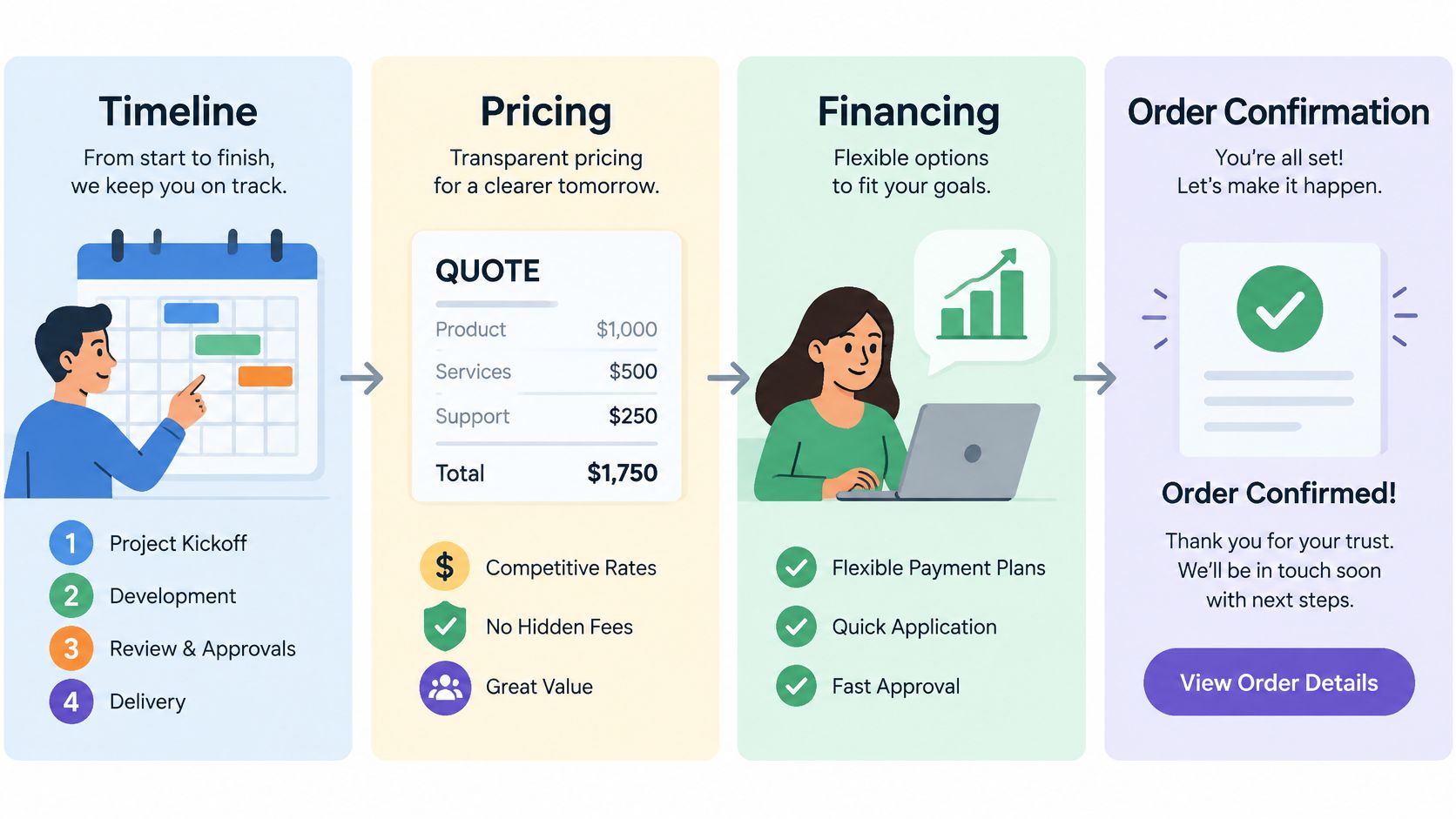
Locate the value in the quote
Request an itemized quote that identifies the base frame, suspension, fabric grade and any separately priced cushion upgrades or dimension changes. This shows where the cost sits, so you can protect the construction choices that matter and adjust decorative details if needed.
Design it your way applies beyond upholstery. Canadel's custom dining catalog describes approximately 9 million options, illustrating the range available in made-to-order furniture. Canadel's dining program and Amish solid wood pieces offer other ways to coordinate a home, each with its own specifications and limits.
Special financing is available, subject to credit approval. Review the payment schedule, applicable charges and full terms alongside the itemized purchase total before signing.
Approve the complete order
The final paperwork should identify:
- Build specifications. Confirm the approved dimensions and configuration against the written design summary.
- Material selections. Fabric identification, performance records, care instructions and finish details.
- Purchase conditions. Deposit requirements, change deadlines, cancellation terms and warranty coverage.
- Delivery arrangements. Estimated timing, access responsibilities and the scope of White-Glove Delivery.
- Payment documents. Itemized total and any approved financing agreement.
Family-owned since 1983, Groen's serves Northwest Indiana from its Dyer and Crown Point showrooms. Before signing, confirm the production estimate, delivery arrangements, itemized total and financing terms match the order you intend to place.
Groen's Fine Furniture offers custom furniture guidance, made-to-order options and special financing, subject to credit approval. Bring room photographs and mock-up measurements to a Dyer or Crown Point showroom to review sofa options and confirm the order details.