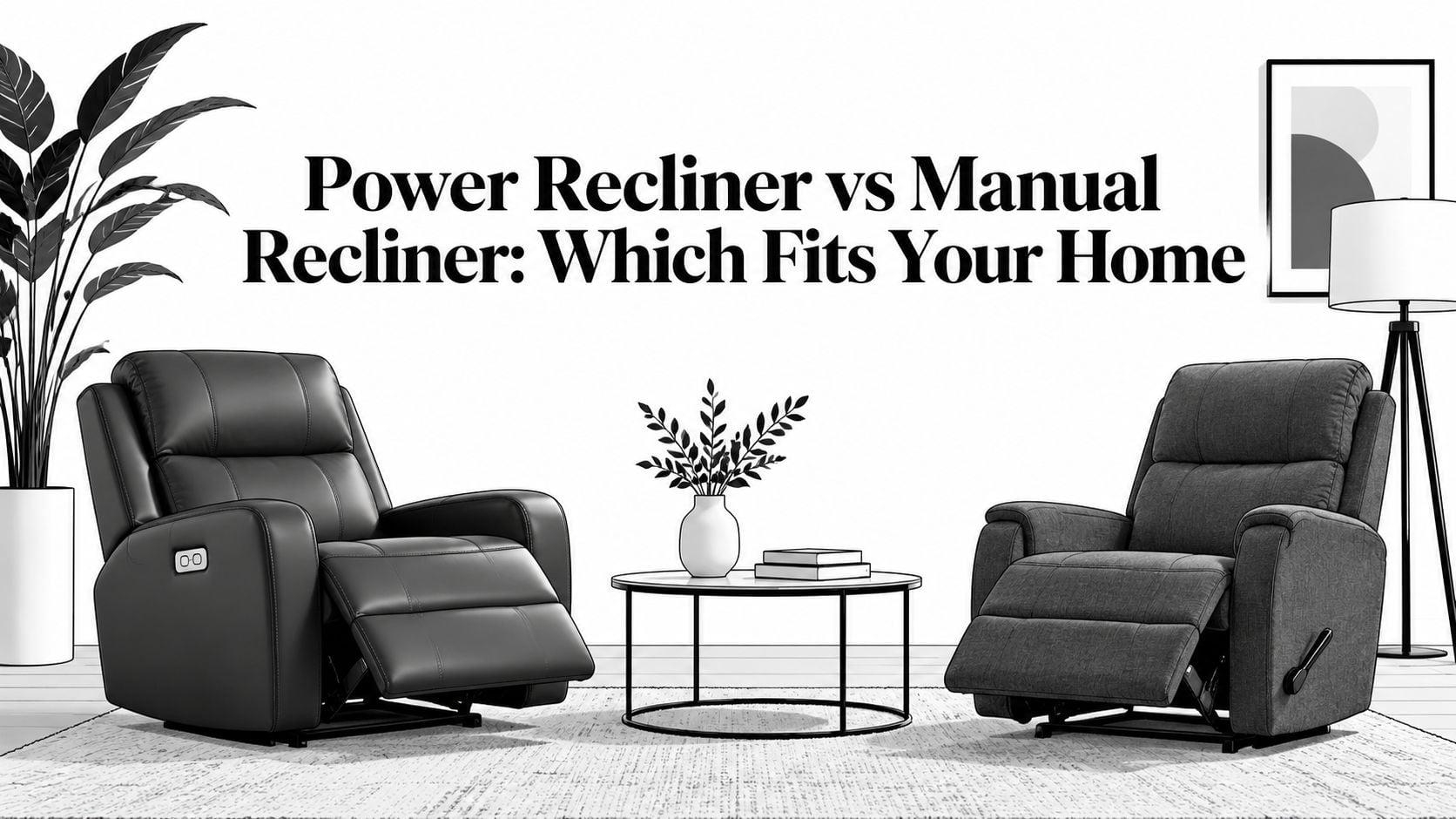
Power Recliner vs Manual Recliner: Which Fits Your Home

A family in Dyer finishes dinner, settles into the living room, and faces a familiar question: should the next recliner be power or manual? The answer depends on more than how soft the seat feels. Room layout, outlet access, daily use, physical effort, upholstery, and budget all shape the better choice.
Since 1983, Groen's Fine Furniture has helped Northwest Indiana households make that decision with personal guidance rather than a one-size-fits-all pitch. Families in Dyer, Crown Point, St. John, Schererville, and Munster can compare the operation, fit, and long-term value of both styles, then test the difference in person. A useful starting point is the broader question of how a recliner works with the rest of the room, including the options discussed in this guide to a couch with recliner.
Choosing the Right Recliner for Your NWI Home
A Crown Point homeowner may want a chair that adjusts gradually during a long evening. A household in Dyer may need a simpler seat for a room where the only outlet sits across the floor. Both shoppers want lasting comfort, but they aren't solving the same problem.
That's why the power recliner vs manual recliner decision should begin with the person using the chair and the room holding it. Power models make small adjustments with a control, while manual models use a lever or body weight. One prioritizes precision and ease. The other prioritizes mechanical simplicity and placement freedom.
The right choice also depends on how often the chair will be used. A daily reader, television viewer, or family member who finds physical reclining difficult may value effortless positioning more than a guest-room shopper does. A manual recliner can make excellent sense in a secondary room, especially when no outlet is nearby or when the household wants fewer components to maintain.
Practical rule: The best recliner is the one that fits the user's body, the room's floor plan, and the household's routine at the same time.
Groen's team approaches the showroom conversation the same way a neighbor would. Customers can sit upright, recline fully, return to standing, inspect the controls, and judge whether the chair feels natural rather than relying on a label. That personal test matters because a power mechanism can feel liberating to one person and unnecessary to another.
The comparison below gives the short answer before the details:
| Decision point | Power recliner | Manual recliner |
|---|---|---|
| Positioning | Continuous adjustment with a control | Lever or body-weight adjustment |
| Physical effort | Minimal effort during reclining | Requires physical engagement |
| Placement | Requires electricity and cord planning | Works without electricity |
| Features | May include USB, heat, massage, or memory settings | Usually simpler |
| Upkeep | More components to maintain | Fewer failure points |
| Best fit | Daily use, precise comfort, mobility concerns | Flexible placement, simplicity, value |
How Recliners Evolved to Two Paths
A chair that began as a practical way to change position eventually split into the manual and power choices found in Northwest Indiana homes today. Henry Kennedy received a patent for the first reclining chair in 1841, and the French military used a reclining bed form by about 1850. (Documented recliner history)
Edward Knabusch and Edwin Shoemaker built on that foundation with their 1928 patent filing, which helped launch a widely recognized modern recliner brand. Reclining furniture moved from a specialized comfort product into everyday home seating. The manual idea remained familiar while manufacturers developed more controlled ways to change position.
By 1986, power recliners and power-assisted lifts had entered the market. Motorized seating created a second path, replacing the lever, latch, or body-weight action with a motor and control system. (Recliner development and power seating timeline)
Why both designs remain relevant
Manual seating keeps the original mechanical approach. It changes position without electricity, which suits rooms with limited outlet access, flexible furniture layouts, or households that want fewer components to maintain.
Power seating adds controlled movement. The user can stop at a preferred point and adjust position gradually, a practical advantage for anyone who wants less physical effort when opening or closing the footrest. It also gives households more placement decisions to consider, including cord routing and clearance around the chair.
Neither design makes the other unnecessary. A manual recliner often fits a simple den, guest room, or room where furniture moves seasonally. A power model can make more sense in a primary living area where the chair gets daily use and the household has planned outlet access.
Groen's selection reflects both paths. Shoppers can explore different types of power reclining seating while comparing manually operated chairs, custom-order possibilities, and financing options. History explains how the choices developed. The person using the chair, the room's layout, and the available outlet determine which path fits.
Mechanism and Daily Operation Compared
A power recliner and a manual recliner can look similar from across the room. Their daily operation feels different as soon as the user changes position.
Power recliners typically use a 29V DC electric motor and a motorized scissor-lift mechanism. That system supports infinite-position adjustment, allowing the user to micro-tune the backrest and legrest angle. Manual recliners rely on a lever or body-weight mechanism and usually lock into a smaller number of discrete positions.
Mechanism at a Glance
| Feature | Power | Manual |
|---|---|---|
| Operating method | Electric control | Lever or body weight |
| Position range | Infinite adjustment within the chair's movement range | A small number of set positions |
| Fine tuning | The user can make small angle changes | The user moves between available settings |
| Physical demand | Low during adjustment | Requires pushing, leaning, or lever use |
| Mechanical character | Motorized and more complex | Straightforward and mechanical |
The power advantage appears during long sitting sessions. A person can ease the backrest slightly forward for reading, lower it again for television, or adjust the legrest without committing to a preset angle. That control can be especially helpful when several people share one chair and each person prefers a different position.
Manual operation has a different strength. The user pulls a lever or shifts body weight, and the chair responds through a simple mechanical system. There's no cord to route and no control panel to learn. For someone who wants a quick, familiar movement and doesn't need fine adjustment, the manual design is direct and dependable.
The most useful showroom test is simple. Sit upright, open the footrest, settle into the chair, and return to the upright position. If the manual action feels easy and natural, simplicity may be the better value. If the user keeps searching for a more exact angle or struggles with the physical motion, power deserves serious consideration.
Comfort Durability and Upkeep
Comfort isn't only softness. It's also the ability to hold a position that supports the user without constant adjustment. Power seating gives the user more control over that position, while manual seating keeps the design less complicated.
Power units may add USB, heat, massage, or memory settings, depending on the model. Those features can make a chair more useful during everyday relaxation, particularly when the chair serves as a reading seat, television seat, or primary living-room position. The extra capability comes with extra components, including the motor and power cord.
A comparable power model typically carries a premium of about $200 to $800 over a manual model, according to the same commercial benchmark. That difference pays for more than the movement itself. It can also cover controls and comfort functions that a manual mechanism doesn't provide.
What ownership feels like
Manual recliners have fewer failure points and generally lower upkeep. Their simpler construction makes them attractive to households that want a chair with fewer electrical parts and less dependence on service for ordinary operation.
Power recliners require more care around cords, controls, and motorized movement. The added complexity doesn't automatically make a quality chair a poor choice, but it does mean that buyers should ask about construction, warranty coverage, parts support, and service before ordering.
Upholstery affects the ownership experience just as much as the mechanism. A household with children, pets, or heavy daily use should consider cleanability, texture, and performance before choosing a cover. Groen's upholstery materials guide can help shoppers compare fabric and leather characteristics before selecting a finish.
A manual recliner usually wins the simplicity argument. A power recliner wins when precise, low-effort comfort will be used often enough to justify the added system.
The honest recommendation is to avoid paying for features that won't be used. A carefully built manual chair can offer strong value. A power chair can justify its premium when the household depends on effortless positioning, added comfort functions, or more precise support.
Room Fit Power and Clearance Needs
A recliner can feel perfect in the showroom and still create a problem at home if the floor plan isn't measured first. This is especially important in NWI homes where a chair may share space with a sofa, walkway, television console, or basement stairs.
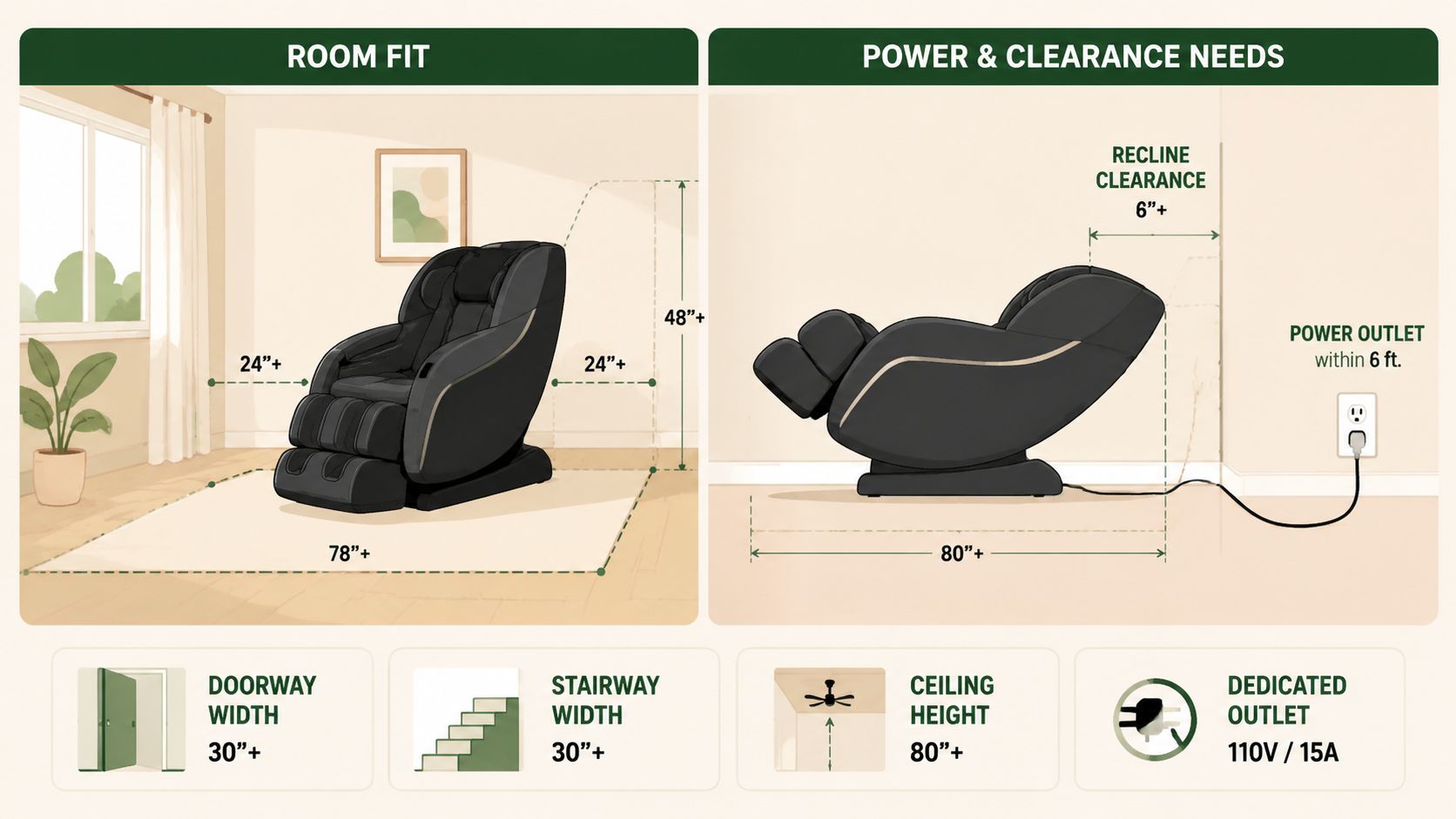
A standard recliner typically needs 12 to 18 inches of wall clearance to fully extend its footrest and backrest. Wall-hugger or zero-wall models can sit much closer to the wall because they move forward as they recline. (Recliner clearance and sizing guidance)
The measurements that prevent trouble
Some zero-wall power recliners may need only 0 to 2 inches of rear clearance, but they can expand forward by about 5 to 8 inches during reclining. A tight wall gap doesn't remove the need to protect the space in front of the chair. (Zero-wall clearance guidance)
Power adds another planning requirement. Cord length is typically 6 to 10 feet, and the outlet must be reachable without creating a trip hazard or forcing the chair into an awkward position. (Recliner measuring and outlet planning)
Before visiting a showroom, households in St. John or Schererville should measure:
- Wall position: Identify whether the chair will sit against a wall, in a corner, or in open space.
- Front clearance: Check the path of the footrest and the nearby coffee table.
- Outlet access: Locate the nearest outlet and estimate the cord route.
- Walking paths: Leave room for people to pass without catching a footrest or cord.
- Doorways: Measure the route from the entry door to the final room, not just the chair's intended location.
A manual chair offers more freedom because it doesn't need electricity. A power chair can still work beautifully in a tight room when the selected model matches the floor plan. Groen's furniture measuring guide gives shoppers a practical checklist to complete before ordering.
Market Value and Price Bands
The market shows that power recliners have moved firmly into the category's premium value segment, even though manual chairs remain widely available. One 2025 market report estimates power recliners at 58.3% of global unit sales and 63.2% of revenue, while manual recliners account for 41.7% of unit share and about 36.8% of market value. (2025 global recliner market estimates)
Those figures don't tell a household which chair to buy. They do show that power seating commands a larger share of category value, reflecting the cost of motors, controls, and added functions.
2025 Recliner Market Split
| Type | Unit share | Revenue share | Retail price |
|---|---|---|---|
| Power recliner | 58.3% | 63.2% | Mid-range models around $1,200 to $2,500 |
| Manual recliner | 41.7% | About 36.8% | Around $350 to $1,200 |
Manual recliners are listed around $350 to $1,200 retail, while mid-range power recliners are listed around $1,200 to $2,500 in the same report. These are broad market bands, not a promise of a specific chair price or a substitute for evaluating frame quality, upholstery, warranty support, and fit.
A practical budget decision
A manual recliner is usually the stronger choice when a household wants honest pricing, simple operation, and flexible placement. A power recliner earns its higher investment when the chair will be used frequently and its positioning or comfort features solve a real daily need.
Groen's offers Special Financing, subject to credit approval, which can provide additional buying power for shoppers who prefer to fit quality furniture into a broader household budget. Financing shouldn't be used to justify a poor fit, but it can make a carefully selected power model more attainable without lowering the standard for comfort or construction.
Real Homes and Recliner Use Cases
A Munster homeowner furnishing an older living room may appreciate a manual recliner because it works during an outage and doesn't require a cord crossing the room. A family member who finds lever operation difficult may reach a different conclusion and benefit more from button-controlled movement.
Manual recliners need no electricity. Power recliners must stay plugged in for normal use and may require battery backup during outages or when outlet access is limited.
Three household patterns
The mobility-focused household should start with ease of operation. If the user has difficulty leaning back, pushing a footrest closed, or rising from a fully reclined position, power is the more practical direction. The showroom test should include entering, adjusting, and returning upright, not just sitting for a few seconds.
The frequent viewer may value precise positioning more than a casual user. Long evenings spent reading or watching programs make small comfort adjustments more meaningful, especially when the chair is a primary seat rather than occasional furniture.
The small-space household needs to protect both wall and walking clearance. A zero-wall model may help in a compact room, but its forward movement still has to clear a coffee table, ottoman, or passage. A manual chair may be easier to place if the nearest outlet is inconvenient.
For a basement theater, the floor also shapes the experience. Families planning seating around a screen and sound system may find this resource on carpet for basement theater rooms useful when coordinating comfort, acoustics, and room finish.
The strongest recommendation is situational. Choose manual when independence from electricity and mechanical simplicity matter most. Choose power when effortless movement and precise adjustment will improve daily use enough to earn the additional investment.
Our Recommendations and Groen's Services
A direct recommendation starts with the household's most important constraint.
Choose a manual recliner when the chair will move between rooms, sit far from an outlet, serve occasional guests, or support a buyer who prefers fewer components. Manual seating is also sensible when the household wants to direct more of its budget toward upholstery quality, a matching sofa, or another essential piece.
Choose a power recliner when one person will use the chair every day, physical effort makes manual reclining uncomfortable, or precise positioning matters during reading and television. Power also makes sense when features such as USB, heat, massage, or memory settings have a clear purpose rather than serving as unused extras.
What Groen's shoppers can customize
Groen's Fine Furniture offers power and manual recliner options alongside broader room-planning guidance. The family-owned retailer serves Northwest Indiana from showrooms in Dyer and Crown Point, with multigenerational ownership, five-star service, and a focus on personal selection rather than rushed transactions.
Customization remains important even when the central decision is mechanical. Customers can compare upholstery colors, textures, and finishes so the recliner works with existing living-room furniture. Flexsteel can be considered when durability is a priority, while Bassett provides another route for shoppers focused on style. American-made and solid-wood furniture choices also help build a cohesive room around the recliner.
Custom order services extend beyond seating. Canadel custom dining allows households to design tables and chairs with varied sizes, shapes, and finishes. Amish Furniture provides solid-wood craftsmanship for families seeking heirloom-quality dining or occasional pieces. The goal is to design it your way, with made-to-order choices that support the room rather than forcing the room around a fixed showroom combination.
Three questions to settle before ordering
Does a power recliner need battery backup?
Households concerned about NWI storms or limited outlet access should ask whether the selected power model supports a battery backup option. The need depends on the chair, the room, and the household's priorities, so the showroom conversation should cover how the chair will be used during an outage.
Can the upholstery be customized?
Many recliner decisions involve more than mechanism. Shoppers should bring the room's existing color palette and consider whether performance fabric, leather, or another upholstery choice will handle the household's routine. A custom finish can help a recliner look intentional instead of like an afterthought.
What should shoppers bring to a showroom test drive?
Bring room measurements, outlet locations, a photograph of the intended space, and the names or samples of nearby upholstery colors. In Crown Point or Dyer, each primary user should operate the chair personally. The test should include upright support, full recline, footrest closure, control reach, and the ease of standing.
White-Glove Delivery can also matter when a large recliner must fit through tight entries, stairs, or finished rooms. Groen's furniture delivery and assembly service helps connect the showroom decision with the final installation, so the selected chair arrives with the home's access and placement needs already considered.
For households also evaluating sleep comfort, Groen's mattress guidance focuses on health and rest rather than specs alone. The Helpful Mattress Guide can support a broader bedroom refresh, with options from Serta and Beautyrest and personal assistance for choosing a sleep surface that fits the household's needs.
Visit Groen's Fine Furniture in Dyer or Crown Point to test-drive power and manual recliners, compare custom upholstery, and review room-fit options with a local family team. Ask about Custom Furniture, White-Glove Delivery, and Special Financing subject to credit approval, then let Groen's help create a comfortable home that fits real NWI life.