Sofas and Sectionals: How to Choose the Right Fit


For most families in Northwest Indiana, the sofa decision starts the same way. Someone stands in the living room doorway with a phone full of screenshots, measures once with a tape that keeps slipping, and asks whether an L-shape will fit. Then a harder question surfaces: will it still fit in three years, after a move, a new dog, or a kid who suddenly needs a homework spot?
Sofas and sectionals are the largest upholstered purchase most households make, and the piece a whole room gets arranged around. Fabric swatches and arm shapes are easy to compare on a showroom floor. Doorway width, stairwell turns, seat depth, cushion density and whether a cover can be replaced later are what decide whether the piece is still right five years from now.
Treat the purchase as a fit problem first and a style problem second. Homes from Dyer and Crown Point to St. John, Schererville and Munster bring their own constraints: older floor plans, snug stairways, finished basements with low ceilings. The advice below is built for those rooms.
Choosing Between a Sofa and a Sectional
Start with a family in Dyer: two adults, two school-age kids, a dog who has already claimed the softest cushion, and one living room that has to handle movie night, homework, a TV wall and the occasional overnight guest. They don't need a showpiece. They need seating that holds four people comfortably on a Tuesday and lets one person stretch out flat on a Sunday.
That's a different brief than "buy a sofa," and it's the brief that matters. Seating furniture, including sofas, sectionals, lounge chairs and recliners, made up 26.1% of a global furniture market estimated at about $714.6 billion in 2025, roughly $186.5 billion, and that forecast projects seating reaching $279.4 billion by 2035, according to Global Market Insights' furniture market report, which also puts sofas at 34.70% of U.S. upholstered-furniture revenue in 2025, with residential use at 69.40% of the market.
Sectional interest is high right now. In a 2024 survey of 1,016 U.S. consumers, 17% had purchased a sectional in the previous year, and more than one-third were considering one for the following year, Furniture Today Strategic Insights reported in 2025.
Three configurations cover nearly every request:
- Straight sofa with accent chairs. Best for a medium living room that divides into zones or centers on a fireplace or TV wall. Smallest footprint, easiest to rearrange, least lounging surface.
- Sectional. The right answer for open-plan space, households of four or more, and anyone who stretches out during a movie. It also walls off part of a room, which is either a feature or a problem depending on the floor plan.
- Sofa with a loveseat or recliner. A practical pickup for small rooms and mixed-use spaces, and the most forgiving option when a living room doubles as an office.
Two tests settle most of it. Count how many people sit at the same time on a normal weeknight, not at Thanksgiving. Then check whether the living room opens directly into a dining area. If it does, an L-shape with the chaise on the far side preserves a walking path. If the room dead-ends into its own walls, a straight sofa plus chairs looks better and moves easier.
A rule worth trusting: if nobody can say where a drink gets set down, the layout isn't finished yet.

Leave with a shortlist of one or two configurations. What comes next costs nothing and prevents most expensive mistakes.
Measure the Room and Choose Your Layout
Measured numbers beat intuition every time, and the tape comes out before the swatch book.
Mark the focal point first
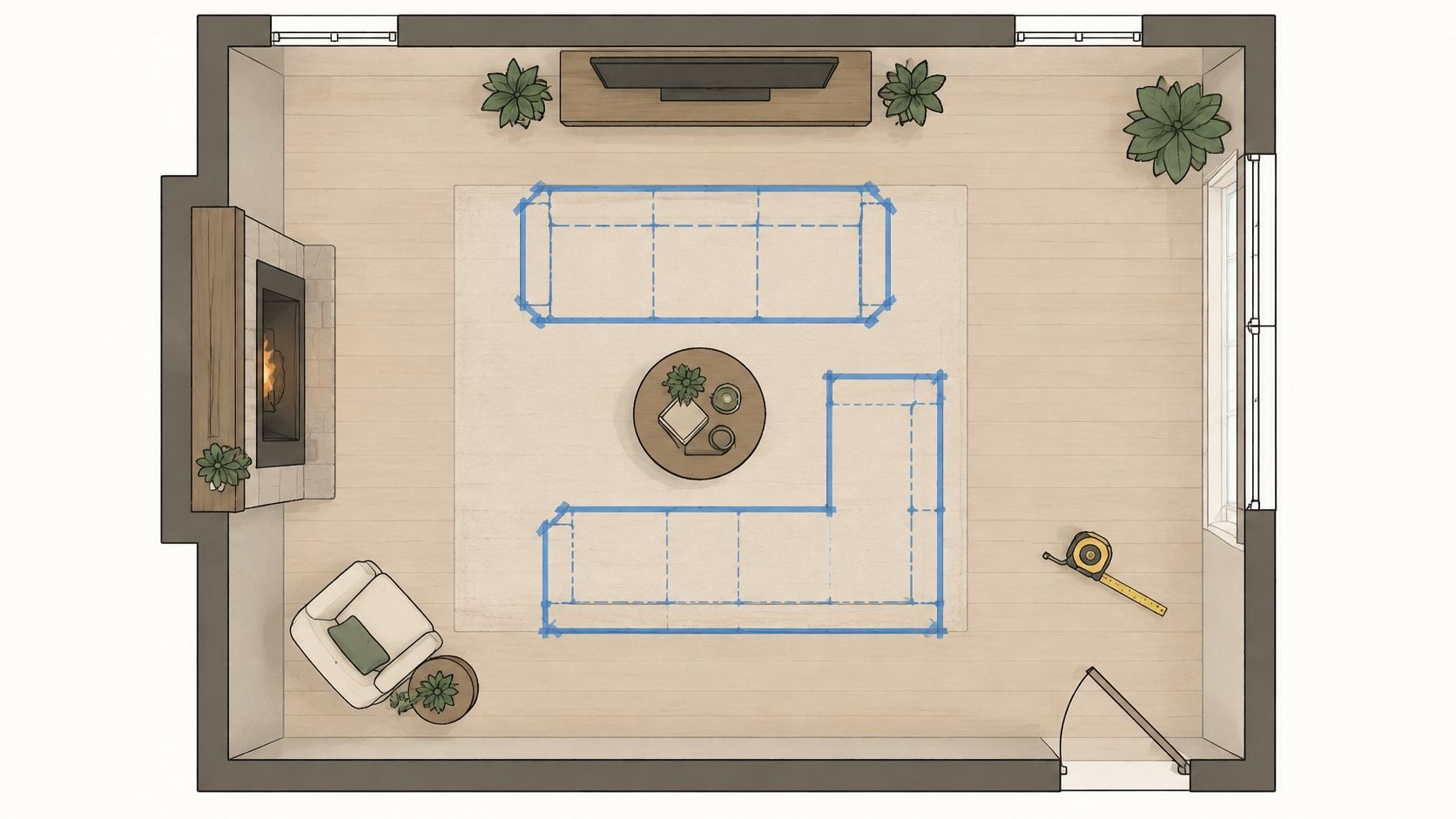
Find the wall the seating has to face: the TV, the fireplace, the window with the view. Mark its center with painter's tape. That mark anchors the sofa, and everything else, coffee table, rug, lamps, walking path, arranges around it.
Tape the footprint and protect the walkway
Lay tape at the full footprint of each option, including the chaise. Leave 30 to 36 inches of walkway between the seat edge and any wall, table or doorway. Tighter than that and people turn sideways to pass, which gets old within a week.
Check the path in before falling in love
A layout that works on paper can fail at the front door. Run these checks in order:
- Doorway width and height. Measure the narrowest opening on the route, not the widest.
- Stairwell turns and ceiling height. A landing that forces the piece vertical can kill a delivery.
- Elevators and angled hallways. Measure the cab interior and the diagonal run at each corner.
- Package dimensions. Nominal width tells you nothing about the crate. Ask for the delivery dimensions of each piece.
- Parts that detach. Arms, legs, chaise sections and connectors decide whether a large sectional can go upstairs at all.
A quick guide to how to measure for a sectional walks through the wall, doorway and diagonal checks in the order they matter.
Decide the chaise side honestly
Look at where light and foot traffic enter the room. A chaise on the traffic side becomes a hurdle; the same chaise on the window side becomes the best seat in the house. Put the corner module where people sit, not against the largest blank wall.
Modularity earns its reputation when households move, and design coverage of 2026 couch trends leans hard on that flexibility. The trade-off gets less airtime: more modules mean more seams and connectors, which can show, shift, and need attention. Ask whether legs and arms detach before committing.
| Configuration | Best room type | Typical seats | Main trade-off |
|---|---|---|---|
| Straight sofa | Medium living room with a TV wall | 3 | Smallest footprint, fewest lounging spots |
| Sectional with chaise | Open-plan room used for lounging | 4-5 | Needs more floor area and a clear side |
| L-shaped sectional | Corner placement in a family room | 5-6 | Corner seat can be less comfortable |
| U-shaped sectional | Large media or game room | 6-8 | Needs the most floor space |
| Modular sectional | Renters, movers, changing layouts | 4-7 | More seams and connectors to maintain |
| Sofa with accent chairs | Divided or zoned room | 4-5 | Flexible but less continuous seating |
Cross off every row that fails the tape or the doorway check, then move on with one or two realistic options.
Sizing for Scale and Seat Depth
Set the starting length from the wall, not from the catalog photo. Subtract 60 inches from the wall the seating faces, which leaves a walkway at each end, then pick a piece that lands inside that number.
| Wall length | Seating length (wall minus 60 in) |
|---|---|
| 150 in | 90 in |
| 300 in | 240 in |
For a sectional, that seating length assumes the chaise or corner sits along one side, so the number covers the longest run rather than the sum of every section. Leave 14 to 18 inches between the seat edge and a coffee table. Closer than that and knees lose the argument.
Match the seat to the body, not the photo
Ergonomic fit comes down to the relationship between seat height, usable depth, back angle and the person sitting there. A peer-reviewed sofa design study based on anthropometric measurements of 150 men and 110 women aged 25 to 35 proposed reference values of about 37 cm (14.6 in) seat height, 57 cm (22.4 in) backrest height, 62 cm (24.4 in) backrest width, a 105-degree seat-to-back angle and a 5-degree seat slope, as published in the Journal of Ergonomics, Health, and Functional Science.
Those are starting points, not rules. Deeper seats suit relaxed lounging and can leave shorter users without back support. Higher seats make standing easier for taller adults and for anyone with limited knee flexion.
The feet-flat test
Sit down and plant both feet flat. The pelvis should be supported and the lower back should touch the cushion without a stack of pillows behind it. If the sitter slides forward, or needs two pillows to feel supported, the effective depth or the back geometry is wrong for that body.
Try the seat you'll actually use. In a sectional, judge the main seat, the chaise and the corner separately, because the corner changes posture and usable depth more than any other module.
Custom ordering solves a near miss. Seat height, cushion firmness and depth can be adjusted on a made-to-order piece, which beats choosing a sofa by overall length and hoping the seat works.
Upholstery Materials and Everyday Performance
An abrasion rating without its test method is a number with no meaning, and most sofa shoppers are handed exactly that.
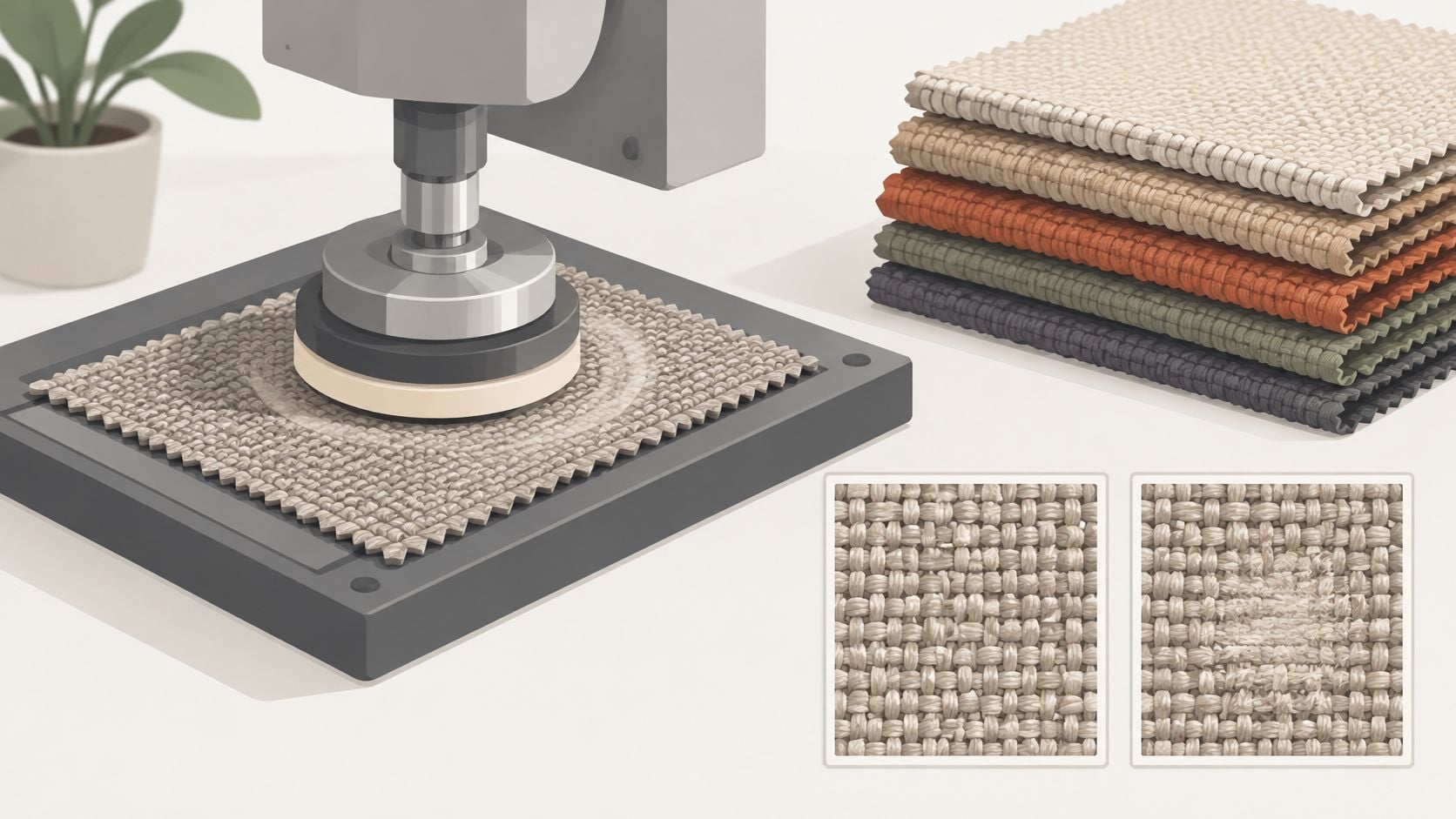
Two methods dominate upholstery testing and they don't convert into each other. The Association for Contract Textiles' abrasion performance guidelines treat ASTM D4157 (Wyzenbeek) and ASTM D4966 (Martindale) as distinct tests, and the reference points come from contract, not residential, seating: about 15,000 Wyzenbeek double rubs or 20,000 Martindale cycles as lower benchmarks for contract upholstery, and roughly 30,000 Wyzenbeek double rubs or 40,000 Martindale cycles for high-traffic public applications. The test ends when two yarn breaks appear or wear shows, so the result is a laboratory abrasion figure, not a count of years in a house with a Labrador.
What the materials actually do
Performance fabrics are built for pets and kids: tight weaves, stain resistance, and color that runs through the yarn rather than sitting on top. Confirm the rating applies to the exact colorway, since a mill's test data often covers the base cloth and not every dye lot.
Woven natural-look fabrics in cotton or linen blends deliver the formal look many living rooms want. They also show pilling, soil and sun fade sooner, so they belong on a low-traffic sofa rather than a chaise.
Microfiber cleans up easily and hides texture well, though a cheap grade can shine and flatten where hands and feet rest.
Leather wears as a surface rather than a weave and develops a patina that hides small marks. Grade matters more than price tag: a top-grain hide with a protective finish holds up, while a thin split can scuff through.
Match the fabric to the load
A chaise and a recliner take concentrated friction from the same few inches of fabric. A formal sofa in a guest room barely gets touched. That difference matters more than one rating number, which is why it pays to compare types of upholstery by household rather than by marketing label.
Ask in the showroom, in this order: which test method, at what pressure, on what substrate, with what endpoint, and whether the fabric in that colorway carries the same result.
Then check cleanability, seam construction and cushion design before signing. A slightly lower abrasion number on a fabric that cleans beautifully and resists pilling can be the better purchase for a family.
Frame, Cushions and Construction That Last
Two questions uncover more than an hour of sitting does: what's inside the seat cushion, and what happens when a part fails.
Foam density in pounds per cubic foot is the best single predictor of whether a seat holds its shape under repeated compression, according to industry guidance on sofa foam specifications. The bands are easy to apply.
| Foam density | Typical placement or use | Expected durability |
|---|---|---|
| Below 1.8 lb per cubic foot | Light or occasional seating | Short-lived under daily use |
| 1.8 to 2.0 lb per cubic foot | Family sofas and sectionals | Serviceable mid-range |
| 2.0 lb per cubic foot or higher | Daily use, high-resiliency foam | Associated with long-term daily use |
| Back cushion fill (softer, blends) | Lighter load than seat | Request separately from seat foam |
The common mistake is asking for "the foam density" and accepting one figure. Seat cushions carry the load; back cushions are often softer foam, fiber or a blend, and they should be quoted separately.
Frame and joints
A kiln-dried hardwood frame with corner blocks, screws and dowels at the stress points will outlast a stapled particle-board box every time. Ask to see a frame sample and look at the corner where the arm meets the seat, which takes the most punishment.
Support under the seat
Sinuous springs, coil systems and eight-way hand-tied webbing all behave differently. What matters is that the support is attached, quiet, and matched to the cushion above it. Sit near the front edge and listen for creaks or a hollow thud.
Cushions and covers
A foam core wrapped in fiber or a down blend gives softness on top of structure. Removable covers with working zippers let a stained panel be cleaned or replaced instead of retiring the sofa. If a seat is already dipping, work out whether the foam, springs or webbing is at fault before replacing anything, and this walkthrough on how to diagnose a sagging sofa seat sets the order of checks.
New upholstered furniture also carries a compliance label, and shoppers should read it. A mandatory federal flammability standard took effect on June 25, 2021, and covered pieces must bear a permanent label reading "Complies with U.S. CPSC requirements for upholstered furniture," per the CPSC's announcement of the standard. That label covers smolder resistance and does not speak to how long a frame or cushion will last.
A sofa that lasts has serviceable parts, not just premium materials. Look at solid wood frame sofas with replaceable cushions and repairable covers if the goal is a decade of daily use rather than a living-room refresh.
Custom Orders, Special Financing and Local Service
The best sofa is the one that fits the room, the body and the budget, and those three rarely line up in a stock floor model.
The custom path, four steps
- Write the must-have list. Seat height, seat depth, arm style, cushion firmness, and whether the back should be loose pillow or tight. That list does more filtering than any catalog.
- Choose the cover and ask for a custom match. Fabric or leather, matched so a new sofa coordinates with the chairs, rug and trim already in the room.
- Confirm dimensions against the measured footprint and doorways. A great piece that won't clear the stairwell is not a great piece.
- Ask about special financing, subject to credit approval. Pairing quality with a payment plan that fits a household budget is how made-to-order furniture stays reachable.
Custom ordering is where the trade-offs get solved. Seat height and depth can be adjusted, a chaise can move to the other side, arms can go from rolled to track, and firmness can be dialed in. Solid wood craftsmanship from Amish builders covers the frames and tables that anchor a room. Flexsteel earns its place on durability, and Bassett on style. The value here is honest pricing and buying power, not a discount sticker.
Groen's Fine Furniture has been family owned since 1983, with multigenerational ownership, five-star service and showrooms in Dyer and Crown Point serving St. John, Schererville, Munster and the wider Northwest Indiana area.
Design it your way: a bespoke piece starts with the room's measurements and the family's habits, not with what happens to be on the floor.
That's the practical difference between custom and catalog. A made-to-order sofa is planned with a family's help, one measurement and one swatch at a time, rather than pulled off a shelf. Start with design your own sofa and bring the tape-marked sketch along.
Delivery, Installation and Long-Term Care
The delivery plan belongs in the purchase conversation, not in the week after the order is placed. Three things get confirmed before anything is built:
- Whole piece or modules. Ask whether the sofa ships assembled or in sections, and whether legs, arms and chaise units detach. That answer decides whether a stairwell turn is a nuisance or a wall.
- White-glove delivery for tight routes. Stairs, narrow halls and second floors are exactly when a professional team earns its fee, carrying pieces in and setting them where they'll live.
- Placement details on the day. Confirm the final spot before the truck leaves, including wall outlets behind power recliners and lift chairs. A recliner against a wall with no outlet becomes a very expensive chair.
Plan for life after the move. Cushions compress over time, so ask early whether seat cushions can be refilled or replaced and whether a reclining mechanism or a fabric panel can be repaired rather than replaced. Modular pieces can be reconfigured when a room changes; a one-piece sectional needs more planning.
Repair is a budget decision as much as an emotional one. A 2025 global circularity study found cost savings were the leading motivation for circular behaviors, cited by 68% of respondents, while 35% identified as early adopters of repairing products such as furniture, according to the BSI circularity report. Ask what repair support exists before buying, and read up on furniture delivery and assembly so the day itself runs on a plan.
Test Drive Your Next Sofa in Dyer or Crown Point
Comfort doesn't transfer through a screen. An hour in a showroom settles more than a week of browsing.
- Bring the numbers. Measured wall lengths, doorway widths and the tape-marked sketch from the layout work.
- Sit properly. Feet flat, back supported, then test the chaise and the corner seat separately. Those are the two spots people regret.
- Compare swatches in daylight. Check any performance rating against the exact colorway and construction, not the mill's general claim.
- Ask about the custom match. Fabric or leather can usually be coordinated with what's already in the room.
The living room range covers sofas, sectionals, loveseats, chairs, recliners, lift chairs, sleeper sofas, tables, entertainment units and accents, and most of it can be customized to personal style and comfort. The Easton sectional, upholstered in supple leather with a custom match, shows what a made-to-order piece can do.
Leave with a shortlist and a clear sense of how each option feels after ten minutes, not ten seconds. Visit Groen's Fine Furniture in Dyer or Crown Point to explore the custom options and ask about special financing plans. Let the family that runs the business help create a home you love.
Groen's Fine Furniture has served Northwest Indiana from showrooms in Dyer and Crown Point since 1983, and the living room floor is built around this exact decision: sofas, sectionals, recliners and sleeper sofas that can be sized, filled and covered for a specific room and a specific family. Bring the wall lengths, the doorway widths and the tape-marked sketch, then spend an hour sitting, reclining and comparing fabrics in daylight at Groen's Fine Furniture. Special financing is available subject to credit approval, so a made-to-order piece can fit a real budget instead of staying on a wish list.