How to Choose a Reclining Sectional with Sleeper

For a family in Dyer or Crown Point, the problem often starts on an ordinary evening: everyone wants a comfortable seat, someone wants to stretch out, and visiting relatives need somewhere to sleep this weekend. A reclining sectional with sleeper can handle those competing needs, but only if the room still works when the furniture opens.
The smartest choice begins with daily routines rather than a product photo. Across Northwest Indiana, a well-planned sectional can make a family room more useful without turning every overnight visit into a furniture-moving project.
One Sofa for Sitting Reclining and Overnight Guests
Say a Dyer household uses its living room for conversation after dinner, movies later in the evening, and occasional visits from grandparents. A conventional sofa handles the first job. Adding reclining seats and a genuine sleeper mechanism can cover the others without adding another large piece of furniture.
A reclining sectional with sleeper combines connected seating modules, motion seating, and an actual convertible sleeping surface. In a fold-out design, the mattress stores inside a seating section. Not every seat reclines, and the sleeper module may operate differently from the neighboring motion seats.
Sectionals aren't a novelty configuration. The North American sofa market generated approximately $75.04 billion in 2025, with sectionals accounting for 31.47% of revenue, according to Grand View Research's North American sofa-market outlook.
Match the furniture to the household
Living rooms, finished basements, family rooms, and guest corners can all benefit from adaptable seating. For households in St. John, Schererville, and Munster, the deciding question is which activity deserves priority.
- Daily relaxation: Seat depth, back support, and easy controls matter every evening.
- Family gatherings: The arrangement should support conversation without leaving someone isolated on a distant chaise.
- Overnight hosting: The bed needs usable length, accessible bedding, and a clear route out of the room.
Groen's sectional buying guide helps distinguish configurations before floor planning begins. For guest preparation beyond furniture, the hosting checklist from Global offers a useful organizational reference for stocking an overnight space.
Comfort has to be sat in and laid on, not guessed from a photo.
Open Bed Sizes That Labels Often Hide
The word "queen" on a sleeper tag can promise more bed than the frame delivers. A conventional U.S. queen measures 60 by 80 inches, while many sofa-bed queens measure approximately 60 by 72 inches, leaving a sleeping surface 8 inches shorter.
Eight inches is roughly the span from ankle to mid-shin on a tall sleeper. A mattress can look generous across its width while leaving a guest's feet pressed against the end rail or hanging past the edge of the deck.
Sleeper open sizes versus standard mattresses
Typical sleeper openings run about 35 by 72 inches for twin, 52 by 72 for full, and 60 by 72 for queen. The queen row shows the pattern most clearly: a familiar size name hides a meaningful length difference, and the shorter opening explains why a tall guest feels it first.
| Size label | Typical sleeper opening | Standard mattress | Usual thickness | Fit note |
|---|---|---|---|---|
| Queen sleeper | About 60 by 72 inches | 60 by 80 inches | About 4.5 inches (within the 4 to 6 inch range) | 8 inches shorter than a home queen |
| Twin sleeper | About 35 by 72 inches | Residential twin runs longer | 4 to 6 inches | Compact option; verify the cavity |
| Full sleeper | About 52 by 72 inches | Residential full runs longer | 4 to 6 inches | Must fold shut inside the well |
Read the twin row as a compact guest option whose cavity still needs checking. The full row gives a wider opening, though width alone leaves the two-person question open. The specific frame determines the mattress size, so measure the cavity rather than copying the old mattress label.
Thickness needs its own check. Sofa-bed mattresses commonly run 4 to 6 inches thick, with about 4.5 inches common. That range exists because the mattress has to fold inside the frame when the mechanism closes, so a thicker replacement pad can keep the bed from shutting properly even if it fits the sleeping surface.
Record the cavity, not just the tag
A tape measure and a written measurement sheet prevent confusion between the mattress, its supporting deck, and the surrounding upholstery.
- Side-to-side cavity: Measure the space the mattress must occupy without binding against hardware.
- Head-to-foot cavity: Record the frame's available length rather than copying an old mattress label.
- Mattress-well depth: Check the storage space available when the assembly closes.
- Usable sleep length: Note whether upholstery, seams, or the end structure reduces comfortable lying space.
- Sheet clearance: Confirm that fitted corners and tucked fabric won't enter hinges or rails.
Groen's guide to mattress sizes gives a useful reference for comparing household beds before you shop. Bedding needs a separate fit check too; the guide to find the right minky blanket fit from On Pins & Needles Quilting Co. can help distinguish blanket coverage from mattress sizing.
A size name stays a starting point until the cavity's width, length, and depth match the mattress you plan to put in it.
How to Measure Seating Recline and the Open Bed
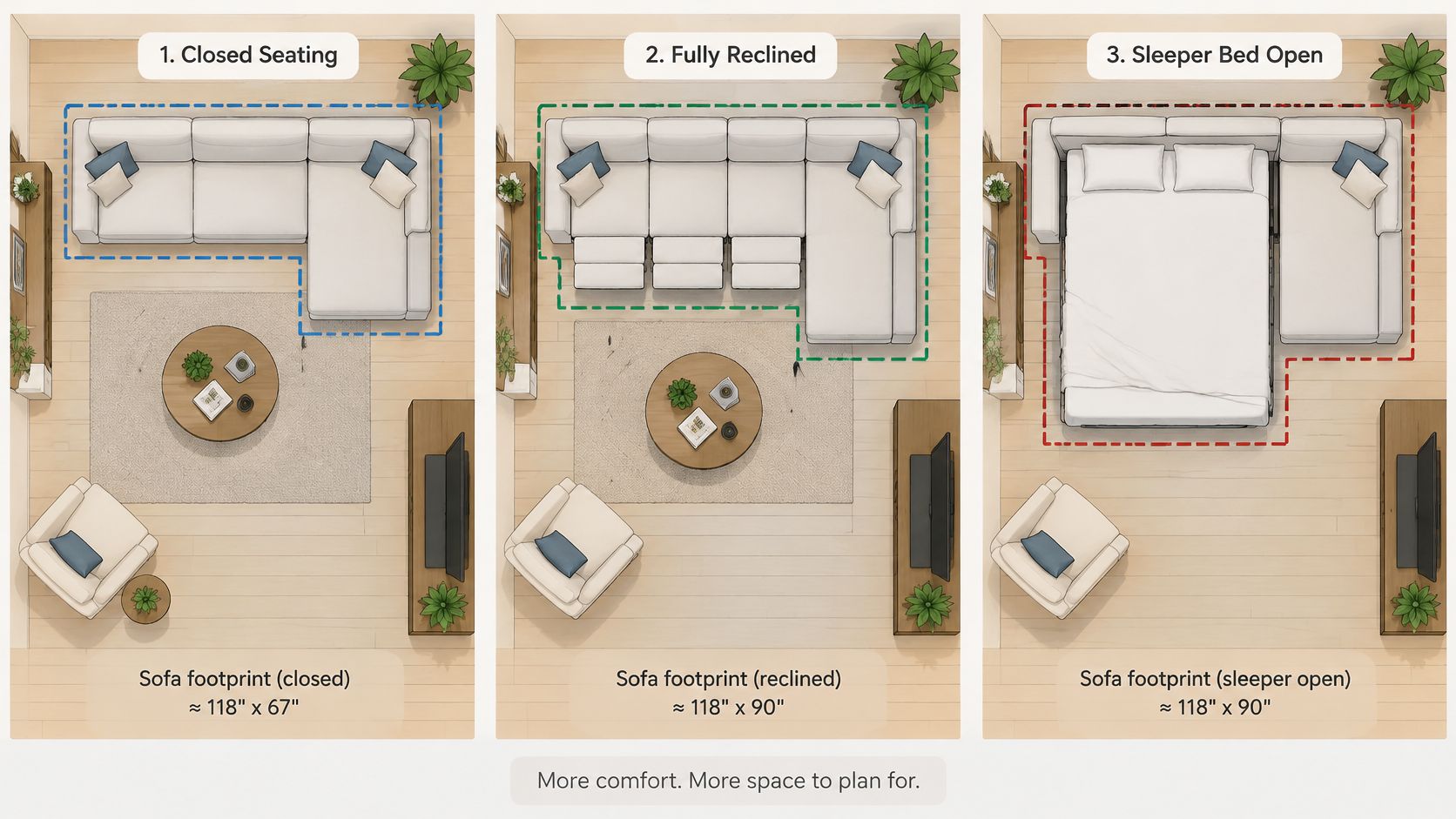
A reclining sectional with a sleeper does three different jobs in the same floor space, and each job behaves like a separate piece of furniture. The closed sofa is the smallest version of it. Full recline sends footrests out toward the coffee table, and the opened sleeper can claim a rectangle the size of a bedroom bed.
That is why the room needs three separate outlines: one for everyday seating, one for full recline, and one for the fully opened sleeper. Low-tack painter's tape makes those competing footprints visible before delivery, and a few dollars of tape is far cheaper than discovering the sofa only fit on paper.
Build a room-scale test
Draw the fixed obstacles. Measure the room and mark door swings, vents, outlets, fireplaces, and the route toward the television. Include furniture that will remain, since a sketch of an empty room hides the obstacles that decide whether the layout works.
Protect the walking route. Plan on 36 inches of clear walking width where people pass the opened bed; the U.S. Access Board's accessible-route guidance uses that figure as the minimum clear width for a walking surface. Treat that path as a fixed line in the layout, and allow more room where a household member uses mobility equipment.
Trace every moving seat. Ask for the fully reclined dimensions of each seat and mark where the footrest ends land. A footrest that clears the coffee table in the showroom drawing can still overlap the sleeper rail or block the path to a neighboring seat at home.
Check the wall-hugger claim. Wall-hugger construction lets the backrest travel forward as it reclines, so the sofa can sit closer to the wall behind it. Front clearance for the footrests and a workable path around the open bed remain separate requirements worth their own tape lines.
Measure the delivery route. Record doorway openings, hallway widths, stair turns, diagonal depth, and overhead clearance. Use packaged dimensions and confirm which modules separate, especially for older NWI homes and finished basements.
Test access to controls. Someone seated normally should be able to reach the power switch and charging ports without climbing over cushions. Cords stay outside walking routes and clear of moving hardware.
Check the room while it is occupied
The tape test tells you more when the family acts out ordinary routines inside the outlines. One person can stand beside the pretend bed while another walks toward the hallway, opens a cabinet, or squeezes into the nearest seat.
An open-plan Crown Point living room may offer plenty of floor area but only a narrow route between the kitchen and the stairs. A basement might have generous seating space yet a difficult landing that keeps the sleeper module upstairs.
Practical rule: A sectional fits only when people and moving parts can use the room together.
Groen's sectional measuring guide walks through the same sketch in more detail. Leave the tape down until delivery day so the placement stays clear of the wall and doorway lines that protect the recline and the open bed.
Sleeper Mattresses Built for Folding and Real Rest
The mattress and folding mechanism should be evaluated as one safety-and-durability system. A comfortable pad isn't suitable if it jams the frame, and a smooth mechanism doesn't compensate for pressure beneath a guest's hips.
Compare feel and folding together
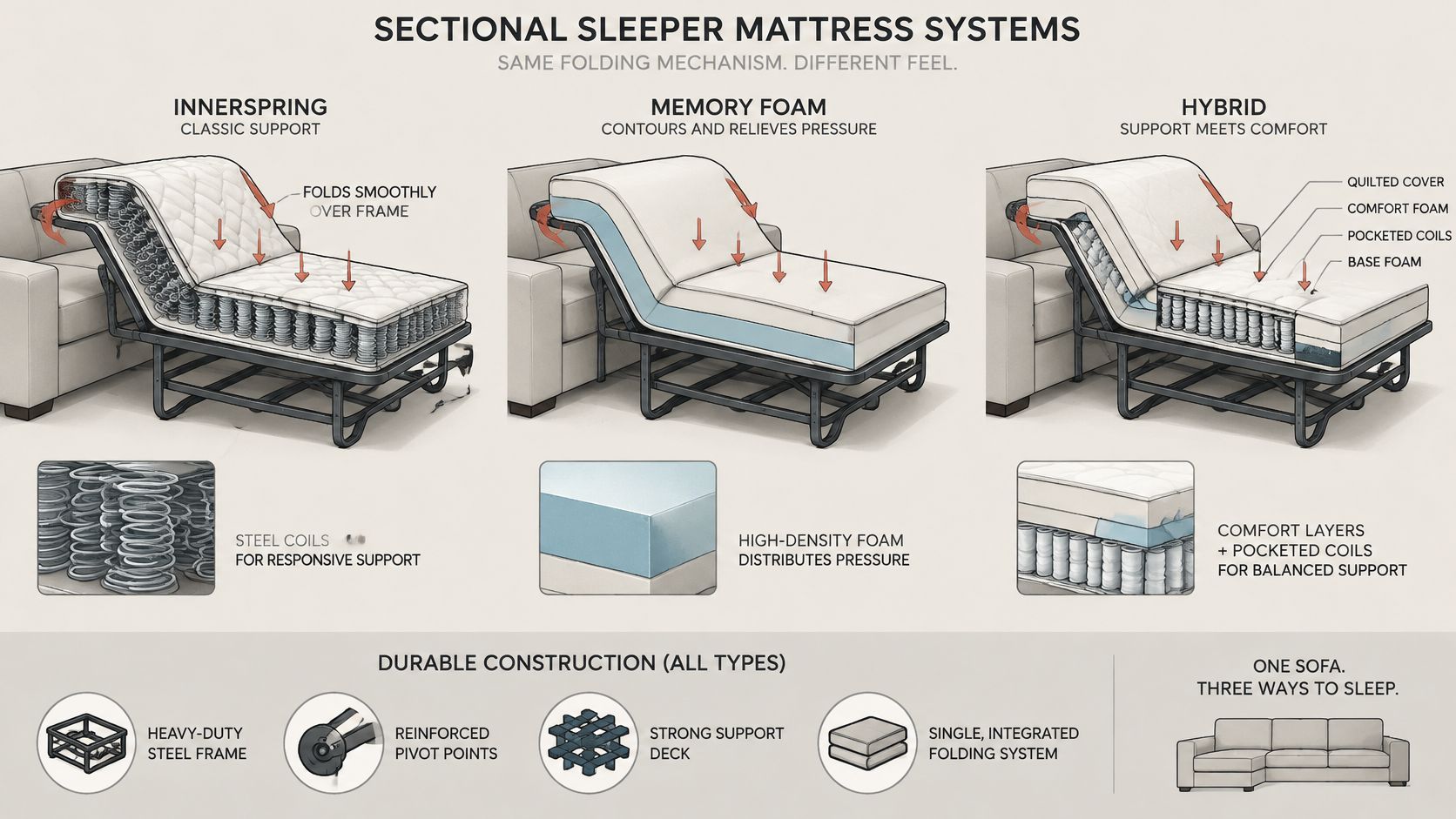
- Innerspring: A responsive surface may appeal to guests who prefer bounce. Check whether coils or the underlying frame create concentrated pressure.
- Memory foam: Contouring can soften the sensation of the support deck. The important test is whether shoulders and hips settle comfortably without excessive sinking.
- Hybrid: Combined support and comfort layers may offer a balanced feel, but the complete mattress still has to store correctly.
A thinner pad may transmit more frame pressure. A thicker pad can improve cushioning but needs additional storage volume and mechanism clearance, so thickness alone isn't a quality rating.
Include safety in the purchase
The Consumer Product Safety Commission's mattress guidance identifies federal requirements under 16 CFR Parts 1632 and 1633, including a smoldering char-length limit of 2 inches (5.1 centimeters) and open-flame fire-growth evaluation over 30 minutes. Buyers should request compliance information and keep extra bedding clear of hinges and ventilation.
For sleep wellness, occasional accommodation deserves a different decision from a primary bed. Groen's Helpful Mattress Guide can support a dedicated-bed discussion involving Serta and Beautyrest when nightly rest, joint discomfort, or shared sleeping needs take priority.
A raised footrest isn't a bed. The actual sleeping surface deserves its own evaluation.
Mechanisms Frames and Fabrics That Last
The best hardware is the hardware that suits the person using it. A manual release may feel straightforward to one family member but require more effort than another can comfortably manage.
Start with the sit-and-recline test. The Cornell ergonomics guidance associates supported seat-to-back recline around 110°–130° with the lowest lumbar-disc pressure and back-muscle activity in its seating discussion. That isn't a medical promise for a sectional; the useful shopping lesson is to check continuous lower-back support with both feet supported.
Choose motion by daily usefulness
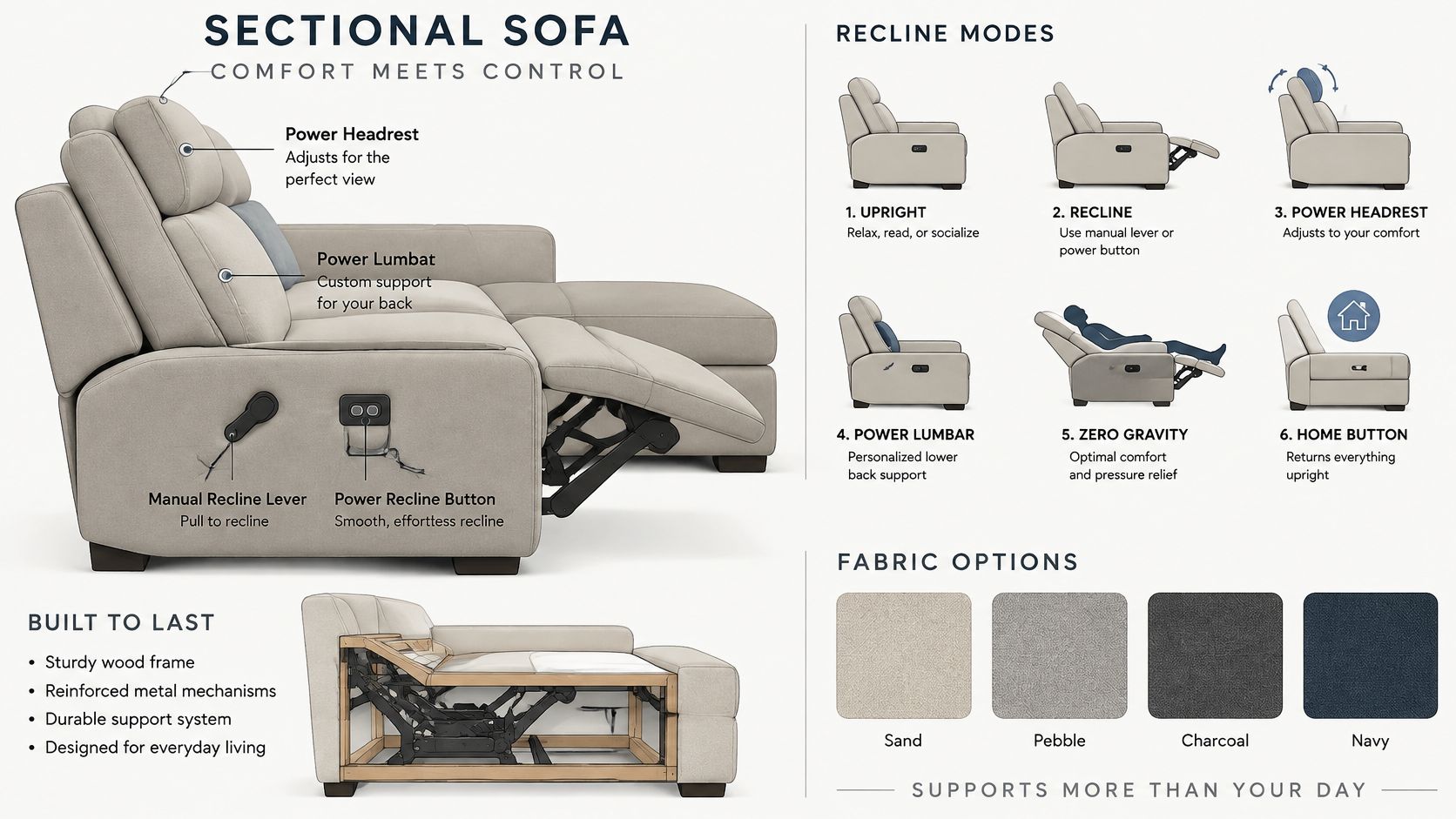
| Motion option | Main benefit | Hands-on check |
|---|---|---|
| Manual recline | Straightforward operation without a powered adjustment | Can the intended user release and close it comfortably? |
| Power recline | Gradual position adjustment | Are the controls easy to locate and operate? |
| Power headrest | More control over head position | Can the user watch television without pushing the chin forward? |
| Power lumbar | Adjustable lower-back contact | Does the support meet the back rather than create a hard bump? |
| Zero-gravity positioning | An alternative supported lounging posture | Does the actual position feel comfortable, regardless of its name? |
| Home return | Convenient return to upright | Is the return movement predictable and easy to stop? |
A gap behind the lower back is a warning that the seat geometry isn't matching the user. The transition should feel smooth without pushing the pelvis forward or producing a sharp pressure edge where the seat meets the back.
Groen's power-versus-manual recliner comparison offers background for that decision. USB and USB-C ports with sensing shutoff are conveniences to verify on the selected model, not reasons to overlook poor support.
Inspect the structure and upholstery
For durability, look for a clearly described frame, such as kiln-dried hardwood with reinforced, blocked joints, and a sturdy steel sleeper mechanism. Hardwood framing and steel conversion hardware serve different purposes; neither label proves the entire assembly is well built.
Watch the connections while the furniture moves. The bed rail shouldn't collide with adjacent recliner hardware, and modules shouldn't shift apart during ordinary use.
Performance fabric can be a practical choice around children and pets, but the cleaning code matters more than the name. Removable pieces aren't automatically machine washable. Supple leather offers a different feel and appearance, with custom matching worth discussing where available.
Flexsteel is a useful brand to consider for durable motion seating, while Bassett offers style choices. American-Made construction and Solid Wood companion pieces can also matter to households selecting furnishings for long-term use.
The strongest purchase combines comfortable geometry, serviceable hardware, and a cover the household can realistically maintain.
“Design it your way” should mean matching the available sleeper configuration, chaise placement, upholstery, and coordinating finishes to actual routines, not just choosing a favorite color.
When a Sleeper Sectional Is the Right Call
A Schererville finished basement that hosts cousins twice a year tells a different story than a Crown Point living room occupied every evening. The first household gains guest accommodation without giving the room over to a bed. The second needs reclining comfort and easy upholstery care every single night, with the sleeper acting as a spare room that happens to fold away.
The piece carries three competing footprints for the same floor space: everyday seating, fully reclined lounging, and the open bed. A sleeper earns its keep when at least two of those jobs matter to the household.
Different routines need different answers
- Occasional relatives: A full or queen sleeper can be a reasonable compromise once the intended guests' height and the open-bed length check out. A mattress labeled queen often runs about eight inches shorter than a standard queen mattress, so measure the tall guest, not the tag.
- Nightly family lounging: Put the reclining seats first. Conversion ease still matters, yet nobody should trade daily comfort for a feature that opens a few weekends a year.
- A teen or couple sleeping there most nights: A Munster or St. John household should strongly consider separate seating and a dedicated mattress.
Sleep research on newer mattress designs shows a familiar pattern: instruments record little objective change while participants report sleeping better and feeling more rested. Those findings describe full-size mattresses in real bedrooms. A folding mechanism and a thinner mattress built to bend are a different construction entirely, so no study result turns a sofa sleeper into a dedicated bed.
Weigh the compromises
Benefits include guest hosting, motion comfort, and one footprint doing the work of two pieces. Tradeoffs include a shorter sleeping surface, a mattress that must fold, extra clearance in front of the unit, and sheets that take more patience to change.
The deciding question stays simple: who uses this piece, and for which job? Welcome the occasional guest warmly. Protect the nightly sleeper with a real bed.
Custom Orders and Special Financing at Groen's
A made-to-order sectional earns its wait time when a stock layout cannot fit the room. Maybe the chaise must land on the left because of a doorway, or the three footprints measured earlier leave no space for a standard configuration. Available made-to-order choices can align a sectional's configuration and upholstery with the household's layout, though sleeper sizes, chaise positions, leather options, and finishes need to be confirmed for the selected collection.
The discussion of choosing custom furniture over ready-made pieces from Studio Contour offers useful context for weighing fit against immediate availability. Bespoke choices are most valuable when the household can identify exactly what a stock arrangement gets wrong.
Make the appointment practical
- Bring the layout. Include the taped footprints, delivery measurements, and mattress-cavity notes.
- Set priorities. Identify the daily recliner user, expected guests, preferred cover, and acceptable conversion effort.
- Confirm the order. Record the selected configuration, available options, expected timeline, and delivery route.
- Review the budget. Compare the complete purchase with household priorities before committing.
Groen's Fine Furniture offers Custom Order Services, including Canadel custom dining and made-to-order Amish Solid Wood pieces for coordinating the surrounding home. Special Financing is available, subject to credit approval, to help fit lasting comfort into a household budget; the furniture financing guide provides a starting point without assuming a particular rate or plan.
Plan the finished room
A premium delivery service can help connect the floor plan with final placement, so the taped outline on paper becomes a sofa that fits its spot. Measurements travel from the living room floor to the order form to the doorway on delivery day, and each step protects the one before it. Done well, customization leaves the household with a room that seats, reclines, and hosts the way the family planned.
Test the Comfort at Groen's in Dyer or Crown Point
The most useful hour in a furniture showroom is spent sitting, reclining, and lying down. Each intended user should sit normally, operate the controls, and spend time on the actual sleeping surface before making a decision. Fabric can be judged from a swatch; comfort has to be felt by the body that will live with it.
Groen's Fine Furniture is a family-owned furniture and mattress retailer that has served Northwest Indiana since 1983, with showrooms in Dyer and Crown Point. Its multigenerational service and five-star reviews reflect a place where families can talk through room constraints and compare comfort in person.
Use the floor models for distinct tests
The 5-Piece Power Reclining Sectional measures 130 by 130 inches, with power lay-back on the chaise and power recline on the right-side facing seat. A footprint that size claims a serious corner of a room even before the recline positions open up, so treat it as a scale reference and measure the exact sleeper configuration under consideration on its own.
The Lakewood Fabric Sleeper shows a contemporary approach, with a slim frame, tapered arms, and plush cushioning that opens into a bed for overnight guests. The Holly Fabric Sleeper takes a transitional line with welt cording, tapered legs, and angled arms, and it opens to a sleeper as well. Both are standalone sleeper sofas, which makes them a clean way to test the fold-out bed and compare upholstery styles separately from the reclining hardware.
- For reclining: Compare foot support, lower-back contact, control access, and how much effort it takes to return to upright.
- For sleeping: Lie flat, then turn onto the preferred side and notice pressure at the shoulder and hip.
- For room fit: Hold the selected model's deployed dimensions against the actual floor sketch.
- For construction: Examine connectors, rails, upholstery care information, and accessible moving parts.
Leave with the details recorded
A useful visit ends on paper. Write down the model name and the three footprints that matter at home: the everyday seating size, the depth at full recline, and the length of the opened bed. Add the chosen fabric, the configuration, and the delivery path through the house. Those notes keep the showroom test connected to the room the piece has to fit, and they make comparisons between models honest later on.
Groen's Fine Furniture offers custom order services, mattress guidance, and Special Financing subject to credit approval for families planning lasting comfort. Visit Groen's Fine Furniture in Dyer or Crown Point with a room sketch to test drive reclining comfort, compare sleeper options, and discuss current financing plans. Let the Groen family help create a home that works for everyday life and overnight guests.